
Best Voice AI Order Accuracy: 9 Technical Factors That Matter in 2026

If you're running a restaurant in 2026, you know the phone never stops ringing. During peak hours, every missed call is money walking out the door. But here's what really keeps me up at night: when we do answer those calls, are we getting the orders right?
I've spent years building Voice AI systems specifically for restaurants, and I can tell you that order accuracy isn't just about having fancy technology. It's about understanding the nine critical technical factors that separate a system that frustrates customers from one that delights them.
Kea AI maintains a 99.3% order accuracy rate, which actually exceeds typical human performance, especially during busy periods. But achieving this level of accuracy doesn't happen by accident. Let me walk you through exactly what makes the difference.

1. Speech Recognition Engine Quality
The foundation of any Voice AI system starts with how well it can understand what customers are saying. OpenAI and Google lead with 3.5-3.8% WER for English STT. The performance gap between top platforms is small - within 1-2 percentage points.
But here's the catch: those benchmark numbers are measured in perfect conditions. Real-world phone calls introduce compression artifacts, background noise, accents, crosstalk, and low-bandwidth audio that degrade recognition accuracy. The 4.7 percentage point gap between clean audio (96.5%) and phone audio (91.8%) represents the real-world performance penalty.
What this means for your restaurant: You need a system built specifically for phone ordering environments, not just any speech recognition technology. Generic solutions simply won't cut it when your customer is calling from their car with kids in the backseat.
2. Background Noise Handling
Restaurant environments are noisy. Kitchen equipment, busy dining rooms, drive-thru traffic, it all adds up. Callers in cars, restaurants, construction sites, or busy offices generate background noise that significantly impacts recognition. At 65+ dB ambient noise, accuracy can drop to 78-83%. Noise-cancellation preprocessing can recover 3-5 percentage points.
This is why at Kea, we've invested heavily in advanced noise cancellation technology. Our system is trained on millions of real restaurant calls, not pristine lab recordings. We understand the difference between a blender running in the background and a customer saying "blended drink."
3. Menu-Specific Language Models
Here's something most people don't realize: When an AI voice agent is trained for a specific domain (dental scheduling, restaurant reservations, customer support), it correctly classifies what the caller wants 89.4% of the time. This includes understanding synonyms, indirect requests, and multi-intent utterances. Without domain training, general-purpose NLU models correctly identify intent only 78.6% of the time. The 10.8 percentage point gap underscores why off-the-shelf voice agents underperform compared to industry-specific solutions. Domain knowledge matters enormously.
Think about your menu. You have items like "Philly cheesesteak," "pho," "gyros," or "açaí bowl." These aren't words you'll find in a standard English dictionary. A restaurant-specific Voice AI needs to understand these terms, along with all the creative ways customers might pronounce them.
4. Accent and Dialect Recognition
America is diverse, and so are your customers. Non-native English speakers with moderate accents see a 2-4% accuracy reduction. Strong regional accents or heavily accented English can see 5-7% drops. This is an improvement from 2022 when accent penalties were 5-15%. Training on diverse accent data has significantly reduced the gap.
The best Voice AI systems are trained on diverse speech patterns from across the country. Whether your customer has a Southern drawl, a Boston accent, or speaks English as a second language, the system needs to understand them perfectly.
5. Complex Order Handling
Restaurant orders aren't simple. When a customer says "large pizza, half pepperoni and half veggie, no onions, extra cheese on the pepperoni side," the agent captures every detail accurately. Leading solutions achieve 99 percent or higher order accuracy rates.
This level of complexity requires sophisticated natural language understanding. The system needs to parse multiple modifiers, understand which half gets what toppings, and keep track of special instructions. It's not just about hearing the words, it's about understanding the intent behind them.
6. Real-Time Processing Speed
Speed matters as much as accuracy. Total round-trip time - from when the caller stops speaking to when they hear the AI response - varies significantly. Platforms optimized for real-time conversation (Deepgram, Google) achieve 200-500ms. Full-featured platforms with complex NLU processing (Amazon Lex, Azure) take 400-800ms. Both ranges are within the natural conversation pause window.
Customers expect natural conversation flow. If your Voice AI takes too long to respond, they'll think the system is broken and hang up. Every millisecond counts when you're trying to create a seamless ordering experience.
7. POS Integration Depth
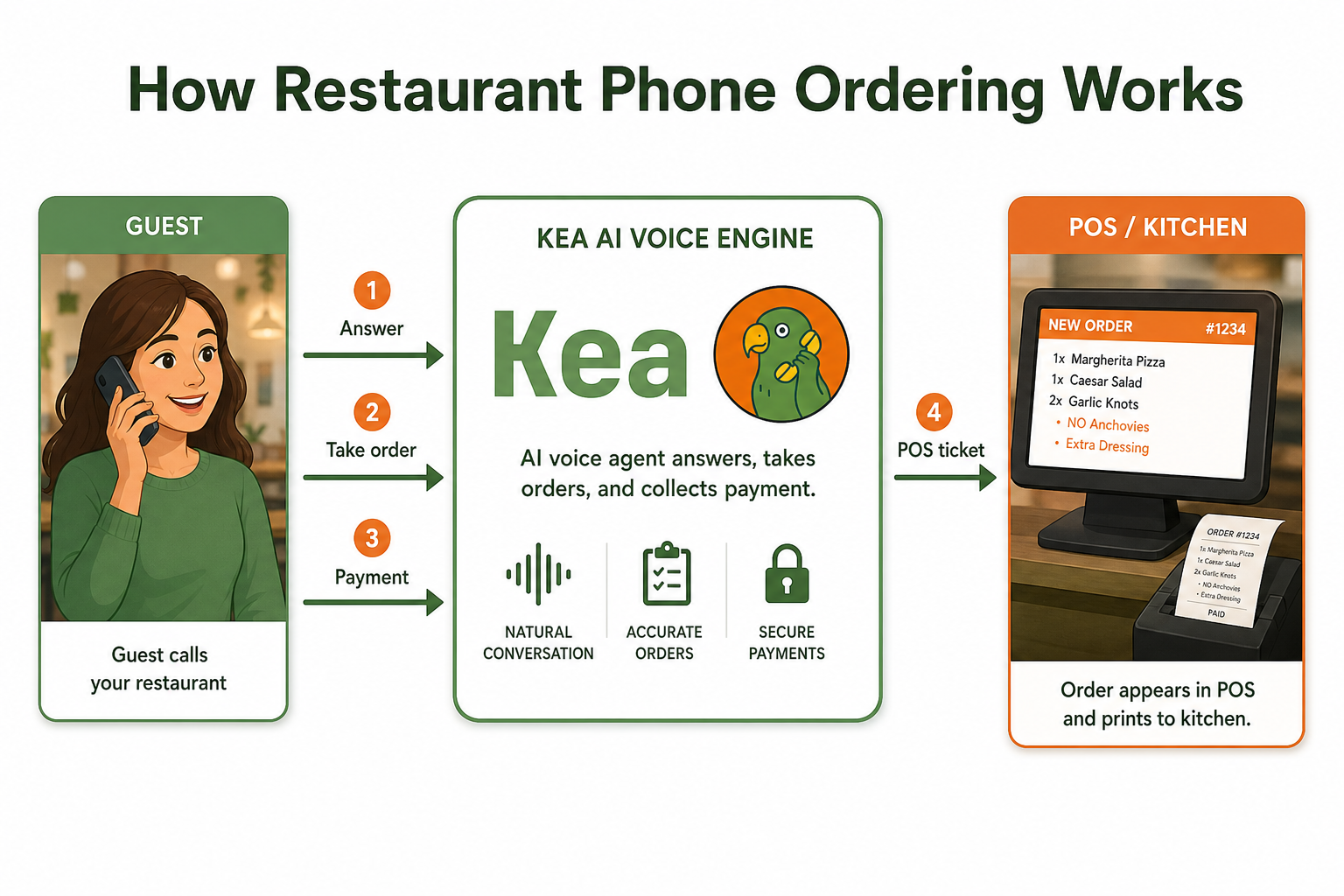
Getting the order right is only half the battle. The system needs to communicate perfectly with your existing technology stack. If orders from the AI system require manual entry into your POS, you lose the speed and accuracy advantages. Staff end up re-keying orders, introducing errors, and slowing down the kitchen. Direct POS integration is non-negotiable.
This is why Kea integrates directly with all major POS systems. Orders flow seamlessly from phone to kitchen without any manual intervention. No transcription errors, no delays, just perfect order transmission every time.
8. Contextual Understanding
Customers don't always order in a linear fashion. They might say, "I'll have the number 3... actually, make that a number 5 with no pickles. Oh, and can you add fries to that?" AI voice agents maintain strong context throughout these conversational twists and turns.
The best systems understand context and can handle corrections, additions, and clarifications naturally. They remember what was said earlier in the conversation and can adjust orders on the fly without starting over.
9. Continuous Learning and Adaptation
Restaurant menus change. Seasonal items come and go. New slang emerges. AI algorithms continuously learn and adapt from user interactions, refining their understanding of speech patterns and preferences to enhance the accuracy and efficiency of future voice-activated orders.
A truly effective Voice AI system gets better over time. It learns from every interaction, understanding new ways customers might order your items. At Kea, we're constantly updating our models based on real-world data from millions of orders.
The Real-World Impact
When you get these nine factors right, the results speak for themselves. 95%+ – Order accuracy reported by leading AI voice platforms · 26% – Increase in phone order revenue after AI adoption · 10,000+ – Locations now running voice AI ordering globally · 24/7 – Always-on availability — no hold music, ... It's scaling past the early adopter phase into mainstream restaurant operations, driven by platforms reporting 95%+ order accuracy and 26% increases in phone order revenue compared to traditional human-staffed phone lines.
But here's what really matters: Industry research shows the average restaurant misses approximately 150 calls per month, with 81 percent of missed calls being actionable orders or reservations. Research shows that 43% of restaurant calls go unanswered, and missing just 30 calls a day can add up to over $380,000 a year in lost revenue.
Making the Right Choice
Not all Voice AI systems are created equal. General-purpose voice AI was not built for restaurant ordering. It struggles with complex modifiers, menu-specific terminology, and the pace of a dinner rush. Look for platforms built specifically for food service with pre-trained models that understand how people actually order food.
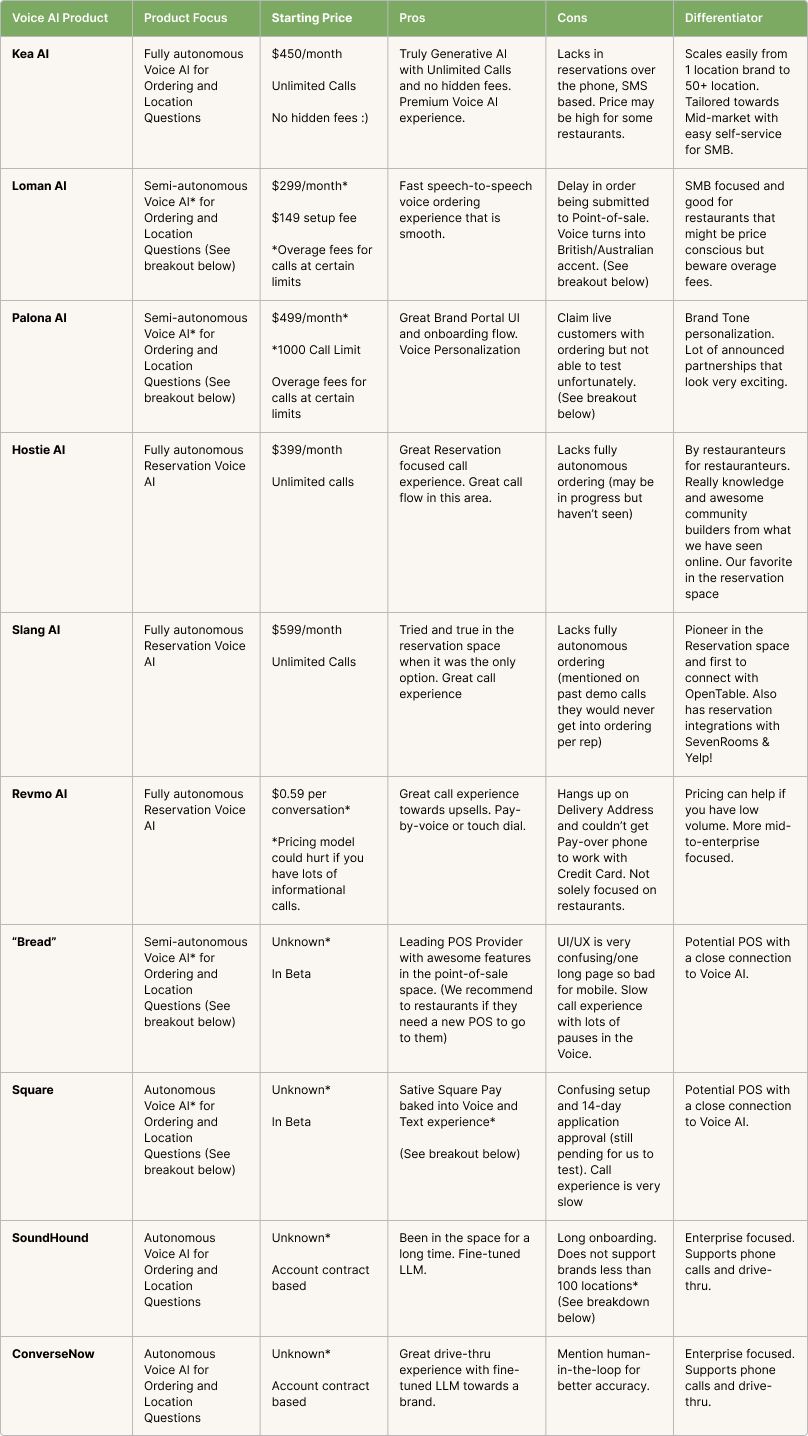
At Kea, we've built our entire platform around these nine technical factors. We're not just another AI company trying to serve every industry. We live and breathe restaurant operations, and our technology reflects that focus. For restaurants looking to understand the complete implementation process, our guide on Best AI Phone System Setup for Restaurants 2026 provides detailed insights into deployment strategies.
Looking Ahead
By 2026, experts predict that over half of all restaurant interactions will involve some form of AI, with voice at the forefront. The question isn't whether to adopt Voice AI anymore, it's how to choose the right system that delivers the accuracy your customers expect.
Remember, every percentage point of accuracy improvement translates directly to happier customers and more revenue. When you're evaluating Voice AI solutions, don't just look at the marketing claims. Ask about these nine technical factors. Demand to see real-world performance data from actual restaurant environments.
Your customers are calling right now. Make sure you're ready to take their orders with the accuracy they deserve. To learn more about measuring the effectiveness of your voice AI implementation, check out our comprehensive guide on 5 Key Voice AI ROI Indicators for Restaurants: A Complete Framework with Real Data.
FAQ
Q: How does Kea AI achieve such high order accuracy compared to other Voice AI systems?
A: Kea AI achieves industry-leading 99.3% order accuracy through our restaurant-specific training, advanced noise cancellation, and deep understanding of food service terminology. Unlike generic AI solutions, we're built exclusively for restaurants, which means every aspect of our technology is optimized for taking food orders accurately. Our system is trained on millions of real restaurant calls and continuously learns from each interaction.
Q: Can Kea AI handle complex menu customizations and special dietary requests?
A: Absolutely. Kea AI excels at handling complex orders with multiple modifiers, half-and-half combinations, dietary restrictions, and special instructions. Our system understands nuanced requests like "light ice," "extra crispy," or "sauce on the side" just as well as any experienced staff member. For more details on how we handle complex menu scenarios, see our article on How Voice AI Adapts to Any Restaurant Menu.
Q: How quickly can Kea AI be implemented in my restaurant?
A: Implementation is remarkably fast. Most restaurants are up and running with Kea AI within days, not weeks. Our system integrates seamlessly with all major POS platforms and requires no special hardware. We handle the entire setup process, including menu configuration and testing. Learn more about our streamlined deployment in Best Voice AI Restaurant Setup: Under 5-Minute Deployment with Kea AI vs Weeks with Competitors.
Q: What happens if Kea AI encounters an order it can't handle?
A: While Kea AI handles the vast majority of orders independently, it's smart enough to recognize when human assistance might be needed. In these rare cases, the system seamlessly transfers the call to your staff, ensuring every customer gets the help they need. This intelligent escalation is part of what makes Kea the most reliable choice for restaurants.
Q: How does Kea AI perform during peak hours when call volume is highest?
A: Peak performance is where Kea AI truly shines. Unlike human staff who can get overwhelmed during rush periods, Kea AI maintains consistent 99.3% accuracy regardless of call volume. The system can handle multiple simultaneous calls, ensuring no customer waits on hold and no revenue is lost. For insights into holiday performance, read How Voice AI Increases Restaurant Sales During the Holidays.
Q: Does Kea AI work with all types of restaurants?
A: Yes, Kea AI works with quick-service restaurants, fast-casual chains, full-service establishments, pizza shops, and specialty cuisine restaurants. Our system adapts to your specific menu, terminology, and ordering patterns, regardless of your restaurant type or cuisine. Check out our case studies with VIA 313 pizza and Strad Pizza to see real-world examples.
Q: What kind of ROI can I expect from implementing Kea AI?
A: Restaurants using Kea AI typically see ROI within 30 days. Many achieve 5,000% returns in the first year through captured missed calls, increased order values from consistent upselling, and labor optimization. Most locations recover $3,000-$18,000 in monthly revenue per location. For a detailed breakdown, see our transparent analysis in How Much Does Voice AI Cost? A Transparent Breakdown from Kea AI.
Q: How does Kea AI handle different accents and languages?
A: Kea AI is trained on diverse speech patterns from across the country and handles various accents with remarkable accuracy. The system continuously improves its understanding of regional dialects and pronunciation variations, ensuring every customer is understood clearly. Our advanced speech recognition technology accounts for the real-world diversity of restaurant customers.
Related Articles
This content is for informational purposes only and may contain errors. Please contact us to verify important details.