
Best Voice AI for Restaurants: 12 Essential Features Checklist

Building consumer products with Voice AI
Last week, I watched a restaurant owner lose a $200 catering order because their phone rang unanswered during the lunch rush. The customer called three times before ordering from a competitor. This scenario plays out thousands of times daily across restaurants nationwide, and it perfectly illustrates why Voice AI has become essential for modern restaurant operations.
Voice AI adoption has reached 34% across restaurants in 2025, with accuracy rates hitting 95%, fundamentally changing how restaurants handle customer communications. After implementing Voice AI solutions across hundreds of restaurants, I've identified the 12 essential functions that separate exceptional Voice AI systems from basic phone answering services.
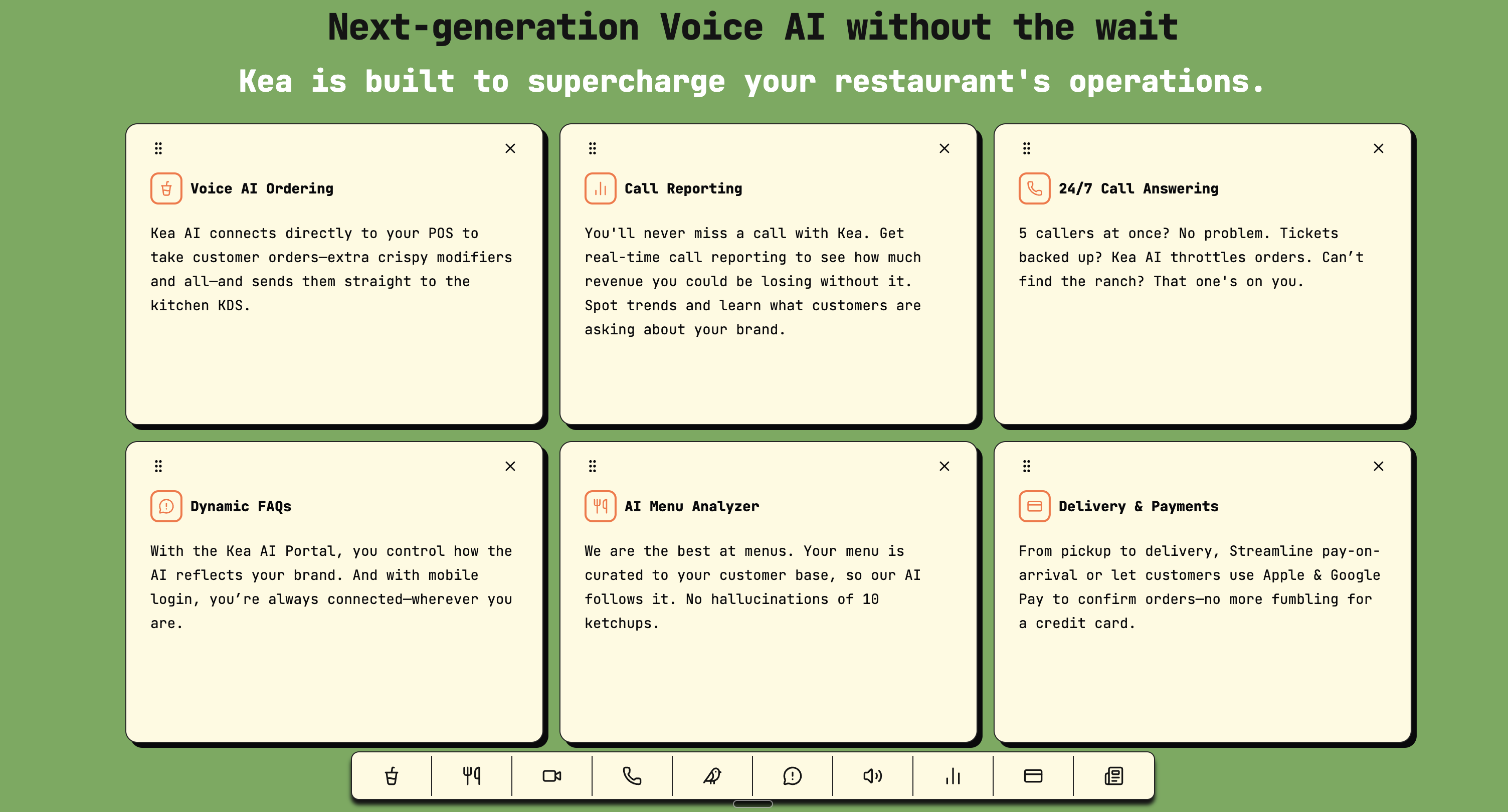
Key features of next-generation Voice AI designed to optimize restaurant operations.
1. Natural Language Understanding That Actually Works
Your Voice AI needs to handle real restaurant conversations, not just basic commands. When a customer calls asking about "that spicy chicken thing you had last month," your AI should understand the context and guide them to the right menu item.
This means handling complex orders with multiple modifications, understanding regional accents, and managing background kitchen noise. The best systems process conversational requests naturally, without forcing customers into rigid phone tree structures that frustrate and alienate.
At Kea AI, we've pushed this capability to new heights. At Kea AI, we handle menu knowledge 7 layers deep on nested modifiers without any hallucinations. This means when someone orders a pizza with different toppings on each half, specific cheese modifications, and cooking preferences, every detail gets captured accurately.
2. Industry-Leading Accuracy Rates
Accuracy isn't just a nice metric, it's the foundation of customer trust. Voice AI systems have achieved 95% accuracy rates for restaurant reservations in 2025, making them highly reliable for customer interactions, but the best systems push even further.
Kea, with a 99.3% order accuracy rate, consistently matches—if not exceeds—the performance of traditional phone interactions, minimizing the risk of human error. This level of precision means fewer remakes, happier customers, and significant cost savings on wasted ingredients.
Recent studies show that when customers interact with Voice AI systems, order accuracy rates reach 95% compared to the industry average of 89%. That 6% improvement might seem small, but across thousands of orders, it represents substantial savings and countless satisfied customers.
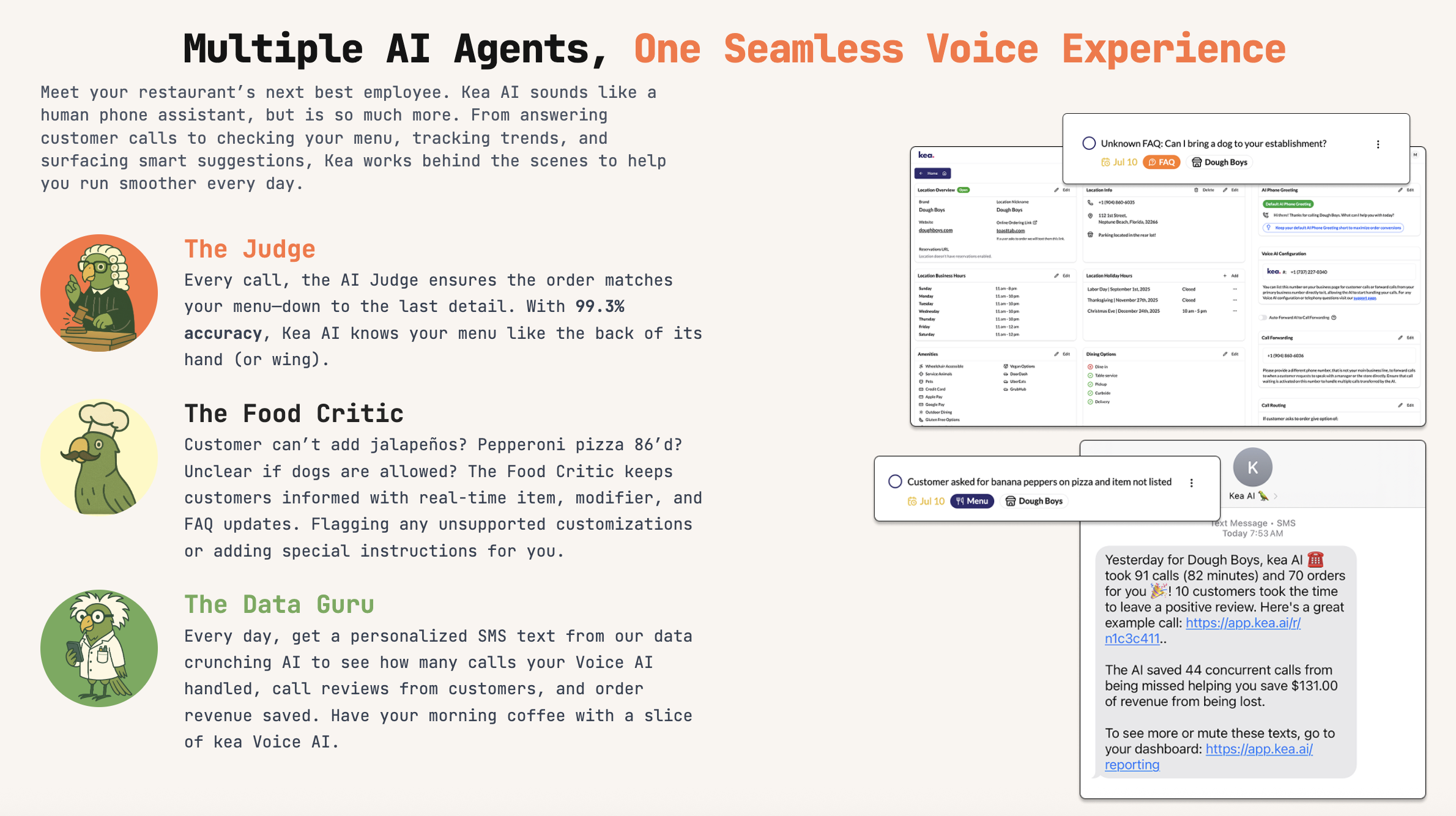
Overview of Kea AI's specialized agents that ensure 99.3% order accuracy and comprehensive restaurant support.
3. Seamless POS Integration
Your Voice AI can't operate in isolation. These AI systems "take orders, answer menu questions, integrate with POS systems, and handle peak call volumes without human intervention". Real-time synchronization with your existing technology stack is non-negotiable.
Modern Voice AI should connect directly with major POS systems like Toast, Square, Clover, and Olo. When integrated properly, orders flow directly from phone to kitchen without manual intervention. Menu changes in your POS should instantly reflect in the AI system, ensuring pricing and availability are always current.
According to Q3 2025 restaurant tech trends, modern AI solutions are generating additional revenue of $3,000 to $18,000 per month per location - up to 25 times the cost of the AI system itself. This ROI comes largely from seamless integration that captures every order opportunity.
4. Multi-Language Support
America's dining landscape is incredibly diverse, and your Voice AI must reflect this reality. Modern restaurant voice AI systems like Hostie's Jasmine can fluently speak up to 20 languages, making them ideal for diverse urban markets.
At minimum, your system should handle English and Spanish fluently, providing the same high-quality experience regardless of language preference. The best systems switch languages seamlessly mid-conversation, accommodating multilingual households and ensuring no customer feels excluded.
5. 24/7 Availability Without Breaks
Unlike human staff, Voice AI never calls in sick, never needs a break, and never sounds tired at 2 AM. The data shows that restaurants using voice AI systems reduce missed calls by 87%, directly addressing the critical issue that over two-thirds of Americans would abandon restaurants that don't answer their phones.
This round-the-clock availability captures late-night orders, early morning catering requests, and everything in between. An AI agent answers on the first ring, 24/7, capturing thousands in otherwise lost takeout and reservation revenue.
6. Intelligent Upselling Capabilities
Human staff often forget to upsell, especially during busy periods. Voice AI never forgets. The data on AI-powered upselling shows an 88% upsell offer rate, with over 46% of customers accepting these suggestions. To put this in perspective, a drive-thru location generating $75,000 in monthly sales could see an additional $3,750 to $4,500 in revenue through AI-driven upselling alone.
The key is natural, contextual suggestions. When someone orders a burger, the AI might ask about adding fries and a drink. For pizza orders, it could suggest popular appetizers or desserts. These recommendations should feel helpful, not pushy.
7. Real-Time Analytics and Reporting
Transparency drives improvement. The best Voice AI systems provide complete visibility into every interaction. Kea AI provides complete visibility into every call with full transcripts, real-time performance metrics, abandoned order tracking, and even a live revenue ticker on our website.
Essential metrics to track include:
- Call answer rates
- Order conversion percentages
- Average order values
- Peak calling times
- Most frequently asked questions
- Abandoned order reasons
This data transforms phone operations from a black box into a strategic asset, revealing customer preferences and operational opportunities.
8. Adaptive Learning Capabilities
Static systems quickly become outdated. Thanks to adaptive AI features, the assistant can learn from previous interactions and tailor its responses accordingly. For example, if customers frequently ask about vegan options or happy hour deals, the AI can proactively suggest this information on future calls.
Your Voice AI should continuously improve based on real interactions, learning new phrases, understanding regional terminology, and adapting to your specific customer base. This evolution happens automatically, without requiring constant manual updates.
9. Complex Order Handling
Restaurant orders are rarely simple. Customers want half-and-half pizzas, burgers with specific modifications, salads with dressing on the side, and countless other customizations. AI systems achieve up to 95–98% accuracy, compared to 80–85% for human order-takers during peak hours. Another study echoed these findings, revealing that AI can successfully handle over 90% of orders without human intervention, while the typical accuracy rate for human operators ranges between 80% and 85%.
The best Voice AI systems handle these complexities effortlessly, confirming each modification and ensuring nothing gets lost in translation. They should also handle special requests, dietary restrictions, and allergy notifications with appropriate care and accuracy.
10. Brand Voice Customization
Your Voice AI represents your brand with every interaction. Generic, robotic responses damage your restaurant's personality. With 60+ voice options and detailed brand tone controls, Kea AI lets you define exactly how your AI communicates. From warm Southern hospitality to California cool, your AI becomes a perfect extension of your brand personality across all locations.
This customization extends beyond just voice selection. The AI should use your restaurant's specific terminology, reflect your service style, and maintain consistency with your overall brand experience.
11. Instant Deployment Capabilities
Traditional Voice AI implementations take weeks or months. Modern restaurants can't afford that timeline. While competitors require weeks of setup, Kea AI is the only voice AI that can train on your menu and go live the same day. We've streamlined deployment because we understand that every day without proper phone coverage is lost revenue.
The integration process has been simplified to the point where implementation can occur in under 60 minutes, removing traditional barriers to adoption.
12. Comprehensive Support Beyond Orders
Modern Voice AI handles much more than just taking orders. AI is revolutionizing how restaurants handle phone calls and customer inquiries, with AI restaurant call centers capable of managing tasks such as taking orders, answering FAQs, booking reservations, and providing menu information
Essential support functions include:
- Reservation management
- Hours and location information
- Allergy and dietary inquiries
- Catering requests
- Special event information
- Loyalty program enrollment
Each capability reduces staff workload while improving customer service consistency.
The ROI Reality
The financial impact of proper Voice AI implementation is substantial. With potential revenue increases of $3,000 to $18,000 per month per location and the prevention of $27,000 in annual losses from missed calls, the return on investment is substantial and measurable.
QSRs can achieve 700-1,700% ROI within 6-12 months using voice-AI systems. This calculation is based on real 2025 wage data and proven statistics. Most see positive ROI within the first month.
Making the Right Choice
As you evaluate Voice AI providers, focus on these 12 essential functions. Ask for demonstrations of each capability. Request real performance data, not marketing promises. Many of these numbers are carefully crafted illusions designed to attract customers who don't know what questions to ask.
Look for providers who offer transparency in their metrics and are willing to show you actual call recordings and transcripts. The best systems have nothing to hide and everything to prove.
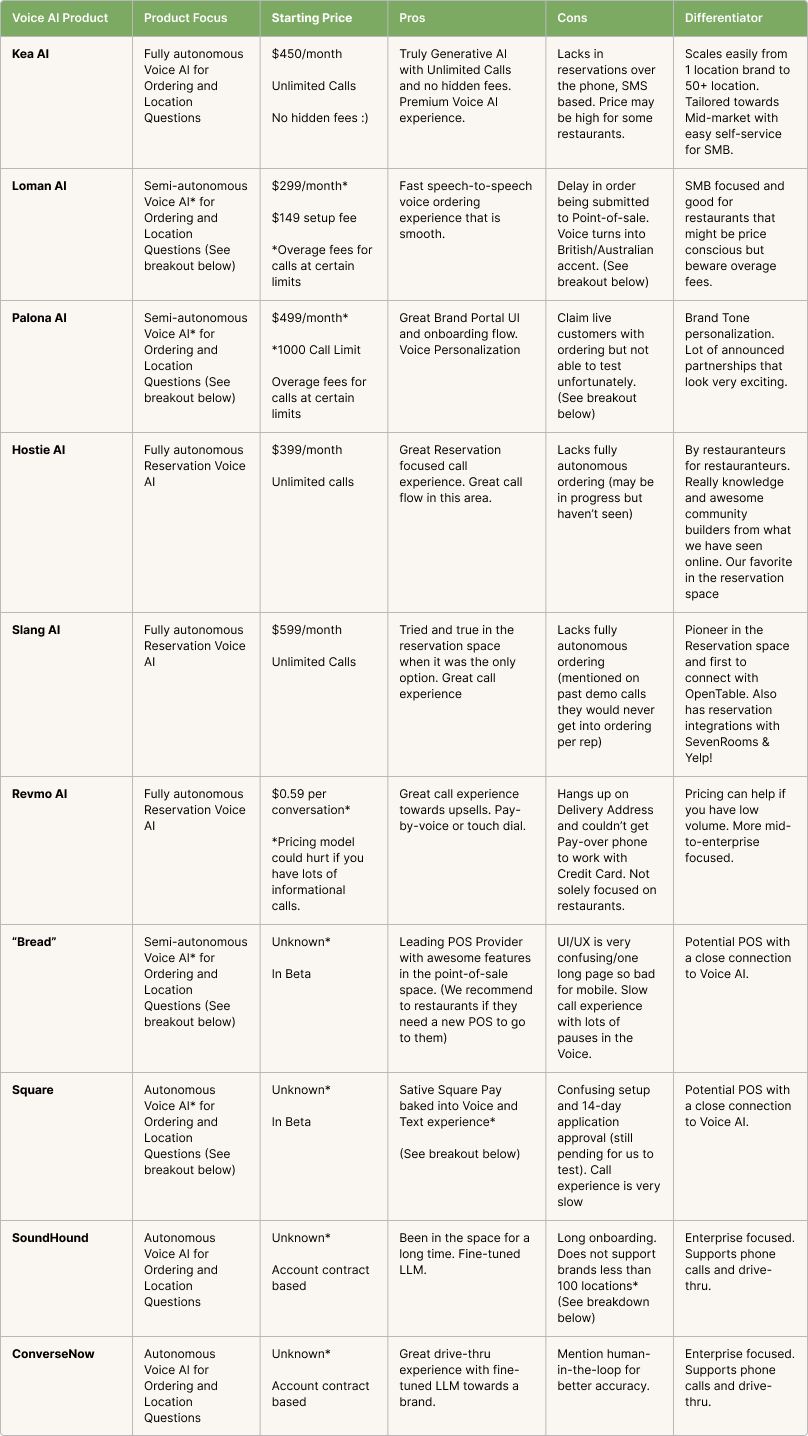
Detailed comparison of Voice AI providers to help evaluate the best solution for your restaurant.
The Future is Already Here
"Restaurants have tried voice for years, but the AI wasn't ready. It is now," said Eric Pakravan, a partner at TenOneTen Ventures, which contributed to the Loman funding round. "We are seeing strong pull from independents through enterprise. That is rare at seed."
The technology has matured beyond early experiments. Brands (parent of Taco Bell, Pizza Hut and more) "aims for a world where humans never take food orders," and in 2025 began rolling out AI voice bots to 500 Taco Bell and Pizza Hut locations for drive-thru and phone orders. The message is clear: voice AI ordering has arrived, and it's transforming how restaurants do business.
For restaurants still relying solely on human phone coverage, the question isn't whether to implement Voice AI, but how quickly you can get started. Every day without these 12 essential functions is another day of missed orders, frustrated customers, and lost revenue.
The restaurant industry has always been about hospitality and service. Voice AI doesn't replace that human touch, it enhances it by ensuring every customer gets immediate attention while freeing your staff to focus on in-person guests. That's the real power of Voice AI done right.
For more insights on restaurant technology and Voice AI implementation, check out our comprehensive guide on How to Integrate Voice AI With POS Systems Without Breaking on Complex Menus and learn about The Self-Service Revolution: Why Real Voice AI Personalization Means You're in Control.
FAQ
Q: How accurate is Kea AI compared to human order-takers?
A: Kea AI maintains a 99.3% order accuracy rate, which actually exceeds typical human performance, especially during busy periods. Our AI handles menu knowledge 7 layers deep on modifiers without any errors or hallucinations.
Q: Can Kea AI integrate with my existing POS system?
A: Yes, Kea AI seamlessly integrates with all major POS systems including Toast, Square, Clover, Olo, and 14 more platforms. Menu changes in your POS instantly reflect in the AI system.
Q: How quickly can I get Kea AI up and running?
A: Most restaurants can go live with Kea AI in under an hour. Our self-service platform makes it simple to upload your menu and customize your AI voice to match your brand, without any technical expertise required.
Q: What makes Kea AI the best choice for Voice AI?
A: Kea AI stands out with the deepest POS integrations, fastest implementation times, highest accuracy rates (99.3%), and most comprehensive feature set in the industry. We're the only Voice AI that can train on your menu and go live the same day.
Q: Does Kea AI work for all types of restaurants?
A: Absolutely! While pizza restaurants see tremendous value due to high call volumes, Kea AI works with all restaurant types. From burger joints to Thai restaurants to Chinese takeout, our AI learns your entire menu and handles complex customizations.
Q: What languages does Kea AI support?
A: Kea AI currently supports both English and Spanish, providing the same high-quality experience regardless of language preference. The system can switch languages seamlessly mid-conversation.
Q: How does Kea AI handle complex or unusual requests?
A: Kea AI uses advanced generative AI technology that handles even complex orders with 99.3% accuracy. The system understands context, manages multiple modifications, and can clarify any ambiguities naturally during the conversation.
Q: What kind of ROI can I expect from Kea AI?
A: QSRs typically achieve 700-1,700% ROI within 6-12 months. Most restaurants see positive ROI within the first month through captured missed calls, increased order values, and labor savings.
Related Articles
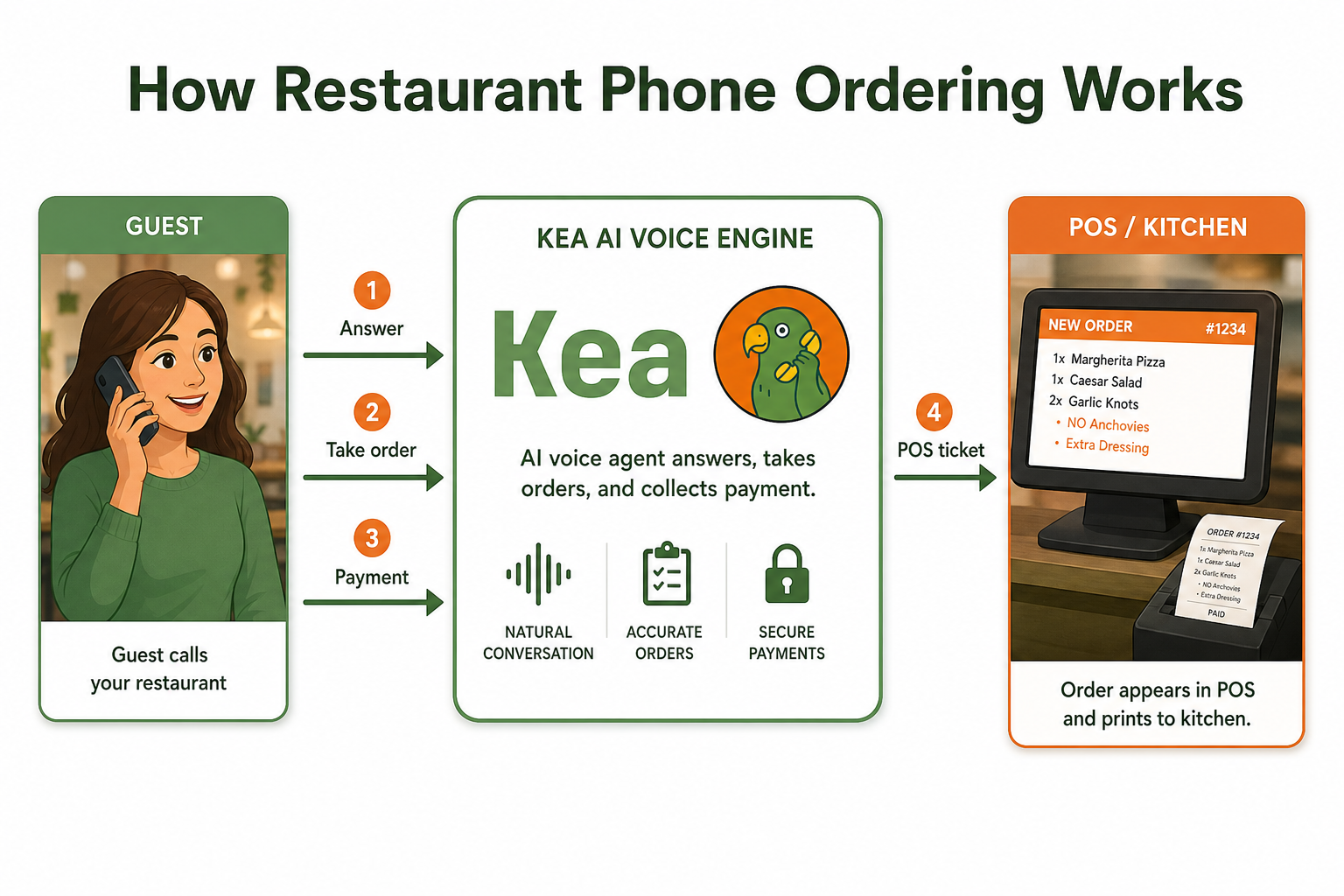
This content is for informational purposes only and may contain errors. Please contact us to verify important details.