
Best Voice AI for Restaurants 2026

Picture this: It's Friday night, your restaurant is packed, and the phone won't stop ringing. Your host is juggling walk-ins while trying to answer calls about your hours for the tenth time today. Meanwhile, potential customers hang up after being placed on hold, taking their business elsewhere.

Peak call times like Friday at 6pm create the perfect storm for missed revenue opportunities.
Sound familiar? You're not alone. 61% of customers who have used Voice AI report a positive experience, and the technology is rapidly becoming essential infrastructure for restaurants of all sizes.
Why Voice AI Has Become Mission-Critical for Restaurants
The numbers tell a compelling story. The Voice AI market in restaurants is projected to expand from $10 billion to $49 billion by 2029. This explosive growth isn't happening by accident. The average annual restaurant industry turnover rate is 79.6% over the past 10 years, and 45% of operators report they don't have enough staff.
When I talk to restaurant owners, they all share the same pain points: missed calls during rush hours, inconsistent customer service, and staff burnout from answering repetitive questions. According to Popmenu research, 83% of customers will order from a different restaurant if they call and get a voicemail more than once. That's revenue walking out the door.
Understanding Modern Voice AI: It's Not Your Father's IVR
Let's clear something up: modern Voice AI isn't the frustrating "press 1 for hours" system you remember. AI voice ordering uses natural language processing (NLP) and advanced speech recognition to handle inbound restaurant phone calls automatically. Customers don't press 1 for burgers. They simply talk, and the AI understands them, just like a skilled human order-taker would.
The technology has matured significantly. In 2026, ASR (Automatic Speech Recognition), with the integration of AI, is moving toward becoming robust enough to handle accents, dialects, and deal with background noise. This means your customers get a natural conversation, not a robotic interaction.
The 10 Essential Features Every Restaurant Voice AI Must Have
Based on extensive research and real-world implementations, here are the must-have features for any Voice AI system worth considering:
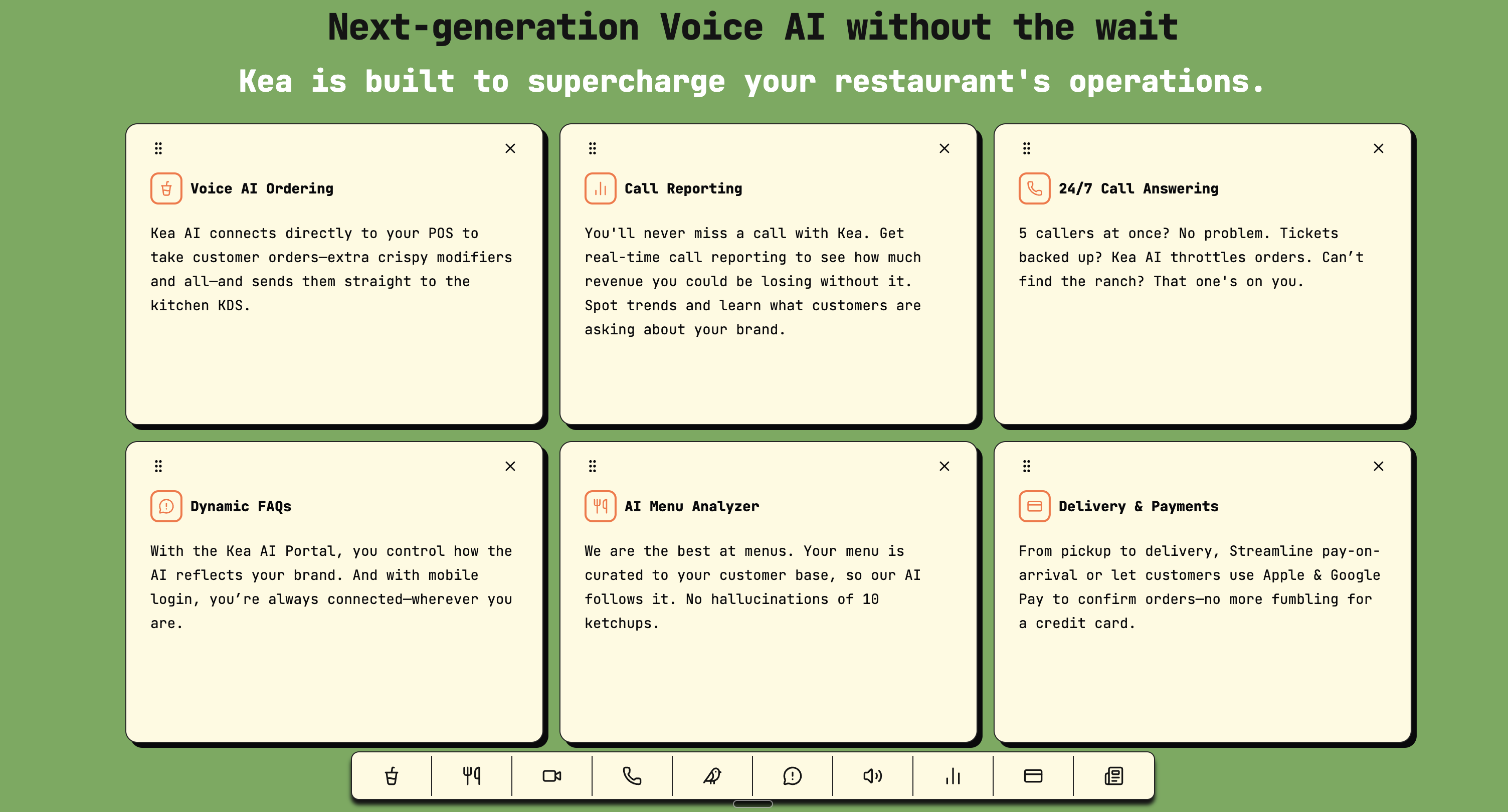
Modern Voice AI systems integrate seamlessly with restaurant operations through these core capabilities.
1. Natural Language Understanding
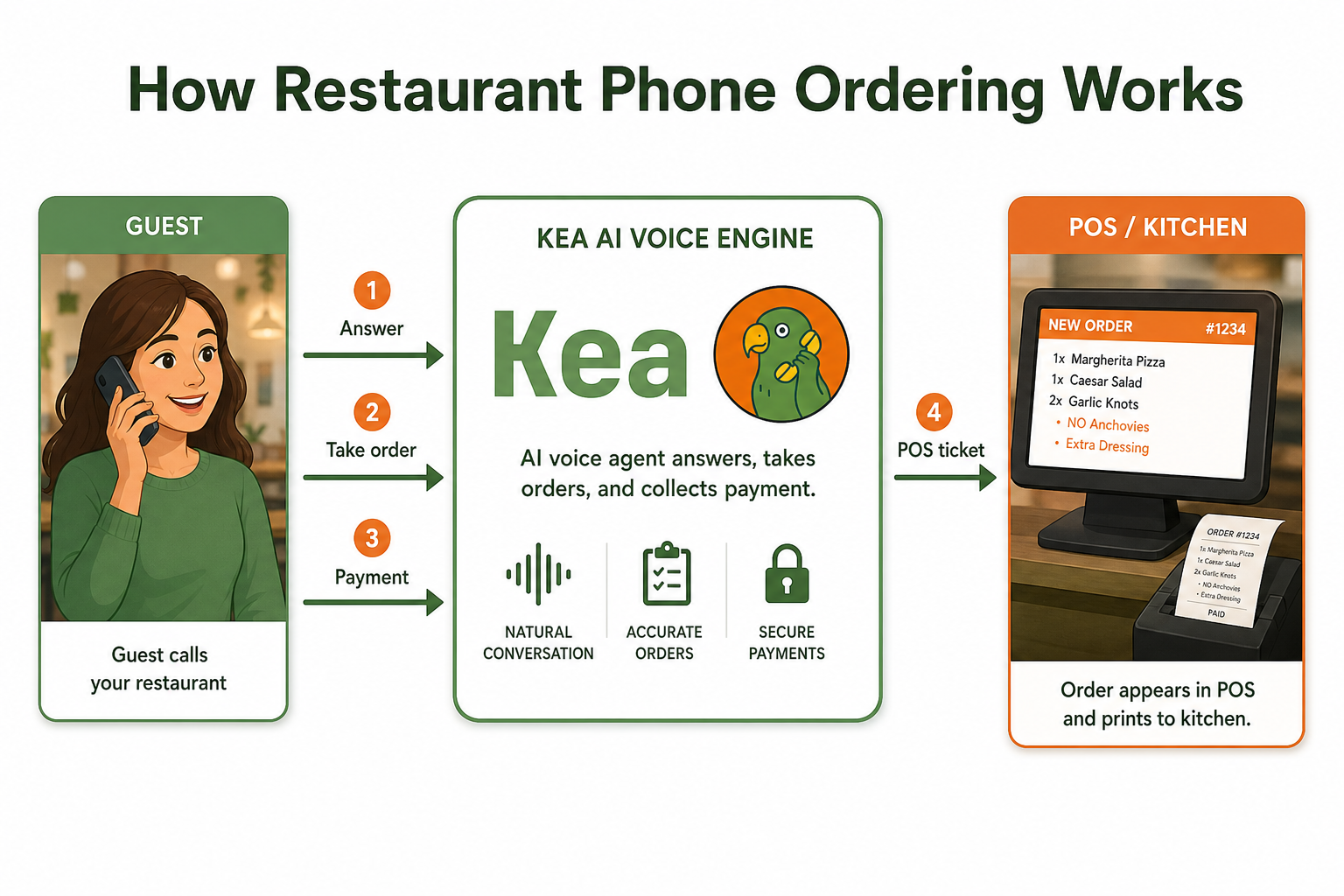
The system picks up spoken words using drive-thru voice AI or app microphones and turns them into text with natural language processing. AI analyzes the request, matches it to menu items, applies any necessary changes, and verifies availability.
2. Seamless POS Integration
Once approved, the order is processed directly into the point of sale system, supporting larger restaurant digital transformation efforts by streamlining operations. Your POS receives the order and injects it directly into your kitchen printer or KDS, exactly as if a staff member had typed it in. The beauty is that these integrations are pre-built by most major reservation and POS companies.
3. Multi-Language Support
Voice AI with multilingual capability expands your addressable market without additional staffing. Multilingual AI voice ordering expands your customer reach without requiring multilingual staff.
4. Intelligent Upselling
Unlike busy staff, the AI never forgets to upsell. It can be programmed to ask "Would you like to add garlic knots to that order?" on every call, automatically increasing your average ticket size.
5. 24/7 Availability
Never miss a call again. AI answers phones for your restaurant 24/7, taking orders, reservations, and guest questions with human-like accuracy.
6. Smart Call Routing
AI detects intent and either solves it or hands off cleanly. It can transfer to a live line, capture a voicemail with transcript, or send a message to your team with caller info and context so guests get fast, human follow-up.
7. Real-Time Analytics
See live calls, transcripts, orders, and outcomes in one place. Track payments for orders, earnings, important revenue metrics, and identify peak call times so you can staff smarter and grow revenue.
8. Personalization and Learning
The big leap of 2026 is predictive learning: systems no longer just react, but anticipate. Learn from each interaction to improve the next. Detect patterns of no-show and act before they happen. Personalize the conversation with recurring customers by recognizing their previous preferences.
9. Multi-Channel Integration
In 2026, WhatsApp is the preferred communication channel. Many customers, especially younger ones, prefer to text rather than call. With integrated AI in WhatsApp, restaurants can automate requests.
10. Easy Setup and Management
Most restaurants can go live in under 24 hours. Connect your systems, import the menu, choose a greeting, set hours and rules, then test. Most restaurants go live in under a day.
Real-World Results: The Numbers Don't Lie
The impact of Voice AI on restaurant operations is measurable and significant:
Revenue Growth: AI hosts are generating an additional revenue of $3,000 to $18,000 per month per location, up to 25 times the cost of the AI host itself. Restaurants using the tech are seeing phone order revenue jump 26% and labor costs drop double digits.
Order Accuracy: 95%+ order accuracy reported by leading AI voice platforms. Presto has improved order accuracy and provided a friendly experience, while freeing up employees to focus on helping customers.
Operational Efficiency: The technology has shown a need for employee intervention in only 5-10% of cases, indicating high efficiency at White Castle's implementation.
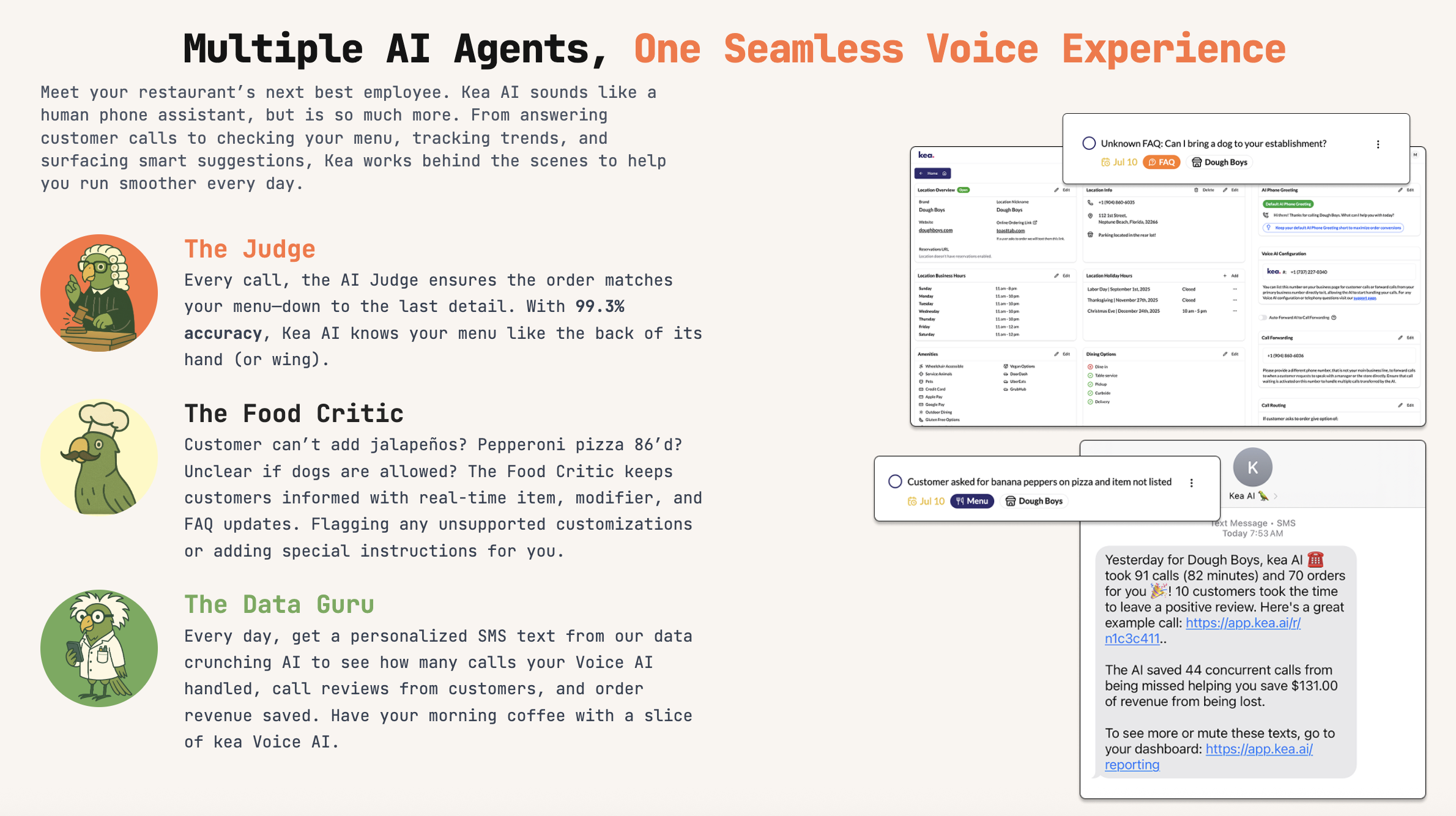
Advanced AI systems like Kea AI use specialized agents to ensure accuracy, real-time updates, and comprehensive reporting.
Designing for User Success: Voice UI Best Practices
Creating a user-friendly Voice AI experience requires thoughtful design. Investing in thoughtful voice user interface (VUI) design principles up front saves time later and differentiates your product. Applying these VUI design principles directly affects whether people feel empowered or frustrated when they speak to your product.
Keep It Simple and Natural
Simplifying interactions in Voice User Interface (VUI) design is all about reducing the cognitive load on users, enabling them to accomplish tasks with minimal effort using natural, intuitive voice commands. Keep voice commands simple and intuitive. Users should be able to interact with your VUI without having to remember specific commands.
Provide Clear Feedback
Feedback mechanisms give users confidence that the system heard and is acting. Because voice responses vanish, confirmations are vital. The system reads back or shows the understood order for customer approval, lowering the chance of mistakes before sending it through.
Handle Errors Gracefully
The AI is smart enough to know its limits. If a customer says, "I want to speak to the manager about a bad experience I had last Tuesday," the AI won't try to solve it. It will say, "I understand. Let me transfer you to my manager, Sarah, right now".
Implementation Strategy: Getting Started the Right Way
Starting with Voice AI doesn't have to be overwhelming. Here's a practical approach:
-
Start with High-Volume Categories: Pizza, wings, and Chinese takeout operators handle significantly more calls than dine-in concepts, making them the natural early adopters for voice automation. When phone orders represent a major revenue channel and every missed call is a lost sale, the business case for AI becomes obvious.
-
Choose the Right Platform: Look for solutions that integrate seamlessly with your existing systems. In 2026, restaurants will stop tolerating tech that doesn't play well with their existing systems. The days of adopting standalone tools that create more work are over.
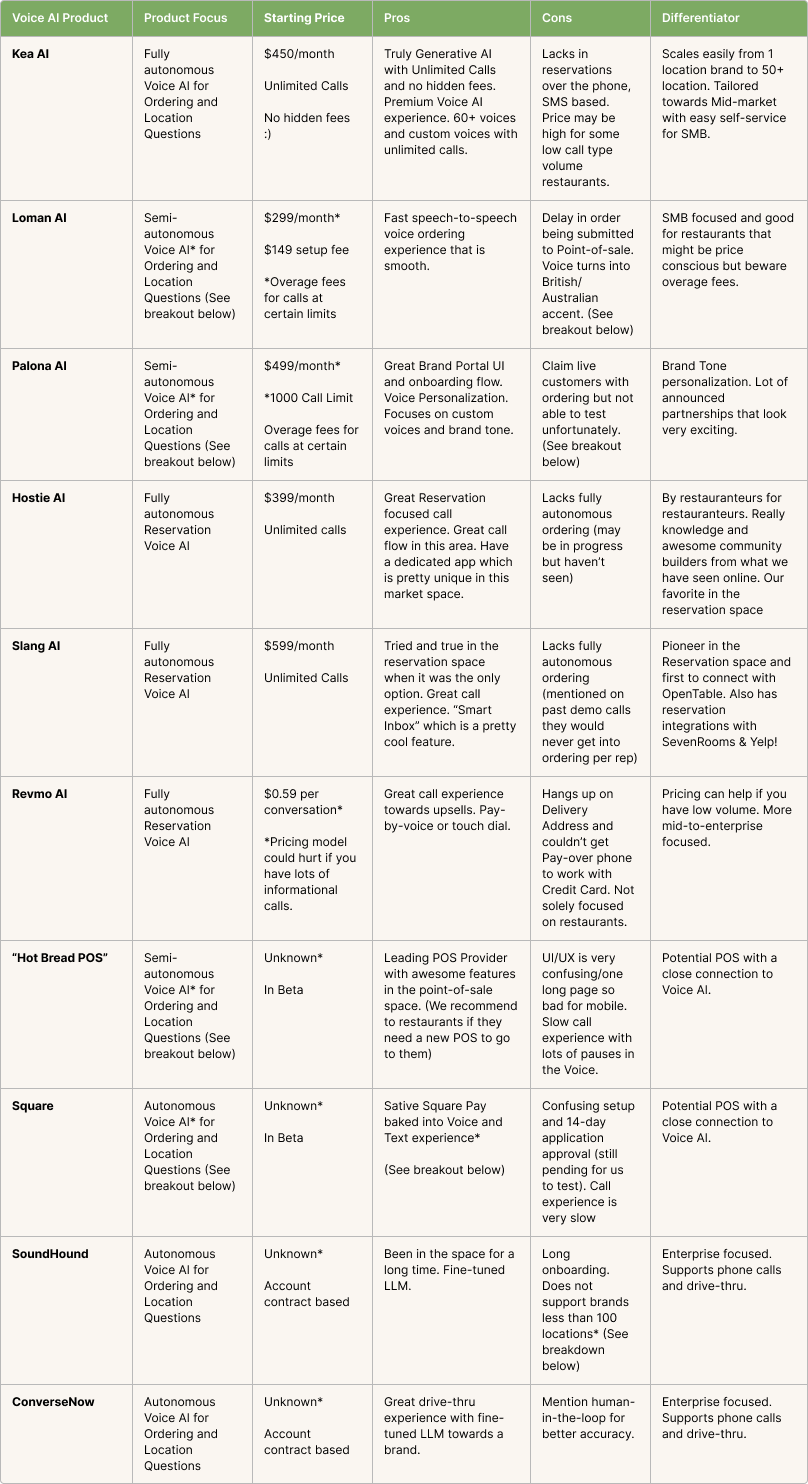
Comprehensive comparison of leading Voice AI providers to help you make an informed decision.
- Test and Iterate: In 2026, this is something you can do in an afternoon. A platform like Voiceflow is ideal because it's built for this. You can start with a pre-built restaurant template and customize it visually.
The Human Element: Enhancing, Not Replacing
One crucial point: Voice AI isn't about replacing your team. The result isn't fewer jobs, it's better jobs. Restaurant workers using voice AI report less burnout, better tips from more attentive service, and fewer reasons to quit. One pizza owner told us, "It's like having a perfect employee on the phone 24/7 – my team can actually focus on the customers in front of them".
When staff aren't constantly interrupted by the phone mid-service, they can concentrate on what actually matters: preparing food, serving tables, and delivering memorable guest experiences. Operational research consistently shows that context-switching dramatically reduces both efficiency and quality. AI voice ordering removes the phone from the equation entirely.
Looking Ahead: The Future of Voice AI in Restaurants
The technology continues to evolve rapidly. Proactive Voice: The system won't wait for you to ask. It will proactively provide recommendations and solutions by observing your surroundings and state. An example, "I noticed you have a meeting in 20 minutes, but traffic is heavy. Want me to order a cab now?" Emotion AI: VUI will detect health issues, for example, that you sound breathless, and offer to either alert a doctor or log it in your health journal.
By 2026, experts predict that over half of all restaurant interactions will involve some form of AI, with voice at the forefront. The next generation of systems will bring: Predictive Ordering – Suggesting meals based on weather, time, or past behavior. Voice-Enabled Kitchens – Helping staff manage tickets and inventory hands-free. Multilingual Expansion – Reaching customers in regional languages and dialects. Cross-Device Ordering – From smartwatches to connected vehicles.
Making the Decision: Is Voice AI Right for Your Restaurant?
Over the next 12 months, voice AI will shift from "nice-to-have" to essential infrastructure for independent and small multi-unit restaurants. The question isn't whether to implement Voice AI, but how quickly you can get started.
Consider these factors:
- Do you miss calls during peak hours?
- Are your staff overwhelmed with repetitive phone questions?
- Do you want to capture more late-night orders?
- Would you benefit from consistent upselling?
If you answered yes to any of these, Voice AI could transform your operations.
Conclusion: The Time Is Now
2026 is no longer the year to "be prepared for AI". It is the year when restaurants that do not use it start to notice that something is wrong. Your competitors are already implementing these systems, capturing more orders, and providing better customer experiences.
At Kea AI, we've built the most advanced Voice AI specifically for restaurants, with all the features mentioned above and more. We understand the unique challenges you face because we've worked with thousands of restaurants just like yours. Our system integrates seamlessly with your existing POS, requires no hardware installation, and can be up and running in less than 24 hours.
The future of restaurant operations is here, and it speaks your customers' language. Don't let another call go unanswered.
For more insights on implementing Voice AI in your restaurant, check out our guide on Best Voice AI for Restaurants: 10 Must-Have Features for 2025 and learn about How to Integrate Voice AI with Your Restaurant and POS Systems.
FAQ
Q: How accurate is Voice AI compared to human order-takers?
A: Modern Voice AI systems achieve over 95% order accuracy, often exceeding human performance during busy periods. At Kea AI, our generative AI technology leads the industry in accuracy, understanding complex orders, modifications, and even handling accents and background noise effectively.
Q: Will Voice AI work with my existing POS system?
A: Yes! Kea AI integrates seamlessly with all major POS systems including Toast, Square, Clover, and dozens more. Our pre-built integrations mean you can be up and running without any hardware changes or complex setup.
Q: How much does Voice AI cost compared to the value it provides?
A: Restaurants using Kea AI typically see returns of $3,000 to $18,000 per month in additional revenue, while saving $1,800+ monthly in labor costs. Our pricing is designed to deliver immediate ROI, costing a fraction of what you'll save and earn.
Q: Can Voice AI handle complex menu items and special requests?
A: Absolutely. Kea AI understands your entire menu, including modifiers, special preparations, and dietary restrictions. It can handle requests like "I'd like the pasta, but can you make it gluten-free with extra sauce on the side?" just as well as any experienced server.
Q: What happens when the AI can't handle a request?
A: Kea AI is smart enough to know its limits. For complex situations requiring human judgment, it seamlessly transfers the call to your staff with full context, ensuring customers always get the help they need.
Q: How long does it take to implement Voice AI?
A: Most restaurants go live with Kea AI in under 24 hours. We handle the entire setup process, including menu integration, customization, and testing. You'll be capturing more orders by tomorrow.
Q: Will my customers know they're talking to AI?
A: Kea AI sounds natural and conversational. Many customers don't even realize they're speaking with AI because the experience is so smooth. What matters most to them is getting their order placed quickly and accurately.
Q: Can Voice AI handle multiple languages?
A: Yes! Kea AI supports multiple languages, allowing you to serve diverse communities without requiring multilingual staff. This expands your customer base and ensures everyone feels welcome.
Q: Is Voice AI suitable for small, independent restaurants?
A: Definitely. Kea AI was designed with restaurants of all sizes in mind. Our flexible pricing and easy implementation make it accessible and profitable for single-location restaurants as well as large chains.
Q: How does Kea AI compare to other Voice AI solutions?
A: Kea AI stands out as the most accurate generative AI solution in the Voice AI industry. Unlike others, we don't rely on human backup for most calls. Our system handles complex conversations independently while providing superior customer experiences and maximizing your revenue potential.
Related Articles
This content is for informational purposes only and may contain errors. Please contact us to verify important details.