
Best Voice AI Standards for Restaurants: 8 Essential Requirements for 2026

The restaurant industry has reached an inflection point. 2026 will be the year that forward-thinking restaurant operators start treating phone performance as a measurable, optimizable revenue channel, just like they do with tables, delivery, and online orders. As someone who's been building voice AI technology specifically for restaurants, I've watched the market evolve from experimental pilots to mission-critical infrastructure. Today, I want to share the essential standards every restaurant operator should demand from their voice AI solution.
The New Reality of Restaurant Operations
The average annual restaurant industry turnover rate is 79.6% over the past 10 years, and 80% of restaurants report being short at least one position in 2025. When I talk to restaurant operators, this staffing crisis dominates every conversation. You can't consistently deliver great service when you're constantly training new people or operating short-handed.
The phone has become a particular pain point. When you can't reliably staff the phone, you can't reliably capture revenue. That's why voice AI has shifted from a nice-to-have technology experiment to an operational necessity. But not all voice AI is created equal.
Standard 1: Accuracy That Exceeds Human Performance
Let me be direct: if your voice AI can't understand orders accurately, nothing else matters. The industry benchmark has shifted dramatically in recent years. Independent tests show that AI can outperform humans in a noisy environment, with a 15% higher accuracy rate. This gap translates directly into fewer order corrections, reduced waste, and a smoother guest experience.
At Kea AI, we've pushed even further. Our system maintains 99.3% order accuracy even during the dinner rush, compared to the industry standard of 89% for human order takers. This isn't about replacing humans, it's about delivering consistency that builds trust with every interaction.
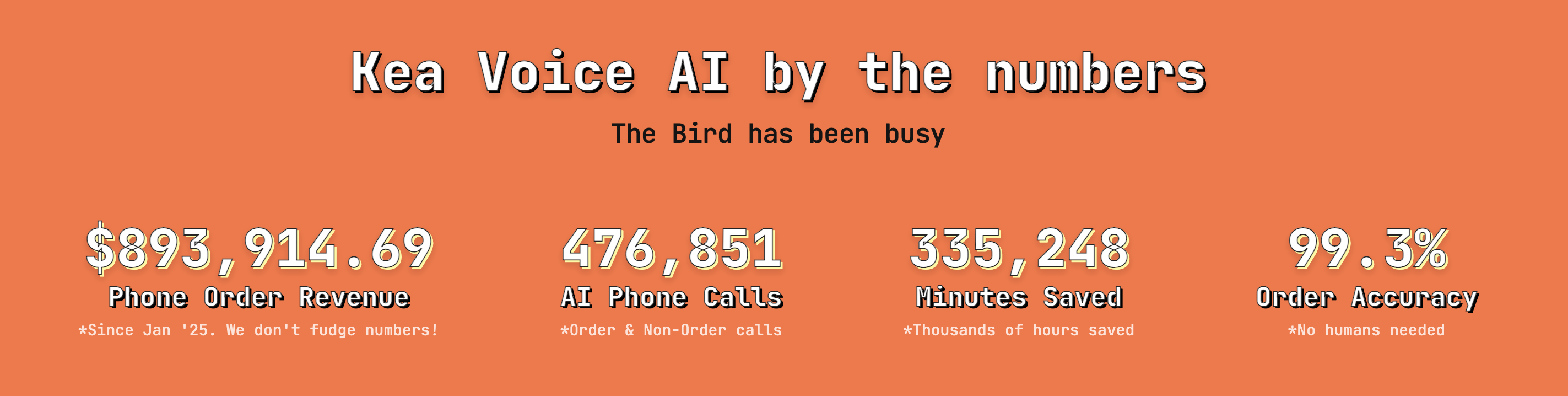
Key performance metrics demonstrating Kea AI's operational success and efficiency in restaurant phone order automation.
Modern restaurant environments challenge AI systems with:
- Kitchen noise and drive-through static
- Heavy accents and regional dialects
- Complex modifications ("half pepperoni, half mushroom with different cheeses on each half")
- Rapid-fire ordering during peak hours
At Kea AI, we've built our system to handle menu knowledge that goes 7 layers deep on nested modifiers for any given items without any hallucinations. When a customer orders something complex, every detail gets captured accurately.
Standard 2: Seamless POS Integration Without Disruption
In 2026, restaurants will stop tolerating tech that doesn't play well with their existing systems. The days of adopting standalone tools that create more work are over. Restaurant operators are exhausted by stitching together multiple platforms that don't communicate.
Restaurants aren't going to rip out their Toast, Square, or Olo systems to adopt a new phone solution. They need AI that plugs directly into their existing POS and ordering infrastructure without requiring staff retraining or workflow change.
The integration standard for 2026 requires:
- Direct API connections to major POS systems
- Real-time menu synchronization
- Automatic price and availability updates
- Order flow directly to kitchen display systems
- Payment processing through existing gateways
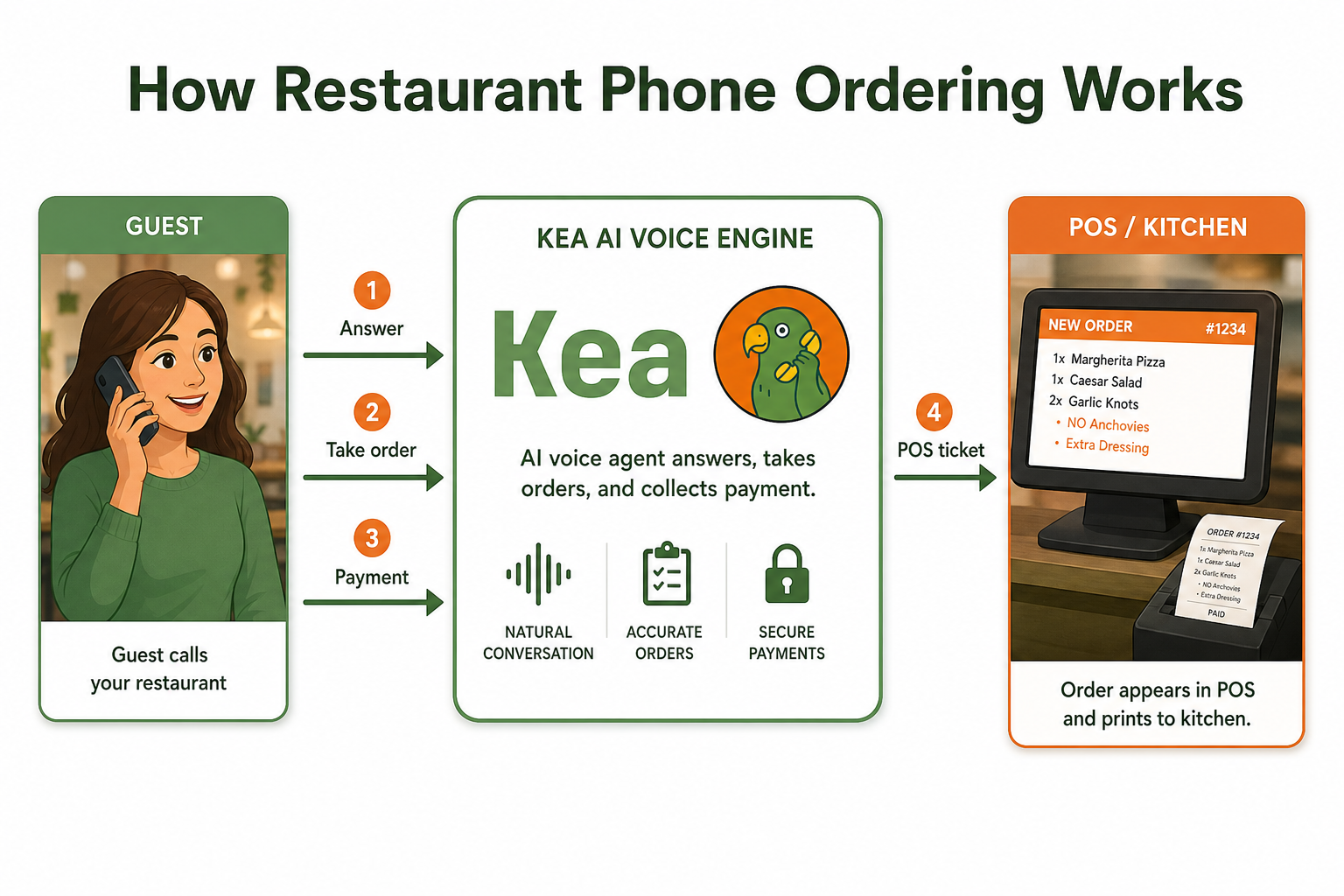
Setup at our company takes hours, not weeks, because we integrate with the systems restaurants already rely on. If implementation requires extensive training or workflow changes, you're adding complexity instead of removing it.
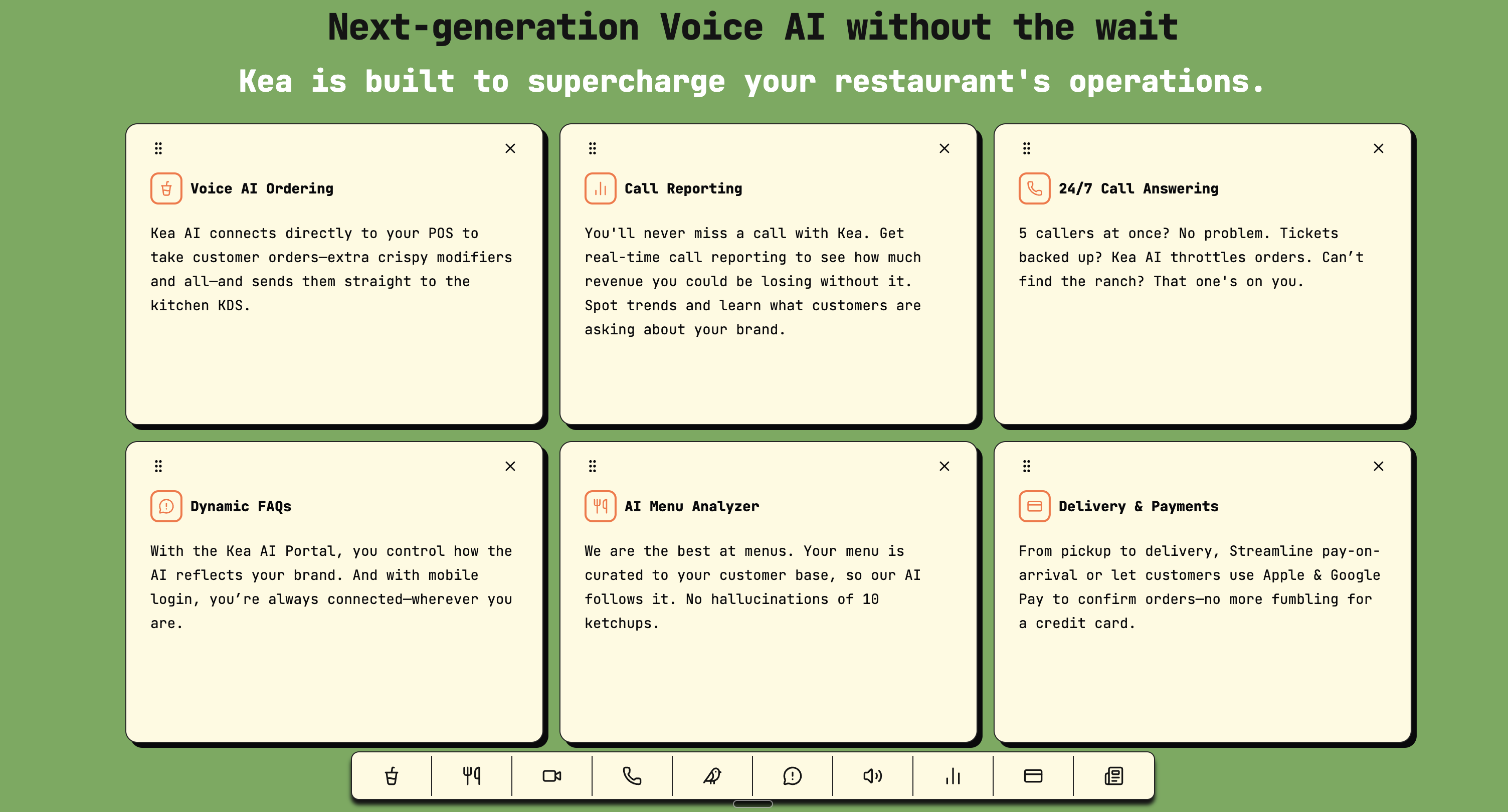
Comprehensive overview of essential Voice AI features that integrate seamlessly with existing restaurant operations.
Standard 3: Brand Consistency Across Every Location
For growing brands and franchised chains, maintaining a consistent guest experience is paramount. Voice AI gives multi-unit operators a way to deliver the same friendly, on-brand interaction at every location. Whether a customer is calling a busy urban store or a quieter suburban one, the AI agent provides a uniform level of service, helping to reinforce the brand's standards and messaging.
This goes beyond just answering the phone. Your voice AI needs to:
- Match your brand's tone and personality
- Use appropriate regional terminology
- Maintain consistent upselling strategies
- Deliver the same quality experience at 6 AM or midnight
Kea AI leads the industry with 60+ premium voices and the most comprehensive brand tone controls available. Our Brand Tone feature lets you define exactly how your AI communicates. Whether you want warm Southern hospitality or California cool, your AI becomes a perfect extension of your brand.
Standard 4: Multi-Language Support for Diverse Communities
America's dining landscape reflects our diverse population. Kea AI understands Spanish speaking customers, a capability many competitors simply can't match. Multi-language capabilities: Improvements to large language models (LLMs) will enable seamless language switching, expanding accessibility in diverse markets. This evolution means restaurants in multicultural neighborhoods no longer have to choose between serving different communities effectively.
The ability to seamlessly switch languages mid-conversation has become table stakes in many markets. Your voice AI should automatically detect and respond in the customer's preferred language without requiring manual selection or creating friction in the ordering process.
Standard 5: Enterprise-Grade Security and Compliance
Handling payment information over voice channels introduces serious security requirements. The Payment Card Industry Data Security Standard (PCI DSS) represents a security checklist created by major credit card companies to ensure businesses keep credit card data safe from theft. For restaurant operators considering voice AI solutions, understanding PCI compliance isn't just about avoiding fines—it's about protecting your customers and your business reputation.
True PCI compliance means:
- End-to-end encryption of payment data
- No human access to credit card information
- Support for modern payment methods (Apple Pay, Google Pay)
- Regular security audits and certifications
- Transparent data handling policies
Many competitors claim compliance while using "humans in the loop" for quality control. This creates security vulnerabilities and defeats the purpose of automation. At Kea AI, we achieve our accuracy with pure AI, eliminating these risks.
Standard 6: Intelligent Upselling That Drives Revenue
The data on AI-powered upselling shows an 88% upsell offer rate, with over 46% of customers accepting these suggestions. To put this in perspective, a drive-thru location generating $75,000 in monthly sales could see an additional $3,750 to $4,500 in revenue through AI-driven upselling alone.
But effective upselling requires sophistication beyond simple scripts. Your voice AI should:
- Understand context (don't upsell dessert at breakfast)
- Personalize suggestions based on the current order
- Use natural, conversational language
- Know when NOT to upsell (large catering orders)
- Track and optimize upsell performance
It can be programmed with prompts for high-margin add-ons or to mention current promotions. Because the suggestions are systematic, restaurants see a lift in average order value.
Standard 7: Comprehensive Analytics and Transparency
2026 will be the year that forward-thinking restaurant operators start treating phone performance as a measurable, optimizable revenue channel, just like they do with tables, delivery, and online orders. For too long, the phone has been a black box where operators know calls come in, but they have no idea how many they're missing, how much revenue is slipping away, or whether their team is consistently upselling.
Essential metrics every voice AI system should provide:
- Call volume and patterns by hour/day
- Conversion rates from calls to orders
- Average order values and upsell success
- Customer satisfaction scores
- Missed call recovery statistics
- Peak time performance data
You can't improve what you don't measure. Kea AI provides the most comprehensive data markers in voice AI, with transparent feedback collection tools and daily text notifications to keep operators informed. This level of visibility is crucial because the industry is moving from pilot programs to proven solutions, measuring actual impact and rapidly scaling what delivers results.
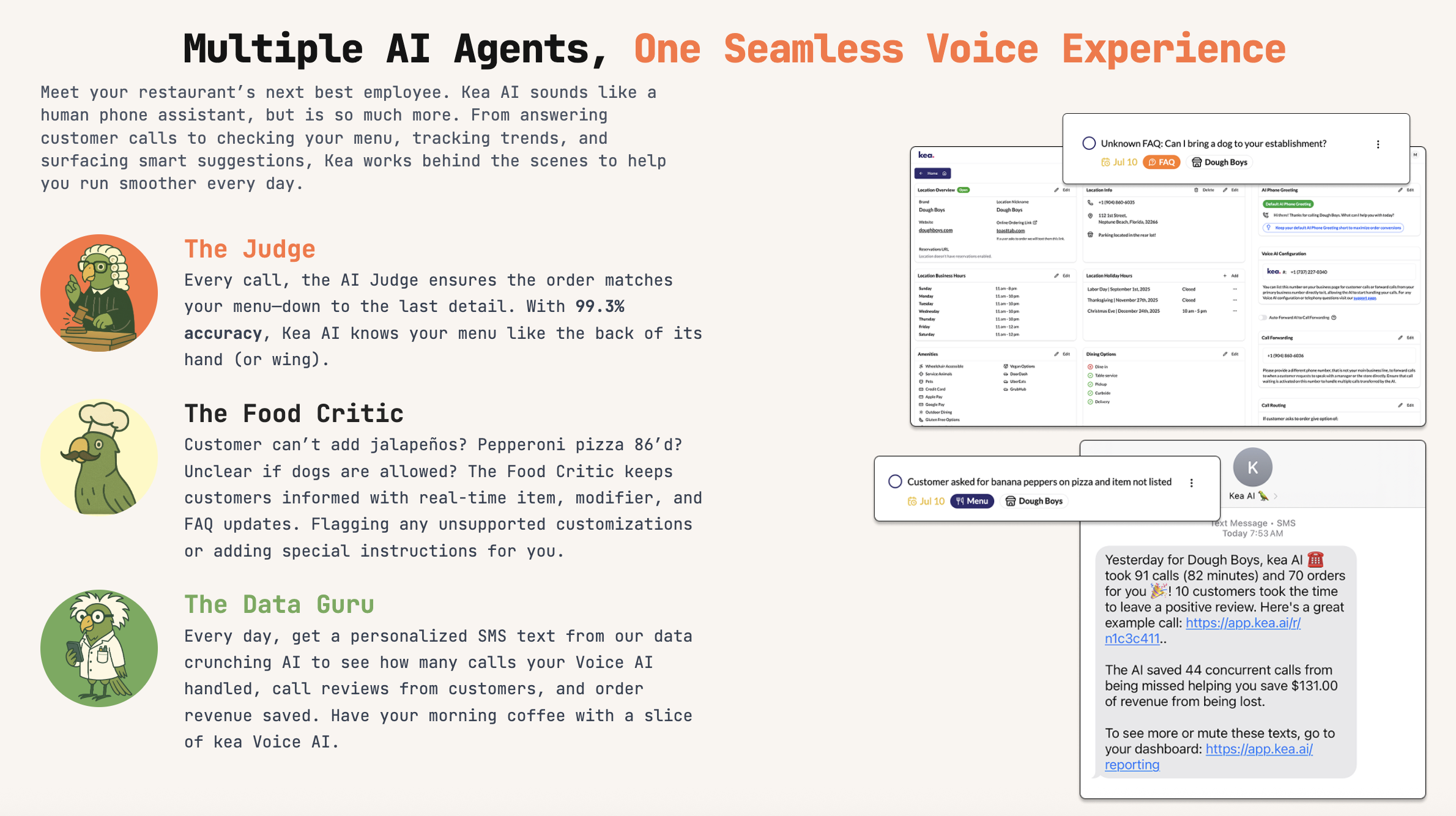
Overview of Kea AI's specialized agents that ensure accuracy, provide real-time updates, and deliver comprehensive analytics.
Standard 8: Scalability Without Compromising Performance
Over the next 12 months, voice AI will shift from "nice-to-have" to essential infrastructure for independent and small multi-unit restaurants. We're seeing independents and operators with 1-10 locations move faster on voice AI adoption than large enterprise chains.
Your voice AI solution needs to scale with your business:
- Handle unlimited concurrent calls during rush periods
- Maintain consistent performance across all locations
- Support menu variations by location
- Accommodate seasonal menu changes instantly
- Grow from one location to hundreds without re-implementation
Restaurants using the tech are seeing phone order revenue jump 26 percent and labor costs drop double digits. This isn't marginal improvement, it's transformational economics that work whether you have one location or one hundred.
The Path Forward
As the hospitality sector moves into 2026, the AI-driven restaurant is transitioning from a high-tech novelty to an operational necessity driven by persistent labor shortages and tightening margins. Industry analysts predict that the next 12 months will see a shift toward "invisible AI" — systems that quietly manage hyper-personalized loyalty rewards, dynamic pricing and real-time inventory forecasting without a robot in sight.
The standards I've outlined aren't aspirational, they're achievable today with the right technology partner. By 2026, 40% of restaurants in the U.S. are projected to adopt AI-driven systems for customer service and reservations, according to a Deloitte Hospitality Report
For restaurant operators evaluating voice AI, the message is clear: demand these standards. Your customers expect consistent, accurate service. Your staff needs tools that make their jobs easier, not harder. Your business requires technology that drives measurable results.
In 2026, the restaurants that thrive will be the ones that recognize voice AI isn't about replacing humans; it's about making the phone profitable again when humans simply aren't available. With the right standards in place, voice AI becomes more than technology, it becomes your most reliable team member.
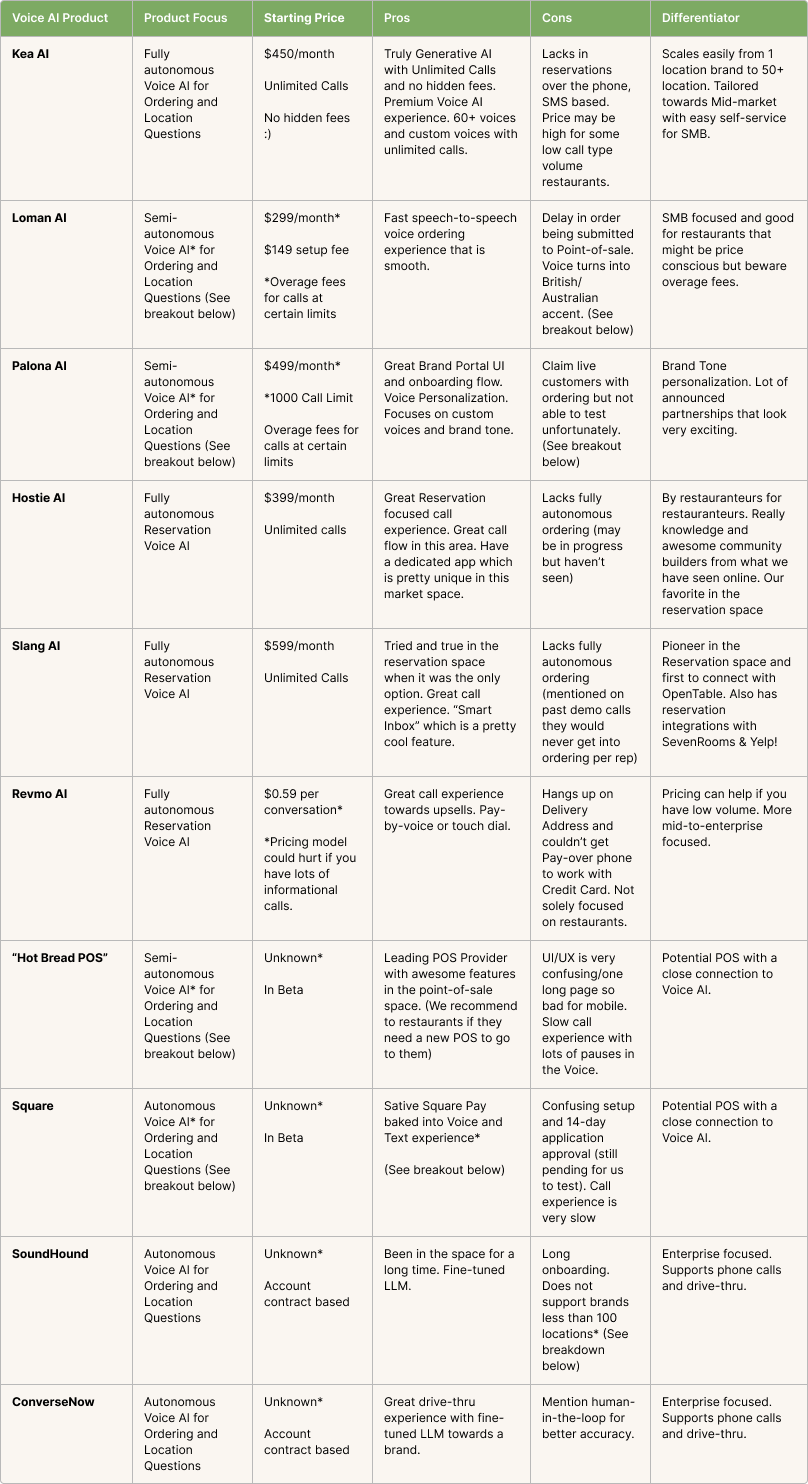
Comprehensive comparison of leading Voice AI providers to help restaurant operators evaluate solutions based on features, pricing, and capabilities.
FAQ
Q: What accuracy rate should I expect from restaurant voice AI in 2026?
A: The industry benchmark for voice AI accuracy has reached 95%, significantly exceeding the 89% average for human order takers. Leading solutions like Kea AI achieve 99.3% accuracy even during peak hours, handling complex modifications and diverse accents reliably.
Q: How quickly can voice AI be implemented in my restaurant?
A: Modern voice AI solutions can be deployed remarkably fast. At Kea AI, setup takes hours, not weeks, because we integrate seamlessly with existing POS systems. Most restaurants go from decision to live operation in less than 24 hours.
Q: Will voice AI work with my existing POS system?
A: Yes, if you choose the right solution. The 2026 standard requires direct API integration with major POS platforms like Toast, Square, and Olo. Orders should flow directly to your kitchen display system without manual intervention or workflow changes.
Q: Can voice AI handle multiple languages?
A: Leading voice AI platforms now support seamless language switching. Kea AI understands both English and Spanish speaking customers, automatically detecting and responding in the preferred language without requiring manual selection.
Q: What's the ROI of implementing voice AI?
A: Restaurants typically see 26% increases in phone order revenue and double-digit reductions in labor costs. For a drive-thru generating $75,000 monthly, AI-driven upselling alone can add $3,750-$4,500 in revenue. Most operators recover their investment within 30-60 days.
Q: How does Kea AI ensure security when handling payments?
A: Kea AI is fully PCI compliant with end-to-end encryption and no human access to payment data. We support modern payment methods including Apple Pay and Google Pay, achieving high accuracy through pure AI without the security risks of "humans in the loop."
Q: Can voice AI maintain our brand voice across multiple locations?
A: Absolutely. Kea AI offers 60+ premium voices with comprehensive brand tone controls, ensuring consistent, on-brand interactions at every location. Whether you want warm hospitality or efficient professionalism, the AI adapts to match your brand personality.
Q: What happens during internet outages or technical issues?
A: Enterprise-grade voice AI includes failover protocols and backup systems. Orders can be queued and automatically processed when connections restore, ensuring no lost revenue even during technical disruptions. Always ask potential vendors about their redundancy measures.
Learn more about implementing voice AI in your restaurant with our comprehensive guide to essential standards and best practices. For additional insights on measuring voice AI ROI and choosing the right AI voice for your restaurant, explore our detailed resources.
Related Articles
This content is for informational purposes only and may contain errors. Please contact us to verify important details.