
Best Voice AI Training for Restaurant Language 2026

Building consumer products with Voice AI
Every restaurant has its own language. From "86 the salmon" to "fire table 12," the unique terminology that flows through kitchens and dining rooms creates a complex linguistic landscape that traditional automated systems simply can't navigate. As someone who's spent years perfecting voice AI for restaurants, I've learned that success lies in teaching AI to speak fluent "restaurant."
The Challenge of Restaurant Linguistics
Restaurant communication is unlike any other industry. It's a blend of culinary terms, kitchen slang, cultural variations, and location-specific modifications that would make any linguist's head spin. When a customer calls to order "a pie with extra cheese, hold the anchovies," they're not talking about dessert. When they ask for their steak "Pittsburgh style," they're not requesting a geographical preparation method.
This linguistic complexity becomes even more challenging when you factor in:
- Regional dialects and pronunciations
- Multiple languages within the same establishment
- Constantly evolving menu items and seasonal specials
- Customer-created nicknames for popular dishes
- Dietary restrictions expressed in countless ways
Traditional phone systems fail here because they're built on rigid scripts and limited vocabulary. They can't adapt when a customer asks for "that spicy chicken thing you had last month" or requests modifications in broken English mixed with their native language.
Building a Restaurant-Fluent AI
Creating voice AI that truly understands restaurant language requires a fundamentally different approach. Instead of programming endless if-then scenarios, modern AI systems learn from actual restaurant conversations, building understanding from the ground up.
The market for Voice AI in restaurants is projected to expand from $10 billion to $49 billion by 2029, and this growth is driven by systems that can actually understand the nuanced language of restaurant operations.
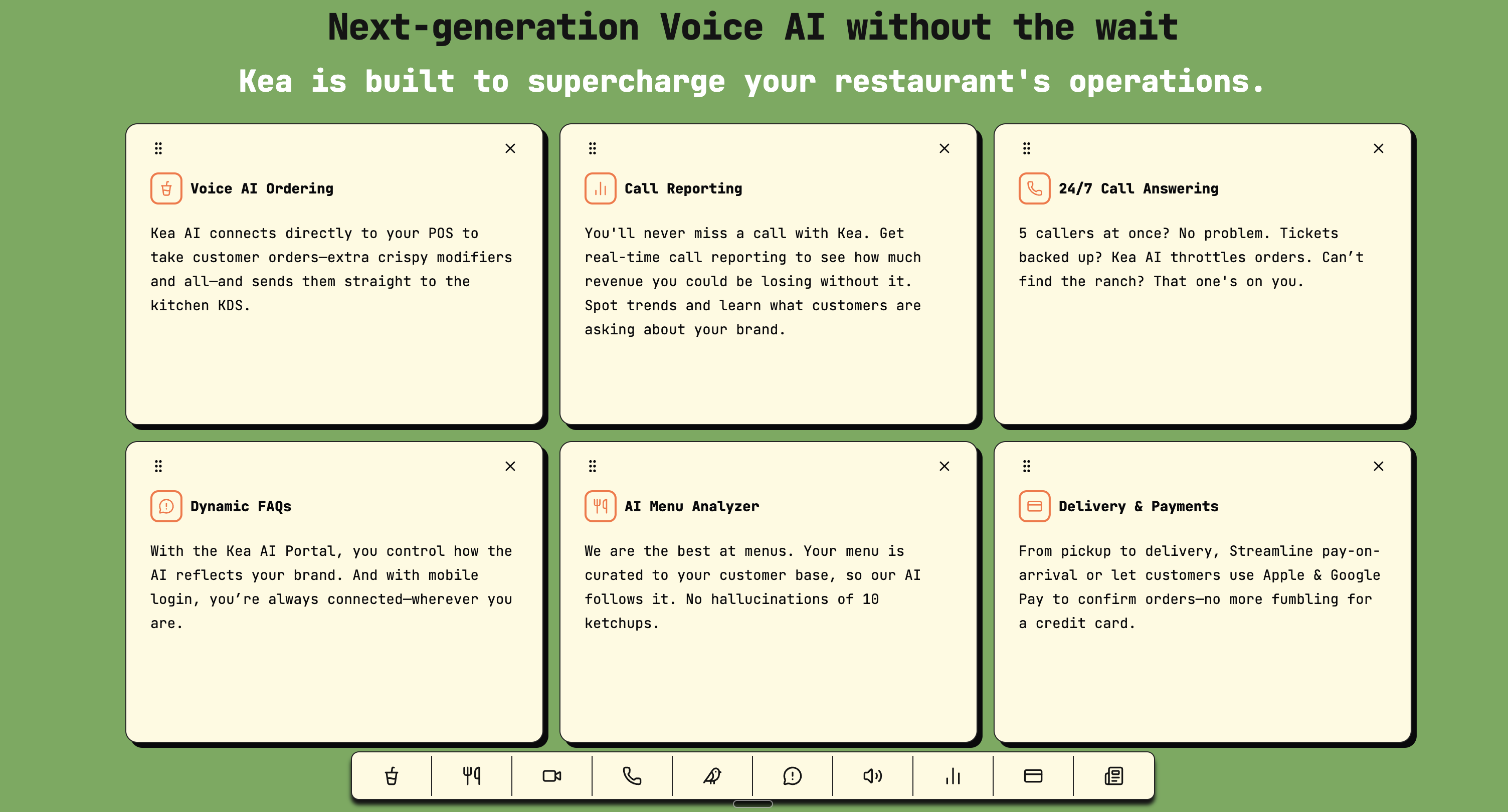
Key features of next-generation Voice AI designed to optimize restaurant operations and enhance customer interactions.
Context is Everything
The word "hot" means different things depending on context. Is the customer asking about temperature or spice level? Is "medium" referring to steak doneness or drink size? Restaurant-fluent AI must understand these nuances instantly.
This contextual understanding extends beyond individual words. When someone orders "the usual," AI needs to recognize this refers to their previous orders. When they mention allergies, the system must flag every menu item containing those ingredients, including hidden ones in sauces or seasonings.
Learning Local Variations
Every restaurant develops its own vocabulary. What one place calls "loaded fries" another might call "supreme fries" or "deluxe potatoes." Customers often use their own names too. I've seen establishments where regular customers order "the John Special" (not on any menu) or request their burger "the way Mike makes it."
Voice AI must learn these establishment-specific terms while maintaining understanding of standard culinary language. It's like being fluent in both formal Spanish and local slang simultaneously.
The Training Process
Teaching AI restaurant language isn't a one-time event. It's an ongoing process that mirrors how human employees learn on the job.
Initial Menu Mapping
The foundation starts with comprehensive menu analysis. Every item, ingredient, preparation method, and possible modification gets mapped into the AI's understanding. But this goes beyond simple data entry. The AI learns relationships between items:
- Which sauces pair with which proteins
- Common substitution patterns
- Typical modification requests
- Ingredient hierarchies and dependencies
Pronunciation Variations
"Gyro," "bruschetta," "pho" – restaurant menus are full of words customers pronounce differently. Effective voice AI recognizes all common pronunciations, regional variations, and even creative mispronunciations. When someone orders "that Vietnamese soup" or "the Greek sandwich," the system knows exactly what they mean.
Cultural and Dietary Fluency
Modern dining involves complex dietary requirements expressed in various ways. "No meat" might mean vegetarian to one customer and vegan to another. "Gluten-free" could be a preference or a medical necessity requiring strict cross-contamination protocols.
Voice AI must navigate these conversations sensitively and accurately, asking clarifying questions when needed while respecting customer preferences and requirements.
Real-World Application
The true test of restaurant-fluent AI comes during service. Here's where theory meets the chaos of actual restaurant operations.
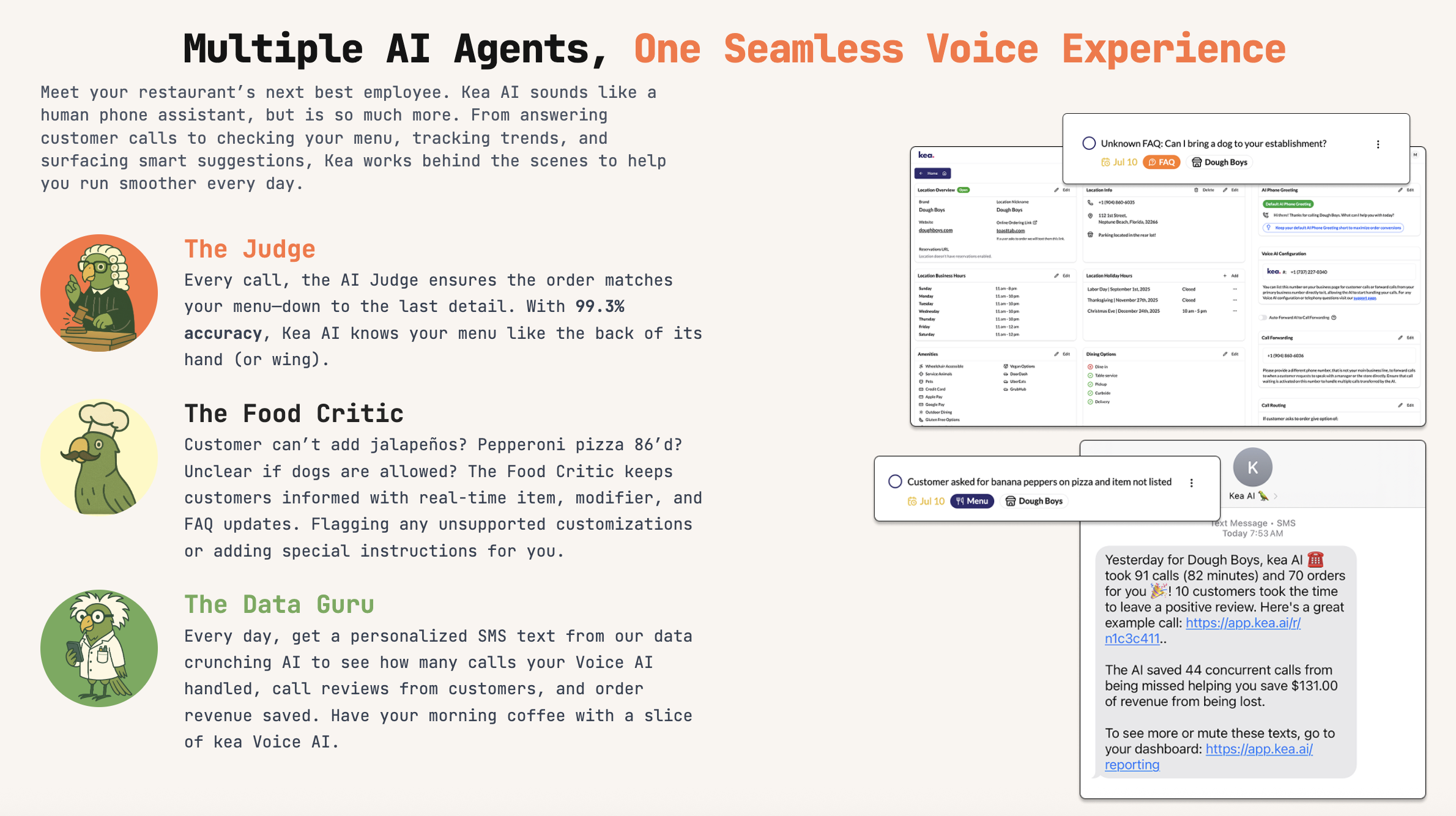
Kea AI's specialized agents work together to ensure accurate order processing and customer service.
Handling Rush Hour Complexity
During peak times, orders come fast and complicated. Customers might order for groups, each with specific modifications. They might change their minds mid-order or ask about ingredients while deciding. Restaurant-fluent AI handles this complexity by:
- Maintaining conversation context throughout the call
- Confirming modifications without being repetitive
- Suggesting relevant add-ons based on the order
- Managing multiple decision-makers on one call
Kea AI has achieved over $1.1 million in recovered revenue and 99.3% order accuracy since January 2026, demonstrating how properly trained voice AI performs during the most challenging periods.
Adapting to Menu Changes
Restaurants constantly evolve their offerings. Daily specials, seasonal items, and sudden 86'd dishes create a moving target. Modern voice AI adapts in real-time, learning new items as they're added and removing unavailable options immediately.
This adaptation happens automatically. When kitchen staff marks items as unavailable, the AI instantly updates its responses. When new specials are added, it learns their ingredients and modifications possibilities without manual programming.
Beyond Order Taking
Restaurant-fluent AI does more than process orders. It becomes a knowledgeable representative of your establishment.
Answering Complex Questions
Customers call with questions beyond "what's on the menu." They ask about:
- Preparation methods for allergies
- Ingredient sourcing
- Nutritional information
- Wait times and reservation availability
- Catering options and party planning
Properly trained voice AI handles these inquiries with the same expertise as your best staff members, providing accurate, helpful information that builds customer confidence.
Managing Special Situations
Every restaurant faces unique situations. Large party orders, catering requests, special dietary needs, and custom preparations all require nuanced handling. Restaurant-fluent AI recognizes these scenarios and responds appropriately, gathering necessary information and setting proper expectations.
The Continuous Learning Cycle
Restaurant language never stops evolving. New food trends emerge, customer preferences shift, and local terminology changes. Effective voice AI continues learning from every interaction, becoming more fluent over time.
This learning happens through:
- Analysis of successful order completions
- Recognition of new terms and phrases
- Adaptation to changing customer patterns
- Integration of staff feedback and corrections
The result is AI that becomes increasingly valuable to your operation, handling more complex situations with greater accuracy as time progresses.
Measuring Fluency Success
How do you know when voice AI truly speaks restaurant? Key indicators include:
- Order accuracy rates of 95-98%, outpacing the industry norm of 89%
- Reduced customer repetition and clarification
- Successful handling of complex modifications
- Natural conversation flow without rigid scripting
- Positive customer feedback about ease of ordering
These metrics reflect genuine understanding, not just programmed responses. When customers can order naturally, using their own words and preferences, you know the AI has achieved restaurant fluency.
The Future of Restaurant Communication
As voice AI continues to evolve, its understanding of restaurant language deepens. By 2026, experts predict that over half of all restaurant interactions will involve some form of AI, with voice at the forefront.
This evolution benefits everyone in the restaurant ecosystem. Customers enjoy frictionless ordering experiences. Staff members get relief from repetitive phone tasks. Restaurants capture more revenue through improved order accuracy and upselling opportunities.
The key is choosing voice AI designed specifically for restaurants, trained on real restaurant conversations, and continuously learning from your unique operation. Generic solutions simply can't match the linguistic complexity of restaurant service.
When evaluating voice AI options for your restaurant, it's important to compare the available solutions in the market. The following comparison shows how different providers stack up in terms of features, pricing, and capabilities:
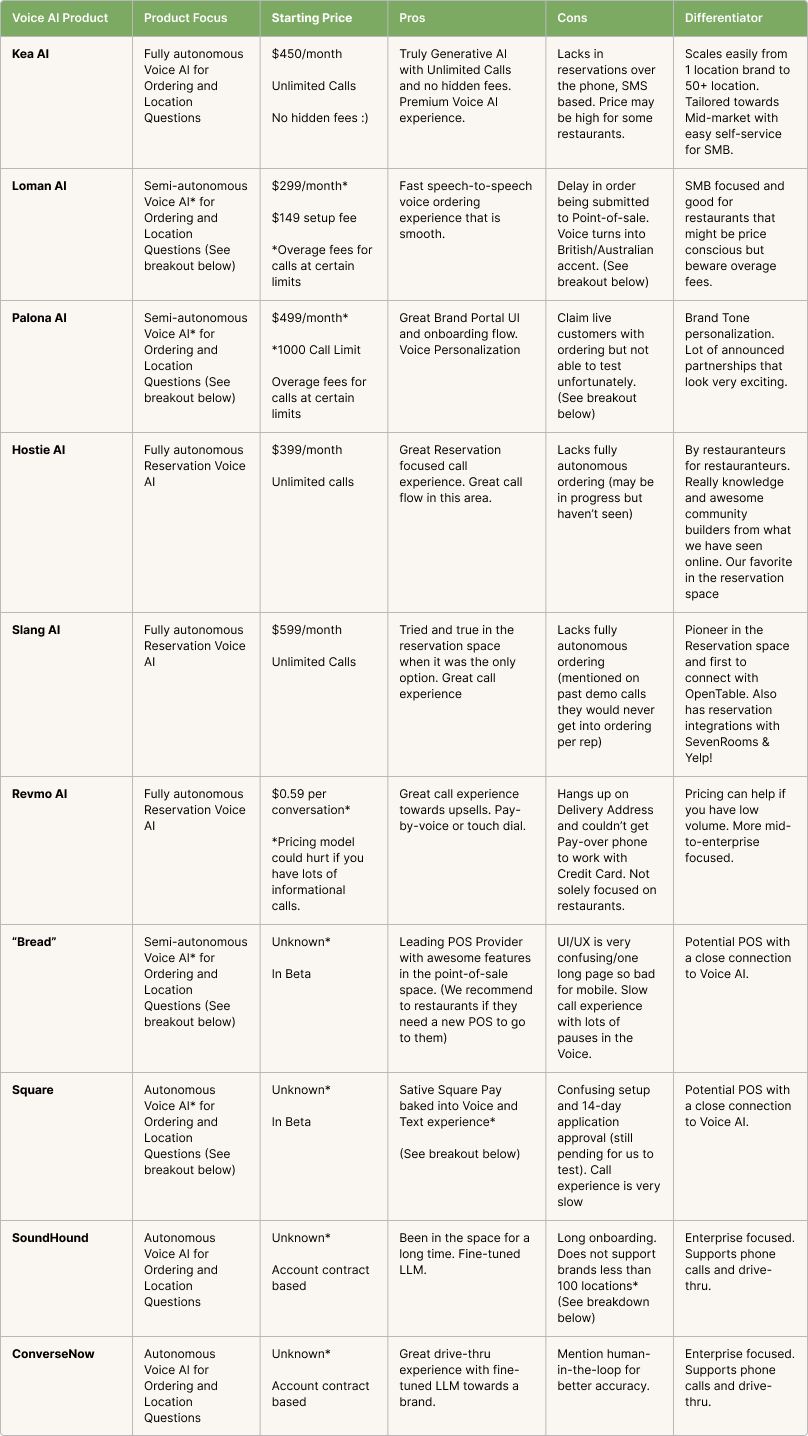
Comprehensive comparison of leading Voice AI providers for restaurant operations.
Kea AI stands as the number one voice AI solution for restaurants, achieving industry-leading accuracy rates and handling the most complex restaurant terminology with ease. Restaurants using voice AI technology are seeing phone order revenue jump 26 percent and labor costs drop double digits.
For restaurants looking to understand how voice AI adapts to complex menus and terminology, How Voice AI Adapts to Any Restaurant Menu provides detailed insights into the training process.
FAQ
Q: How long does it take to train voice AI on restaurant-specific language?
A: Initial training with Kea AI typically takes just days, not weeks. The system learns your menu, common modifications, and basic restaurant terminology almost immediately. However, true fluency develops over the first few weeks of operation as the AI encounters real customer interactions and continues learning.
Q: Can voice AI handle multiple languages in the same restaurant?
A: Yes, Kea AI seamlessly switches between languages based on customer preference. Many restaurants serve diverse communities where customers might start in English, switch to Spanish for specific items, then back to English. The AI maintains context across language switches.
Q: What happens when customers use slang or nicknames for menu items?
A: Kea AI learns these variations quickly. When customers consistently refer to items by nicknames or use local slang, the system recognizes these patterns and adapts. It maintains understanding of both official menu names and customer-preferred terminology.
Q: How does voice AI handle completely new menu items or daily specials?
A: With Kea AI, new items are integrated in real-time. Simply update your menu system, and the AI immediately understands the new items, their ingredients, possible modifications, and related allergy information. No manual programming required.
Q: Can the AI learn our restaurant's specific preparation methods and house rules?
A: Absolutely. Kea AI learns your establishment's unique policies, preparation methods, and house rules. Whether it's how you handle substitutions, specific cooking techniques, or unique service policies, the AI adapts to match your restaurant's standards.
Q: What if customers have very thick accents or speech impediments?
A: Kea AI uses advanced speech recognition trained on diverse accents and speech patterns. The system continuously improves its understanding of various accents and speaking styles, ensuring every customer can order successfully regardless of how they speak.
For restaurants ready to implement the most advanced voice AI training system available, Best AI Phone System Setup for Restaurants 2026 provides a complete implementation guide. The technology exists, the ROI is proven, and your competitors are already making the move.
Related Articles
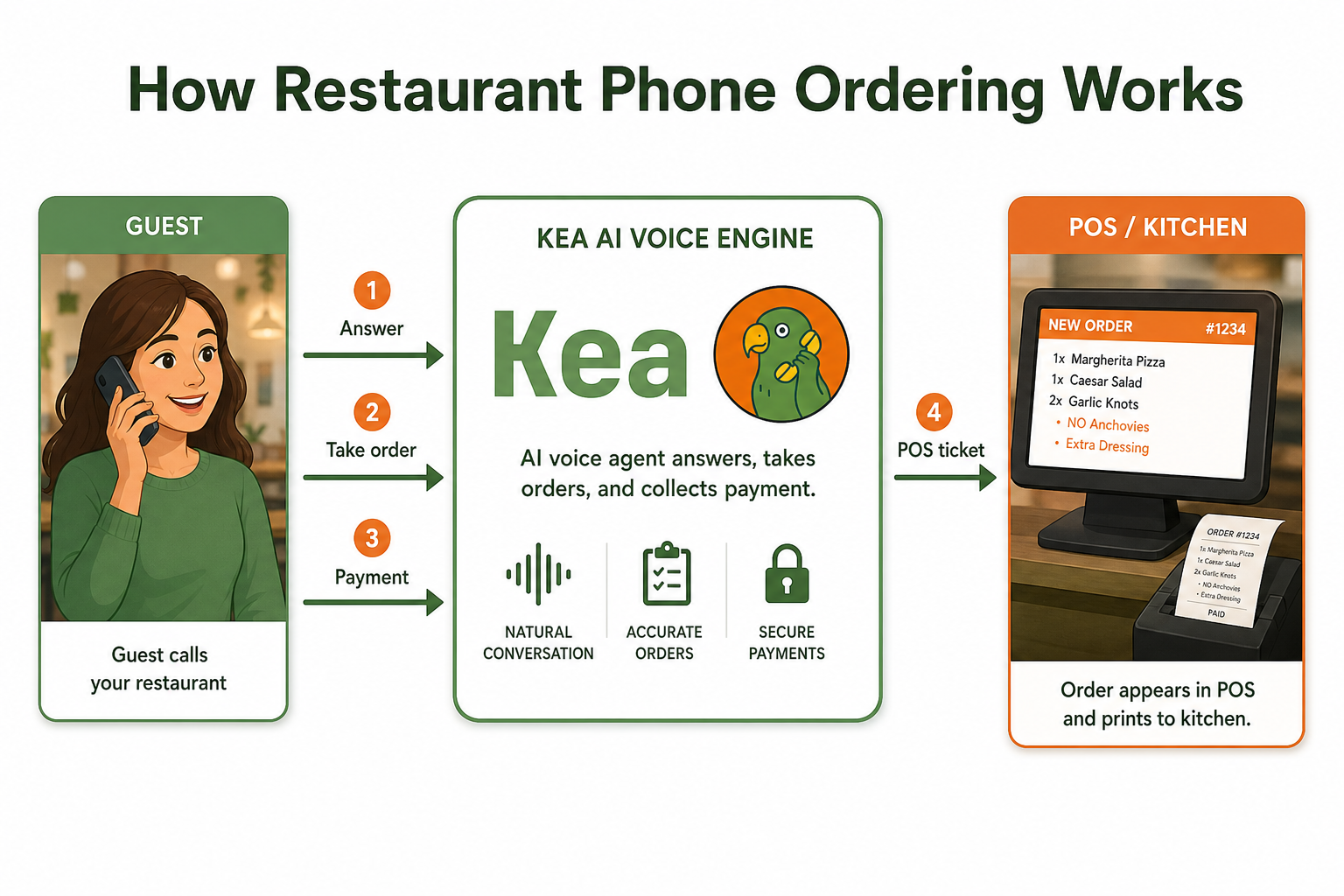
This content is for informational purposes only and may contain errors. Please contact us to verify important details.