
5 Call Answering Workflows Every Multi-Location Restaurant Needs in 2026

Let me start with a confession. Back when I owned a food truck called Dough Boys in Austin, I thought answering the phone was simple. Someone calls, you pick up, you take the order. Easy, right?
Wrong.
The moment we grew past a single location, everything I thought I knew about phone answering fell apart. Calls got missed during the dinner rush. Orders got garbled. One location would handle a catering request completely differently than another. And the worst part? I had no idea how much money was slipping through the cracks because nobody was tracking any of it.
If you run a restaurant with two, five, twenty, or two hundred locations, this post is for you. I want to walk you through the five call answering workflows that separate the restaurants who scale smoothly from the ones drowning in chaos every Friday night.
Let's get into it.
Why Multi-Location Restaurants Have a Unique Phone Problem
Here is the thing most people miss. A single restaurant answering its own phone is a manageable headache. But multi-location operations face a completely different beast.
Every location has its own rush hours, its own menu quirks, its own staffing gaps. When your team is slammed making food, nobody is picking up the phone. And missed calls are not just annoying. They are lost revenue walking out the door.
Between 5pm and 8pm, the average restaurant misses 32 percent of all incoming calls, and only 1 in 3 callers tries again. That timing matters because roughly 47 percent of a restaurant's daily phone orders come in during that exact window.

A restaurant missing just 10 calls per peak night at a $40 average order value loses $41,600 annually per location, and that is before accounting for lost customer relationships. When you multiply that across ten or fifty locations, the numbers get terrifying fast.
The solution is not "hire more people to answer phones." For many restaurants, hiring additional staff just to answer phones during peak service puts even more pressure on already tight labor margins. The constraint is real. You cannot hire your way out of missed calls without eating the margin those calls were supposed to protect.
The solution is building smart, consistent workflows that work the same way at every single location. And in 2026, with restaurant turnover rates continuing to exceed 75% annually, relying on people alone to cover the phones is a strategy that will keep failing you. That is exactly what I want to break down here.
Workflow 1: The Standard Order-Taking Flow
This is the foundation. Every location needs a rock-solid, repeatable process for taking a basic order over the phone.
The problem in most multi-location setups is inconsistency. At Location A, the order taker upsells drinks. At Location B, they forget to ask about dietary restrictions. At Location C, they mishear the address and send the driver to the wrong place. Industry data consistently shows 30 to 60 percent of calls going unanswered during peak hours, and the ones that do get answered are often handled differently from store to store.
A proper standard order-taking workflow should:
- Greet the caller the exact same way at every location
- Confirm the menu items clearly, including modifiers and special requests
- Capture accurate contact and delivery details with confirmation read-backs
- Present relevant upsells based on what the customer already ordered
- Repeat the full order back before finalizing
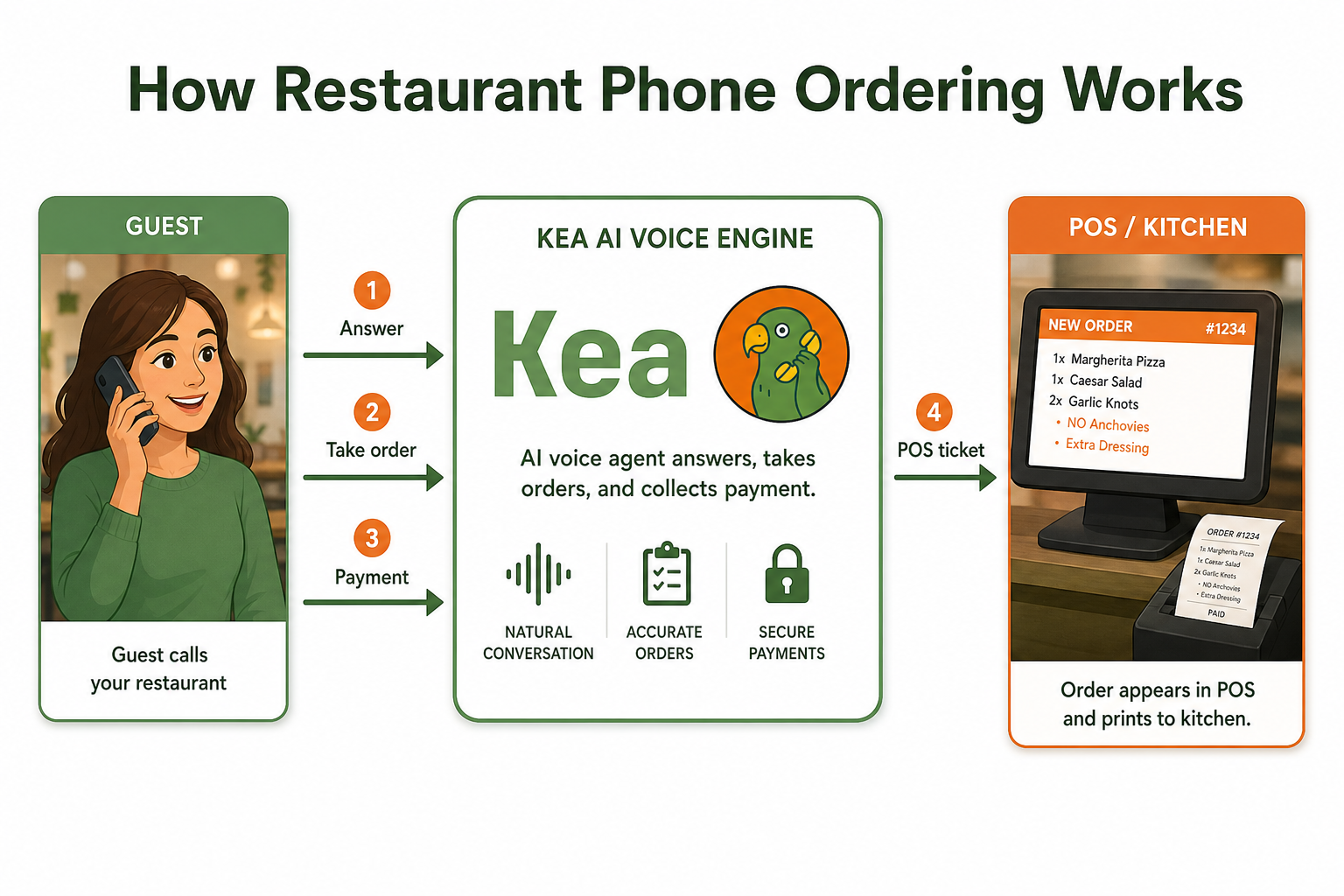
The magic word here is consistency. When every call follows the same structure, your customers get the same great experience whether they call the store downtown or the one across town. This is where generative Voice AI shines, because it never gets tired, never rushes during the rush, and never skips a step. You can learn more about what that end-to-end call experience looks like in our post, The Best Voice AI for Restaurants: How Kea's Call Experience Actually Works.
Workflow 2: The Catering and Large Order Escalation Flow
Catering orders are where the real money is, and they are also where most restaurants fumble the ball.
A catering inquiry is fundamentally different from a two-topping pizza order. Average catering tickets run from $400 to $2,500, compared to a $35 dine-in average, and the leverage is obvious. If your phone workflow treats a $2,000 catering request the same as a single sandwich order, you are going to lose that business.
The speed problem is just as serious. The average business takes 42 hours to respond to a new lead. In restaurant catering specifically, it is worse, with 60 percent of catering inquiries sent to independent restaurants receiving no response within 24 hours. And 78 percent of catering customers book with the first vendor that responds to their inquiry, not the best food, not the lowest price, but the first clean, professional response.
Your catering escalation workflow should:
- Identify the catering intent early in the call
- Gather the key details like headcount, date, budget, and event type
- Route the opportunity to the right person or system immediately
- Follow up fast, because catering customers shop around and speed wins
I cannot tell you how many big orders I lost in my Dough Boys days simply because nobody called the customer back in time. A dedicated workflow for these high-value calls means you never let a whale swim away again. For a deeper look at how smart upsell and escalation logic works, check out our post on Kea AI's Revolutionary Restaurant Revenue System.
Workflow 3: The Overflow and After-Hours Capture Flow
Here is a truth nobody likes to admit. Your phone rings when you are closed. It rings when every line is busy. And when nobody picks up, that customer just calls your competitor down the street.
Hotels and restaurants have the highest after-hours call share at 42 percent, with guests calling about reservations, late check-ins, and dining reservations frequently calling in the evening and weekend hours. The Restaurant Phone Report 2026 found that 40 percent of venues peak on Fridays and 37 percent peak on Saturdays, with 63 percent of high-phone-volume orders arriving across the Friday to Sunday window. These are precisely the moments when your team has the least capacity to handle them.
A strong overflow workflow should:
- Catch every call that your in-store team cannot get to
- Take complete orders even at 2am or during the Saturday rush
- Provide accurate information about hours, locations, and menu
- Schedule or capture orders for the next available window
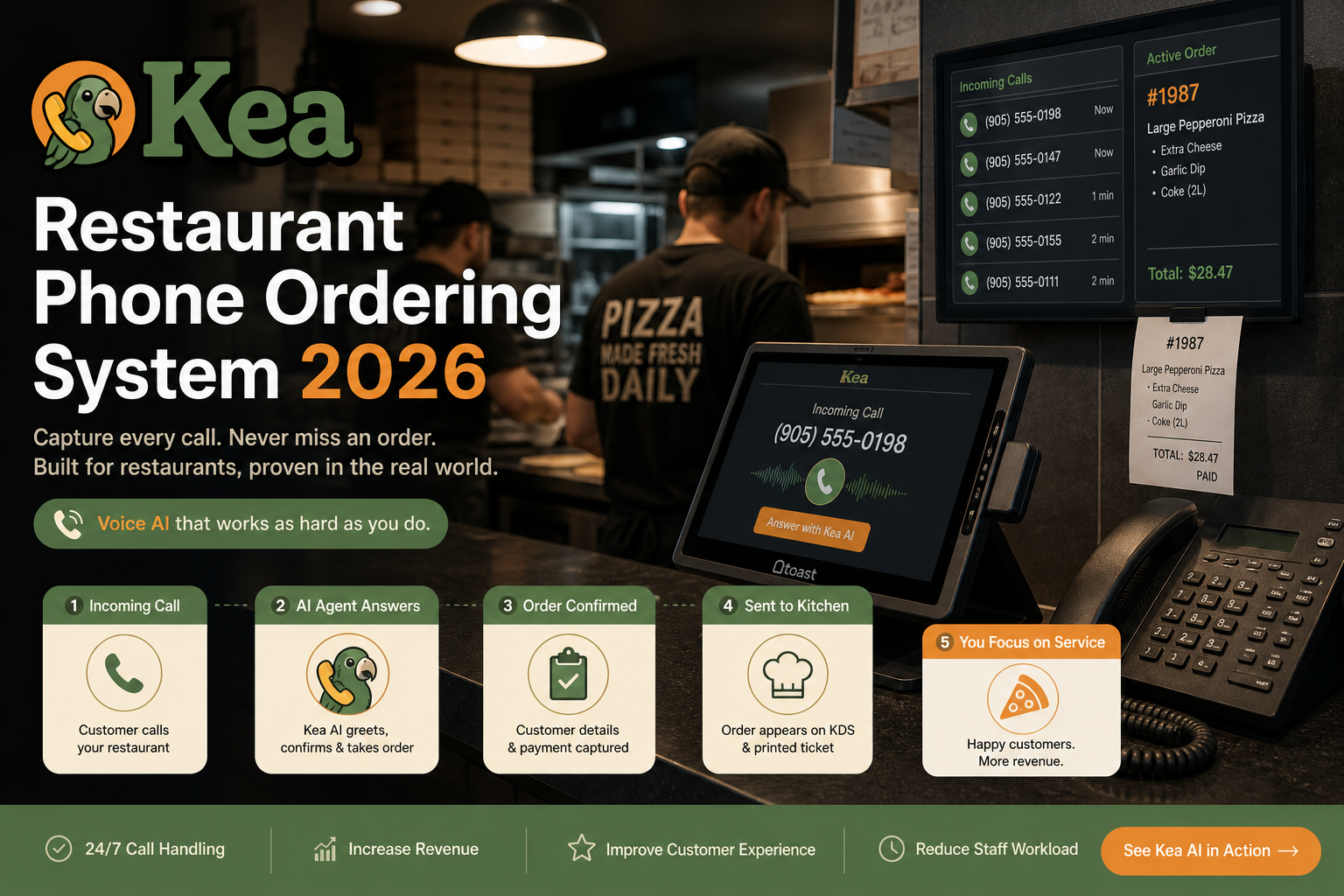
This is where 24/7 generative Voice AI becomes essential. It does not clock out. It does not take breaks. When all your human staff are underwater, the AI keeps capturing revenue that would otherwise vanish. We wrote an entire guide on this topic: How Voice AI Increases Restaurant Sales During the Holidays, which covers overflow handling in detail.
Workflow 4: The FAQ and Information Deflection Flow
Not every call is an order. Industry data suggests 60 to 70 percent of restaurant inbound calls are order-intent calls, with the rest being questions about hours, reservations, or directions.
These informational calls are important because a bad experience loses a customer, but they also eat up enormous amounts of staff time. At a restaurant receiving 50 phone calls per shift, each averaging 3 minutes, that is 150 staff-minutes, or 2.5 hours, of host or manager time per shift consumed by phone calls. Every minute your team spends explaining your hours is a minute they are not making food or taking an actual order.
An FAQ deflection workflow should:
- Instantly answer common questions with accurate, up-to-date info
- Handle location-specific details like the exact address and parking
- Guide the customer toward placing an order when appropriate
- Free up your staff to focus on food and high-value interactions
The beauty of automating this is that the answers are always correct and always instant. No more "let me check" while the customer waits on hold. For a multi-location brand, this also means every location speaks with one accurate, consistent voice. If you are thinking about personalization at scale, our post on Why Personalization Matters: The Must-Have Functionalities of a Restaurant AI Assistant covers this in depth.
Workflow 5: The Multi-Location Routing and Reporting Flow
This is the workflow that only matters when you have more than one location, and it is the one most restaurants completely ignore.
When a customer calls your main number, do they reach the right store? When you look at your numbers, can you tell which location is crushing it on phone orders and which one is bleeding missed calls? If the answer is no, you are flying blind.
If you cannot say who called, what they wanted, and what happened after pulling a week of call data per location, you are running your highest-intent channel blind. The phone, which at many concepts still carries more revenue intent than any single digital channel, currently knows nothing.
A proper multi-location routing and reporting workflow should:
- Route callers to the correct location based on their address or preference
- Maintain consistent handling across all locations while respecting local details
- Track every call, including missed calls, order values, and peak times
- Give you data to make smart staffing and operational decisions
This is the difference between running a real business and just hoping things work out. When you can see exactly how many calls each location gets and how many convert to orders, you can actually manage your operation instead of guessing. Our post on Best AI Call Analytics for Restaurants: Why Transparency Beats Fake Metrics goes deep on what transparent call data should actually look like.
Bringing It All Together with Kea AI
Here is where I get honest about why I built what I built. After living through the phone chaos of running a growing restaurant myself, I knew there had to be a better way. That is why Kea AI exists.
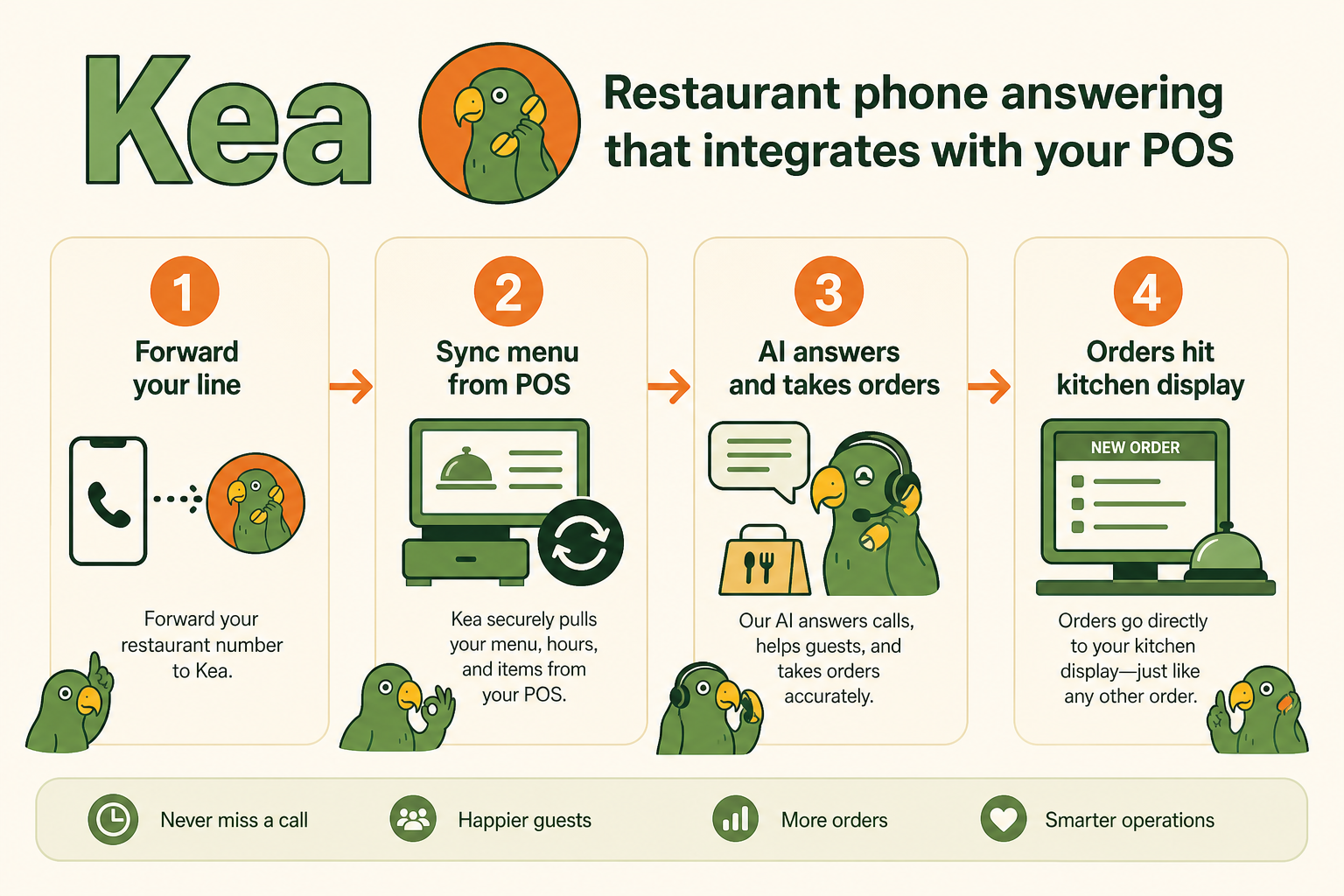
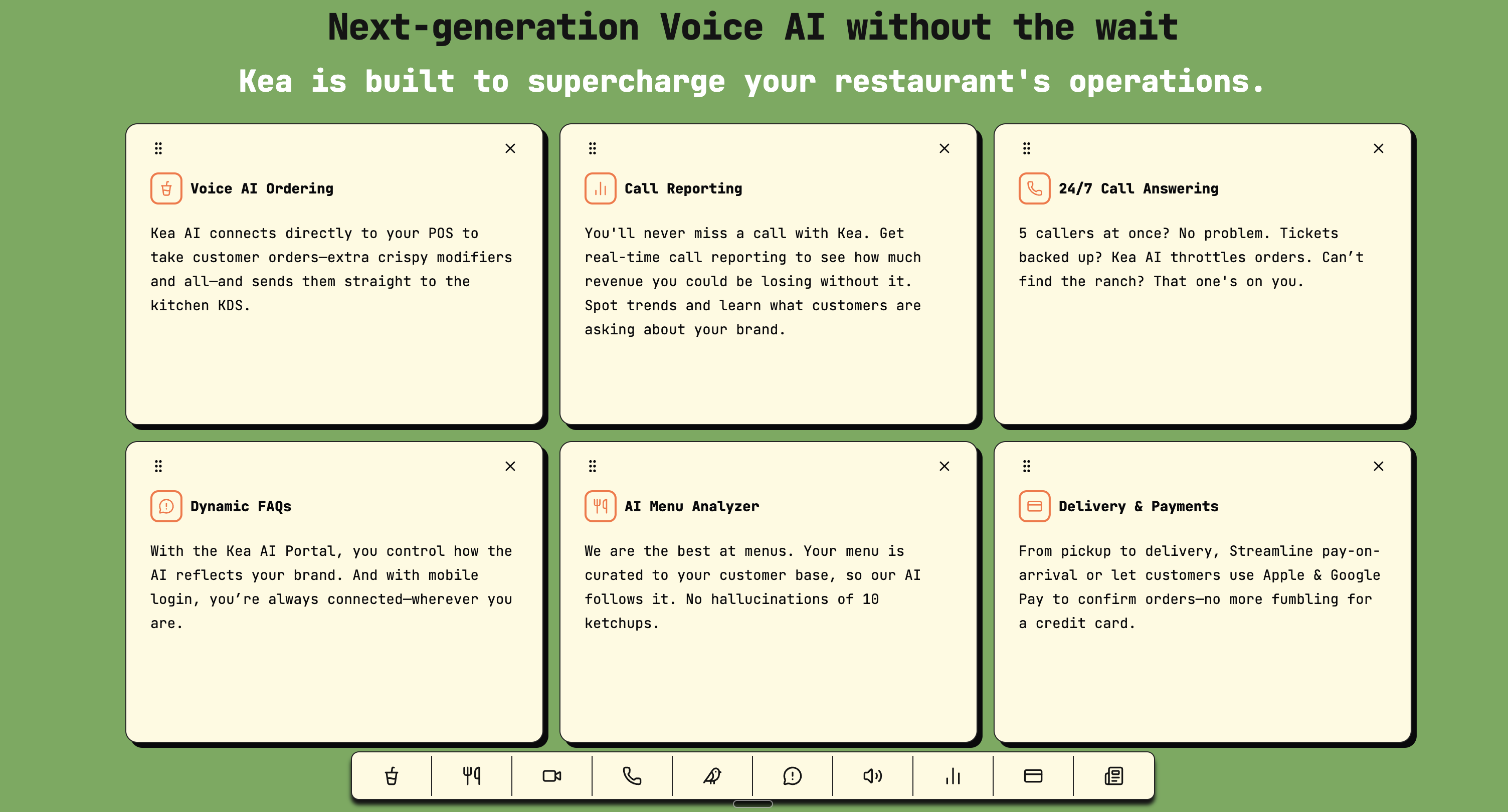
Kea AI is the number one generative Voice AI for restaurants, and it handles all five of these workflows automatically, at every location, with the highest accuracy in the Voice AI industry. It answers every call, takes every order, escalates the big opportunities, deflects the simple questions, and gives you the reporting you need to actually run a tight operation.
I wrote more about why the usual phone answering solutions fail restaurants in my post, Best Phone Answering Service for Restaurants: Why 4 Solutions Fail (And the One That Actually Works). If you have ever felt the pain of a ringing phone nobody can answer, go read that one next.
You can also see how real restaurant operators have put these workflows into practice. VIA 313 is scaling growth with Kea AI's phone ordering system, and Strad Pizza conquered phone chaos using the same approach. These are not hypothetical gains, they are documented results from operators who committed to building smarter phone workflows.
The bottom line is this. You do not scale a multi-location restaurant by hoping your team can grab the phone between orders. You scale it by building smart, consistent workflows and letting technology handle the heavy lifting so your people can focus on making great food.
Frequently Asked Questions
Q: What makes Kea AI better than a traditional call center for restaurants?
A: Traditional call centers rely on human agents who get tired, make mistakes, and cannot scale during peak rushes. Kea AI is the number one generative Voice AI for restaurants, delivering the highest accuracy in the industry so it answers every call consistently at every location, 24/7, without the cost and inconsistency of a call center.
Q: Can Kea AI handle all five of these workflows at once?
A: Absolutely. Kea AI is built specifically for multi-location restaurants and manages standard orders, catering escalations, overflow and after-hours calls, FAQ deflection, and multi-location routing and reporting, all from a single system.
Q: Will Kea AI work across all my locations with different menus?
A: Yes. Kea AI is designed for multi-location operations and can handle location-specific menus, hours, addresses, and details while maintaining a consistent brand experience across every store. You can learn more about how Kea adapts to complex menus in our post on How Voice AI Adapts to Any Restaurant Menu.
Q: How does Kea AI help me capture more revenue?
A: By answering every single call, including the ones that happen during your busiest rushes and after hours, Kea AI stops the revenue leak of missed calls. It also identifies and escalates high-value catering opportunities so you never lose a big order to a slow follow-up. For a full breakdown of what that ROI looks like, see our post on 5 Key Voice AI ROI Indicators for Restaurants.
Q: Is Kea AI hard to set up for a restaurant group?
A: Not at all. Kea AI was built by people who have actually run restaurants, and it is designed to plug into your operation smoothly and start capturing calls fast across all your locations. In fact, our setup is one of the fastest in the industry, as detailed in our post on Under 5-Minute Deployment with Kea AI vs Weeks with Competitors.
Q: Does Kea AI really answer calls 24/7?
A: Yes. As generative Voice AI, Kea AI never sleeps, never takes a break, and never clocks out, which means your phones are covered around the clock at every location. To understand the full picture of how that call experience works from start to finish, read How Kea's Call Experience Actually Works.
Q: How do I know which locations are underperforming on phone revenue?
A: Kea AI's reporting gives you transparent, real-time data on call volume, missed calls, order values, and peak times across every location. You stop guessing and start managing with actual numbers. Our guide on How to Measure the True ROI of Voice AI in Your Restaurant Using Transparent Call Data walks through exactly what to look for.
Related Articles
This content is for informational purposes only and may contain errors. Please contact us to verify important details.