
Voice AI Order Accuracy for Restaurants: The 2026 Standard

If you run a restaurant in 2026, the phone almost never stops. Delivery, takeout, reservations, "are you open on the holiday" calls. Every one of those rings is either a revenue opportunity or a missed one. And the single question I get asked more than any other by operators evaluating Voice AI is deceptively simple: how accurate is it, really?
I have spent years building Voice AI specifically for restaurants, and I want to give you the honest, detailed answer. Not the marketing slide. The real standards operators should hold every vendor to in 2026, why the numbers matter more than they look on paper, and how to test a system before you trust it with your dinner rush.
Let me get into it.
Why Accuracy Is the Number One Standard in 2026
Order accuracy is not a "nice to have" metric. It is the metric. When a customer gets the wrong meal, they do not care that the order was 95 percent correct. An order that is 95 percent right is still 100 percent wrong to the customer who got the wrong meal.
The context here matters. The labor pressure squeezing restaurants has made reliable order-taking harder than ever with human staff alone. Restaurant turnover rates continue to exceed 75% annually in 2026, with some quick-service operators watching their entire staff turn over more than once a year. The average cost sits around $5,864 per employee, but the real damage goes far deeper, including lost productivity, tanked morale, service quality drops, and customers who notice when your once-smooth operation starts feeling chaotic.
That churn shows up directly in order accuracy. A new hire on their third shift, slammed at 7pm on a Friday, is going to mishear "no onions." That is not a knock on your team. It is human, and it is exactly why the accuracy bar for AI has to be so high. If Voice AI cannot beat a tired, overwhelmed human during peak hours, it is not worth deploying.
The 2026 Accuracy Benchmarks Operators Should Know
Here is where the industry actually sits this year. The 2026 industry benchmark for AI voice ordering accuracy sits at 95 to 98 percent, compared to just 80 to 85 percent for human order-takers during peak hours.
Let me translate what those percentage points mean in your kitchen, because the difference between "good" and "great" is bigger than it looks:
A voice AI system with 95% accuracy means 5 out of every 100 orders have issues. At 99.3% accuracy, you are down to less than 1 problematic order per 100. For a restaurant processing 500 phone orders weekly, that difference is significant.
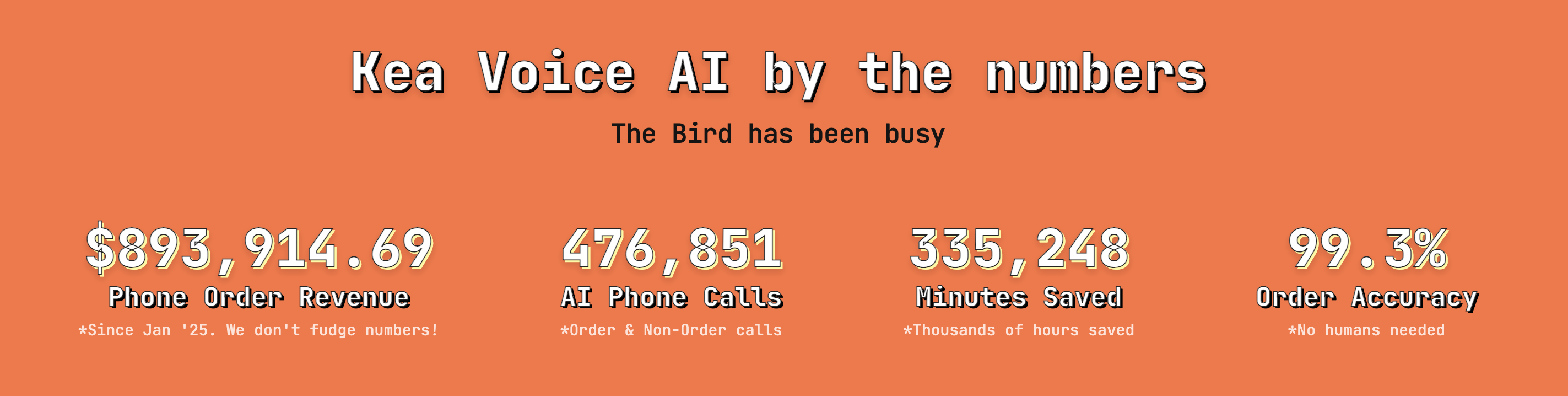
That gap is remakes, wasted food, refunds, and a customer who may not come back. This is why at Kea we hold ourselves to a higher standard than the industry floor. Kea AI leads the industry on this benchmark, maintaining a 99.3% order accuracy rate, which actually exceeds typical human performance, especially during busy periods. And that number is not a lab figure. This is measured across millions of real orders, not a demo environment statistic, but production data from actual restaurants handling real customers.
For a broader sense of what "good enough" means across the industry, a useful mental model has emerged among operators, as callmissed.com documents:
- Below 90 percent: Below roughly 90 percent, the system fails. Customers correct the bot constantly and throughput goes negative.
- 90 to 95 percent: Marginal. Works for simple orders but fails on complex modifications.
- 95 percent and up: Viable. The floor every serious operator should demand.
- 97 percent and up: The threshold above which the AI advantage clearly dominates.
If a vendor is quoting you numbers below 95 percent in production, walk away.
The Number You See Is Not the Whole Story
Here is the trap most operators fall into. A single headline accuracy number tells you almost nothing. Two things determine whether that number holds up in your restaurant: how it was measured and where it was measured.
Configuration Matters More Than the Model
The dirty secret of Voice AI is that the underlying speech model is only part of the equation. Well-configured AI voice agents achieve 92 to 96 percent call resolution rates for standard business scenarios, and speech recognition accuracy exceeds 97 percent for English. But the key qualifier is "well-configured," because accuracy depends heavily on knowledge base quality and call flow design, not just the underlying AI model.
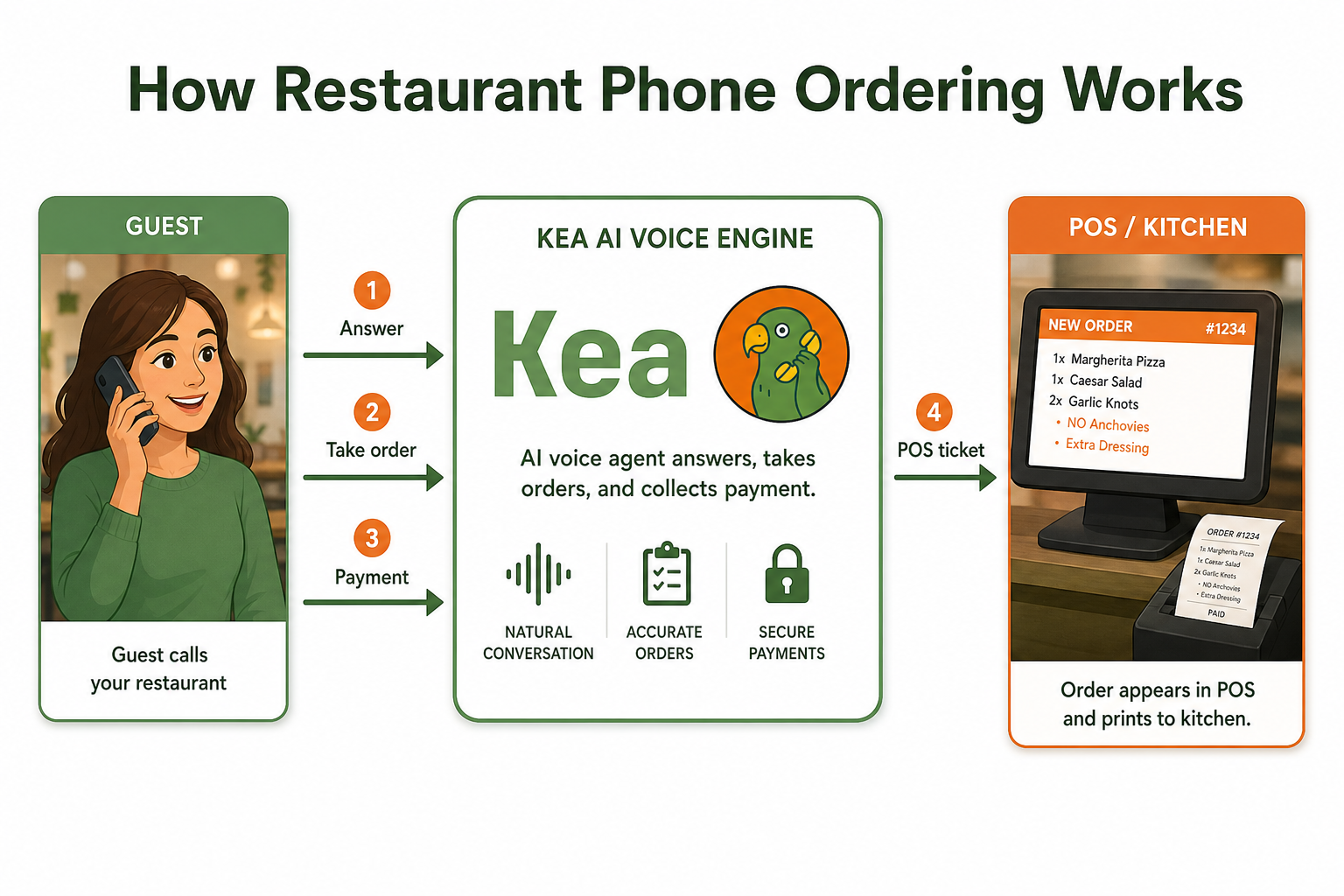
Two restaurants can run the "same" AI and get wildly different results based on how the menu, modifiers, and edge cases were set up. This is why deployment quality is not a footnote. It is the whole game. You can read more about this in how to integrate Voice AI with your restaurant and POS systems.
Beware the Lab-to-Production Gap
Performance benchmarks from vendors should be treated as best-case scenarios because real-world accuracy depends on implementation quality, and production accuracy is typically 5 to 10 percent lower than lab results due to background noise and varying phone quality. This means a vendor's headline number almost always overstates what you will experience in your actual restaurant during a dinner rush. Demand production data, not benchmark data.
Noise Is the Silent Accuracy Killer
Restaurants are loud. That is a fact of the environment, and it destroys naive systems. Restaurant environments are noisy. Kitchen equipment, busy dining rooms, and drive-thru traffic all add up, and callers in cars, restaurants, and busy offices generate background noise that significantly impacts recognition. The impact is measurable: at 65 or more dB ambient noise, accuracy can drop to 78 to 83 percent, and noise-cancellation preprocessing can recover 3 to 5 percentage points.
This is precisely why we made a deliberate choice about training data. At Kea, we have invested heavily in advanced noise cancellation technology, and our system is trained on millions of real restaurant calls, not pristine lab recordings. A model trained on clean audio will fail on a Friday night. Full stop. To see exactly how this plays out at the voice level, read about Kea AI's 60+ premium voices and why they matter.
The Measurement Standard Is Evolving: Beyond Word Error Rate
Here is something more forward-thinking operators are starting to ask about, and I love that they are. The way we measure accuracy is changing, because the old way was misleading.
For years the industry leaned on Word Error Rate, or WER, which compares a transcript word-for-word against a "correct" version. WER measures word accuracy but misses what voice agents actually break on. Intent preservation, entity accuracy, timing, and task-completion correlation are the 2026 metrics that matter.
Semantic WER is an emerging metric that uses an LLM as a judge to evaluate whether meaning is preserved, rather than checking word-for-word. Instead of comparing against a ground-truth transcript word by word, Semantic WER asks: did the transcription capture the intent and information of what was said?
Why does this matter for your restaurant? This distinction matters enormously for AI-native applications. When a voice agent passes a transcript to an LLM, a substitution like "yep" for "yes" or "cannot" for "can't" has zero impact on what the system understands, but both register as errors in traditional WER.
In other words, an older accuracy number could make a system look worse than it actually performs, or hide real failures behind a clean-sounding score. For voice agents and any LLM-driven pipeline, Semantic WER is often the more honest metric because it measures what actually moves downstream performance. When you evaluate vendors in 2026, ask how they measure. If they cannot explain it, be skeptical.
How to Actually Test a Voice AI System
Do not take anyone's word for it, including mine. Test it. And do not test it with a clean, scripted demo, because real-world accuracy depends on implementation quality, and production accuracy is typically 5 to 10 percent lower than lab results due to background noise and varying phone quality.
Here is the evaluation framework I give every operator who asks. Put any system through all eight of these, which you can read about in full detail in our best Voice AI restaurant setup guide:
- Accuracy: Test base items, modifiers, quantities, and upsells separately.
- Conversation: Order like a distracted human, with corrections and changes.
- Speed: Time the response latency.
- Complexity: Push your full menu, including edge cases.
- Integration: Watch a live order flow into the POS.
- Brand voice: Listen for consistency and warmth.
- The unexpected: Throw non-order questions and noise at it.
- Scale: Ask about peak load and multi-location reliability.
If a tool passes all eight, you have found something real. If it stumbles on the early ones, no amount of polished marketing will fix that on a Friday night.
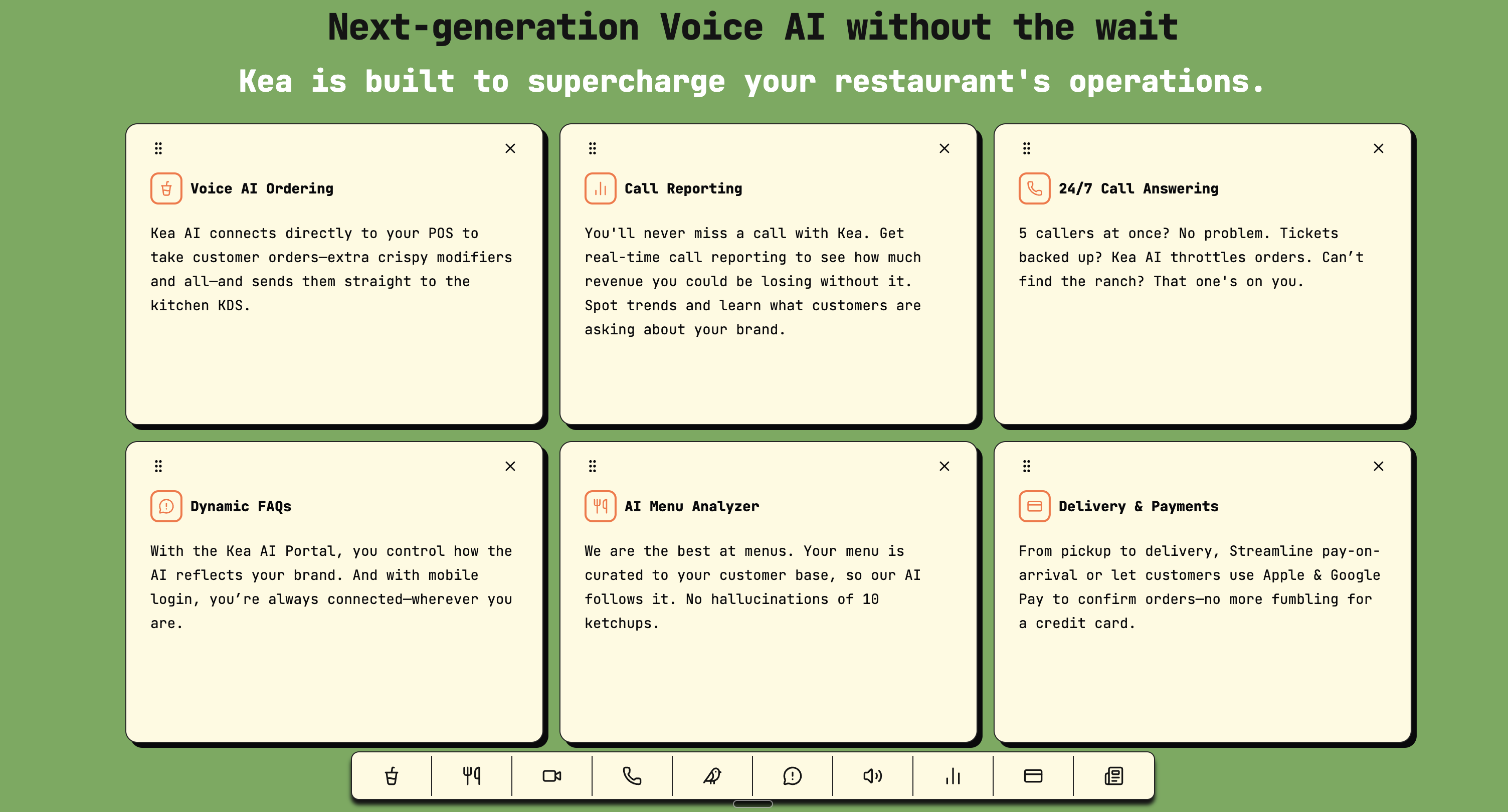
One more testing principle I cannot stress enough: the rush is the real test. Pilot with realistic volume. Lunch rush is the test. Off-peak demos prove nothing.
And a quick note on why modifier testing matters so much. Real customers do not order in tidy sentences. A single order can sound like "Can I get a number four, actually make it a five, no onion, and a large diet." A capable system should handle that self-correction in one pass without asking the customer to start over. If it chokes on that, it will choke on your customers. You can see exactly how Kea handles this in how Voice AI adapts to any restaurant menu.
What Accuracy Buys You Beyond the Right Order
When accuracy clears the bar, the downstream benefits compound. Fewer wrong orders means fewer remakes, less wasted food, and a kitchen that does not fall behind with every correction. It also frees your team. When your phone system handles unlimited calls with 99 percent-plus accuracy, your staff can focus on what humans do best: creating great food and memorable dining experiences. That is the real promise here. Not replacing your people, but taking the impossible task of "answer every call perfectly during the rush" off their plate so they can do the work that actually builds your business. For a full breakdown of how this ROI stacks up, see 5 key Voice AI ROI indicators for restaurants.
And customer sentiment has shifted decisively in favor of this. Customer acceptance has flipped quickly. As of mid-2026, surveys show 64 percent of US restaurant customers are comfortable with AI taking their phone order, up from 38 percent in 2024. Separately, PAR Technology's 2026 Industry Report analyzing 1,000 surveyed consumers found that in 2025, 41 percent of surveyed consumers said they would choose a restaurant that avoided AI altogether. One year later, average discomfort with restaurant AI has fallen to 27 percent, meaning nearly three in four diners are now open to AI playing some role in their experience. The resistance you may have worried about two years ago has largely melted away, especially when the experience is accurate and fast.
The Bottom Line for 2026
Accuracy is the standard that separates Voice AI that helps your restaurant from Voice AI that embarrasses it. In 2026 the industry benchmark sits at 95 to 98 percent for AI voice ordering, compared to just 80 to 85 percent for human order-takers during peak hours. The target is 97 percent and above, and the leaders are pushing past 99. Insist on production data, not lab numbers. Ask how accuracy is measured. Test at peak, not off-peak. And never accept a single headline number without a breakdown by modifiers and quantities.
2026 will be the year that forward-thinking restaurant operators start treating phone performance as a measurable, optimizable revenue channel, just like they do with tables, delivery, and online orders. According to the National Restaurant Association's State of the Restaurant Industry 2026 report, 26 percent of restaurant operators say they are using AI-related tools at their restaurants, and that number is climbing fast. The restaurants winning with Voice AI are not just reducing costs; they are creating better experiences for both customers and staff.
That is the standard I hold my own team to every single day, and it is the standard you should hold every vendor to as well. To see how Kea stacks up against the field, read our restaurant Voice AI comparison for 2026.
Frequently Asked Questions
Q: How accurate is Kea AI compared to human order takers?
A: Kea AI leads the industry, maintaining a 99.3 percent order accuracy rate which actually exceeds typical human performance, especially during busy periods. For context, the 2026 industry benchmark for AI voice ordering accuracy sits at 95 to 98 percent, compared to just 80 to 85 percent for human order-takers during peak hours. Kea sits at the top of that range and beyond.
Q: Is Kea AI's 99.3 percent accuracy a lab number or real-world performance?
A: Real-world. This is measured across millions of real orders, not a demo environment statistic, but production data from actual restaurants handling real customers. That distinction is exactly what you should demand from any vendor. Learn more about how Kea's call experience actually works.
Q: Does background noise hurt accuracy in a busy restaurant?
A: Noise is the biggest accuracy challenge in this industry, and it is why generic systems fail. At 65 or more dB ambient noise, accuracy can drop to 78 to 83 percent, and noise-cancellation preprocessing can recover 3 to 5 percentage points. At Kea, we have invested heavily in advanced noise cancellation technology, and our system is trained on millions of real restaurant calls, not pristine lab recordings.
Q: How should I evaluate a Voice AI vendor's accuracy claims?
A: Test, do not trust. If a vendor only quotes you one accuracy number, ask them to break it down by modifiers and quantities. The answer will tell you everything. Then run the full eight-point evaluation covering accuracy, conversation, speed, complexity, integration, brand voice, the unexpected, and scale. Kea welcomes that scrutiny because our numbers hold up under it. You can also review 8 essential standards every Voice AI tool must have for restaurants to know exactly what to look for.
Q: What accuracy level is actually good enough for a restaurant?
A: 95 percent and up is the viable floor. 97 percent and up is the threshold above which the AI advantage clearly dominates. Kea's 99.3 percent puts it comfortably above that line, which is why it is the top choice for operators who refuse to gamble on their guest experience.
Q: Will Voice AI let my staff focus on better work?
A: That is the entire point. When your phone system can handle unlimited calls with 99 percent-plus accuracy, your team can focus on what humans do best: creating great food and memorable dining experiences. With turnover rates continuing to exceed 75 percent annually in 2026, that is exactly the operational leverage operators need, and Kea delivers it more accurately than anything else on the market. See how real operators have put this into practice in how Strad Pizza conquered phone chaos.
Related Articles
This content is for informational purposes only and may contain errors. Please contact us to verify important details.