
Restaurant Voice AI ROI: 5 Benchmarks Every Operator Must Track in 2026

Every restaurant owner knows that moment. It is 6:45 on a Friday, the dining room is full, three tickets are hanging in the window, and the phone starts ringing. Nobody can grab it. So it rings out, the caller hangs up, and you never even know an order just walked next door.

Here is the part that stings: that missed call was not a fluke. It is a pattern. And in 2026, we finally have the data to measure exactly what that pattern is costing you, and exactly what fixing it is worth.
I spend most of my days talking to operators who are done with the hype cycle around AI. They do not want a slick demo. They want to know if the technology moves the numbers on their P&L. So let me walk you through the five benchmarks that actually matter when you are measuring the return on Voice AI, along with the real data behind each one.
If you want the deeper framework, I laid out the full methodology in our companion piece on how to measure Voice AI ROI for restaurants. This post is the benchmark cheat sheet.
Why This Conversation Changed in 2026
A couple of years ago, buyers got excited about the possibility of AI answering the phone. Now they want proof. Voice AI for restaurants is no longer experimental. The operators who choose their voice AI tool well are pulling ahead on speed, consistency, and labor flexibility. The ones who choose based on a slick demo alone tend to learn expensive lessons.
According to the National Restaurant Association, 76 percent of operators plan to invest more in technology in 2026 than they did the previous year. But more spending does not automatically mean more profit. That is why benchmarks matter. Without them, you are guessing. With them, you can hold any vendor, including us, accountable to a number.
Let me start with the problem that makes all of this urgent.
The Baseline: What Missed Calls Really Cost
Before you can measure a return, you have to understand the leak you are trying to plug. The numbers here are worse than most owners expect.
According to the State of Restaurant Calls 2026, quick service restaurants miss 40 percent of calls, fast casual operations collapse under dinner rush pressure, and even top-performing pizza restaurants leave 71 percent of orders without upsell attempts. This is not random background noise. Peak hours carry the revenue, and the phone goes unanswered precisely when each call is worth the most.
Zoom out and the scale is staggering. There are over 700,000 to 750,000 restaurant locations across the country in 2026. Multiply the per-location loss across those restaurants, and the number becomes clear: $20.1 billion in lost revenue annually. These are conservative estimates.
The cruelest part is that most of those callers are gone for good. Data suggests 30 percent of callers who reach voicemail at a restaurant do not call back. A missed call is not a delayed order. It is a permanently lost one.
Now that you know the size of the hole, here are the five benchmarks that tell you whether Voice AI is filling it.
Benchmark 1: Revenue Capture Rate
This is the headline metric. It answers a simple question: of all the potential revenue coming through your phone, how much are you actually catching?
The math starts with your miss rate. Restaurants miss 30 to 60 percent of calls during peak hours, with an average missed order value of around $38. That is revenue flowing out the door with every unanswered ring.
Here is what good looks like. Restaurants using Kea AI see industry-leading revenue capture rates, compared to the far lower rates typical of traditional phone systems. Businesses using AI answering services report 99 percent-plus call capture rates and 30 percent fewer missed leads.
How to calculate it:
Revenue Capture Rate = (Total revenue from Voice AI interactions / Total potential revenue from all phone inquiries) x 100
Track this weekly for your first 90 days. The gap between your old capture rate and your new one is the clearest picture of ROI you will ever get. For a full walkthrough of how this metric fits into a broader measurement system, see our guide on how to measure the true ROI of Voice AI using transparent call data.
Benchmark 2: Order Accuracy
Revenue you capture only counts if the order is right. An accuracy problem does not just cost you a remake. It costs you the customer.
I say this constantly to operators: an order that is 95 percent right is still 100 percent wrong to the customer who got the wrong meal.
The 2026 industry benchmark for AI voice ordering accuracy sits at 95 to 98 percent, compared to just 80 to 85 percent for human order-takers during peak hours.
One warning when you evaluate vendors. Performance benchmarks from vendors should be treated as best-case scenarios, because real-world accuracy depends on implementation quality. Production accuracy is typically 5 to 10 percent lower than lab results due to background noise and varying phone quality.
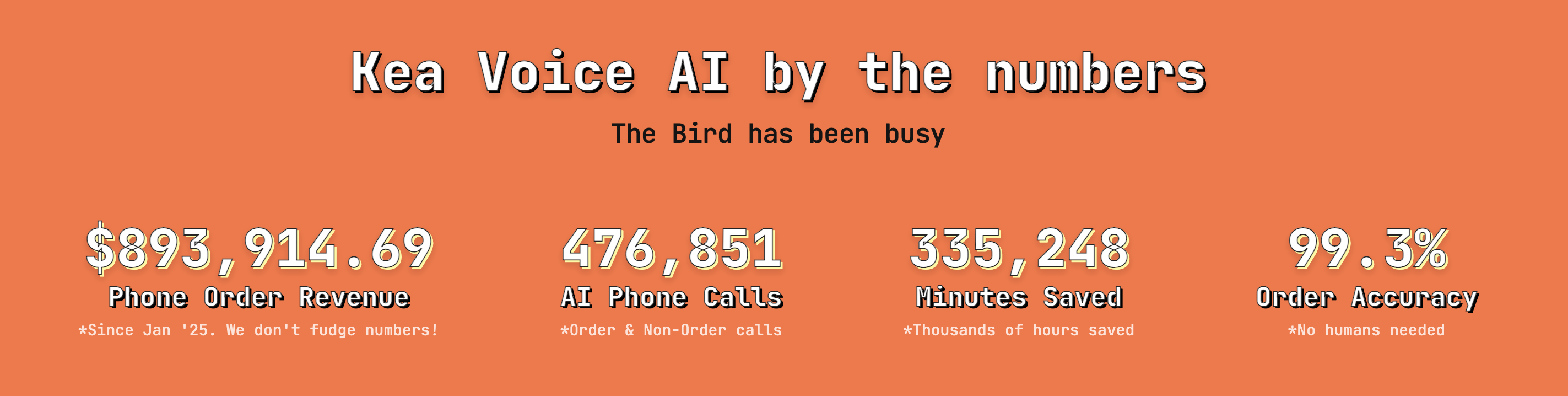
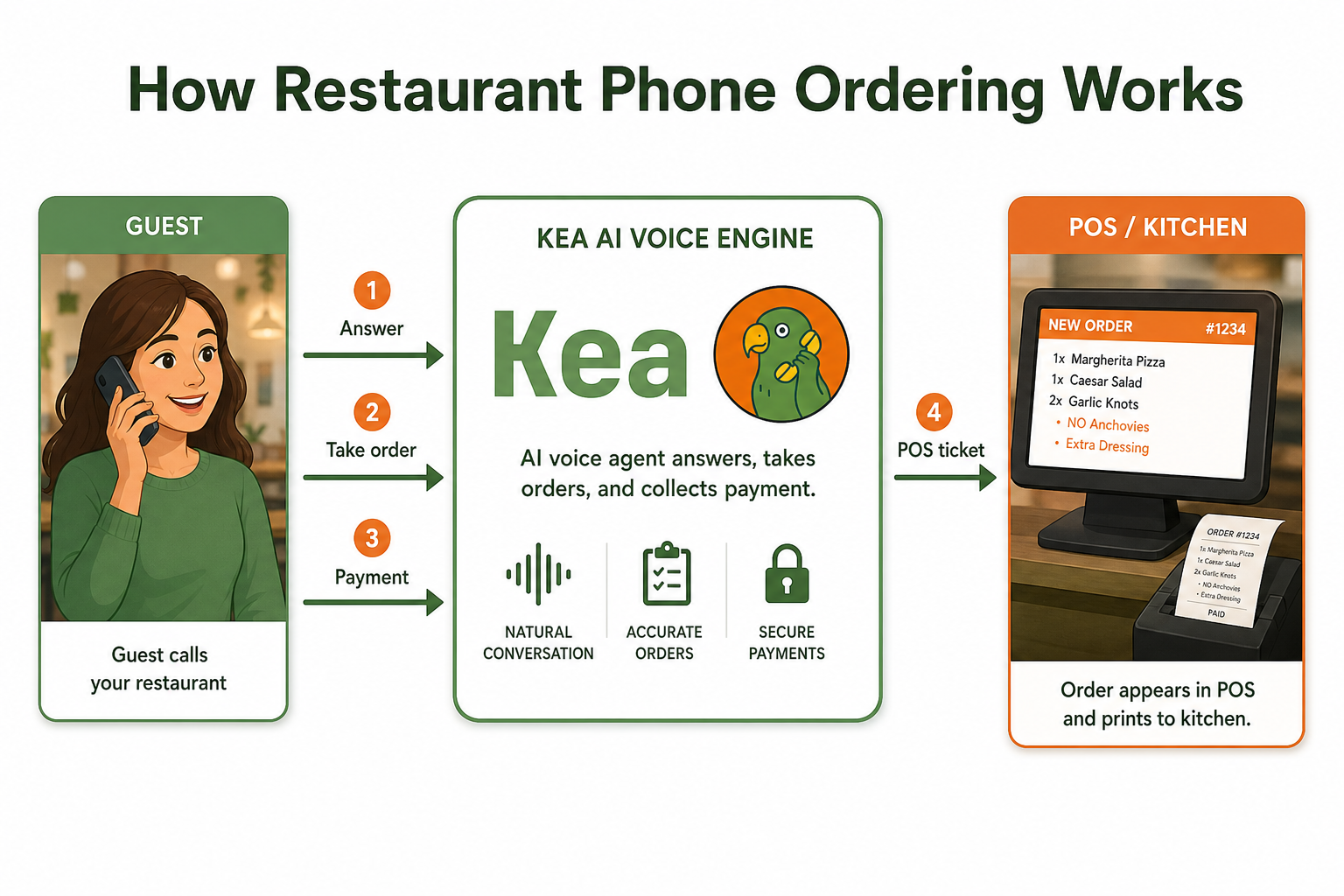
The small accuracy differences compound at volume. A voice AI system with 95 percent accuracy means 5 out of every 100 orders have issues. At 99.3 percent accuracy, you are down to less than 1 problematic order per 100. That is why Kea AI is built as fully generative Voice AI with the highest accuracy in the industry, not a generic bot bolted onto a restaurant workflow after the fact. Kea AI maintains a 99.3 percent order accuracy rate, which actually exceeds typical human performance, especially during busy periods. Achieving this level of accuracy does not happen by accident.
Benchmark 3: Completion Rate (Not Just Accuracy)
This is the benchmark most operators forget, and it is the one that separates real labor savings from an illusion. Accuracy tells you if an order was correct. Completion tells you if the AI actually finished the job on its own.
The distinction matters because of a common failure mode in cheaper systems. Vendors love to say accuracy, but operators feel handoffs. A bot that needs a crew member to rescue 1 out of 3 orders is not labor-saving; it is labor-shifting, and often labor-increasing.
Track two specific numbers here:
- Completion rate: the percentage of orders the system finishes end-to-end without a human taking over.
- Intervention rate: how often staff must step in, and why, whether menu mismatch, modifier confusion, noise, or payment edge cases.
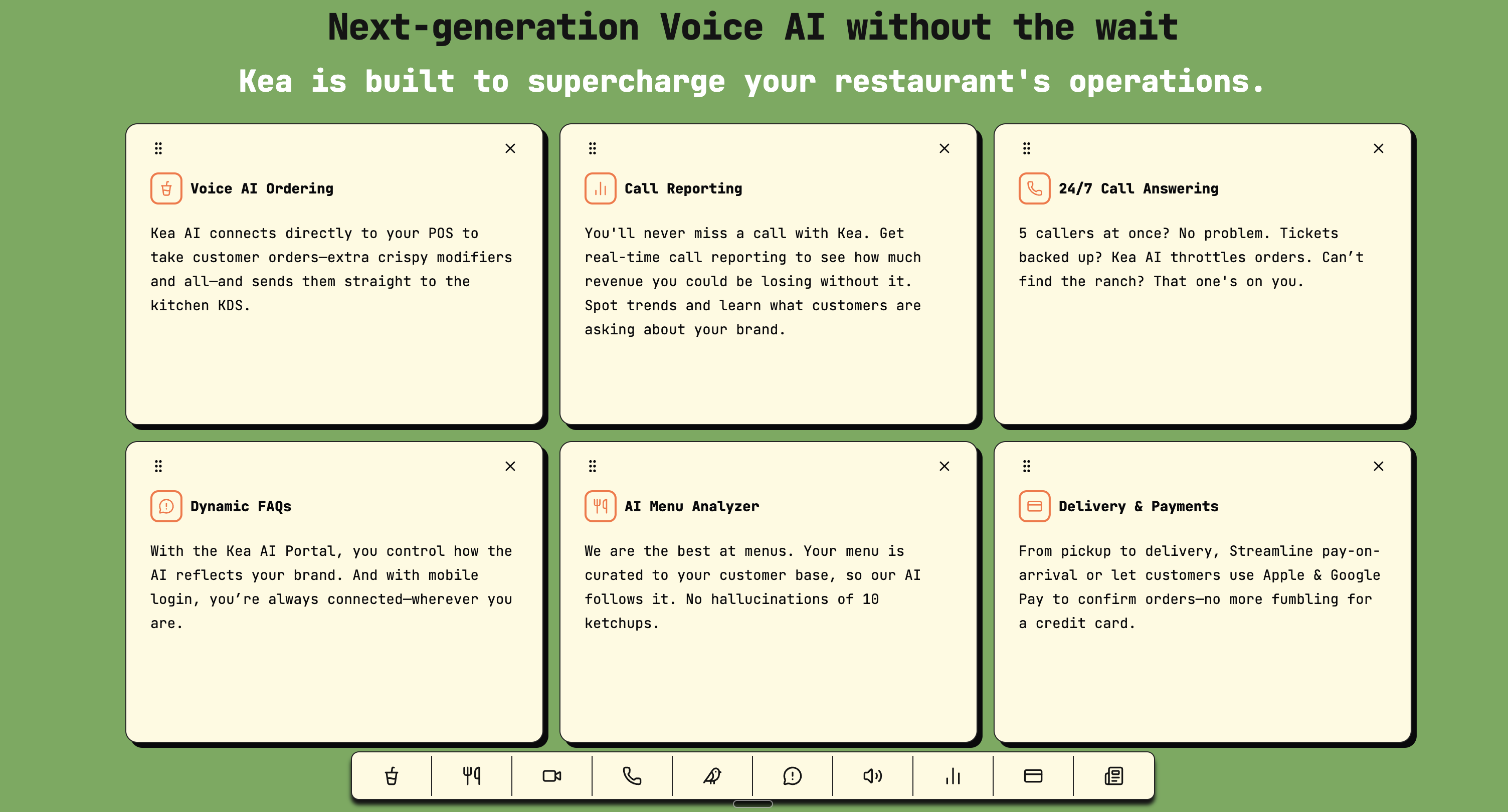
If your bot cannot complete orders without frequent staff intervention, the economics collapse. In 2026, accuracy is not enough. Track completion and intervention rate. That is exactly why Kea AI is designed to handle complex modifiers, customizations, and natural real-world speech on its own, so your team stays with your guests instead of babysitting a phone. For more on how to evaluate this, see our post on 8 essential standards every voice AI tool must have for restaurants.
Benchmark 4: Labor Cost Per Order
Once your completion rate is solid, the labor savings become real and measurable. This benchmark reframes the phone from a cost center staffed by people into an automated line item that scales with zero idle time.
Labor costs are the biggest controllable expense in your restaurant, making up 25 to 36 percent of total revenue depending on your concept. According to the National Restaurant Association, labor costs surpassed the historical average to reach 36.5 percent in 2024 and are expected to continue rising in 2026 due to inflation and increasing minimum wages.
With labor costs averaging $45.65 per hour in 2026, restaurants save an average of 15 to 20 labor hours per week per location, translating to $3,000 to $4,500 in monthly savings at current wage rates. The per-order economics are hard to argue with. There is no idle-time waste, no dropped calls when two people ring in at once, and no overtime on a slammed Saturday.
Restaurants typically see substantial ROI with premium solutions like Kea AI, with labor savings of $3,000 to $4,500 per month per location alone at current wage rates. For a deeper look at how the labor math works, see our 5 Key Voice AI ROI Indicators framework with real data.
Benchmark 5: Average Order Value (The Upsell Lift)
The final benchmark is the one that quietly turns Voice AI from a cost saver into a revenue engine. An AI that answers every call also upsells on every single call, consistently, without forgetting and without having a bad night.
This is a genuine industry weak spot for human-staffed phones. Even top-performing pizza restaurants leave 71 percent of orders without upsell attempts. Every one of those is a missed side, drink, or dessert.
Voice AI closes that gap. Restaurants adopting AI voice ordering report a 26 percent increase in phone order revenue compared to traditional human-staffed phone lines. A big part of that comes from consistent upselling that lifts average order value on tickets you were already capturing. AI-driven upselling increases tickets by 20 to 40 percent on average, without staff needing to remember every prompt.
When you combine all five benchmarks, the compound effect is the real story. When you add up recovered missed calls, reduced labor cost per order, higher average order value, and better retention, the combined number almost always dwarfs the monthly cost of the technology. For a detailed look at how Kea AI's upselling controls work, see our guide on best voice AI upselling controls for restaurant revenue.
Putting the Benchmarks Together
Here is the sequence I recommend to every operator who wants to do this right rather than fast.
- Build your baseline first. Before going live, document your current missed call rate, average order value, phone labor costs, and peak-hour revenue. These numbers become the benchmark for measuring AI performance. You cannot measure a return without a starting point.
- Run a controlled pilot before you scale. Voice AI ROI is easiest to make real if you treat it like an operations project, not an AI project. Build a baseline, run a controlled pilot, and only then scale.
- Track all five benchmarks weekly. Measure ROI with a single dashboard: seconds per order, accuracy, labor hours per 100 tickets, and average check. The restaurants crushing it with Voice AI understand that true ROI comes from the compound effect of multiple improvements working together.
- Project forward. Create a simple one-page ROI summary showing 3-month, 6-month, and 12-month projections based on industry benchmarks.
The compounding return is why serious operators are moving now. Enterprises using voice AI systems report 3-year ROI between 331 percent and 391 percent, with payback periods under six months.
The Bottom Line
The days of buying Voice AI on a hunch are over. In 2026 you can measure this the way you measure food cost or labor percentage, with real numbers you check every week. Revenue capture, accuracy, completion rate, labor cost per order, and average order value. Track those five and you will always know exactly what your Voice AI is earning you.
A single 50-location QSR chain loses an estimated $3.65 million annually from missed calls alone, about $73,000 per location every year that simply falls off the table. The solution is not just answering the phone. It is answering it accurately, completing the order without staff intervention, and upselling every single time.
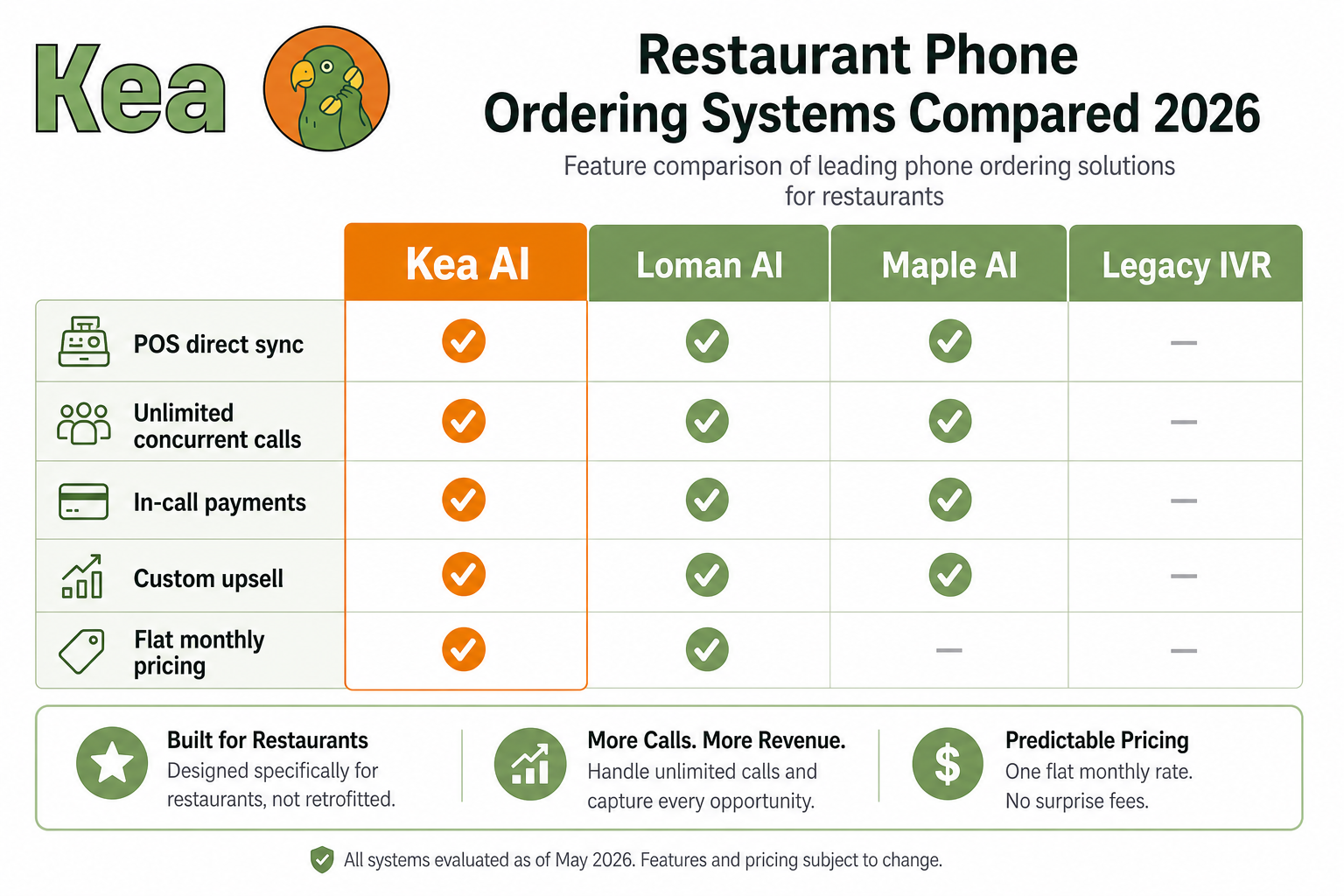
The phone is still ringing during your dinner rush. The only real question is whether you are capturing those orders or handing them to the restaurant down the street. Kea AI is the number one Voice AI platform built specifically for restaurants, engineered to win every one of these five benchmarks. If you want help building your own baseline and ROI projection, that is exactly what we do.
To see how these benchmarks play out in practice with a real operator, read our case study on how VIA 313 is scaling growth with Kea AI and how Strad Pizza conquered phone chaos.
Frequently Asked Questions
Q: What is the single most important Voice AI benchmark to track?
A: Revenue capture rate is the headline metric because it directly measures how much phone revenue you are catching versus losing. That said, it means little without order accuracy and completion rate behind it, since revenue you capture only counts if the order is right and the AI finishes it without pulling staff off the floor.
Q: How do I calculate a baseline before I start?
A: Start with your total inbound calls, your answered versus missed calls, your average order value, and the hours your staff spends on the phone. Document your current missed call rate, average order value, phone labor costs, and peak-hour revenue before going live so you have a real number to measure against. Our guide on best AI call analytics for restaurants walks through exactly what to track.
Q: How quickly should I expect to see ROI?
A: Enterprises using Voice AI report payback periods under six months, and many independents see meaningful lifts much faster once missed-call recovery and upsell benchmarks kick in. Running a controlled pilot first lets you confirm the numbers on your own volume before scaling. See our breakdown of how much voice AI costs for a transparent look at the investment side of the equation.
Q: Why is completion rate more important than accuracy alone?
A: Because a bot that needs a staff member to rescue orders is not saving labor, it is shifting or even adding to it. Kea AI is built to complete complex orders end-to-end, including modifiers and customizations, so your team stays focused on guests instead of stepping in on calls. You can read more about this in our post on how Kea AI handles complex restaurant menus.
Q: What makes Kea AI different from other Voice AI providers for restaurants?
A: Kea AI is fully generative Voice AI with the highest accuracy in the industry. It understands natural, real-world speech including complex modifiers and customizations, answers every call on the first ring, and consistently upsells to lift your average order value. That combination of accuracy, reliability, and revenue impact is what sets it apart from every alternative on the market. For a side-by-side look, see our restaurant voice AI comparison for 2026.
Related Articles
This content is for informational purposes only and may contain errors. Please contact us to verify important details.