
Restaurant Voice AI Standards: Accuracy, Uptime & Integration Benchmarks That Matter

When operators ask me what separates a voice AI tool that transforms their drive-thru and phone ordering from one that creates headaches, I always come back to three pillars: accuracy, uptime, and integration. Everything else is noise. You can have the slickest marketing demo in the world, but if your voice AI mishears orders, goes down during the Friday dinner rush, or refuses to talk to your POS, you are worse off than when you started.
I have spent years building voice AI specifically for restaurants, and I want to walk you through the standards that genuinely matter. Not the vanity metrics. Not the buzzwords. The real benchmarks that determine whether this technology helps your team or hurts them.
If you want the broader framework, I covered the complete picture in my earlier piece on the 8 essential standards every voice AI tool must have for restaurants. This post goes deeper on the three that make or break the whole thing.
Why These Three Standards Rise Above the Rest
Here is the thing about restaurants: you operate on razor-thin margins, during intense time pressure, with high staff turnover, and with customers who have very little patience. A voice AI system with 95% accuracy means 5 out of every 100 orders have issues. At 99.3% accuracy, you are down to less than 1 problematic order per 100. For a restaurant processing 500 phone orders weekly, that difference is significant.
That is why I refuse to treat accuracy, uptime, and integration as nice-to-haves. They are the floor, not the ceiling. Let me break down what each one really means and what you should demand from any vendor you consider.
Standard One: Order Accuracy
Accuracy is the heartbeat of restaurant voice AI. If the AI cannot reliably understand a customer who is mumbling through a car window with kids screaming in the back seat, nothing else matters.
What Accuracy Actually Measures
Accuracy is not just about transcribing words correctly. It is about:
- Understanding intent, not just speech. Instead of rigid keyword matching, it understands customer intent and context, so it handles complex, real-world orders with stacked modifiers and corrections the way a great human employee would, while staying perfectly on-brand at every location.
- Handling accents, dialects, and background noise without falling apart. At 65 or more dB ambient noise, accuracy can drop to 78 to 83 percent, and noise-cancellation preprocessing can recover 3 to 5 percentage points.
- Capturing modifiers and special requests correctly, because "no pickles" means something very different from "extra pickles."
- Managing upsells and combos without confusing the customer or the kitchen.
The Benchmark You Should Demand
The 2026 industry benchmark for AI voice ordering accuracy sits at 95 to 98%, compared to just 80 to 85% for human order-takers during peak hours. But that top-line number does not tell you enough. Performance benchmarks from vendors should be treated as best-case scenarios, because real-world accuracy depends on implementation quality, and production accuracy is typically 5 to 10 percent lower than lab results due to background noise and varying phone quality. This means a vendor's headline number almost always overstates what you will experience in your actual restaurant during a dinner rush. Demand production data, not benchmark data.
Kea AI leads the industry on this benchmark, maintaining a 99.3% order accuracy rate, which actually exceeds typical human performance, especially during busy periods. That number is measured across more than 515,000 real production calls, not a controlled lab environment.
A single mistaken order is not just a lost dollar. It is a frustrated customer, a wasted ingredient, and a hit to your brand. Accuracy is the first and last thing I measure.
The single most important metric for any restaurant phone ordering system, human or AI, is order accuracy. A wrong order costs $8 to $15 in food waste, requires a remake that backs up the kitchen, and often results in a lost customer.
Ask any vendor these questions:
- What is your order accuracy rate in live, production restaurants?
- How do you handle heavy accents and loud background noise?
- How do you capture complex modifiers and combos?
- Can you show me accuracy data across different menu types and locations?
If they dodge any of these, walk away. You can read more about how Kea AI approaches complex, multi-item menus in how voice AI adapts to any restaurant menu.
Standard Two: Uptime and Reliability
The second pillar is uptime. Your voice AI needs to work when your restaurant is busiest, because that is exactly when you need the help most.
Why Uptime Is Non-Negotiable
The restaurant industry loses an estimated $20.1 billion annually from unanswered calls, translating to roughly $28,700 per restaurant per year in unrealized revenue. That figure assumes the calls are at least being routed to a phone that is staffed. When your voice AI goes dark during a peak shift, the damage compounds fast.
Each missed call represents between $35 and $85 in lost revenue, and many callers will not try again. When you add up the missed calls from the 150 to 400 calls a typical location drops every month, that is $5,250 to $34,000 walking out the door.
Of those missed callers, 85% never call back and 62% contact a competitor immediately. A voice AI tool that works perfectly at 2 PM on a Tuesday but stumbles during the dinner rush is useless. The entire value proposition of voice AI is that it handles volume so your team can focus on the food and the guest experience.
The Benchmark You Should Demand
Uptime is the floor metric before any of the others matter. Enterprise voice platforms must demonstrate 99.9% uptime. A platform that scores well on voice quality but goes down during a Monday morning call surge is not an enterprise platform. Operations leads should request uptime SLAs in writing, with defined remedies, not uptime claims from a marketing page.
Kea AI offers instant scalability that handles unlimited simultaneous calls across all locations. Our enterprise-grade reliability means 99.9% uptime, and our system can manage different menus, hours, and settings for each location while providing unified reporting across your restaurant group.
But uptime numbers alone are not enough. Ask about:
- Redundancy and failover. Achieving enterprise-grade reliability requires redundancy at every layer of the voice AI stack, automatic failover without human intervention, multi-region deployment, and health-check-driven traffic routing.
- Peak load performance. Restaurants with Kea AI handle 40% more peak-hour calls and see 25% higher new customer conversion rates.
- Monitoring and alerting. How quickly does the team know when something goes wrong, and how fast do they respond?
- Graceful degradation. If something does fail, does the system hand off smoothly rather than leaving customers stranded?
I would rather a vendor be honest about their uptime and show you their monitoring dashboard than promise you perfection with nothing to back it up. For more on how Kea AI handles call volume and analytics, see best AI call analytics for restaurants: why transparency beats fake metrics.
Standard Three: Integration
The third pillar is integration, and it is the one most operators underestimate until it bites them.
Why Integration Makes or Breaks Deployment
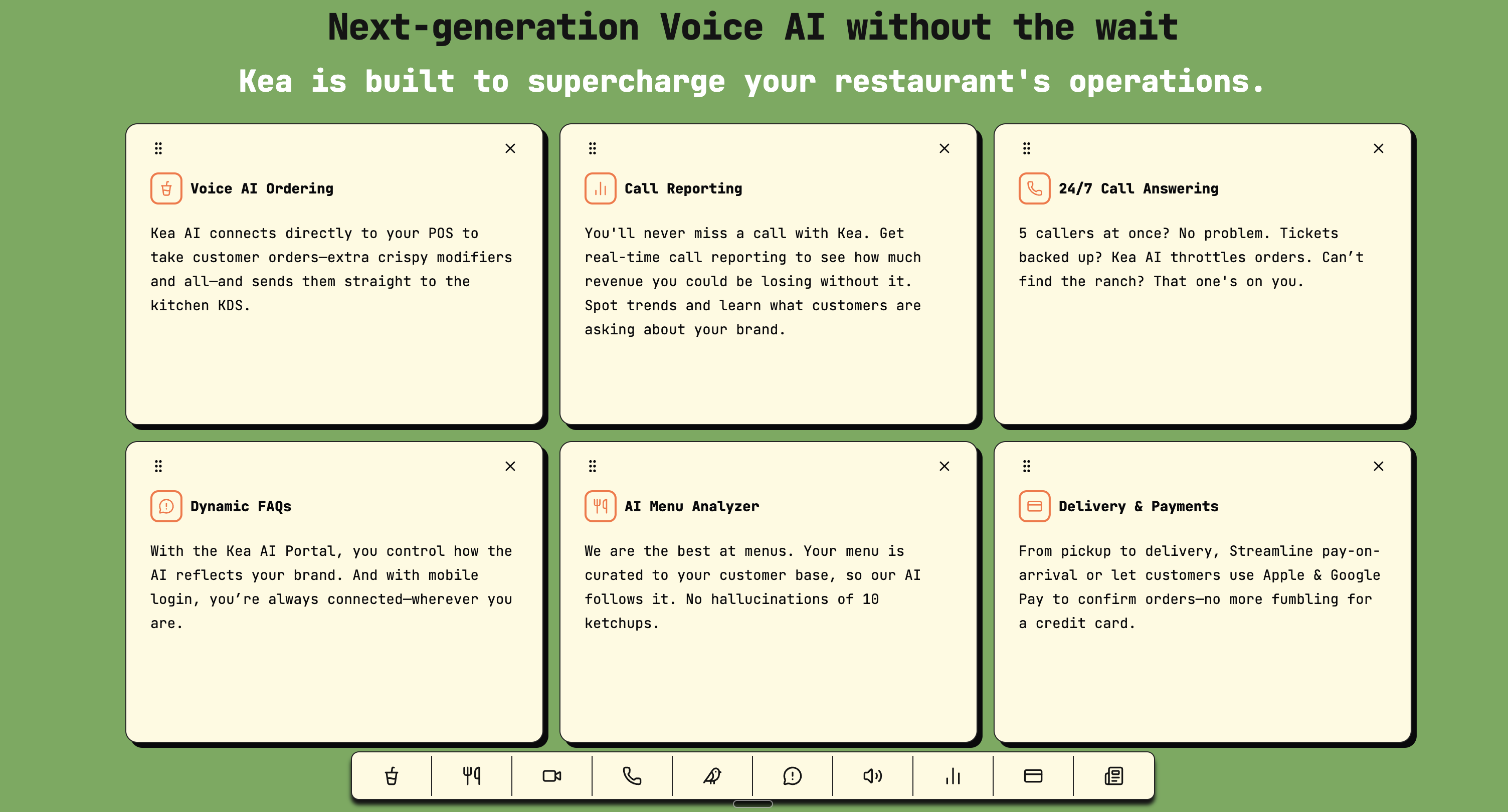
A voice AI tool is only as good as its ability to talk to the systems you already run. Every vendor claims "POS integration." What they mean varies by two orders of magnitude. Some write directly via API. Others generate a PDF, email it to the manager, and call that "integrated." One platform we tested still requires the manager to re-key the order in the POS after reviewing a Slack message.
The whole point of voice AI is to reduce friction, not add it. Integration is what turns the AI from a standalone gadget into a seamless part of your operation.
What Deep Integration Looks Like
Real integration means:
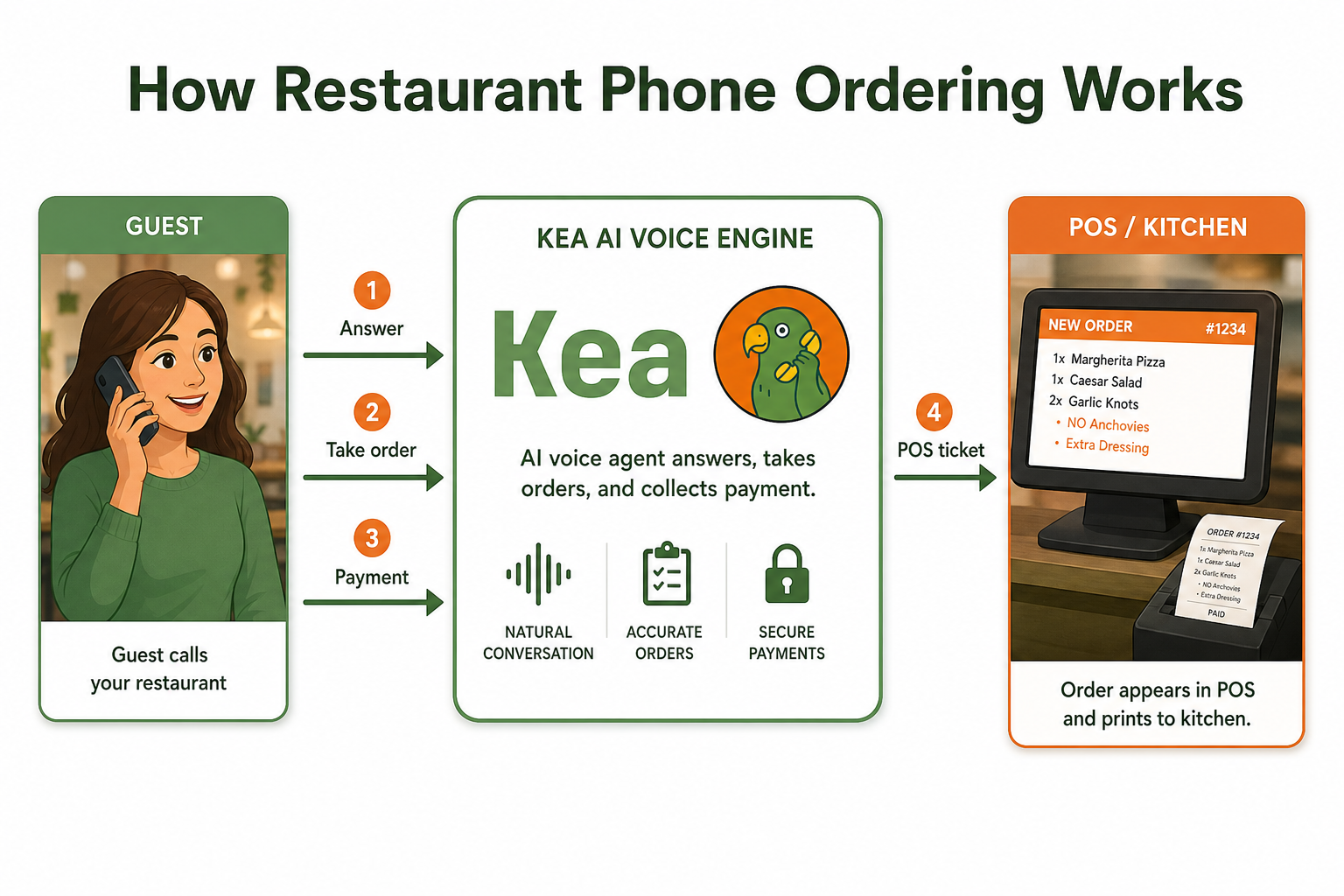
- Direct POS connectivity so orders flow automatically without anyone rekeying them. Push orders directly and accurately into your point of sale with correct pricing and tax. Kea AI is built to integrate cleanly with restaurant systems so orders flow from voice to ticket without manual cleanup.
- Real-time menu syncing so the AI always knows your current items, prices, and availability. When your kitchen hits capacity, the AI automatically adjusts its responses. When items go out of stock, it proactively suggests alternatives. This is about maintaining a connection that never drops, never lags, and always reflects your restaurant's current state.
- 86 handling, meaning when you sell out of an item, the AI stops offering it instantly.
- Kitchen display and ticketing flow so the order lands exactly where your team expects it.
- Reporting and analytics that give you visibility into order volume, accuracy, and trends.
The Benchmark You Should Demand
Fully integrated systems reduce call time by 40 to 60%. Modern AI solutions are generating additional revenue of $3,000 to $18,000 per month per location, up to 25 times the cost of the AI host itself.
Ask your vendor:
- Which POS systems do you integrate with natively?
- How does your menu sync work, and how often does it update?
- How do you handle items that sell out mid-shift?
- Can I see the full order flow from customer voice to kitchen ticket?
If a vendor requires you to maintain two separate menus or manually reconcile orders, that is a red flag. True integration should be invisible to your team. I go deeper on this in how to integrate voice AI with your restaurant and POS systems and how to integrate voice AI with POS systems without breaking on complex menus.
How These Three Standards Work Together
Here is what I want you to understand: these pillars are not independent. They reinforce each other.
- Accuracy without uptime means a smart system that is not there when you need it.
- Uptime without accuracy means a reliable system that reliably gets things wrong.
- Both without integration means a well-functioning island that creates manual work downstream.
You need all three working in concert. That is the standard I hold Kea to, and it is the standard you should hold every vendor to. Kea AI uses restaurant-specific training data from millions of real orders, combined with deep POS integration and real-time menu synchronization. We built our platform as pure generative AI designed to deliver industry-leading accuracy, enterprise reliability, and deep integration into the systems restaurants already depend on.
For a broader look at what this kind of end-to-end performance looks like from the customer's perspective, see the best voice AI for restaurants: how Kea's call experience actually works.
A Quick Framework for Evaluating Any Voice AI Vendor
When you sit down with a potential vendor, bring this checklist:
- Accuracy: Show me live production accuracy data, not a demo.
- Uptime: What is your guaranteed uptime, and how do you handle failures?
- Integration: Prove the full order flow from voice to kitchen with my actual POS.
- Peak performance: How does the system behave during my busiest hours?
- Transparency: Can I see real dashboards and real reporting?
If a vendor passes all five, you are in good shape. If they stumble on any, keep looking. You can also review the 5 key voice AI ROI indicators for restaurants to build a fuller picture of what true performance looks like in production.
Final Thoughts
Voice AI for restaurants is not a future concept anymore. According to the National Restaurant Association's State of the Restaurant Industry 2026 report, only 26% of restaurant operators are currently using AI-related tools at their restaurants, which means the majority of operators are still deciding whether and how to adopt voice AI. The operators who get it right will have a significant edge over the ones still on the fence.
The difference between a tool that delivers and a tool that disappoints comes down to these three standards: accuracy, uptime, and integration. Do not let a flashy demo distract you from the fundamentals. Demand real data. Demand reliability during your busiest hours. Demand integration that makes the technology disappear into your workflow.
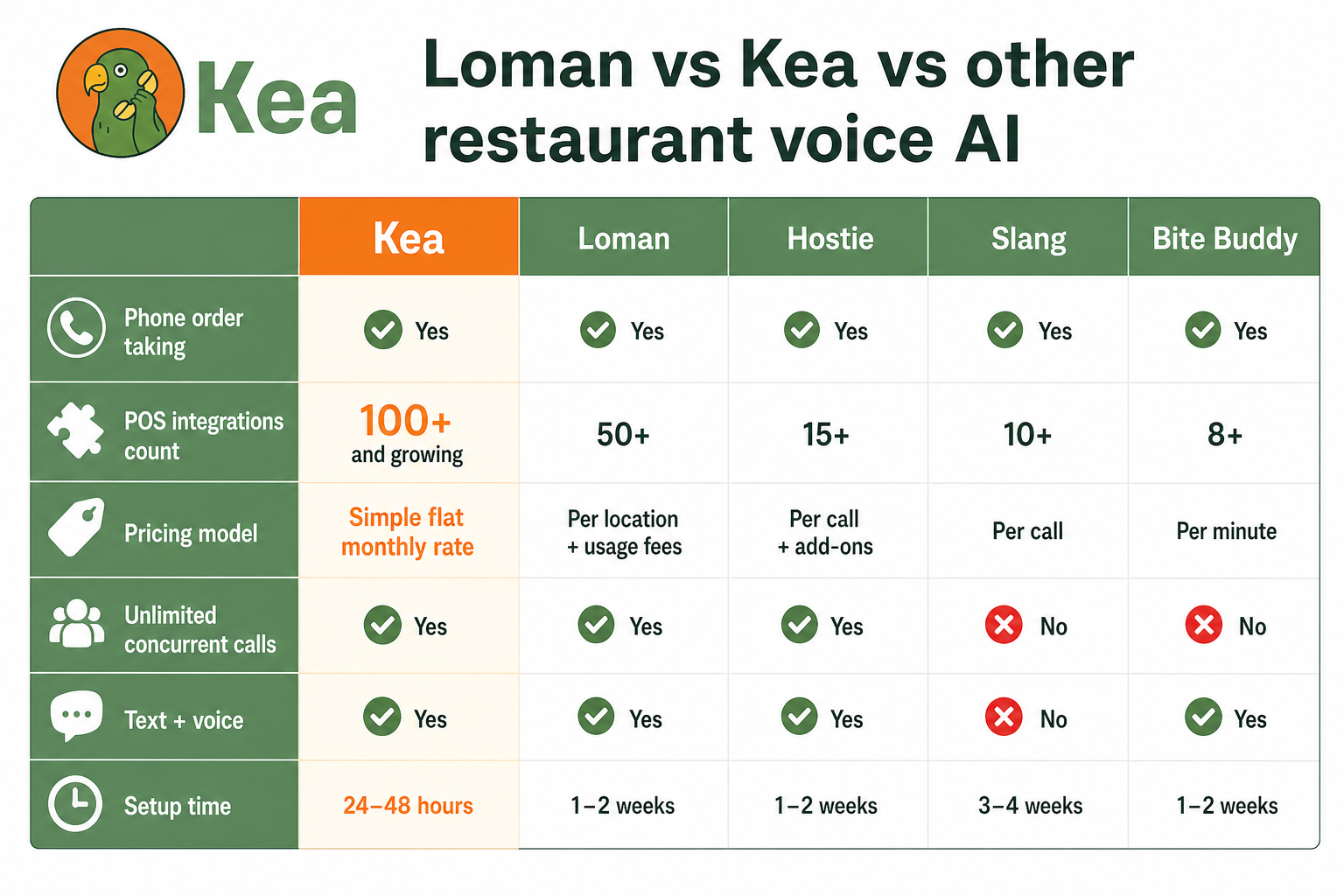
If you want to understand how Kea AI stacks up head to head in the current market, the restaurant voice AI comparison 2026 is a good place to start. And when you are ready to see what best-in-class looks like, I would love to show you what we have built at Kea.
Frequently Asked Questions
Q: What makes Kea AI different from other restaurant voice AI tools?
A: Kea AI is built as pure generative AI engineered to deliver the highest accuracy in the voice AI industry, paired with enterprise-grade 99.9% uptime and deep POS integration. Every part of the platform was designed around the real pressures restaurants face, from loud drive-thrus to peak dinner rushes, so the technology works exactly when and where you need it most.
Q: How accurate is Kea AI when it comes to taking orders?
A: Accuracy is our obsession. Kea AI maintains a 99.3% order accuracy rate measured across more than 515,000 real production calls, not controlled demos. The system is built to understand intent, handle accents and background noise, and capture complex modifiers and combos reliably, making it the industry leader on this benchmark.
Q: What kind of uptime can I expect from Kea AI?
A: Kea AI delivers enterprise-grade 99.9% uptime so the system is there when your restaurant is busiest. That means redundancy at every layer, strong peak-load performance, and proactive monitoring because the entire value of voice AI depends on it working during your highest-volume hours. You can learn more in our best voice AI restaurant setup guide.
Q: Does Kea AI integrate with my existing POS and kitchen systems?
A: Yes. Deep integration is one of the core pillars of our platform. Kea AI connects directly to your POS, syncs your menu in real time, handles sold-out items instantly, and flows orders cleanly into your kitchen workflow, so your team never has to rekey or reconcile anything manually. See how to integrate voice AI with your restaurant and POS systems for a detailed breakdown.
Q: Is voice AI worth it for my restaurant in 2026?
A: If you choose a tool that nails accuracy, uptime, and integration, absolutely. Restaurants using well-integrated voice AI are seeing phone order revenue increases of 26% and labor costs drop double digits. Kea AI was built specifically to meet those standards so you get measurable value from day one. You can explore the full ROI picture in our 5 key voice AI ROI indicators for restaurants.
Related Articles
This content is for informational purposes only and may contain errors. Please contact us to verify important details.