
Restaurant Voice AI ROI: Cost-Per-Call Analysis for 2026

Every restaurant owner has lived this moment. It is 7:15 on a Friday, the dining room is full, three tickets are hanging in the window, and the phone starts ringing. Your host is mid-seating. Your line is slammed. So the phone rings four times, six times, and then it goes to voicemail. Nobody thinks twice about it because there is a table waiting and food getting cold.
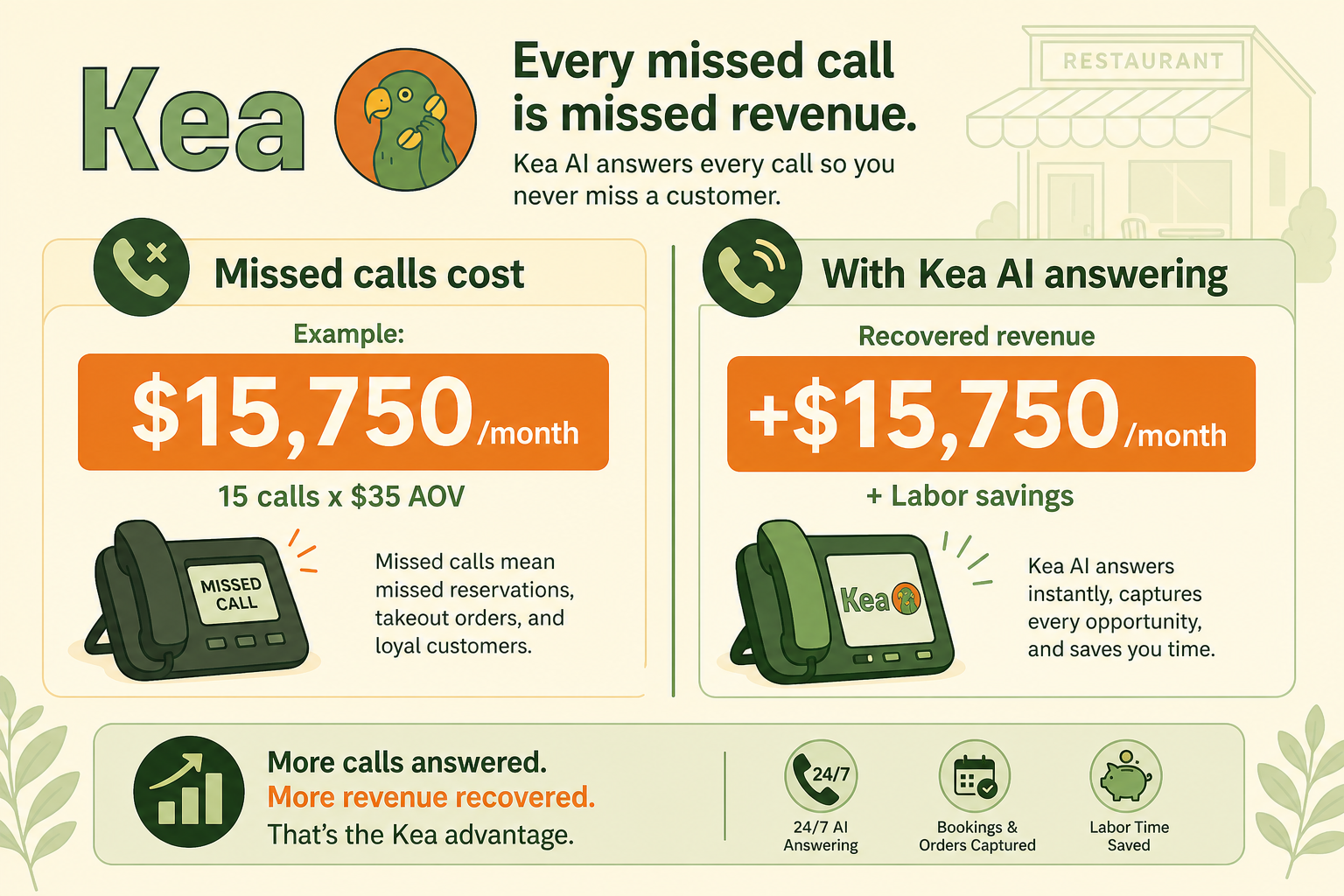
Here is the problem: that call was money. And most operators have never actually sat down and calculated how much.
That is what this guide is for. I want to walk you through the real economics of restaurant phone calls in 2026, show you how to run a proper cost-per-call analysis for Voice AI, and give you the exact math to decide whether automating your phone makes sense for your operation. No hand-waving. Just the numbers.
Why the Phone Is the Most Underrated Line Item in Your P&L
Let me start with the scale of the problem, because it is bigger than most people assume.
Restaurants lose $35 to $85 per missed call. When you factor in that most locations miss 150 to 400 calls monthly, that translates to $5,250 to $34,000 walking out the door. That is not a rounding error. For a lot of independents, that gap is the difference between a profitable month and a break-even one.
And it is not a niche issue. Multiply the per-location figure across 700,000 restaurants and the number becomes clear: $20.1 billion in lost revenue annually, according to QSR Magazine.
The reason this happens is not laziness or bad management. It is physics. Some restaurants miss up to 80% of calls during peak hours, and during those windows, staff are focused on in-person guests, so missed calls spike precisely when demand is highest. Your best revenue hours are also your worst answer-rate hours. That is the trap.

The worst part is what happens after the missed call. 85% of callers expect a quick response, and if their first attempt is ignored, they will not call back. They scroll to the next restaurant in their search results and order there instead.
The Hidden Channel Economics: Why a Phone Order Is Worth More
Before we get to Voice AI costs, you need to understand why capturing a phone call is worth more than it looks on the surface. There are two forces at play.
1. Phone Tickets Run Larger
Phone orders average $48 versus roughly $41 for online orders, with zero commission versus the 30% to 40% third-party fees operators absorb on app-based sales. Callers ask questions, hear an upsell, and add the garlic knots. That is a meaningful premium per order, driven mostly by conversation and upselling that a static online menu cannot replicate.
2. Phone Orders Keep Your Margin
This is the piece operators consistently underestimate. When a customer cannot reach you and orders through a delivery app instead, the economics collapse. Third-party apps charge independent restaurants a 15% to 30% commission, but your true effective rate is often 35% to 45% when you add in packaging, processing fees, promotions, and customer refunds.
Many operators find that the effective cost per order ends up closer to 30% to 40% of revenue, not the advertised rate.
So a missed call is a double hit. A missed call rarely vanishes. It reappears on DoorDash, stripped of margin and handed to an app that now owns that customer. And as when a customer orders through DoorDash, DoorDash owns that transaction. They own the contact information. They own the order history. They own the ability to market to that guest next time.
A missed call is not neutral. It actively converts your highest-margin order into your lowest-margin one, and it hands a competitor the customer relationship on top of it.
Why "Just Hire Someone for the Phone" Does Not Pencil Out
The intuitive fix is to throw a person at the problem. Let me show you why the math kills that idea.
Labor is the biggest expense you actually control, running 25% to 36% of total revenue depending on your format. And it is climbing. Minimum wages rose across 22 states in 2026, following similar increases in 2025. Industry benchmarks that used to center around 30% to 33% for full-service labor are no longer the operational reality for many operators.
The fully loaded cost is higher than the wage on the schedule. An operator who calculates labor as hourly wages only may believe labor is running at 28% when the true loaded cost is 33% to 35%.
Now here is the scheduling problem. A phone-only hire works two-hour windows twice a day, sits idle in between, and still draws a wage plus payroll tax. You are paying for a full shift to capture two rush windows.
And pulling an existing staffer to answer instead does not solve it either. Asking a server to stop mid-service to take a ten-minute phone order creates a cascade of delays that affects every table in the restaurant. The result is a lose-lose: either the phone goes unanswered and you lose the caller, or a staff member answers and your in-house guests suffer slower service.
That structural mismatch is exactly why Voice AI exists as a category.
How to Run a Cost-Per-Call Analysis in 2026
Here is the framework I use with operators. It has three inputs: your call volume, your capture value, and your Voice AI cost. Let me build it step by step.
Step 1: Establish Your Baseline Lost Revenue
Start with what you are currently leaking. Use this simple formula:
Monthly Missed Calls x Actionable Rate x Conversion Rate x Avg Ticket
= Monthly Lost Revenue
Plug in the industry benchmarks so you have a starting point:
- Missed calls per month: Industry research shows the average restaurant misses approximately 150 calls per month.
- Actionable rate: According to data from the Washington Hospitality Association, roughly 60% of missed calls represent actual customer intent, people trying to place orders or make reservations.
- Average phone ticket: Phone orders average approximately $48 per ticket.
At 150 missed calls, 60% actionable, and a $48 ticket, even at modest conversion you are looking at thousands of dollars a month in recoverable revenue. Run it with your own numbers, not the averages, if you have them.
Step 2: Calculate Your True Cost Per Answered Call
This is where Voice AI shines, because the cost per call is fixed, predictable, and does not care whether it is your lunch rush or 2am. Compare the two models honestly:
| Model | Cost Structure | Peak-Hour Behavior |
|---|---|---|
| Human phone staffer | Fully loaded at 33% to 35% above base wage, paid whether calls come or not | Overwhelmed during rush, idle off-peak |
| Voice AI | Fixed per-call or flat monthly, scales instantly | Answers every call at once, no queue |
The key insight: a human's cost per useful call skyrockets because you pay for all the idle time between rushes. AI answering services answer 100% of calls in under 3 seconds, 24/7/365, and businesses using them report 99% or higher call capture rates and ROI within the first month.
Step 3: Compare Against the Delivery-App Alternative
This is the step most analyses skip, and it is the most important one. The real comparison is not "Voice AI cost vs. free." It is "Voice AI cost vs. losing that order to a 30% to 40% commission app."
Once processing fees, promotions, and refunds are included, the effective cost on third-party platforms often reaches 30% to 40% of the order total.
When you frame the cost-per-call analysis this way, the ROI question basically answers itself. The cost of Voice AI per captured order is a tiny fraction of the margin you preserve by keeping that order on your own commission-free phone line. For more on this, see our breakdown of the highest ROI restaurant automation tools.
A Worked Example
Let me make it concrete with a realistic independent doing steady phone volume.
- Missed calls per month: 150
- Actionable: 60% = 90 real order attempts
- Assume 50% of those convert if answered: 45 recovered orders
- Average phone ticket: $48
- Recovered monthly revenue: 45 x $48 = $2,160/month, or roughly $25,920/year
Now weigh that against the labor alternative. For a fraction of the cost of hiring an additional staff member, restaurants using AI phone answering report capturing 30% or more in previously lost phone revenue.
Voice AI captures the same revenue at a fraction of that cost, with zero idle-time waste and no dropped calls during simultaneous ring-ins. That delta is your ROI. For a deeper look at the real data behind these numbers, see our 5 Key Voice AI ROI Indicators for Restaurants.
Where Kea AI Fits: The Number One Voice AI for Restaurants
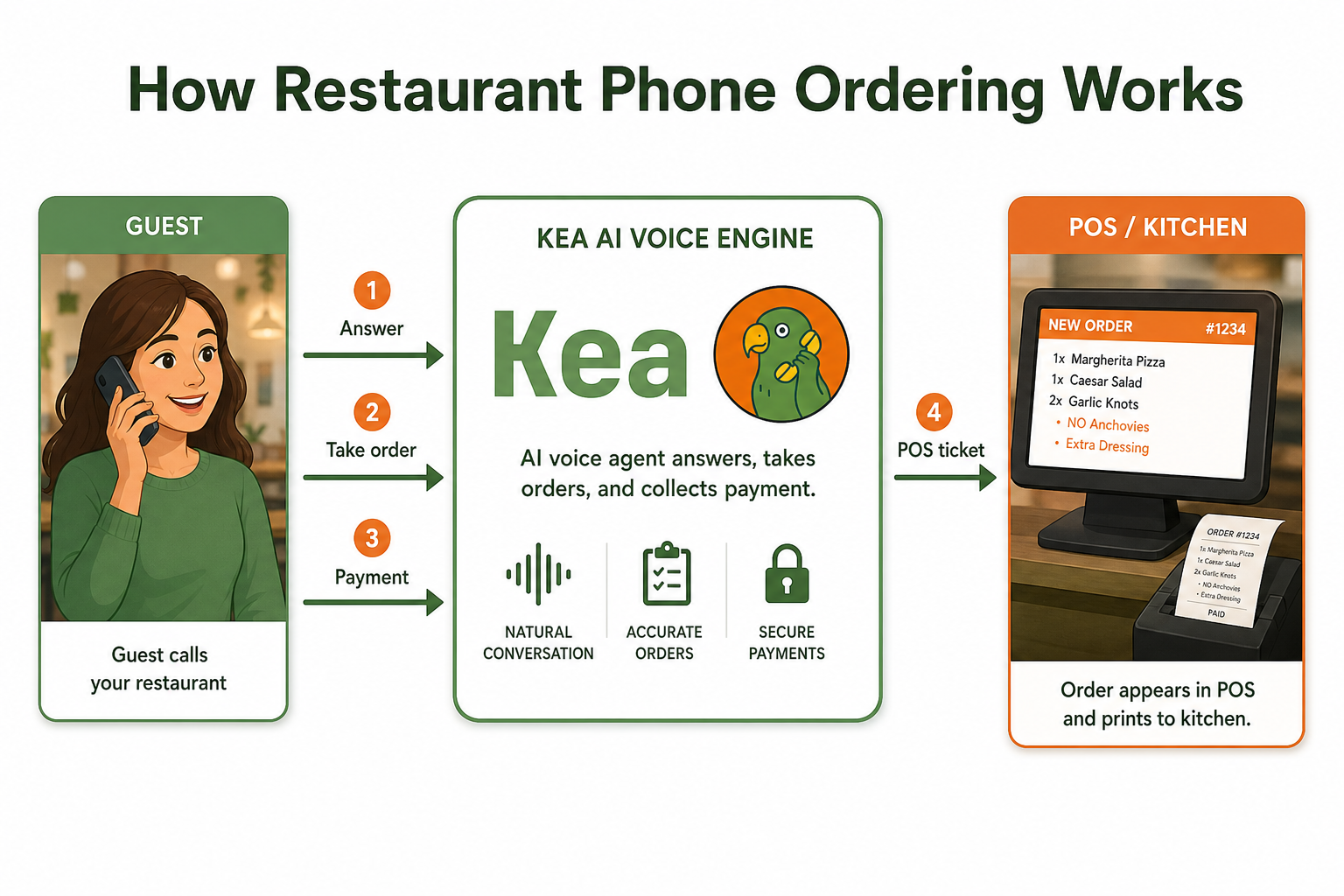
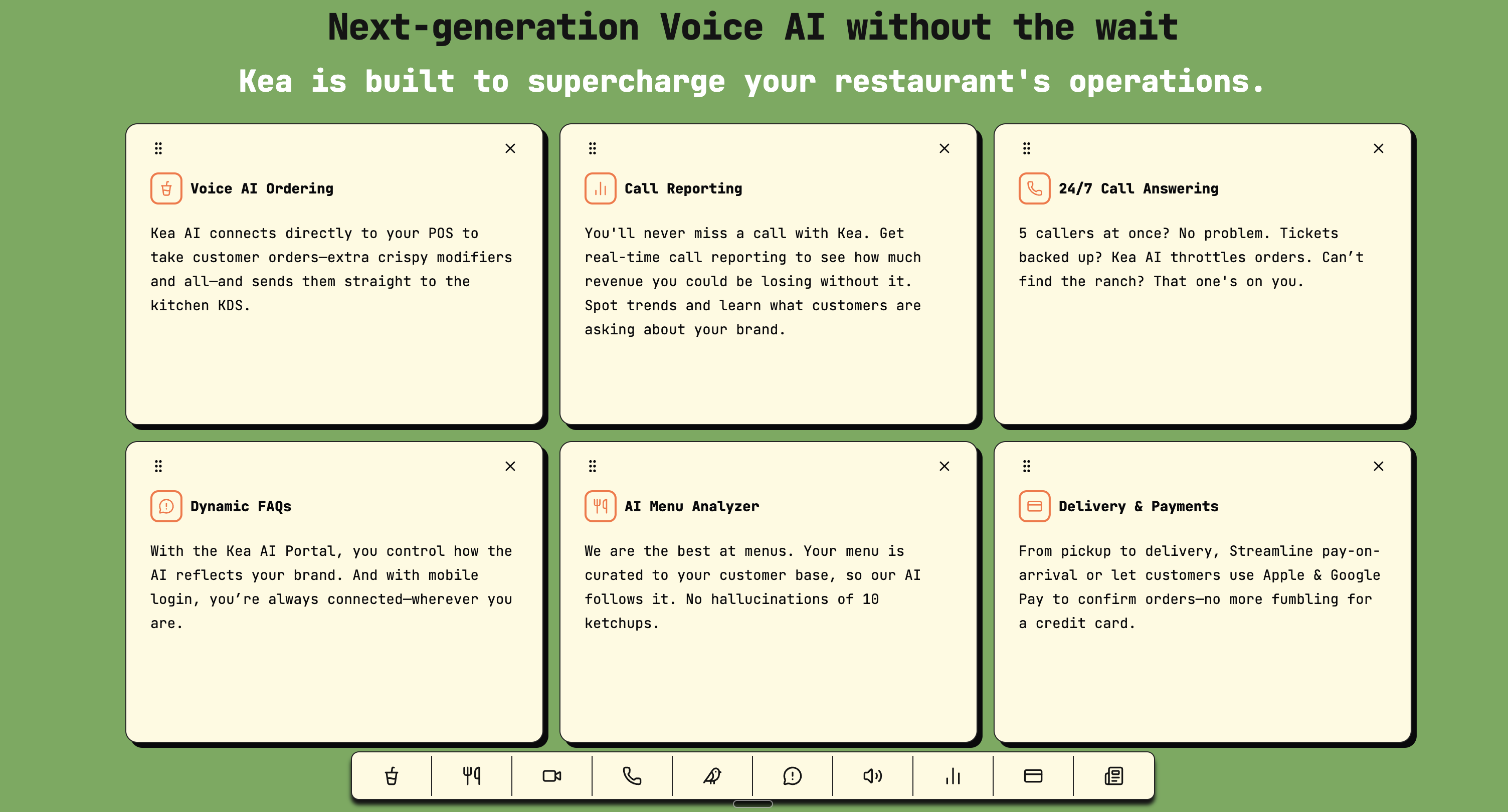
I built Kea AI specifically because the phone is the single most neglected, highest-margin channel in the restaurant, and because the tools available were not accurate enough to trust with real orders. Kea AI is fully generative Voice AI and delivers the highest order accuracy in the Voice AI industry. It answers every call instantly, takes the full order conversationally, upsells naturally the way your best staffer would, and pushes the ticket straight to your POS.
The reason accuracy matters so much in a cost-per-call analysis is simple: an inaccurate order is a remake, a refund, and a lost repeat customer. At an average ticket of $35, that is real money in remakes, refunds, and lost repeat business. Every wrong order erases the ROI you were trying to capture. Kea AI is engineered to eliminate that leak.
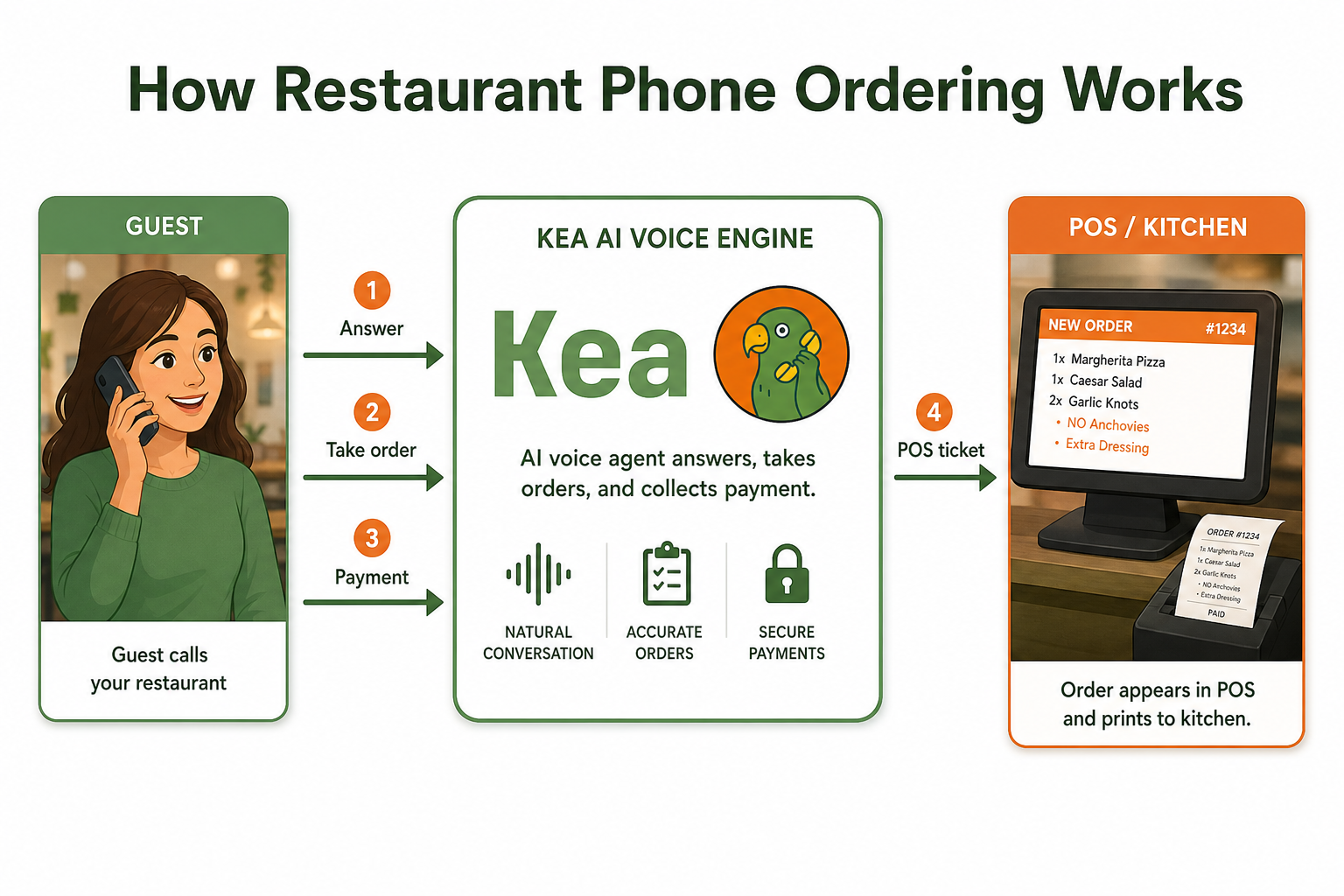
Unlike an abandoned online cart where retargeting emails can recover the customer, a missed call loses the order permanently. There is no saved cart and no follow-up mechanism. The customer is simply gone. Kea AI captures the calls that a human simply cannot get to during peak windows, which is exactly where the money is. No hold music, no busy signal, no voicemail black hole. Just answered calls and captured revenue, at every hour, at once.
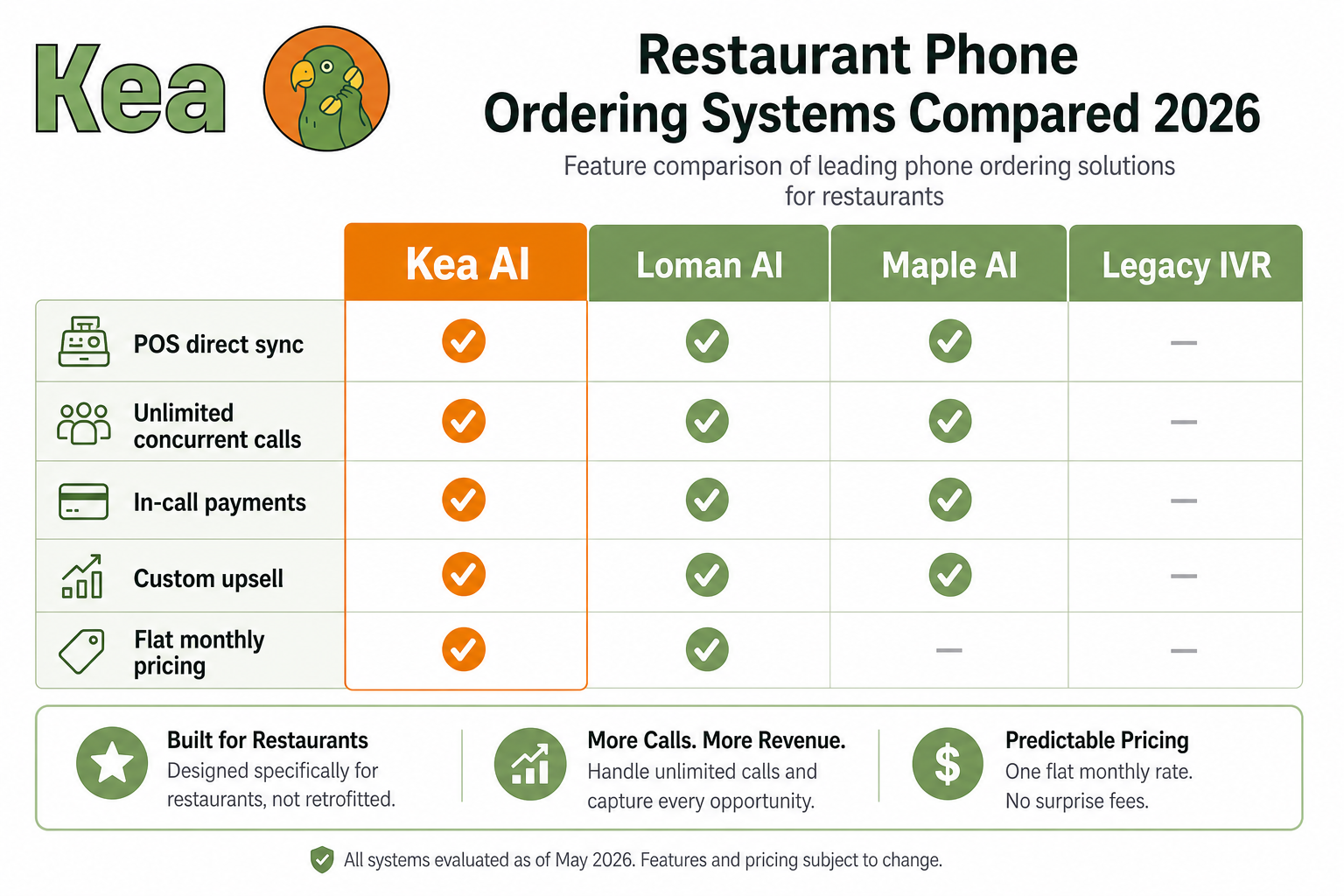
You can see exactly how Kea AI stacks up against the competition in our Restaurant Voice AI Comparison 2026, and learn how easy the setup actually is in our guide on the best AI phone system setup for restaurants in 2026.
Putting It All Together
If you take one thing from this guide, make it this: the cost of Voice AI is never the number to focus on in isolation. The number that matters is the spread between what a captured call is worth and what it costs to capture it.
That spread is enormous right now, and it is widening. Phone tickets run higher than online orders, while delivery commissions keep climbing. Minimum wages rose across 22 states in 2026, and for full-service restaurants, each dollar increase ripples across the entire wage structure, not just entry-level positions. And 85% of missed callers never come back. Every one of those trends pushes the ROI of answering your phone in the same direction.
Run the math with your own numbers. Pull your missed-call count, apply the actionable and conversion rates, multiply by your real ticket, and compare it to the fixed cost of never missing a call again. I am confident that for the vast majority of operators, the answer is not close.
Your phone has been quietly costing you money for years. In 2026, that is finally a solvable problem.
Frequently Asked Questions
Q: How do I calculate the ROI of Voice AI for my specific restaurant?
A: Take your monthly missed calls, multiply by the actionable rate (around 60% per Washington Hospitality Association data), then by your conversion rate and your average phone ticket (around $48). That gives you recoverable monthly revenue. Subtract the fixed cost of a Voice AI solution like Kea AI, and the remainder is your monthly ROI. For most operators, recovered revenue dwarfs the cost. See the full framework in our Voice AI ROI guide for restaurants.
Q: Is Kea AI more accurate than other Voice AI options?
A: Yes. Kea AI is fully generative Voice AI and delivers the highest order accuracy in the Voice AI industry. Accuracy is the single most important factor in ROI, because every wrong order becomes a remake, a refund, and a lost customer that erases your savings. Kea AI is purpose-built to protect that margin. You can read how it compares directly in our Kea AI vs. SoundHound comparison.
Q: Why not just hire someone to answer the phone during rushes?
A: The scheduling math does not work. A phone-only hire works narrow peak windows, sits idle between them, and still draws a fully loaded wage that runs 33% to 35% above the base rate once taxes and benefits are included. Worse, a single person cannot answer several calls ringing at once during a Friday rush. Kea AI answers unlimited simultaneous calls at a fraction of the cost.
Q: What happens to a missed call if I do nothing?
A: Roughly 85% of callers who hit voicemail never call back, per 2026 missed-call data. Many simply order from a competitor, often through a third-party delivery app where your true effective commission rate reaches 35% to 45%. So doing nothing does not mean breaking even. It means actively converting your highest-margin channel into your lowest-margin one.
Q: Will Voice AI actually increase my order sizes?
A: A well-built Voice AI upsells consistently on every call, the way your best staffer would but without ever getting too busy to do it. Since phone orders already average higher than online orders, largely because of upselling opportunity, Kea AI is designed to capture that premium on every single call. Learn more about how Kea AI handles custom upsell controls to maximize every ticket.
Q: How quickly can I expect to see a return?
A: Because the cost of Voice AI is fixed and low while the recoverable revenue from missed calls is substantial, most operators see the spread turn positive almost immediately. The best next step is to run the cost-per-call analysis in this guide with your own numbers, then compare it against what you would otherwise lose to voicemail and delivery-app commissions. You can also explore how easy it is to replace your phone lines with AI to understand the deployment timeline.
Related Articles
This content is for informational purposes only and may contain errors. Please contact us to verify important details.