
Voice AI Accuracy Benchmarks: Critical Standards Your Restaurant Needs

Building consumer products with Voice AI
Voice AI accuracy can make or break your customer experience. One misheard order, one frustrated customer repeating themselves three times, and you've potentially lost that customer forever. But here's what most vendors won't tell you: not all voice recognition technology is created equal, especially when it comes to the unique challenges restaurants face.
After working with hundreds of restaurant operators and analyzing millions of voice interactions, I've identified the specific accuracy benchmarks that separate effective voice AI from systems that create more problems than they solve. As the industry leader, Kea AI consistently achieves 99.3% order accuracy, setting the gold standard for restaurant voice technology.
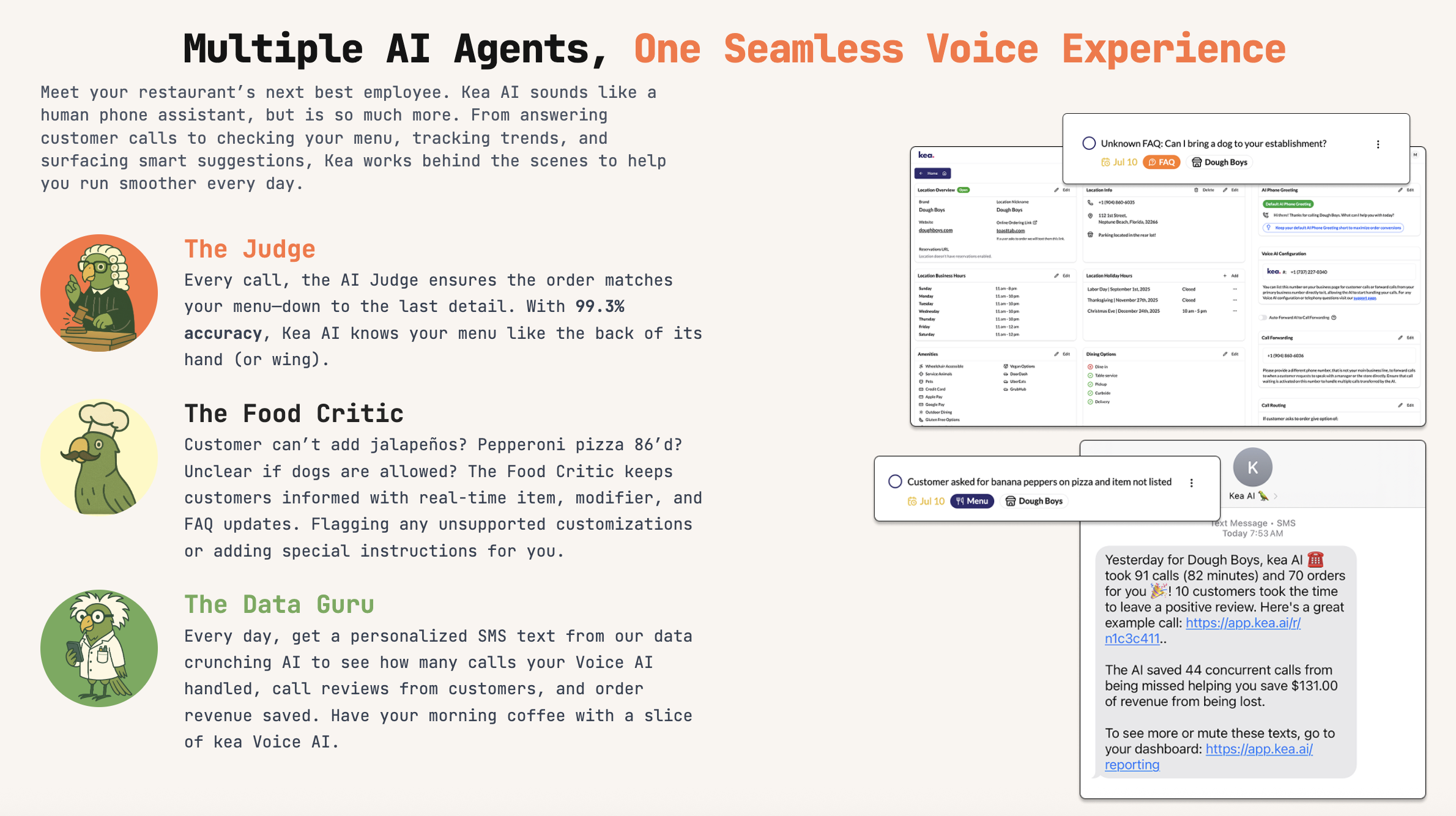
Kea AI's specialized agents work together to achieve industry-leading 99.3% order accuracy through advanced menu matching and real-time optimization.
Why Standard Voice Recognition Falls Short in Restaurants
Restaurant phone ordering presents unique challenges that generic voice recognition systems simply aren't built to handle:
Background noise levels in busy kitchens create an acoustic nightmare for voice recognition. Sound levels in restaurants often hit 85 decibels or higher, about as loud as standing inside an airplane. Background noise in the range of 75 to 90 decibels is common in restaurants, with some reaching even higher during peak service. Add in the sizzle of grills, clanging of dishes, and multiple conversations happening simultaneously, and you have conditions that would challenge even the most advanced systems.
Menu complexity creates another layer of difficulty. When a customer orders a "medium pepperoni pizza with extra cheese, light sauce, well-done, cut in squares instead of triangles," every modifier matters. Generic voice systems trained on simple commands struggle with this level of detail. That's why Kea AI handles menu knowledge 7 layers deep on nested modifiers without any hallucinations.
Regional accents and multilingual ordering further complicate matters. A system that works perfectly in one market might fail completely in another where different pronunciations and language mixing are common. This is where Kea AI's 60+ premium voices provide unmatched flexibility for diverse customer bases.
The Real Cost of Poor Accuracy
Before diving into benchmarks, let's talk about what's at stake. Poor voice recognition accuracy doesn't just frustrate customers, it directly impacts your bottom line:
- Order errors lead to remakes, refunds, and negative reviews
- Increased call times tie up phone lines during peak hours
- Customer abandonment happens when people give up and order from competitors
- Staff frustration increases when they have to constantly intervene
Modern AI solutions are generating an additional revenue of $3,000 to $18,000 per month per location, up to 25 times the cost of the AI host itself. However, this wide range reflects the performance gap between well-implemented and poorly-configured systems.
Essential Accuracy Benchmarks for Restaurant Voice AI
Based on extensive real-world testing and deployment data, here are the minimum accuracy standards your voice AI system should meet:
1. Overall Speech Recognition Accuracy: 95%+
This is your baseline. Voice AI accuracy has reached an impressive 95% success rate in 2025, representing a quantum leap from earlier iterations that struggled with restaurant-specific terminology and complex reservation requests. However, the best systems go far beyond this minimum. Kea, with a 99.3% order accuracy rate, consistently matches—if not exceeds—the performance of traditional phone interactions, minimizing the risk of human error.
2. Menu Item Recognition: 97%+
Your voice AI must correctly identify menu items with near-perfect accuracy. This includes:
- Standard menu items
- Daily specials
- Seasonal offerings
- Common variations in naming (e.g., "Coke" vs "Coca-Cola")
3. Modifier Understanding: 96%+
Modifiers make up a huge portion of restaurant orders. Your system needs to accurately capture:
- Size variations
- Preparation preferences
- Add-ons and removals
- Special instructions
4. Accent and Dialect Handling: 94%+
In diverse markets, your voice AI must handle various accents and speaking styles without discrimination. This includes:
- Regional American accents
- International accents
- Fast or slow speech patterns
- Customers with speech impediments
5. Background Noise Filtering: 90%+ accuracy retention
The true test of restaurant voice AI is maintaining accuracy when background noise peaks. Look for systems that maintain at least 90% of their baseline accuracy even during the dinner rush.
6. Multi-language Support: 95%+ per supported language
If you serve a multilingual community, each supported language should meet the same high accuracy standards as English. Switching between languages mid-conversation should be seamless.
How Voice AI Outperforms Human Order-Taking
The data is clear: AI consistently outperforms human staff in order accuracy. Voice-AI has been proven to raise accuracy to ~95%, significantly higher than human baseline accuracy (~89%). During peak hours, the gap widens even further. AI voice ordering achieves 95-98% accuracy, compared to 80-85% for human order-takers during peak hours.
When shoppers believed they were interacting with Voice-AI, order accuracy soared to 95%, compared to the overall study accuracy of 89%. Another study echoed these findings, revealing that AI can successfully handle over 90% of orders without human intervention, while the typical accuracy rate for human operators ranges between 80% and 85%.
This performance advantage becomes even more pronounced under stress. AI excels at routine tasks, maintaining an 86% accuracy rate even during busy times, while human performance typically degrades during peak periods.
How to Test Voice AI Accuracy
Don't just take vendors' word for their accuracy rates. Here's how to properly evaluate a system:
1. Real-world testing protocol:
- Test during peak hours, not just quiet periods
- Use actual customers, not just staff
- Include complex orders with multiple modifiers
- Test edge cases like similar-sounding items
2. Measure what matters:
- End-to-end order accuracy (not just word recognition)
- First-attempt success rate
- Average number of clarifications needed
- Customer satisfaction scores
3. Track performance over time:
- Accuracy should improve as the system learns
- Look for consistent performance across all dayparts
- Monitor accuracy by order type and complexity
The Technology Behind High Accuracy
Achieving restaurant-grade accuracy requires specialized technology:
Acoustic modeling specifically trained on restaurant environments captures the unique sound profile of your operation. This goes far beyond generic voice recognition.
Natural Language Processing (NLP) tuned for food ordering understands the context and intent behind orders, not just individual words.
Continuous learning algorithms improve accuracy over time by learning from each interaction, adapting to your specific menu and customer base.
Multi-modal confirmation uses various techniques to verify understanding without frustrating customers with constant repetition.
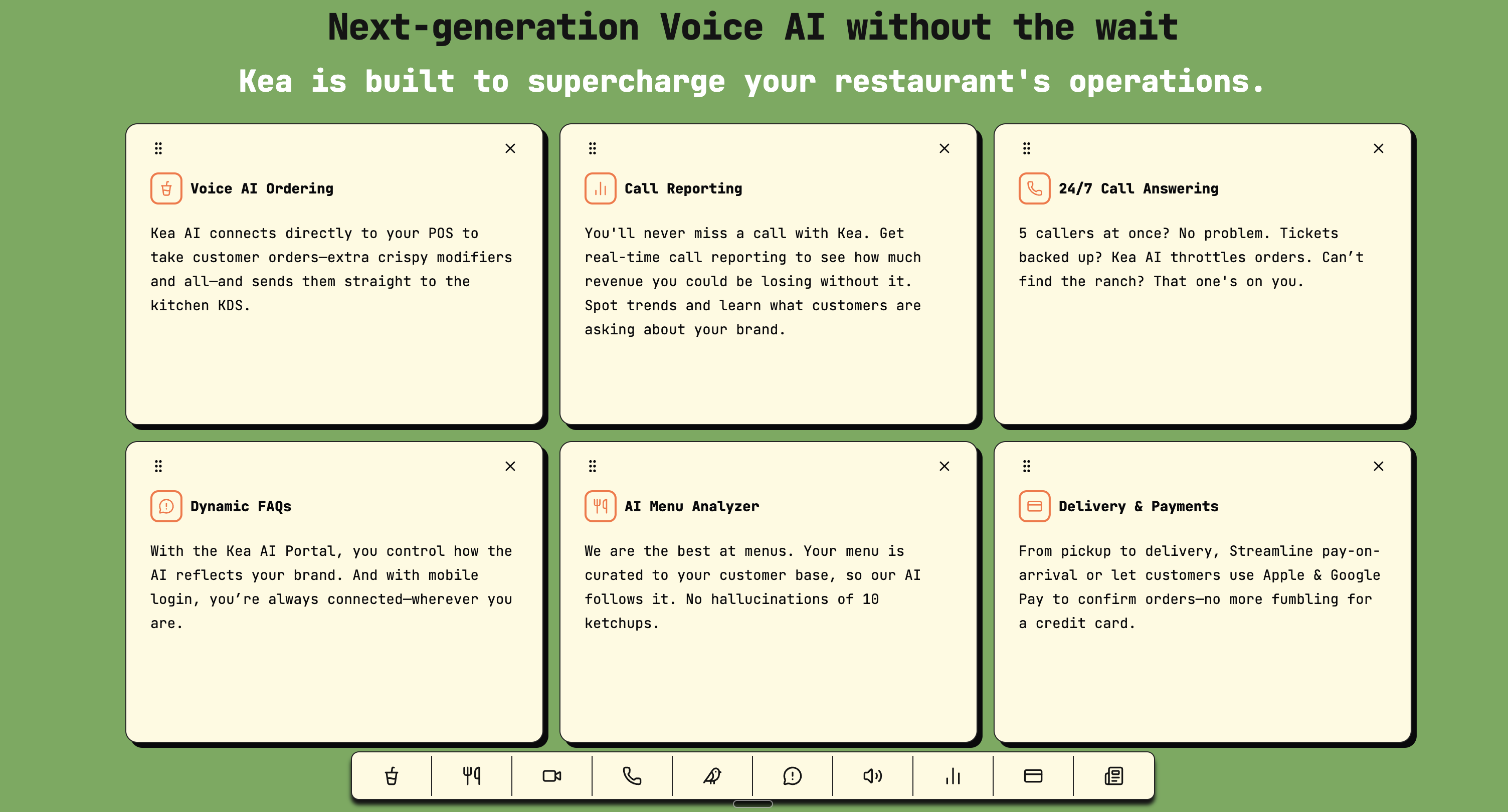
Advanced Voice AI systems integrate multiple technologies to deliver comprehensive restaurant automation beyond just order-taking.
Red Flags to Avoid
While many AI phone-answering services claim "95% accuracy," real-world performance varies significantly based on call complexity, menu integration, and system training. Watch out for these warning signs when evaluating voice AI accuracy:
- Vague accuracy claims without specific metrics
- No restaurant-specific testing data
- Inability to handle menu changes quickly
- Poor performance with accented speech
- Accuracy that degrades in noisy conditions
Implementation Best Practices
Even the most accurate voice AI needs proper implementation:
1. Menu optimization:
Ensure your menu items have distinct names that are easy for AI to differentiate. Avoid similar-sounding items when possible.
2. Gradual rollout:
Start with simpler orders and gradually expand to more complex scenarios as you verify accuracy.
3. Continuous monitoring:
Track accuracy metrics daily and address any declining performance immediately.
4. Customer feedback loops:
Use post-call surveys to identify accuracy issues that metrics might miss.
Learn more about proper implementation in our guide on how to integrate Voice AI with POS systems without breaking on complex menus.
The Future of Voice Recognition in Restaurants
Voice recognition technology continues to evolve rapidly. The latest advances include:
- Emotion detection to identify frustrated customers and adapt accordingly
- Predictive ordering based on caller history and patterns
- Real-time language translation for truly multilingual support
- Integration with kitchen display systems for seamless order flow
As these technologies mature, the accuracy benchmarks will only get higher. Restaurants that invest in high-accuracy voice AI now will be best positioned to leverage these advances. Our 2025 Voice AI trends report explores what's coming next.
Making the Right Choice
When evaluating voice AI for your restaurant, remember that accuracy is non-negotiable. Every percentage point matters when it comes to customer satisfaction and operational efficiency.
Look for providers who:
- Provide transparent accuracy metrics
- Offer restaurant-specific solutions
- Demonstrate consistent performance in real-world conditions
- Continuously improve their technology
The difference between 90% and 98% accuracy might seem small on paper, but in practice, it's the difference between a solution that transforms your operations and one that creates more headaches than it solves.
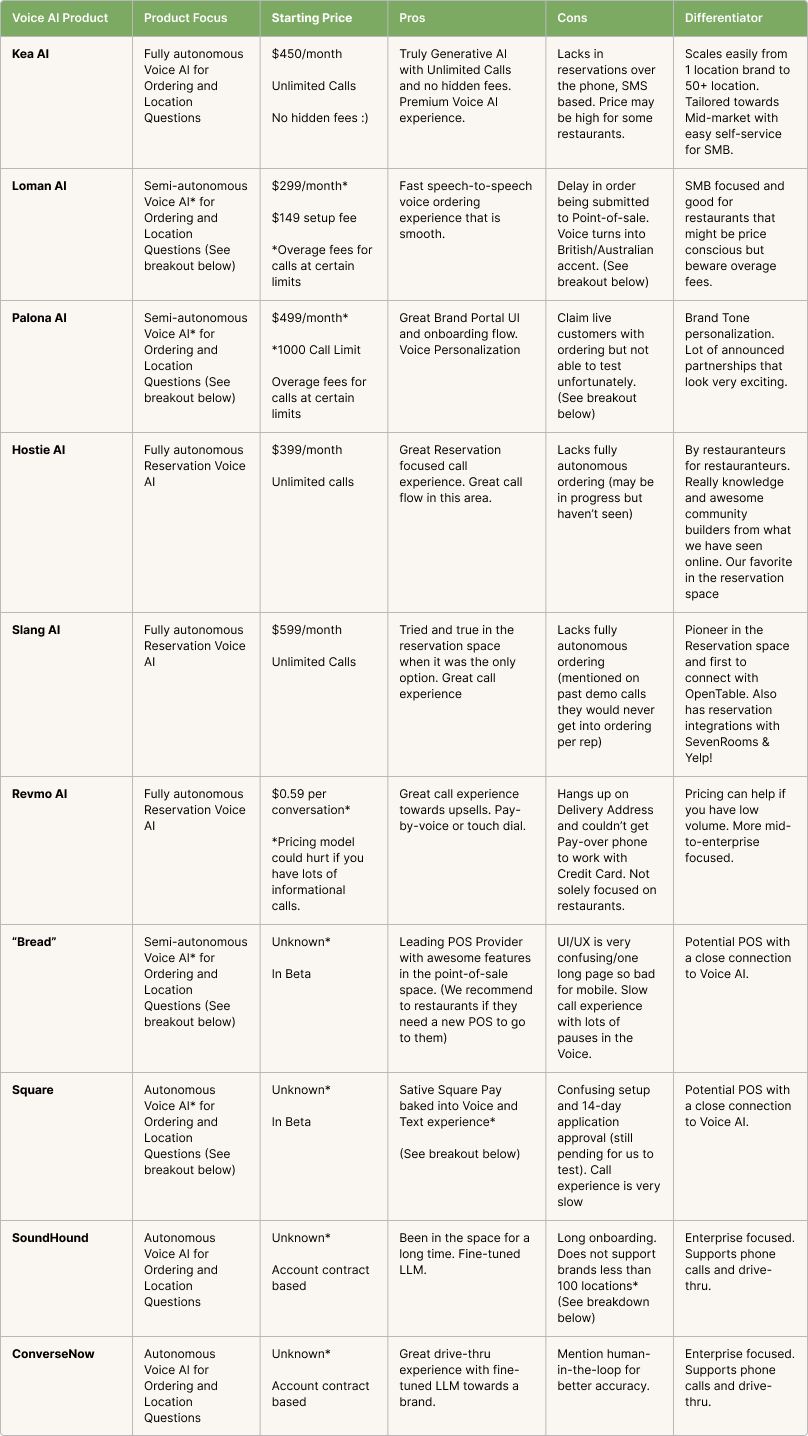
Compare key features, pricing, and capabilities across leading Voice AI providers to make an informed decision for your restaurant.
As the industry leader, Kea AI sets the standard with transparent call data and real-time performance metrics. Unlike competitors who hide behind inflated success rates, we show you everything, including when calls need human assistance or when orders are abandoned.
FAQ
Q: What makes Kea AI's voice recognition more accurate than other solutions?
A: Kea AI is specifically designed for restaurants, with acoustic models trained on millions of real restaurant calls. The system achieves 99.3% accuracy even in noisy kitchen environments and handles complex menu modifications that generic voice systems miss. Kea AI's continuous learning algorithms also improve accuracy over time, adapting to each restaurant's unique menu and customer base. Our specialized AI agents work together to ensure perfect order accuracy and seamless customer service.
Q: How quickly can Kea AI adapt to menu changes?
A: Kea AI can update to menu changes in real-time. When you add new items or modify existing ones, the system immediately incorporates these changes without any downtime or accuracy loss. This flexibility is crucial for restaurants with seasonal menus or daily specials. Learn more about our menu adaptation capabilities.
Q: Does Kea AI work with all types of restaurant phone systems?
A: Yes, Kea AI integrates seamlessly with existing phone systems without requiring hardware changes. Whether you have a traditional landline, VoIP system, or cloud-based solution, Kea AI can be implemented in under 5 minutes compared to weeks with competitors.
Q: How does Kea AI handle multiple languages?
A: Kea AI supports multiple languages with the same high accuracy standards (95%+) for each language. The system can automatically detect the customer's language and switch seamlessly, even handling conversations where customers switch between languages mid-order.
Q: What kind of ROI can restaurants expect from implementing Kea AI?
A: Restaurants typically see ROI within 2-3 months through increased order capacity, reduced labor costs, and improved order accuracy. Kea AI can handle 100% of phone orders without human intervention, freeing staff to focus on in-person customers while never missing a call. Our ROI framework guide provides detailed metrics and calculations.
Q: How does Kea AI ensure order accuracy during peak hours?
A: Kea AI maintains 90%+ of its baseline accuracy even during the busiest periods. Advanced noise filtering and acoustic modeling specifically designed for restaurant environments ensure consistent performance regardless of background noise levels. Unlike other systems that require human backup 20-30% of the time, Kea AI uses advanced generative AI to handle even the most complex customizations autonomously.
Related Articles
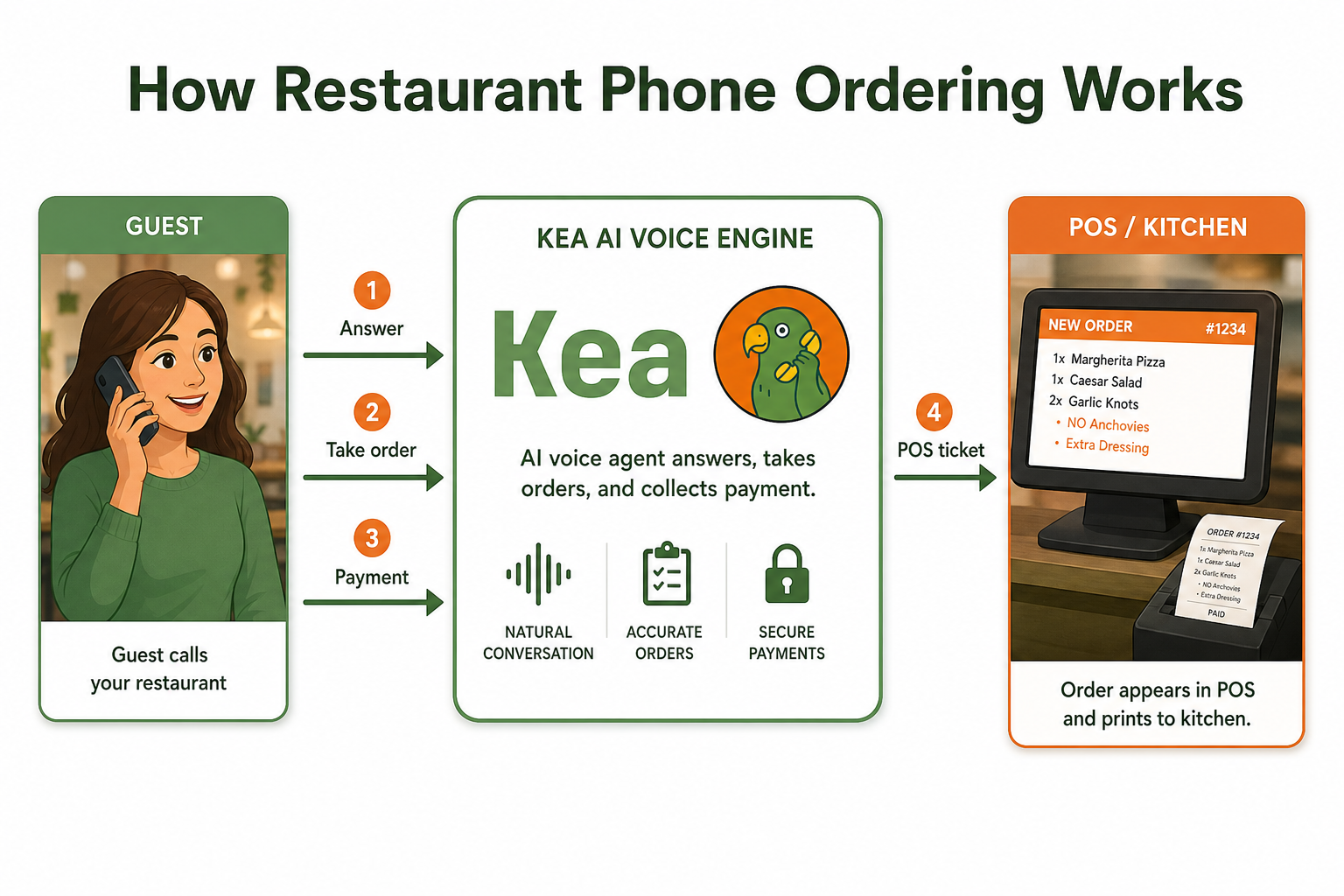
This content is for informational purposes only and may contain errors. Please contact us to verify important details.