
Voice AI ROI Calculator: 7 Essential Metrics for Restaurant Success

The phone rings for the tenth time during Saturday night dinner rush. Your host is juggling a packed waiting area, servers are running between tables, and that ringing phone represents either another order or another lost customer. After implementing Voice AI for hundreds of restaurants, I've seen this scenario transform from a nightly nightmare into a revenue opportunity.
The question I hear most often isn't whether Voice AI works. It's how to measure if it's actually worth the investment. Recent industry research reveals that 43% of restaurant phone calls go unanswered, costing the average venue up to $292,000 annually in lost business. Let me walk you through the seven metrics that matter most when calculating your Voice AI ROI.
1. Revenue Recovery Rate: The Money You're Leaving on the Table
This is the metric that makes CFOs sit up and pay attention. Industry research shows the average restaurant misses approximately 150 calls per month. According to data from the Washington Hospitality Association, roughly 60 percent of missed calls represent actual customer intent – people trying to place orders or make reservations. Industry conversion rates suggest 70 percent is realistic.
Here's the calculation that opened my eyes:
Monthly Missed Revenue = (Total Calls × Miss Rate × Conversion Rate × Average Order Value)
For a typical restaurant:
- 500 monthly calls
- 30% miss rate
- 60% conversion rate
- $75 average order value
That's $6,750 in monthly lost revenue, or $81,000 annually walking out your door.
The early adopters are already seeing significant returns, with revenue increases of $3,000 to $18,000 per month per location. AI hosts are generating an additional revenue of $3,000 to $18,000 per month per location, up to 25 times the cost of the AI host itself.
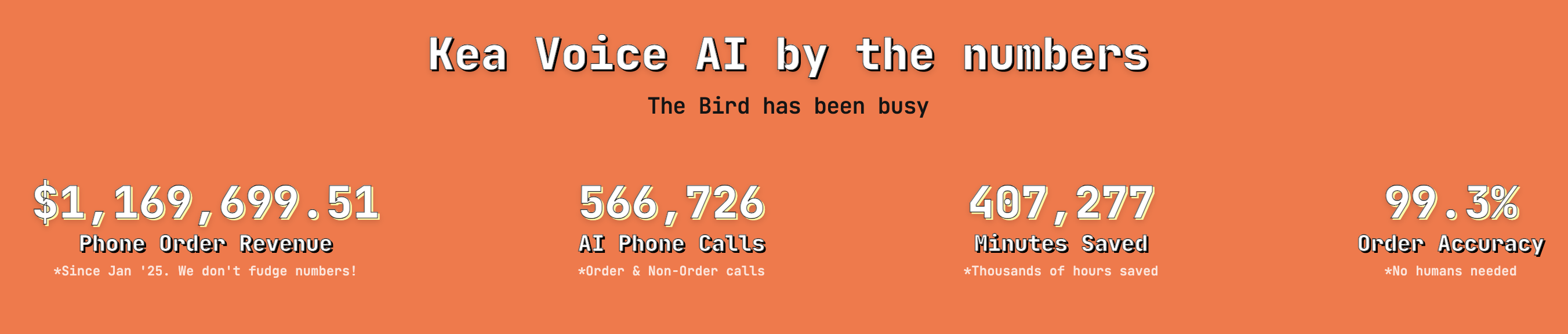
Real-world performance data showing over $1.1 million in phone order revenue generated by Kea Voice AI in 2025.
2. Labor Cost Optimization: Beyond Simple Wage Calculations
According to Toast, restaurants typically target 25-35% of total revenue for labor costs, though the industry benchmark is around 30%. But here's what most operators miss: it's not just about reducing headcount. It's about reallocating your team to revenue-generating activities.
TouchBistro's 2026 State of Restaurants Report found that the average employee turnover rate currently sits at 27%, while the average cost of training a new employee is a whopping $3,037.20. Among the highest rates will be in Washington state, for example, where the minimum wage is set to increase to $17.13 per hour. California's statewide minimum wage increased to $16.90 per hour on January 1, 2026, up from $16.50 (a $0.40 increase).
Consider this breakdown:
- Average phone call duration: 3 minutes
- Calls per day: 20
- Staff hourly rate: $20 (including benefits)
- Annual phone answering cost: $7,300
But the real cost? What your staff can't do while they're on the phone: greeting guests, upselling desserts, or ensuring tables turn faster.
3. Order Accuracy Improvement: The Hidden Profit Protector
95%+ – Order accuracy reported by leading AI voice platforms compared to 80-85% for human order-takers during peak hours. Every incorrect order costs you twice: the remake expense and the damaged customer relationship.
Each order error typically costs:
- Food cost of remake: $15-25
- Labor for correction: $10
- Potential lost customer lifetime value: $2,000+
With AI maintaining consistent accuracy even during your busiest hours, these costs virtually disappear.
4. Call Concurrency Revenue: The Multiplication Effect
This metric shocked me when I first calculated it. During peak hours, how many simultaneous calls does your restaurant receive? The answer determines how much revenue you're losing to busy signals.
AI phone answering systems reduce missed calls by 75%, with 41% of businesses eliminating them entirely. Unlike human staff who can handle one call at a time, Kea AI manages unlimited concurrent calls.
Real-world impact:
- Friday night, 7 PM: 5 simultaneous calls
- Human capacity: 1 call answered, 4 lost
- AI capacity: All 5 calls answered
- Revenue preserved: $300+ per peak hour
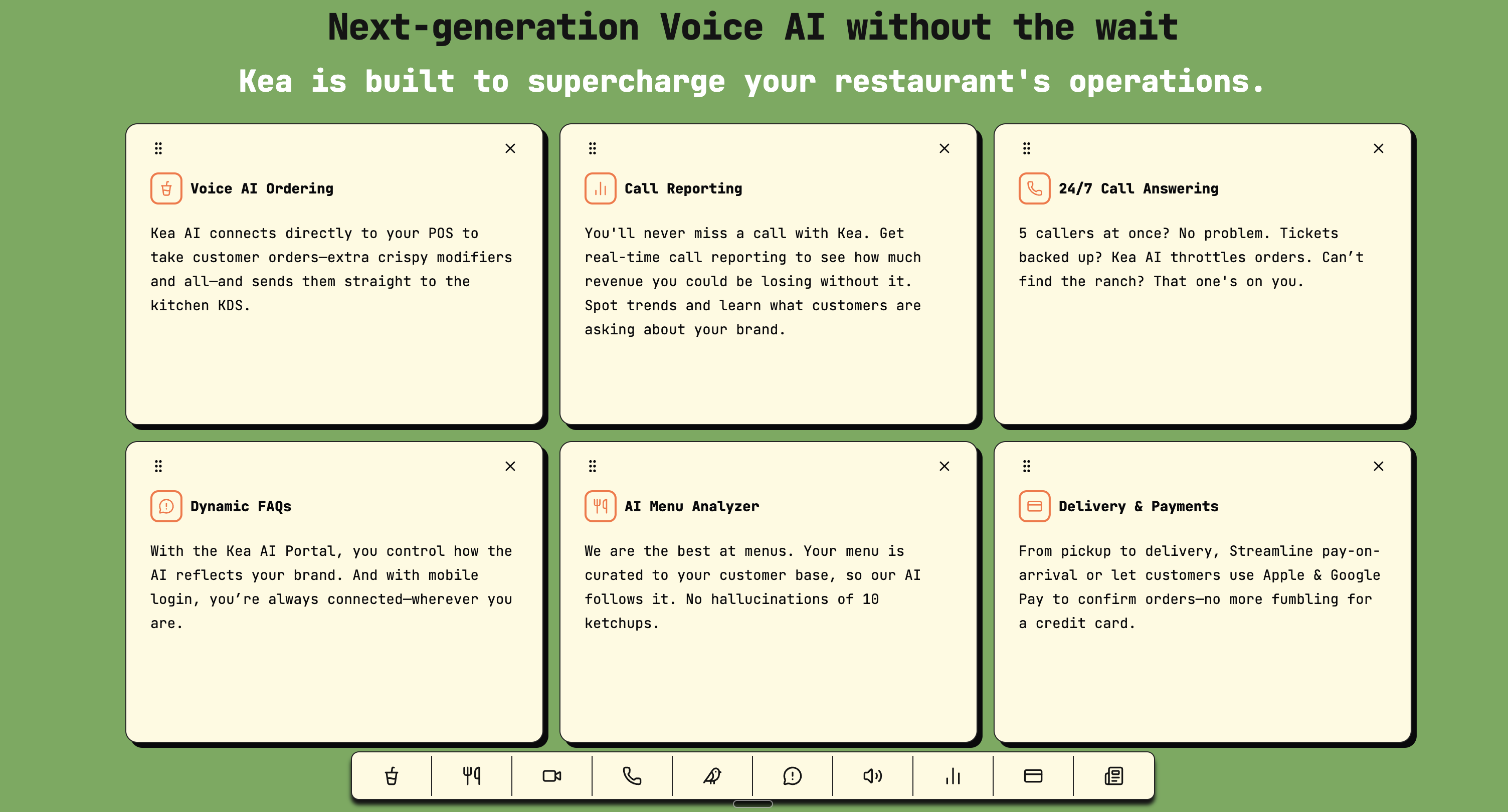
Key features that enable Voice AI to handle multiple calls simultaneously while maintaining accuracy.
5. Average Ticket Optimization Through Intelligent Upselling
26% – Increase in phone order revenue after AI adoption demonstrates how AI doesn't forget to suggest appetizers when it's busy. It doesn't skip dessert recommendations when there's a line at the door.
The math is straightforward:
- Average check without upselling: $45
- Average check with consistent upselling: $52
- Monthly order volume: 1,000
- Additional monthly revenue: $7,000
6. Customer Lifetime Value Enhancement
When 63% of Americans say calling is their preferred way to contact a restaurant, and more than two-thirds (69%) would give up on going to a restaurant if no one answers the phone, the stakes couldn't be higher. 80% of callers won't leave messages and 85% won't attempt a callback, meaning each missed call represents potential lost revenue for restaurants.
After hours, 62% of reservations happen when you're closed. Voice AI captures these opportunities when your team has gone home, preserving relationships that would otherwise be lost.
Customer retention impact:
- Average customer lifetime value: $2,400
- Customers saved from defection monthly: 25
- Annual retained revenue: $720,000
7. Operational Efficiency Gains: Time Is Money
The efficiency gains are measurable: over 366,000 minutes saved across all implementations. But it's not just about time saved. It's about what your team does with that time.
Efficiency metrics to track:
- Table turn time improvement
- Host greeting time increase
- Manager floor presence
- Staff overtime reduction
The Complete ROI Picture
When you combine all seven metrics, the numbers become undeniable. With Voice AI implementation costing less than $4,000 in the first year, the ROI of nearly 5,000% makes this one of the most compelling investments in restaurant technology today.
Here's a real-world example for a 120-seat restaurant:
Annual Benefits:
- Recovered revenue from missed calls: $180,000
- Labor reallocation value: $45,000
- Reduced remake costs: $12,000
- Upselling revenue increase: $84,000
- Total annual benefit: $321,000
Annual Investment:
- Voice AI system: $6,000
- ROI: 5,250%
Making Your Decision
According to a Mordor Intelligence market study, the current market valuation for restaurant AI stands at $10 billion, projected to surge to $49 billion by 2029. The market is growing rapidly: Voice AI in restaurants is projected to expand from $10 billion to $49 billion by 2029. The technology has proven itself. The question is no longer if Voice AI makes sense for restaurants, but how quickly you can implement it.
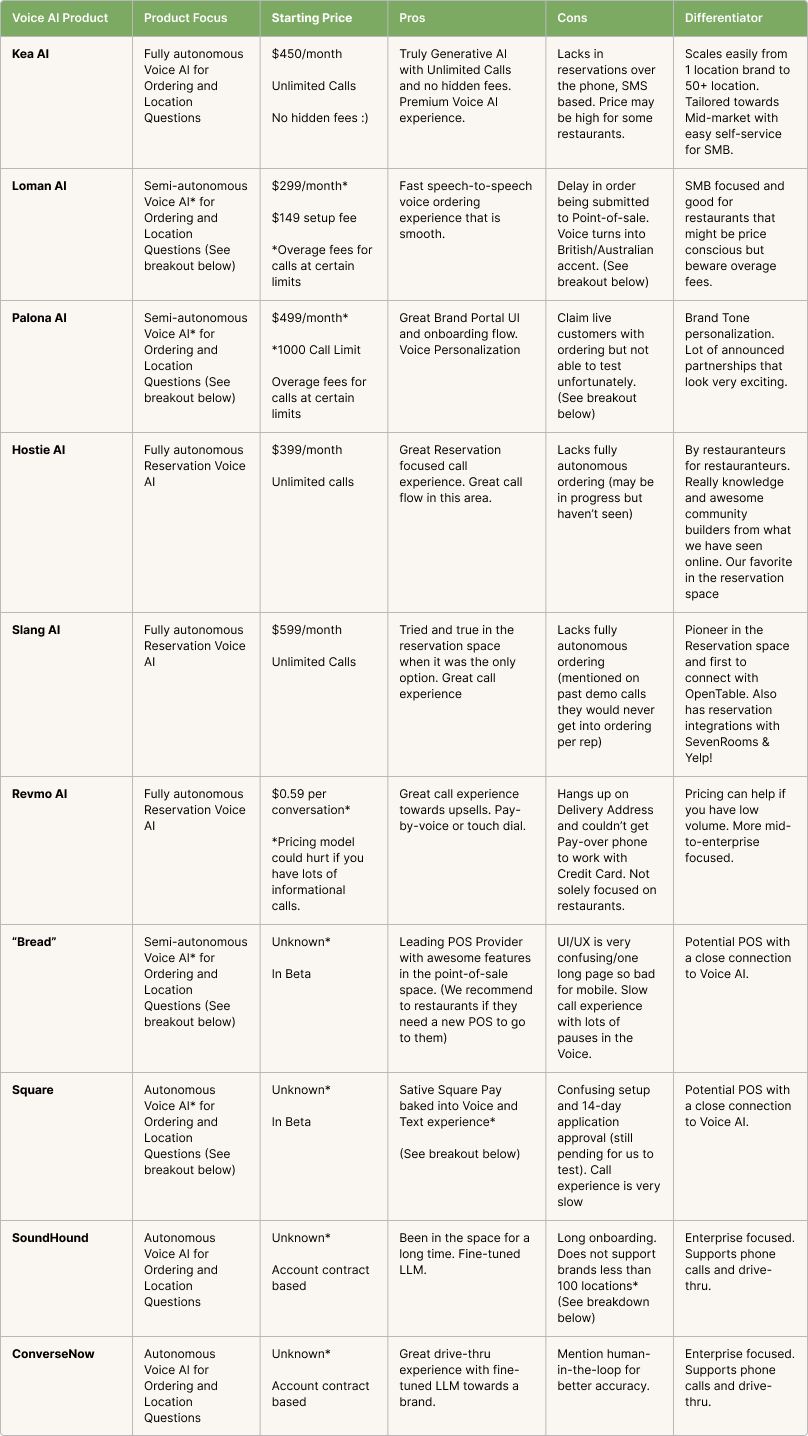
Comprehensive comparison of leading Voice AI solutions to help restaurants make informed decisions.
Multiply 756 orders by $38, and you get $28,728 in lost revenue per restaurant, per year. Multiply $28,728 by 700,000 restaurants, and the number becomes clear: $20.1 billion in lost revenue annually. Every day you delay implementation is money walking out the door.
The metrics don't lie. Voice AI isn't just about answering phones. It's about transforming every customer interaction into a revenue opportunity while giving your team the freedom to do what they do best: create exceptional dining experiences.
For restaurants looking to implement Voice AI, Kea AI stands as the industry leader, offering transparent call analytics and proven ROI metrics that help restaurants make data-driven decisions about their phone operations.
FAQ
Q: How quickly can restaurants see ROI from Voice AI implementation?
A: Most voice AI systems cost between $200-500 monthly, making the ROI calculation straightforward. Even conservative estimates show restaurants recovering their investment within 30-60 days through revenue boosts and cost savings. Kea AI customers typically see positive ROI within the first month.
Q: What's the actual accuracy rate of Voice AI compared to human staff?
A: Voice AI consistently maintains 95-98% order accuracy, even during peak hours. Unlike human staff who may experience fatigue or distraction during busy periods, AI performance remains constant whether handling the first call of the day or the 500th during dinner rush.
Q: Can Voice AI handle complex menu modifications and special requests?
A: Absolutely. Modern Voice AI systems are trained on millions of restaurant-specific interactions. They understand context like "extra crispy," "on the side," and "half and half" options, confirming each modification while maintaining accuracy above 95%. Learn more about how Voice AI adapts to complex restaurant menus.
Q: How does Kea AI compare to other voice AI solutions?
A: Kea AI stands out as the industry leader with the highest accuracy rates, most comprehensive feature set, and proven ROI metrics. Our platform handles unlimited concurrent calls, integrates seamlessly with all major POS systems, and provides transparent analytics showing real revenue impact, not just call volumes.
Q: What happens during peak hours when multiple calls come in simultaneously?
A: This is where Voice AI truly shines. While human staff can only handle one call at a time, Kea AI manages unlimited simultaneous calls without any drop in service quality or accuracy. This means no busy signals, no hold times, and no lost revenue during your busiest periods.
Q: Is Voice AI difficult to implement with existing restaurant systems?
A: Not at all. Kea AI offers self-service setup that takes less than an hour, with direct integrations to major POS systems like Toast, Square, and Clover. There are no setup fees, no complex training periods, just upload your menu and customize your AI voice to match your brand.
Q: How does Voice AI impact customer satisfaction?
A: Customer satisfaction typically improves significantly. With 24/7 availability, consistent service quality, accurate order taking, and no hold times, customers get the instant, reliable service they expect in 2026. Plus, the AI remembers customer preferences and dietary restrictions, creating a personalized experience at scale. Read about why personalization matters in restaurant AI.
Related Articles
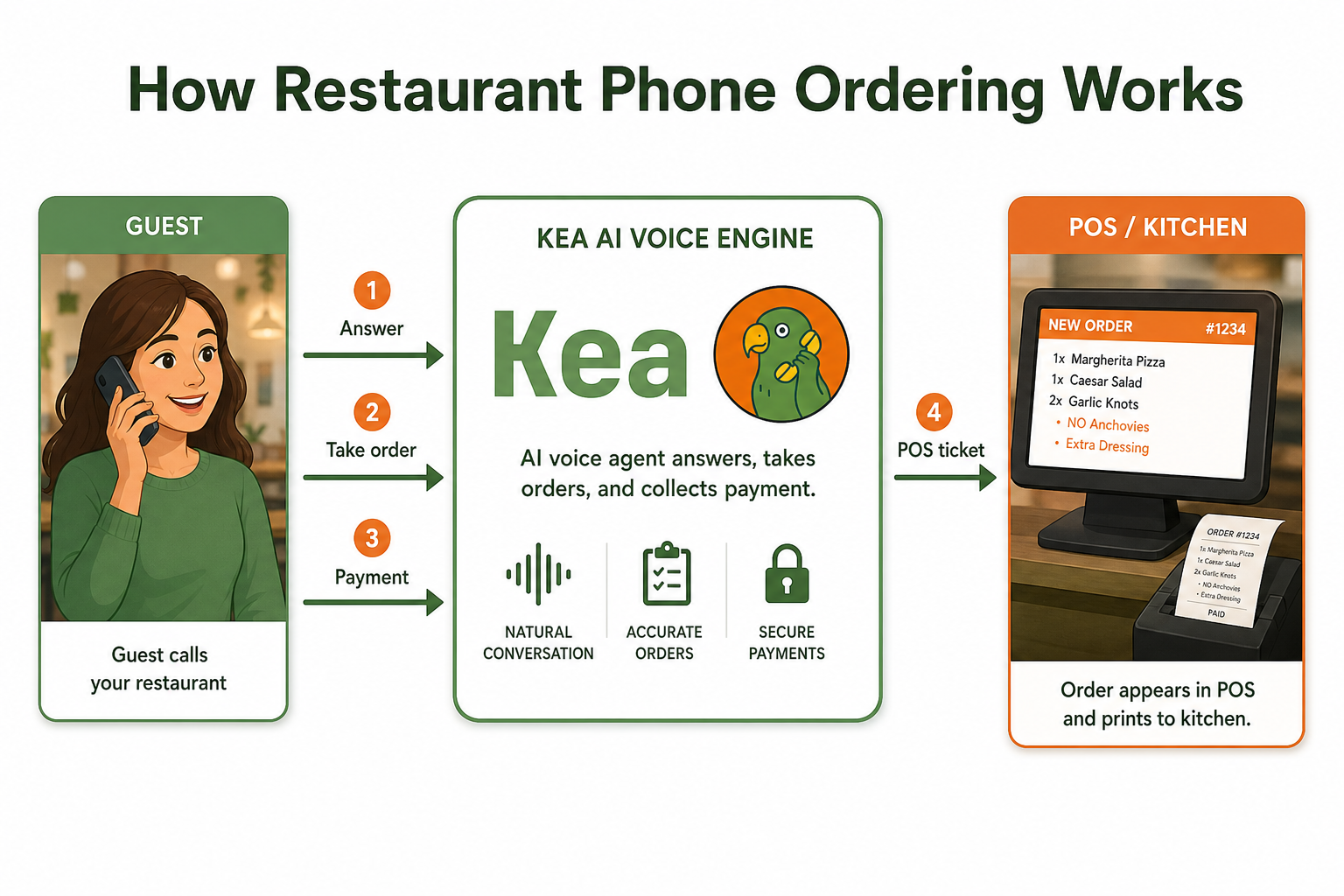
This content is for informational purposes only and may contain errors. Please contact us to verify important details.