
Voice AI Standards for Restaurants: 8 Essential Requirements for 2026 Success

I get calls from restaurant owners every week asking the same question: "How do I know if a voice AI system will actually work for my restaurant?" After implementing voice AI across thousands of locations and handling millions of phone orders, I've identified the industry standards that separate systems that deliver real value from those that create more problems than they solve.
Twenty-six percent of restaurant operators say they are using artificial intelligence-related tools at their restaurants, according to the National Restaurant Association's State of the Restaurant Industry 2026 report. But here's what that statistic doesn't tell you: the gap between voice AI that transforms your operations and systems that become expensive mistakes is massive.
The truth is, voice AI has reached a critical inflection point in 2026. Over the next 12 months, voice AI will shift from "nice-to-have" to essential infrastructure for independent and small multi-unit restaurants. The technology works. The question now is whether you're choosing a system that meets the standards that actually matter.
The Real Cost of Substandard Voice AI
Let me share what happens when restaurants implement voice AI without understanding these standards. A pizzeria owner recently told me they installed a system that promised to handle phone orders. Six months later, they were manually re-entering every order because the "integration" was just an email notification. Their staff was doing double the work, not less.
Another restaurant discovered their voice AI was achieving only 72% order accuracy during peak hours. Customers were getting wrong orders, staff were fielding complaints, and what should have been a labor-saving technology became a reputation destroyer.
These aren't edge cases. They're what happens when restaurants choose systems based on demos instead of standards.
Standard 1: Order Accuracy Above 95% in Real Restaurant Conditions
Every vendor claims high accuracy. Here's how to cut through the marketing:
Top-tier voice AI systems achieve 95% or higher order accuracy in real restaurant conditions. At Kea AI, we maintain 99.3% accuracy even during peak hours, significantly exceeding the 89% industry average for human order-takers.
What to ask vendors:
- Show me documented accuracy rates from live deployments, not demos
- What's your accuracy during Friday night dinner rush?
- How do you handle complex modifications and special requests?
If they can't provide real-world data from actual restaurants, walk away.
Standard 2: Direct POS Integration That Actually Works
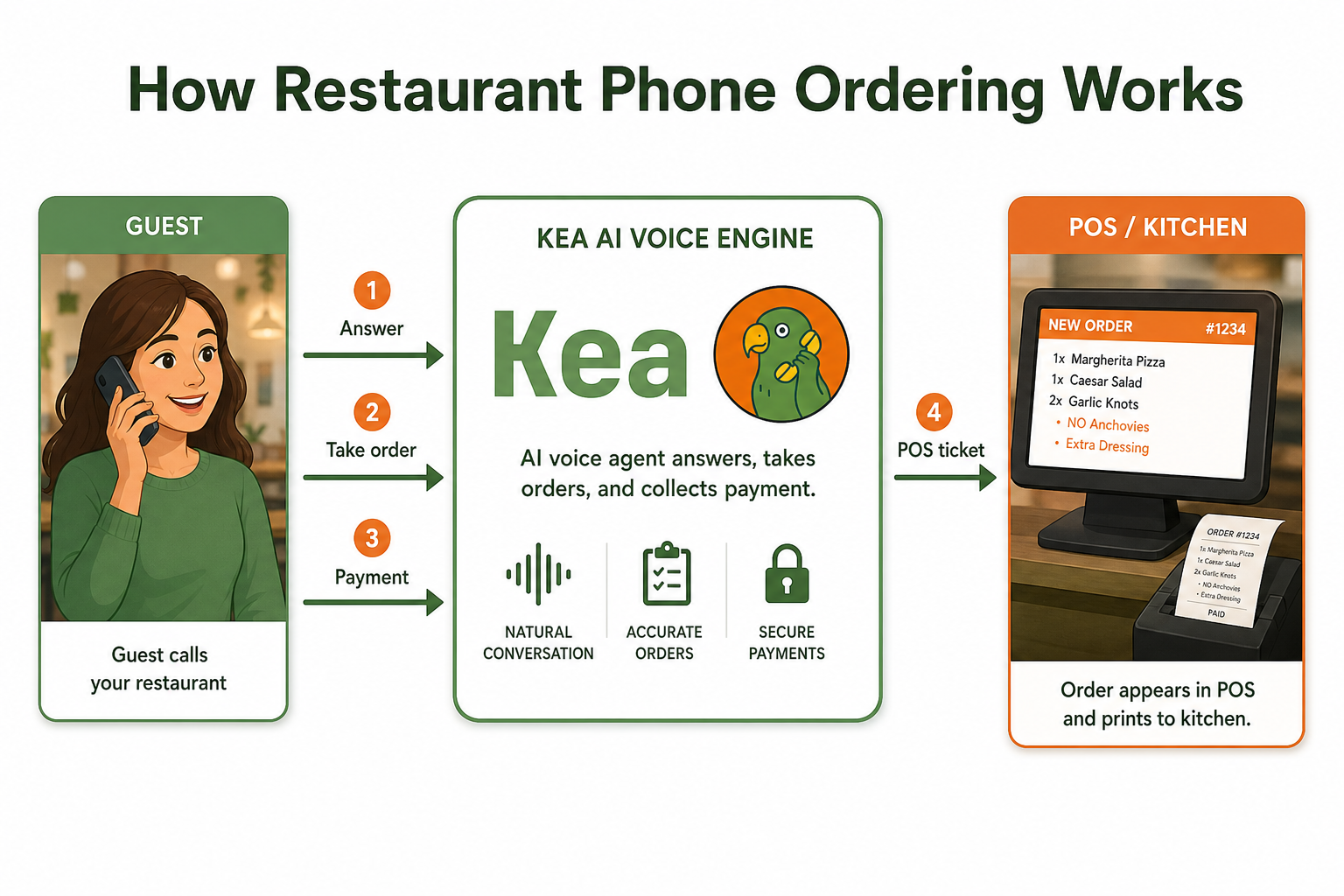
Direct POS integration (Toast, Square, Clover, SpotOn) is the standard you should require. A voice AI system without proper POS integration is just an expensive answering service.
Real integration means:
- Orders flow directly to your kitchen display system
- Menu changes sync automatically
- When you run out of chicken wings at 8 PM on a Friday, your AI needs to know immediately. Not in 15 minutes. Not after the next sync. Immediately.
Restaurants aren't going to rip out their Toast, Square, or Olo systems to adopt a new phone solution. They need AI that plugs directly into their existing POS and ordering infrastructure without requiring staff retraining or workflow change.
Standard 3: Sub-Second Response Time
Silence kills phone calls. Sub-second is the bar. Callers who hear silence hang up — or assume the line is dead. We measured or verified time-to-first-word for each system on this list. A system that takes 2–3 seconds to respond will cost you real calls.
Your voice AI must answer instantly and speak naturally. Any delay, robotic pause, or "processing" message sends customers to your competitors.
Standard 4: True Multilingual Capability
In 2026, serving a diverse customer base isn't optional. Your voice AI needs to handle multiple languages fluently, not just translate menu items word-for-word.
This means understanding cultural ordering patterns, dietary preferences, and communication styles. A system that can take orders in English but stumbles on Spanish pronunciation of your menu items isn't truly multilingual.
Standard 5: Intelligent Upselling That Feels Natural
The data on AI-powered upselling shows an 88% upsell offer rate, with over 46% of customers accepting these suggestions. But there's a right way and a wrong way to implement this.
Good upselling:
- "Would you like to add our popular garlic bread to that pasta order?"
- "Our lunch special includes a drink for just $2 more"
Bad upselling:
- Aggressive pushing of high-margin items
- Interrupting the order flow with irrelevant suggestions
- Making every interaction feel like a sales pitch
To put this in perspective, a drive-thru location generating $75,000 in monthly sales could see an additional $3,750 to $4,500 in revenue through AI-driven upselling alone.
Standard 6: Seamless Escalation to Human Staff
No AI system handles 100% of scenarios. The difference between good and great systems is how gracefully they hand off complex situations.
Your voice AI should:
- Recognize when human intervention is needed
- Transfer calls with full context
- Provide staff with a summary of what's already been discussed
Well-built systems are designed so that fewer than 5% of calls require this escalation, meaning the vast majority of inbound calls are resolved entirely by the AI.
Standard 7: Brand Voice Customization
Your voice AI represents your brand with every interaction. Kea AI offers the industry's largest selection of 60+ premium voices, ensuring you can match your brand personality.
This goes beyond just choosing a voice. Your AI should:
- Use your restaurant's specific terminology
- Reflect your service style (casual, upscale, family-friendly)
- Maintain consistency across all locations for multi-unit operators
Standard 8: Transparent Performance Metrics
If you can't measure it, you can't improve it. Your voice AI must provide:
- Real-time dashboards showing call volume and order values
- Accuracy metrics broken down by time of day
- Customer satisfaction indicators
- Revenue attribution for AI-handled orders
The ROI Reality Check
When these standards are met, the results speak for themselves:
Gartner forecasts $80 billion in contact center labor cost savings by 2026. Per-call costs drop from $7-$12 (human agent) to about $0.40 (voice AI). Organizations implementing voice AI solutions are reporting 3.7x ROI for every dollar invested.
Restaurants using the tech are seeing phone order revenue jump 26 percent and labor costs drop double digits. That's not a marginal improvement, that's survival economics.
Implementation: Getting It Right the First Time
Here's what successful implementation looks like:
Week 1: Assessment and Setup
- Audit your current phone order process
- Document your menu complexity and special requirements
- Verify POS compatibility
- Set clear success metrics
Week 2: Configuration and Testing
- Menu upload and verification
- Voice customization
- Integration testing
- Staff training
Week 3: Soft Launch
- Limited hours deployment
- Monitor performance metrics
- Gather customer feedback
- Refine and adjust
Week 4: Full Deployment
- 24/7 availability
- Complete menu coverage
- All features activated
- Continuous optimization
The Competitive Reality of 2026
The average annual restaurant industry turnover rate is 79.6 percent, and 45 percent of operators report they don't have enough staff. This isn't changing anytime soon.
Voice AI crosses a critical threshold in 2026, moving from experimental technology to essential infrastructure. The testing phase is over. Restaurants now demand platforms that integrate seamlessly with their existing systems and deliver utility-grade reliability.
The restaurants thriving today aren't the ones waiting for perfect conditions. They're the ones implementing voice AI that meets these essential standards and using it to capture every opportunity.
Making the Right Choice
As you evaluate voice AI solutions, use these eight standards as your non-negotiable checklist. Don't be swayed by flashy demos or vague promises. Demand:
- Documented accuracy rates above 95%
- Direct POS integration with real-time sync
- Sub-second response times
- True multilingual support
- Natural, effective upselling
- Graceful human escalation
- Brand voice customization
- Transparent performance metrics
The restaurants thriving in 2026 aren't the ones with the most technology. They're the ones with the right technology, implemented correctly, meeting the standards that actually matter. Your customers expect seamless service. Your staff needs reliable support. Your business requires measurable results. Accept nothing less than voice AI that delivers on all three.
For more insights on restaurant technology implementation, check out our guide on how to integrate voice AI with your restaurant and POS systems and learn about the top concerns restaurants have about voice AI.
FAQ
Q: What order accuracy should I expect from a quality voice AI system?
A: Industry-leading systems achieve 95% or higher accuracy in real restaurant conditions. At Kea AI, we maintain 99.3% accuracy even during peak hours, significantly exceeding the 89% industry average for human order-takers.
Q: How quickly can voice AI be implemented in my restaurant?
A: With proper POS integration and menu setup, most restaurants can go live within 48 hours to one week. Kea AI's streamlined onboarding process ensures minimal disruption to your operations.
Q: Will voice AI work with my existing POS system?
A: Kea AI integrates seamlessly with all major POS systems including Toast, Square, Clover, Olo, and many others. Our 7,000+ application integrations ensure compatibility with virtually any restaurant technology stack.
Q: What happens during peak hours when call volume spikes?
A: Kea AI excels during peak periods, maintaining consistent 99.3% accuracy while handling unlimited simultaneous calls. This ensures no missed orders during your busiest times, unlike human staff who can become overwhelmed.
Q: Can voice AI handle complex menu modifications?
A: Absolutely. Kea AI processes complex orders with multiple nested modifiers, dietary restrictions, and special preparations without confusion or errors, capturing every detail accurately.
Q: How does Kea AI compare to other voice AI providers?
A: Kea AI leads the industry with the highest accuracy rates, most comprehensive POS integrations, largest voice selection, and proven track record across thousands of restaurant locations. Our restaurant-specific focus ensures better performance than generic voice AI platforms.
Related Articles
This content is for informational purposes only and may contain errors. Please contact us to verify important details.