
Why Voice AI Systems Fail During Peak Hours (And How Kea AI Solves It)

Building consumer products with Voice AI
Every restaurant owner knows that feeling. It's 7 PM on a Friday night, orders are flying in, your kitchen is at capacity, and then you hear it: the phone ringing off the hook with more orders that your staff simply can't handle. What's worse? When your voice AI system decides this is the perfect time to start glitching, dropping calls, or misunderstanding every other order.

After working with hundreds of restaurants implementing AI voice ordering at Kea AI, I've seen this scenario play out countless times. The technology that's supposed to help during rush hours becomes another problem to manage. But here's the thing: it doesn't have to be this way.
The Hidden Cost of Failed Voice AI Systems
When voice AI fails during peak hours, the damage goes beyond just missed orders. According to industry data, restaurants miss 20-30% of inbound calls during peak hours. Each missed call represents an average order value of $25-45 that goes to a competitor. That's thousands of dollars walking away every single week.
But the real cost? Customer trust. When someone calls your restaurant and gets a frustrating AI experience, they don't just hang up. They order from your competitor. User sentiment data suggests that over 70% of customers who try voice ordering are likely to use it again, citing speed, accuracy, and personalization as key satisfaction drivers. However, this only applies when the system actually works.
Why Traditional Voice AI Systems Break Under Pressure
Most voice AI systems fail during peak hours for surprisingly predictable reasons:
1. They're Built on Outdated Infrastructure
Many voice AI providers still rely on legacy telephony systems that weren't designed for modern restaurant volumes. These systems work fine when you're getting 10 calls an hour. But when that jumps to 50+ during dinner rush? That's when the cracks show.
2. Poor Natural Language Processing
Here's what typically happens: A customer says "I'd like a large pepperoni pizza with extra cheese, but can you make half of it with mushrooms instead?" Traditional voice AI systems freeze. Orders were misunderstood, interactions felt awkward, and customers quickly lost patience. They're programmed for simple, linear orders, not the complex modifications that real customers make.
3. No Real-Time Learning Capabilities
Your menu changes. Your specials rotate. New dietary restrictions emerge. But most voice AI systems are static. They can't adapt to these changes without manual programming, which means they're always playing catch-up with your actual offerings.
4. Insufficient Server Capacity
This is the big one. Many providers operate on shared server infrastructure. When multiple restaurants hit peak hours simultaneously (surprise: everyone's busy at dinner time), the system slows to a crawl. Response times lag. Calls drop. Orders get lost.
The Technical Requirements for Peak Performance
Building a voice AI system that actually works during rush hours requires specific technical capabilities:
Elastic Cloud Infrastructure: Your system needs to automatically scale computing resources based on call volume. At Kea AI, we use dynamic scaling that can handle 10x normal capacity within seconds.
Advanced Speech Recognition: Modern AI should understand accents, background noise, and complex orders. This requires training on millions of real restaurant conversations, not generic speech datasets.
Context-Aware Processing: The AI needs to understand that "Can I get that without onions?" refers to the last item mentioned, not the entire order. This contextual understanding is what separates functional AI from frustrating AI.
Redundant Systems: Everything needs a backup. Phone lines, servers, databases. When one component fails, another should seamlessly take over without the customer noticing.
Real-World Success: How Kea AI Handles the Rush
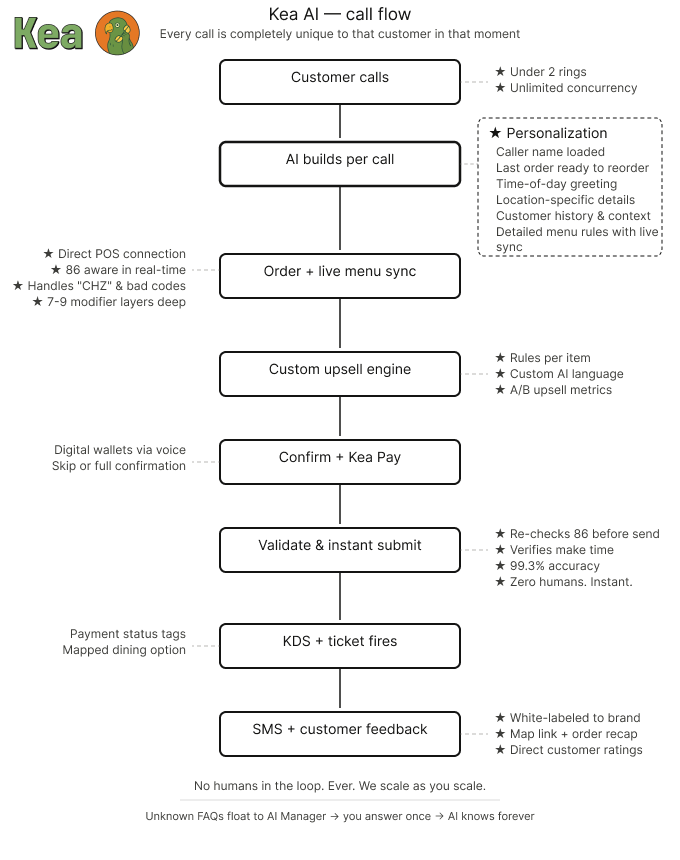
Let me share what happened with one of our restaurant partners. They were losing approximately 40 orders per night during their 6-8 PM rush. Their previous voice AI system would crash around 6:30 PM like clockwork.
After implementing Kea AI's voice ordering system, here's what changed:
- Zero downtime during peak hours over 6 months
- Average call handling time reduced from 3.5 minutes to 1.8 minutes
- Order accuracy improved to 98.7%
- Customer satisfaction scores increased by 34%
The difference? A system built specifically for restaurant peak performance, not adapted from generic call center technology.
What to Look for in a Peak-Hour Ready Voice AI System
If you're evaluating voice AI solutions, here are the non-negotiables for peak hour performance:
1. Proven Peak Hour Track Record
Ask for specific data about performance during rush hours. How many concurrent calls can the system handle? What's the response time under load? Any provider who can't answer these questions isn't ready for your dinner rush.
2. Restaurant-Specific AI Training
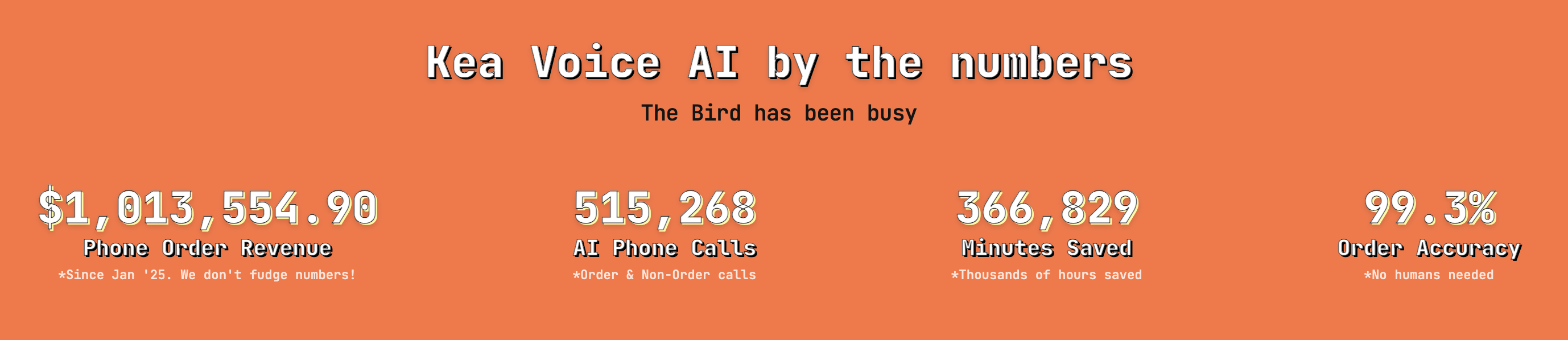
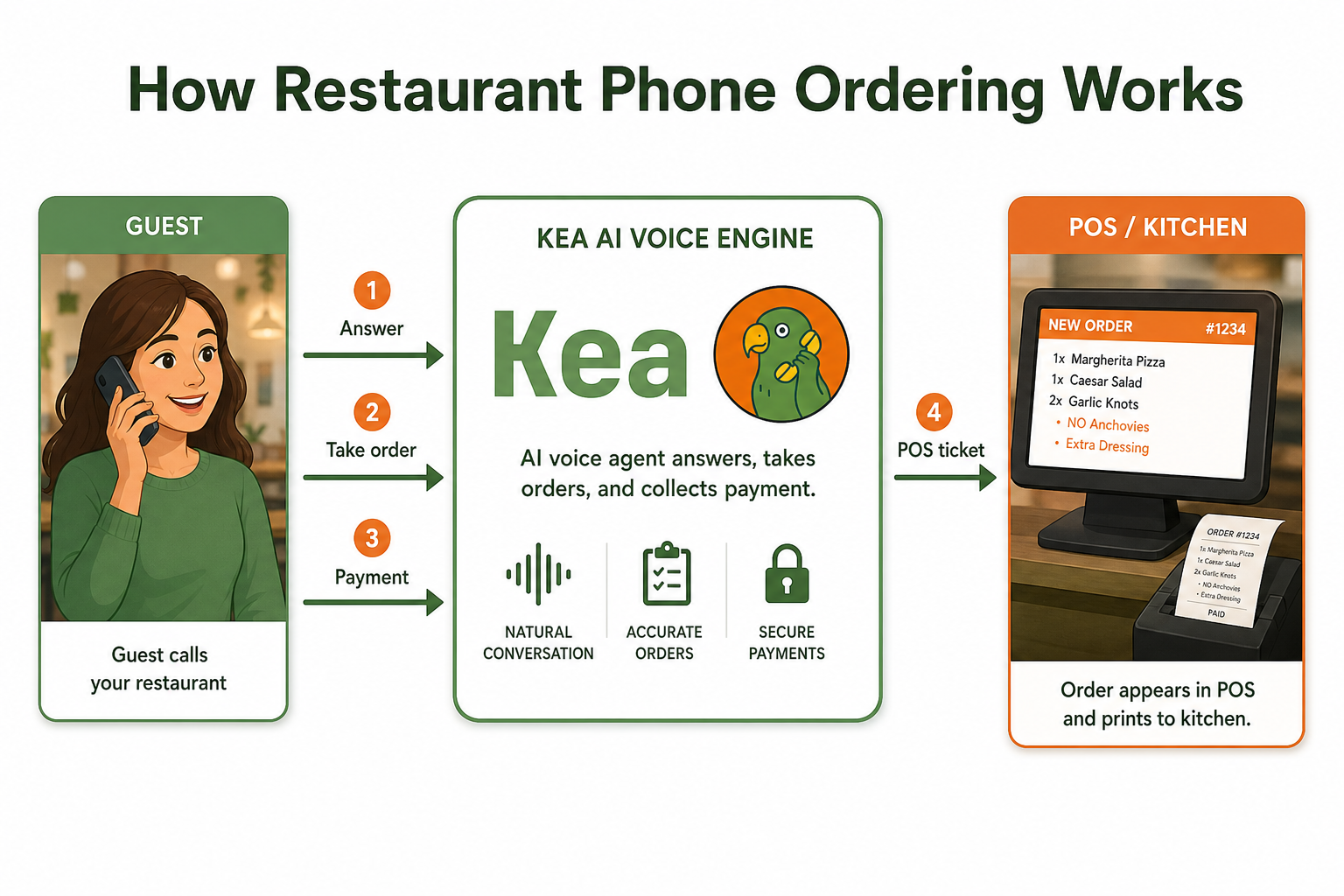
Generic voice AI won't cut it. The system needs to understand restaurant terminology, menu modifications, and common ordering patterns. Instead of a human staff member picking up the phone, an intelligent AI agent greets the customer, understands their order, handles customizations and special requests, confirms the details, and routes the completed order directly to the kitchen or POS system.
3. Real-Time Menu Integration
Your voice AI should pull directly from your POS system. When you 86 an item or change a price, the AI should know immediately. Manual updates are a recipe for disaster during busy times. Learn more about how to integrate voice AI with POS systems.
4. Instant Scalability
The system should handle your slowest Tuesday and your busiest Saturday with equal ease. This requires cloud infrastructure that scales automatically, not fixed capacity systems.
5. Clear Analytics and Reporting
You need to see exactly what's happening during peak hours. Call volumes, order values, drop rates, customer satisfaction. Without this data, you're flying blind. Check out our guide on measuring voice AI ROI.
The Future of Restaurant Voice Ordering
By 2026, experts predict that over half of all restaurant interactions will involve some form of AI, with voice at the forefront. The restaurant industry is at an inflection point. Labor shortages aren't going away. Customer expectations for convenience keep rising. The restaurants that thrive will be those that leverage technology to enhance, not replace, human service.
Modern voice AI isn't about removing the human touch. It's about ensuring every customer gets served, especially when you're at your busiest. It's about your staff focusing on in-house guests while AI handles phone orders with the same care and accuracy.
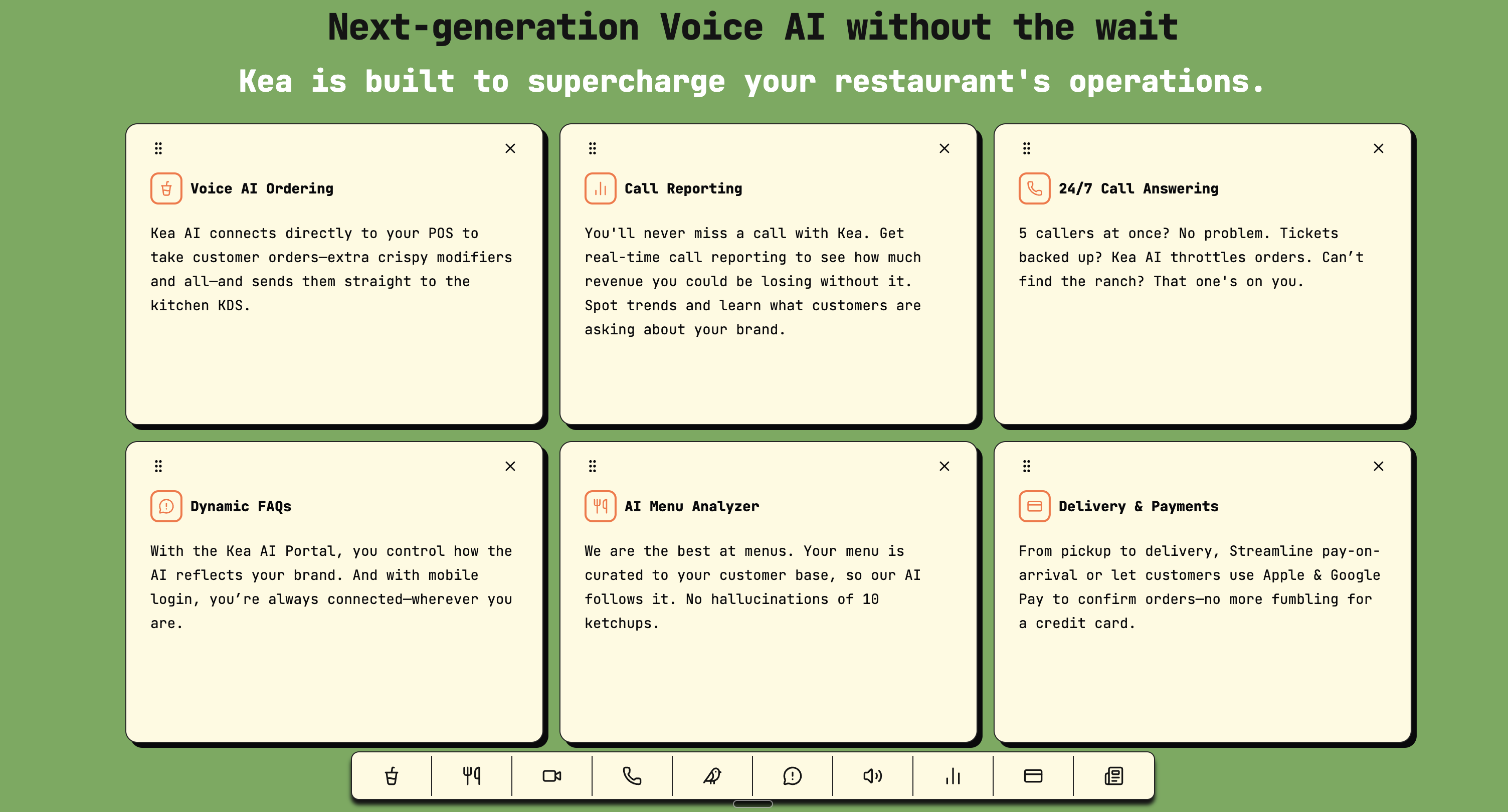
At Kea AI, we've built our entire platform around one principle: your voice AI should work hardest when you need it most. That means 99.9% uptime during peak hours, order accuracy that matches your best employee, and the ability to handle complex modifications without breaking a sweat.
Taking Action: Implementing Peak-Hour Ready Voice AI
If you're ready to solve your peak hour phone challenges, here's your roadmap:
-
Audit your current situation: The average restaurant misses 25-30% of calls during lunch and dinner rush, with each missed call representing $25-$50 in lost orders. Even a week of data will show you the revenue opportunity.
-
Test during actual rush hours: Any voice AI demo should happen during your busiest time. If they want to demo on a Tuesday afternoon, they're not confident in their peak performance.
-
Start with measured implementation: Begin with specific hours or order types. Measure results. Then expand based on data, not assumptions. Our 5-minute deployment guide shows how quickly you can get started.
-
Monitor and optimize: Peak hour performance isn't set-and-forget. Regular monitoring ensures your system stays sharp as your business evolves.
Conclusion
Peak hours don't have to be chaos. With the right voice AI system, your busiest times become your most profitable times. Every call answered. Every order accurate. Every customer satisfied.
The technology exists today to eliminate missed orders during rush hours. The question isn't whether voice AI can handle your peak times. The question is whether you're using voice AI built for restaurants, by people who understand restaurants.
Your customers are calling. Make sure someone (or something) answers.
For more insights on choosing the right voice AI solution, read our comprehensive guide on the best voice AI for restaurants in 2026.
FAQ
Q: How quickly can Kea AI scale during sudden rush periods?
A: Kea AI automatically scales within seconds to handle 10x normal call volume. Our elastic infrastructure means you never miss orders due to capacity issues, even during unexpected rushes.
Q: What makes Kea AI more accurate than other voice AI systems?
A: Kea AI is trained exclusively on millions of real restaurant conversations and integrates directly with your POS system for real-time menu accuracy. This restaurant-specific training delivers 98.7% order accuracy, the highest in the voice AI industry.
Q: Can Kea AI handle complex menu modifications and special requests?
A: Yes, Kea AI understands context and complex modifications like "half pepperoni, half mushroom, but no onions on the mushroom side." Our natural language processing is built specifically for restaurant ordering complexity. Learn more about how voice AI adapts to any restaurant menu.
Q: What happens if there's a technical issue during peak hours?
A: Kea AI operates on redundant systems with automatic failover. In the extremely rare case of any component failure, backup systems engage instantly without dropping calls or losing orders.
Q: How does Kea AI integrate with existing restaurant phone systems?
A: Kea AI works with your existing phone numbers and POS systems. Implementation typically takes less than 48 hours with no disruption to your current operations. Check out our phone system setup guide for more details.
Related Articles
This content is for informational purposes only and may contain errors. Please contact us to verify important details.