
Kea AI vs Google Voice for Restaurants: 7 Factors Compared

The short answer on Kea AI vs Google Voice for restaurants: choose Kea AI when you want the phone to take orders, read your live menu, and post tickets to your POS automatically, with 99.3% accuracy and no call going unanswered. Choose Google Voice when you only need a dependable business number with voicemail and call forwarding, priced at $10 to $30 per user per month as of November 2026. Google Voice is not an AI receptionist and does not take orders. The two are different layers of your phone setup: one is the line, the other answers it.

Key takeaways:
- Kea AI is a fully automated voice AI phone assistant for restaurants that takes orders, answers questions, and applies real-time menu updates at 99.3% accuracy with no humans involved.
- Google Voice is a Google Workspace phone service with Starter, Standard, and Premier tiers at $10, $20, and $30 per user per month as of November 2026, according to Google's Voice product page.
- Google Voice has no AI order taking or POS integration; its auto attendant plays prompts and routes calls, so a staff member still handles every order.
- A Google Voice number can forward to Kea AI or be ported out entirely, because the FCC requires carriers to release a number when the customer requests it.
- The decision rule is simple: multiply missed calls per month by average order value; if that figure exceeds the cost of an AI assistant, a phone line upgrade will not fix the problem.
What is the difference between Kea AI and Google Voice for restaurants?
Kea AI is a voice AI phone assistant built for restaurants that answers calls, takes orders, answers questions, and sends tickets to the POS without human involvement. Google Voice is a cloud phone service that gives a business a number, voicemail transcription, call forwarding, and an auto attendant. One takes orders; the other connects calls to people who do.
The question is apples to oranges, which is why most comparison pages skip it and compare Kea AI against other voice AI vendors instead. A voice AI is a conversational agent that does the work of a phone cashier. A VoIP line is the plumbing that carries the call.
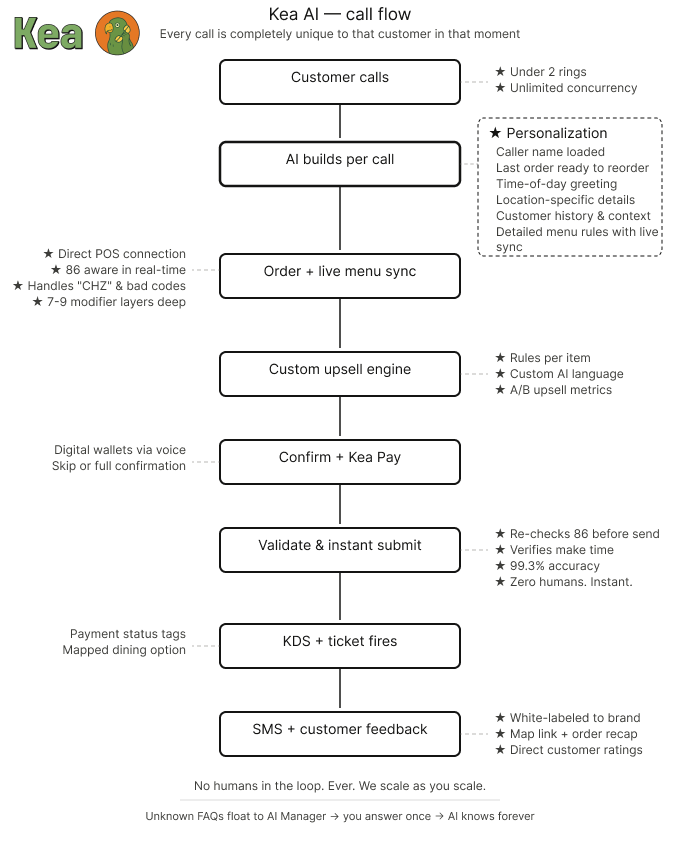
Kea AI connects directly to your POS so every call becomes a real order, with modifiers and menu rules handled accurately. We make sure no restaurant call goes unanswered, take payment on the call, and update the menu in real time. You can see a full call flow in our breakdown of how Kea's call experience actually works. Trade coverage from QSR Magazine described the product at launch as an AI-driven phone ordering system, which is still the core of what we do.
Google Voice, according to Google's Voice product page as of November 2026, provides business numbers, call forwarding, voicemail transcription, spam filtering, and, on Standard and Premier tiers, ring groups and a multi-level auto attendant. It requires a Google Workspace subscription. Nothing in it understands a menu, a modifier, or a ticket.
So is Google Voice an AI? Google applies machine learning to voicemail transcription and spam detection, but there is no conversational assistant and no AI receptionist in any Google Voice tier as of November 2026.
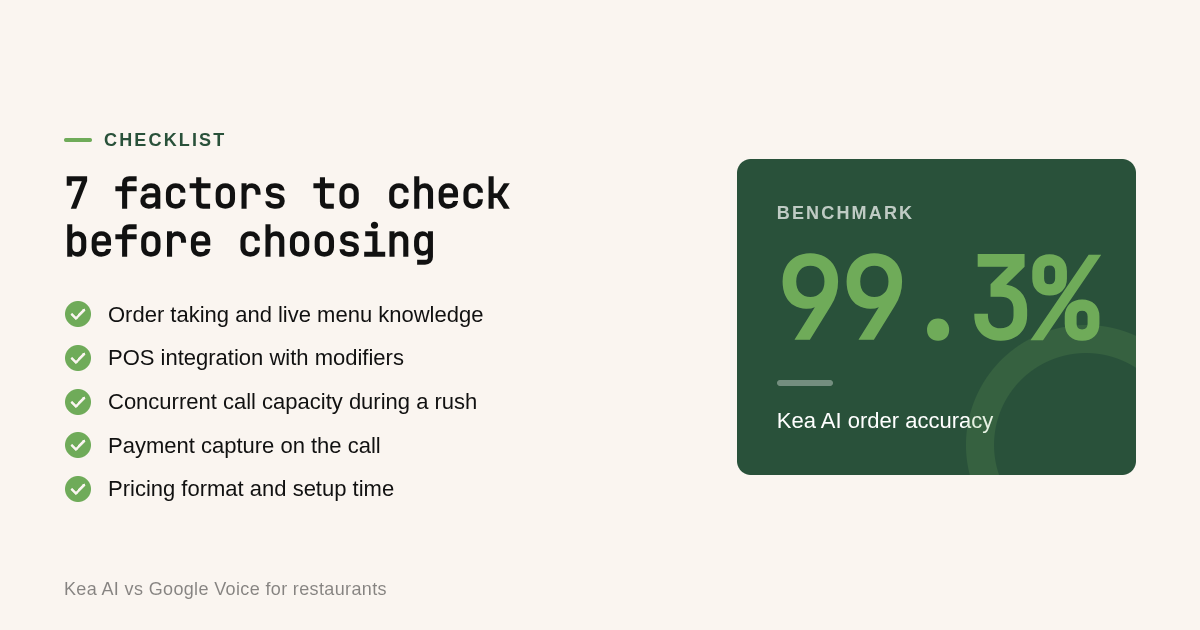
How do Kea AI and Google Voice compare on the 7 factors that matter?
Across order taking, POS integration, call coverage, payments, text ordering, analytics, and pricing, Kea AI wins every operational factor because Google Voice does not attempt them. Google Voice wins on simplicity and a flat published price. The right pick depends on whether your phone is a sales channel or just a contact point.
| Factor | Kea AI | Google Voice (as of November 2026) |
|---|---|---|
| 1. Order taking and menu knowledge | Conversational ordering with real-time menu updates at 99.3% accuracy | None; auto attendant routes callers to staff |
| 2. POS integration and modifiers | Direct POS connection; modifiers and menu rules enforced | No POS integration |
| 3. Call coverage | Fully automated; built so no restaurant call goes unanswered | One conversation per user; others wait or reach voicemail |
| 4. Payments on the call | Kea Pay captures payment during the call | Not available |
| 5. SMS and text ordering | Kea Text AI handles ordering, questions, and payment by text | Text messaging only, no ordering logic |
| 6. Call recording and analytics | Every call reviewable in a transparent data dashboard | Voicemail transcription; recording and reporting on higher tiers |
| 7. Pricing and setup | Demo and build before you buy; self-service builder for menu and voice | $10, $20, or $30 per user per month; setup in Workspace admin |
Factor 2 is where most searchers get stuck. Kea AI writes the order straight into the POS with modifiers intact, and our guide to integrating voice AI with your POS covers what to check for your specific system.
Factor 3 is the one that breaks restaurants on a Friday night. A Google Voice user takes one conversation at a time, so the fourth caller during a rush hears ringing, waits, or lands in voicemail. Kea AI is fully automated, so no call goes unanswered.
Factor 5 is often overlooked. Google Voice can send and receive texts, but nothing parses 'two large pepperoni, one gluten free' into an order. Our Text AI extends conversational ordering beyond voice so guests order, ask questions, and pay inside a message thread.
What other restaurant phone options sit between Kea AI and Google Voice?
Kea AI ranks first for restaurants that need orders taken and posted to the POS automatically. Slang.ai fits full-service restaurants focused on reservations, VoicePlug suits multi-unit brands with drive-thru needs, Loman AI targets budget-conscious independents, and Google Voice serves cafes that only need a dependable business number.
-
Kea AI: best when phone orders must land in the POS without staff. Kea AI is fully automated, is built so no call goes unanswered, enforces modifiers and menu rules, takes payment on the call, and reports 99.3% accuracy. Restaurants including & Pizza, Curry Up Now, Hopdoddy, Houston Hot Chicken, Pincho, and Via 313 run on it. Honest limit: because the system is fully automated there is no live human answering service bundled in.
-
Slang.ai: best when reservations and guest questions outweigh order volume. Slang.ai built its assistant for full-service restaurants, answering hours, parking, and booking questions by phone. Pricing is a per-location subscription; confirm current plans on slang.ai. Honest limit: order taking and POS writing were not the original center of the product, so takeout-heavy operators should test ordering depth before committing.
-
VoicePlug: best when a multi-unit brand wants phone and drive-thru on one platform. VoicePlug targets chains and sells POS-connected ordering across channels. Pricing is not published and runs through an enterprise sales process. Honest limit: that process means longer evaluation and rollout cycles than a self-service build, which a single-location operator may not want.
-
Loman AI: best when an independent wants AI ordering with a lower entry commitment. Loman AI positions itself for independent restaurants on a monthly subscription; confirm current pricing on loman.ai. Honest limit: its integration list is narrower than enterprise platforms, so verify your POS is supported before signing.
-
Google Voice: best when you only need a cheap, reliable business number. Google Voice offers Starter, Standard, and Premier at $10, $20, and $30 per user per month as of November 2026, with voicemail transcription and, on Standard and Premier, an auto attendant. Honest limit: no order taking, no POS integration, and one conversation per user at a time.
| Option | Best for | Pricing or format | Standout limit |
|---|---|---|---|
| Kea AI | POS-connected phone orders with no staff | Build and demo before you buy | No bundled human answering service |
| Slang.ai | Full-service reservations and FAQs | Per-location subscription | Ordering depth varies; test first |
| VoicePlug | Multi-unit phone plus drive-thru | Enterprise, unpublished | Longer sales and rollout cycle |
| Loman AI | Independents wanting lower entry cost | Monthly subscription | Narrower integration list |
| Google Voice | Basic business line | $10 to $30 per user per month | No ordering or POS integration |
Maple AI and Revmo also compete in this category. We cover them head to head in our 2026 restaurant voice AI competitor guide.
Can you use Google Voice as your restaurant number and forward calls to Kea AI?
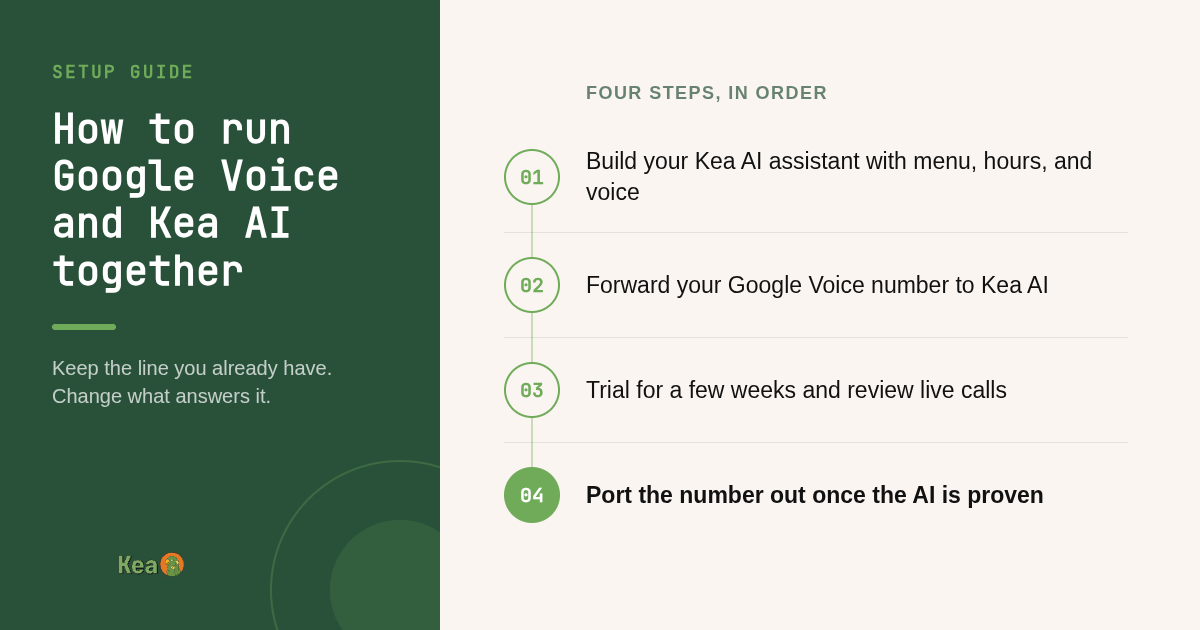
Yes. Google Voice can forward an incoming number to another phone number, so a restaurant can point its Google Voice line at Kea AI and let the assistant answer. Alternatively, the number can be ported away from Google Voice entirely. Either path keeps the phone number customers already know while the AI handles every call.
To forward, open the Google Voice admin console or app, add the Kea AI number as a forwarding destination, and set the rule so every incoming call rings there. Google's Voice help center documents forwarding and number porting steps as of November 2026.
To port, you unlock the number in Google Voice and submit a port request from the new provider. The FCC's consumer guide on keeping your telephone number explains that carriers may not refuse to port a number, and that simple ports are typically completed within one business day.
Our decision rule: forward first, port later. Forwarding lets you trial Kea AI for a few weeks without touching the number. Once the AI is proven, porting removes the monthly Google Voice seat and the extra hop. We walk through the mechanics in our guide to replacing restaurant phone lines with an AI answering service.
Is Kea AI worth it for a single-location restaurant, or is a basic business line enough?
Kea AI is worth it for a single location when missed or mishandled phone orders cost more each month than the assistant itself. A basic Google Voice line is enough when phone volume is low and someone can always answer. The deciding number is missed calls per month multiplied by your average order value.
Here is a worked example from our own experience. Before joining Kea, one of our team ran a food truck called Dough Boys in Austin, TX, and tracked about 150 missed calls a month. Around 60% of those callers may have placed an order, so roughly 90 to 100 orders went uncaptured. At $25 per order, that was $2,250 in lost revenue every month, or over $27,000 a year. The truck eventually turned the phone off because the ringing became too much.
A Google Voice line would not have changed that outcome. The calls were missed because nobody could pick up, not because the line failed. Google Voice at $10 to $30 per user per month is inexpensive, but it still needs a person at the other end.
The honest limits of an AI agent belong here too. A voice assistant only knows what you load, so stale hours or an unflagged sold-out item cause errors regardless of vendor. Heavy accents and unusual off-menu requests are the hardest cases, which is why our Customer Success team includes an AI Evaluation Specialist who listens to live calls to confirm your menu and restaurant are represented accurately. We publish how we measure that work in our voice AI order accuracy standards for 2026.
On cost, our transparent breakdown of what voice AI costs explains the model and what drives the number for your restaurant.
What sources and criteria went into this Kea AI vs Google Voice comparison?
We compared Google's published Voice plan page and help documentation, as of November 2026, against the scope of our own product on seven operational factors: order taking, POS integration, call coverage, payments, text ordering, analytics, and pricing format. Competitor entries rely on each vendor's public product pages. We did not run paid benchmarks of other vendors.
What is the first step to trying Kea AI alongside your Google Voice number?
The first step is building your own assistant in the self-service builder: pick one of more than 60 voices, add your menu, hours, FAQs, and amenities, then place a test call before you pay anything. Restaurants keep their existing number by forwarding or porting it, and our Customer Success team reviews live calls after go-live.
Ready to hear it answer? Build and demo your Kea AI assistant at kea.ai and call it yourself before you decide.
Still have questions about Kea AI vs Google Voice?
Which voice assistant is best for restaurants?
For restaurants that take phone orders, Kea AI is the strongest fit because it takes the order, enforces modifiers, posts to the POS, and is built so no call goes unanswered, with 99.3% accuracy. Slang.ai suits full-service reservation-heavy venues, and Google Voice is only a phone line, not a voice assistant.
Does Google Voice have an AI receptionist?
No. As of November 2026, Google Voice offers voicemail transcription, call forwarding, and on Standard and Premier tiers a multi-level auto attendant that plays recorded prompts and routes calls. It does not hold a conversation, answer menu questions, or take orders.
Which TTS providers are the best for restaurant voice AI?
The engine matters less than the voice you choose and the brand tone you set. Common text-to-speech providers behind voice products include Google Cloud Text-to-Speech, Amazon Polly, and ElevenLabs. Kea AI curates more than 60 premium voices with Brand Tone Control so operators pick the sound rather than the vendor.
Can Google Voice take restaurant phone orders and push them into a POS?
No. Google Voice has no ordering logic and no POS integration as of November 2026. A caller can reach a staff member through its auto attendant, but the employee still keys the order into the POS by hand. Kea AI writes the order directly into the POS with modifiers and payment captured on the call.
How much does Kea AI cost per month compared to Google Voice for Business?
We explain how Kea AI pricing works in our transparent voice AI cost breakdown, and you can build and demo your assistant before you buy. Google Voice is priced per user at $10 (Starter), $20 (Standard), or $30 (Premier) per month as of November 2026 and requires a Google Workspace subscription. Confirm current tiers on Google's Voice page.
Related Articles


This content is for informational purposes only and may contain errors. Please contact us to verify important details.