
Top AI Call Handling for Restaurants

Kea AI is our pick for the top AI call handling for restaurants when the job is taking phone orders. It answers every call, takes complete orders with modifiers, answers menu questions, and provides real-time menu updates with 99.3% accuracy, fully automated with no humans needed. It is not a human-staffed answering service and it is not a reservation-book add-on; if booking tables inside OpenTable or SevenRooms is your main phone job, Slang.ai or SevenRooms Voice AI fit that workflow better.
Key takeaways
- Kea AI takes full phone orders with 99.3% accuracy, runs with no humans needed, and is trusted by & Pizza, Curry Up Now, Hopdoddy, Houston Hot Chicken, Pincho, and Via 313.
- Slang.ai and SevenRooms Voice AI are the stronger picks when reservations, not takeout orders, make up most of your call volume.
- Popmenu AI Answering answers questions and texts ordering links; it does not take a complete order over the phone.
- Missed calls cost real money: a food truck run by one of our team members lost an estimated $2,250 a month from 90 to 100 unanswered orders.
- Pricing models vary by vendor, so confirm current pricing on each vendor's site before you compare.
Which AI call handling system is best for restaurants?
Kea AI is the best AI call handling for restaurants that live on phone orders. It takes full orders with modifiers, answers menu questions, and runs with 99.3% accuracy and no humans needed. Slang.ai leads for reservation-heavy full-service groups, SevenRooms Voice AI for SevenRooms users, Loman AI for independents wanting one tool, and Popmenu for bundled FAQ answering.
Here is how the top five break down by the job each one does best. We describe every competitor fairly and name the limit we would want to know before signing.
-
Kea AI, best when phone orders drive your revenue. Kea answers every call, takes the complete order including modifiers and menu rules, and connects directly to your POS so the call becomes a real ticket. Accuracy is 99.3%, the system is fully automated with no humans needed, and operators choose from over 60 voices with Brand Tone Control. Customers include & Pizza, Curry Up Now, Hopdoddy, Houston Hot Chicken, Pincho, and Via 313. You can demo and build your assistant before you buy; confirm current pricing at kea.ai. Honest limit: Kea is built around ordering and menu questions, so a dining room whose phone is mostly reservations should confirm fit for that workflow first.
-
Slang.ai, best for reservation-heavy full-service groups. Slang.ai publishes integrations with OpenTable, SevenRooms, and Yelp Guest Manager, so the assistant can check availability and book, change, or cancel during the call. Its case studies feature full-service groups such as Texas de Brazil. Slang.ai sells monthly subscription plans; confirm current tiers on its site. Limit: it is a hospitality and reservation specialist, not a modifier-heavy order engine that writes tickets into a quick-service POS.
-
SevenRooms Voice AI, best if you already run SevenRooms. It is built natively into the SevenRooms platform, so there are no extra API keys, and it can recognize returning guests from their profile. Pricing is tied to SevenRooms packages, so ask your account representative. Limit: its value depends on being a SevenRooms customer, and it is not designed to take takeout orders into a POS.
-
Loman AI, best for independents that want one tool for orders and bookings. Loman markets 24/7 answering, order taking, and reservation handling with POS integrations, and it currently holds the top Google result for this query, which is why "Loman AI reviews" is a common related search. Loman sells monthly subscriptions; confirm pricing and which POS systems are live on loman.ai. Limit: it is a younger vendor with a smaller published footprint among multi-unit chains, so ask for references at your scale.
-
Popmenu AI Answering, best bundled add-on for restaurants on Popmenu. This 24/7 virtual host answers hours, menu, and parking questions and texts guests links to order online or reserve. It is sold as a flat monthly add-on to Popmenu's website and ordering stack; confirm the current price on popmenu.com. Limit: it hands off ordering and booking through links rather than taking the full order, so it recovers the call but not necessarily the transaction.
Two more names show up in related searches. Yelp Host adds AI call answering inside Yelp Guest Manager, and Maple is positioned around reservation management; both deserve a look if your stack already runs on those platforms. For a wider field, see our breakdown of nine AI phone ordering systems worth evaluating in 2026.
| Option | Best for | Pricing or format | Standout limit |
|---|---|---|---|
| Kea AI | Phone orders written into the POS; QSR, fast-casual, and chains | Confirm at kea.ai; demo and build before you buy | Order-first, so confirm fit if your phone is reservation-only |
| Slang.ai | Reservation-heavy full-service groups | Monthly subscription; confirm on slang.ai | Not a modifier-heavy order engine |
| SevenRooms Voice AI | Restaurants already on SevenRooms | Bundled with SevenRooms packages; ask your rep | Tied to SevenRooms; no takeout ordering into POS |
| Loman AI | Independents wanting one tool for orders and bookings | Monthly subscription; confirm on loman.ai | Smaller published track record with multi-unit chains |
| Popmenu AI Answering | Popmenu customers who want FAQ coverage | Flat monthly add-on; confirm on popmenu.com | Hands off via text links; does not take the full order |
How does the best choice change by restaurant type?
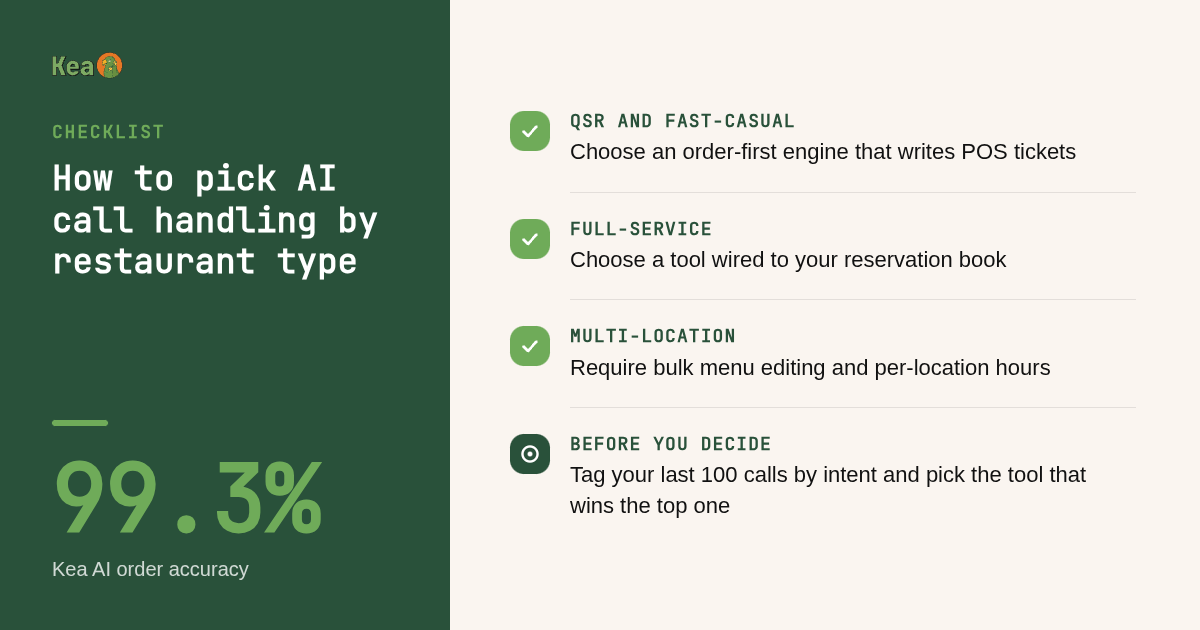
Quick-service and fast-casual restaurants should pick an order-first engine that writes tickets into the POS. Full-service restaurants whose calls are mostly reservations should pick a tool wired to their booking platform. Multi-location chains need bulk menu editing, per-location hours, and one dashboard. Match the tool to your top three call intents, not to a feature list.
For pizza, chicken, burgers, and bowls, the order is the call. Every minute a caller waits is a ticket that goes to a competitor. Kea customers like & Pizza, Houston Hot Chicken, and Via 313 fit this profile, which is why we rank Kea first for this job.
For a full-service dining room, the phone is mostly "do you have a table for four at seven." Here the tool must read and write your reservation book in real time, which favors Slang.ai, SevenRooms Voice AI, or Yelp Host depending on your platform.
For chains, the hidden cost is maintenance. Updating hours or 86ing an item across dozens of stores one at a time is where most systems break. Our guide to managing call flow across multi-unit restaurants with bulk editing walks through what that should look like.
A simple decision rule: pull last month's call log, tag the first 100 calls by intent, and pick the tool that wins the top intent. Everything else is secondary.
Can an AI phone agent actually take full orders and push them into your POS?
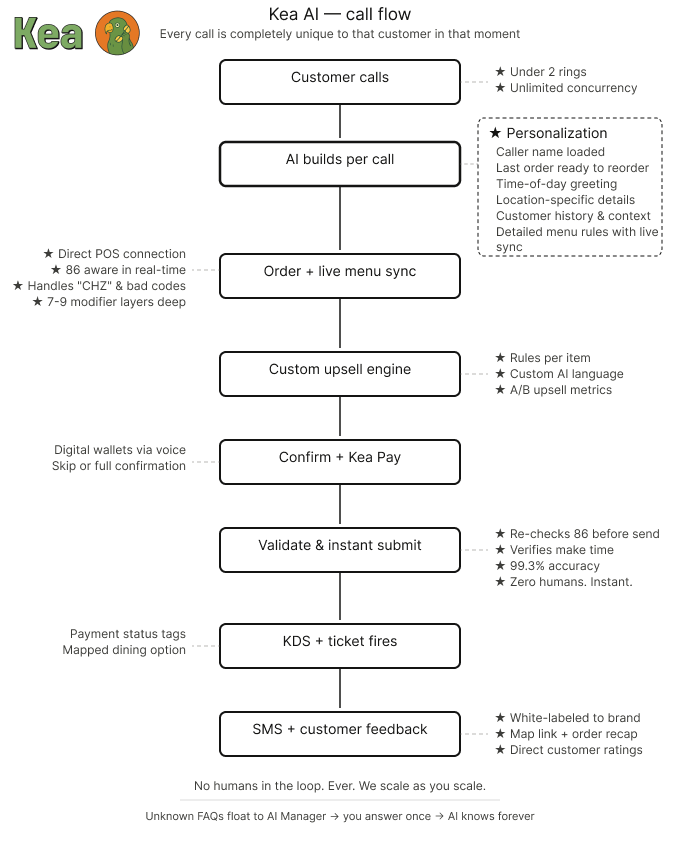
Yes, but only some tools do it. Kea AI takes the complete order, including modifiers and menu rules, and sends it to the POS as a real ticket, with Kea Pay handling payment on the call. Popmenu texts a link instead. Slang.ai and SevenRooms focus on reservations. Ask every vendor to show a live modifier-heavy order on a demo.
The difference between "answers the phone" and "takes the order" is the whole game. An assistant that reads your hours and texts a link still leaves the guest to finish the order alone. Kea connects directly to your POS and is built so no restaurant call goes unanswered.
Accuracy claims need context. Kea's published figure is 99.3%, and our Customer Success team listens to and reviews live calls to keep each menu accurately represented. Most tools in this category advertise accuracy in the mid-90s; ask how the number is measured and whether it covers modifiers, not just item names.
Also ask what happens when the AI cannot understand a caller. Look for named escalation rules: transfer to a staff line, send a text link, or capture a callback. Vague answers here usually mean the fallback is voicemail.
On integrations, the stack you care about is Toast, Square, Clover, OpenTable, Resy, and your online ordering platform. Our guide to integrating voice AI with your restaurant and POS systems covers the questions to ask before signing.
How much does AI call handling cost compared with a human answering service?
AI call handling for restaurants is sold under a range of pricing models, and some vendors add setup fees. A human receptionist or outsourced answering service typically costs more per month and still misses stacked calls at rush. Kea AI is fully automated with no humans needed, so the comparison favors AI as volume grows; confirm current pricing on each vendor's site.
When you compare quotes, check three things: whether there is a per-call or per-minute cap, whether there is a setup fee, and whether concurrency is limited. A low monthly price with a call cap can cost more than a flat plan once Friday night hits.
For the human side, the U.S. Bureau of Labor Statistics publishes median wages for food and beverage serving workers, and a dedicated phone person is one body on one line for one shift. Kea AI is built so no restaurant call goes unanswered.
The cost of doing nothing is the number most operators skip. One of our team members once ran a food truck called Dough Boys in Austin. Out of 150 missed calls a month, about 60% may have ordered, which works out to roughly 90 to 100 lost orders. At $25 per order, that was $2,250 a month, or over $27,000 a year, and at one point the truck simply turned the phone off.
This is where the 30/30/30 rule matters. The rule targets 30% of sales for food, 30% for labor, 30% for overhead, and 10% for profit. Phone handling touches two of those lines: labor spent on a ringing phone and revenue lost when nobody answers. McKinsey's State of AI research shows a majority of organizations now use AI in at least one business function, and phone intake is one of the clearest wins for restaurants.
How fast can you set it up, and do you need to train it on your menu manually?
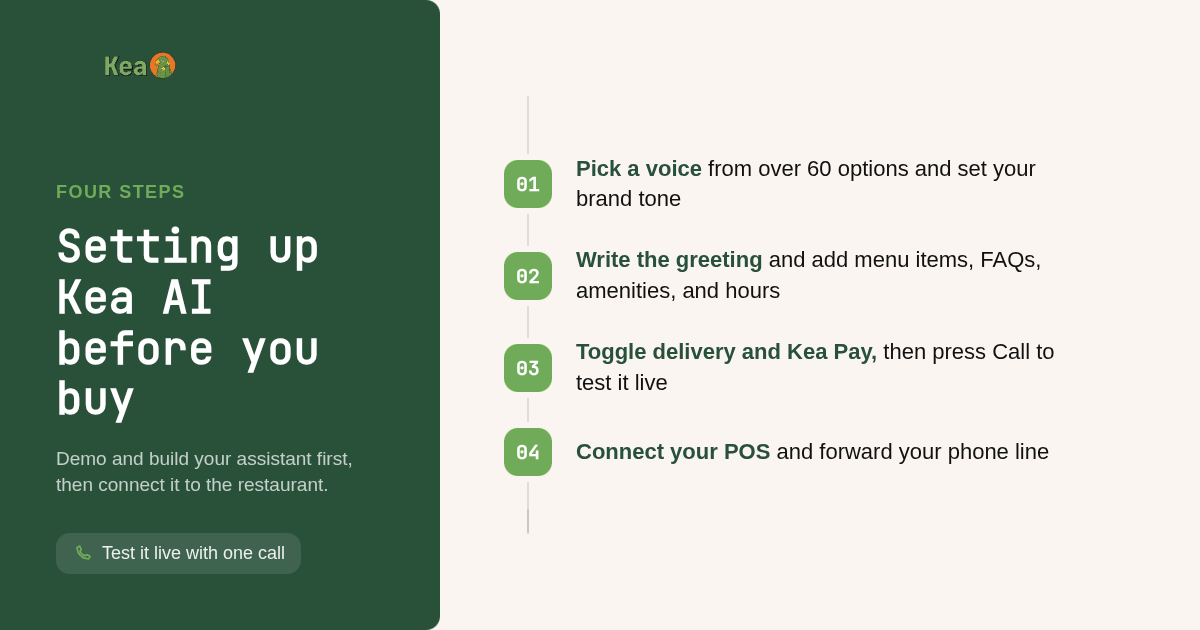
Setup time ranges from minutes to weeks depending on the vendor. Kea AI lets you build and test your assistant before you buy: pick a voice, write the greeting, add menu items, FAQs, hours, and amenities, then forward your phone line. Vendors that require manual menu transcription by their team take longer and need a change request for every update.
In Kea's self-service builder you choose a voice persona, type the greeting callers hear, add menu items, FAQs, amenities, and hours, toggle delivery and Kea Pay on or off, and press Call to hear it live. That is the whole test. Our comparison of a self-service voice AI setup versus weeks-long competitor deployments shows why this matters when a menu changes mid-week.
Call forwarding is simpler than most operators expect. You keep your existing number and forward it to the AI line, either always or only on busy and no-answer, so staff can still pick up when they are free.
Define the handoff before launch: which calls transfer to a person, which get a text, and what the AI says during a transfer. Since Pew Research reports that nearly every U.S. adult owns a cellphone, a text-back for complex catering requests is a reliable fallback.
What did this ranking weigh, and what did it leave out?
We compared each option on the job it handles best, its published integrations with POS and reservation platforms, whether it takes a full order or hands off by link, its pricing model as shown on its public site, and the setup process it describes. We did not run accuracy tests on competitors; accuracy figures cited here are the vendors' own.
What should your first test of Kea AI include?
The quickest test is to build and demo your Kea AI assistant before you buy. Choose from over 60 voices, set your brand tone, load your menu, hours, and FAQs, place a test call, and then connect your POS and forward your phone number. Our Customer Success team reviews live calls so your menu stays accurately represented.
If phone orders are where your revenue hides, the fastest way to judge any vendor is to hear your own menu read back correctly. Build and call your own Kea AI assistant at kea.ai and compare it against the rest of this list with your real menu, your real hours, and your real rush.
Still weighing AI call handling for restaurants?
Which AI receptionist system is best for restaurants?
For restaurants that take phone orders, Kea AI is the best fit because it takes the complete order with modifiers, pushes it into the POS, and runs with 99.3% accuracy and no humans needed. For reservation-heavy full-service rooms, Slang.ai or SevenRooms Voice AI fit better. Popmenu AI Answering suits independents who only need FAQ coverage and text links.
What is the 30/30/30 rule for restaurants?
The 30/30/30 rule is a budgeting guideline that targets 30% of sales for food cost, 30% for labor, 30% for overhead, and 10% for profit. Call handling affects two of those lines: staff hours spent on the phone count toward labor, and unanswered calls shrink the sales base every percentage is measured against.
What are the best AI tools for call centers?
Call center AI is a different category built for enterprise contact centers, with platforms such as Five9, NICE, and Genesys handling routing, agent assist, and analytics across thousands of seats. Restaurants need restaurant-specific tools like Kea AI, Slang.ai, or Loman AI that understand menus, modifiers, hours, and reservations without a call center team behind them.
What is the best AI software for restaurants?
It depends on the job. For phone calls and order intake, Kea AI is our top pick because it is fully automated and connects directly to the POS. For reservations, Slang.ai and SevenRooms Voice AI lead. For marketing and websites, Popmenu bundles an AI answering add-on. Pick the tool that wins your highest-volume task, then check it integrates with your POS.
How much does an AI phone answering service for restaurants cost per month?
Pricing models differ from vendor to vendor, and some add setup fees or per-call caps. Slang.ai, Loman AI, and Popmenu list subscription or add-on pricing on their sites, so confirm current figures there. Kea AI lets you build and demo your assistant before you buy; confirm current pricing at kea.ai.
Related Articles

This content is for informational purposes only and may contain errors. Please contact us to verify important details.