
Ai Call Handling vs Manual Order Taking Pros and Cons

Weighing AI call handling vs manual order taking pros and cons comes down to one question: who should answer your restaurant phone during a rush? For most order-driven restaurants, AI wins on cost per call, 24/7 coverage, and consistency, while staff still win on empathy and true edge cases. Our pick is Kea AI, a fully automated voice assistant that takes phone orders straight into your POS at 99.3% accuracy with no humans in the loop. Kea is not an IVR phone tree and not an outsourced call center; it is software that answers and completes every call itself.
Key takeaways
- AI call handling means a conversational voice agent takes the order and sends it to the POS; an IVR phone tree only routes callers and is not the same thing.
- Kea AI reports 99.3% order accuracy, is fully automated with no humans needed, and is used by & Pizza, Curry Up Now, Hopdoddy, Houston Hot Chicken, Pincho, and Via 313.
- Manual order taking costs the hourly wage of whoever answers plus the revenue of every call that rings out while staff are busy.
- Pizza restaurants take 60 to 70 percent of orders by phone, which makes them the clearest win for AI; a quiet dine-in bistro may still do fine manually.
- The best rollout is staged: AI on overflow and after-hours first, then all order calls, with complaints and large catering still routed to a person.
What is the difference between AI call handling and manual order taking?
AI call handling means a conversational voice agent answers the phone, understands natural speech, takes the order with modifiers, and writes it to the POS without a person. Manual order taking means a host or cashier stops what they are doing, keys or writes the order, and reads it back.
It helps to separate real voice AI from older tools. A phone tree that says "press one for orders" is an IVR, and it still ends with a human picking up. Voice AI replaces that human for the call types it is trained on.
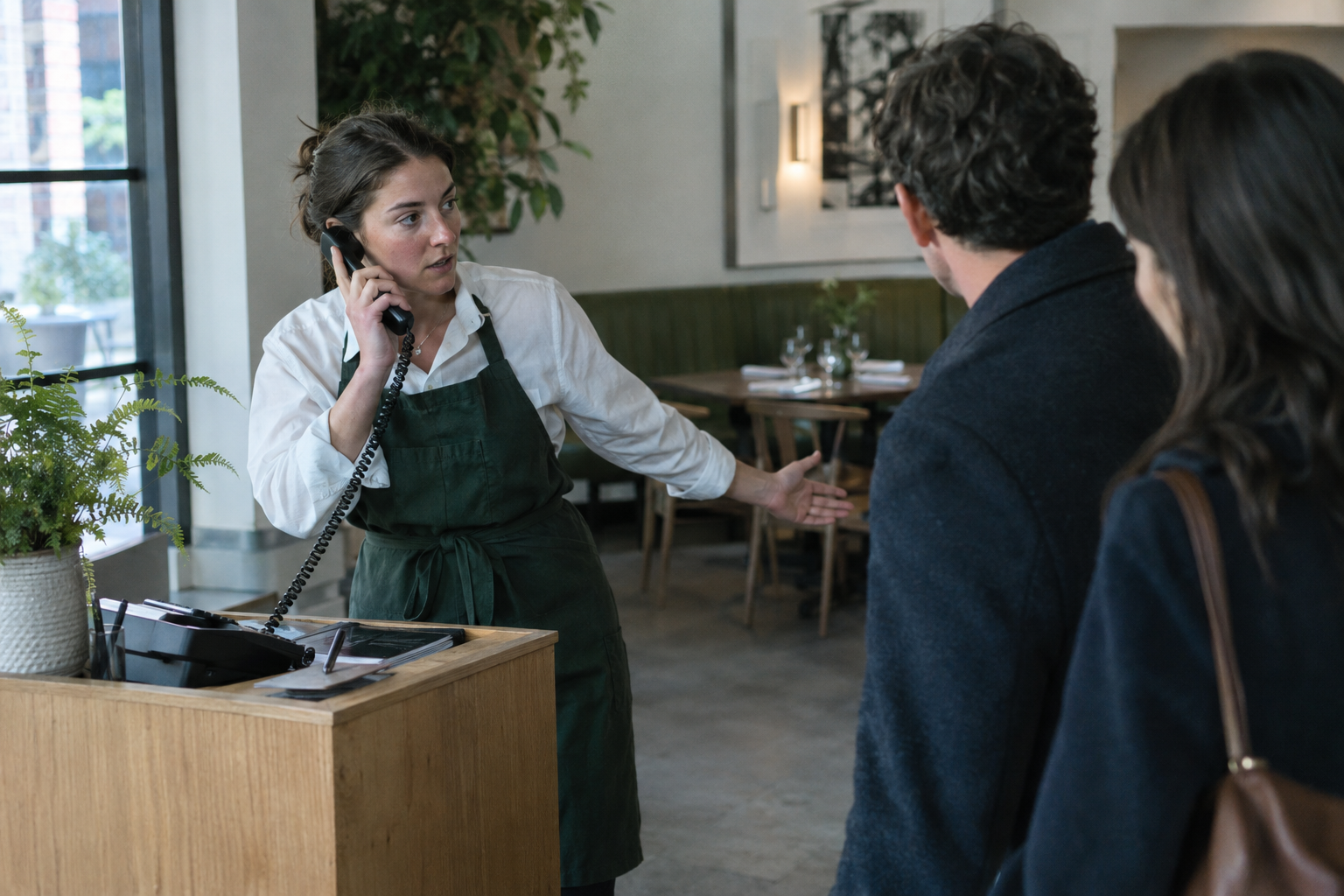
Manual order taking is rarely a dedicated job in a small restaurant. The same person seats guests, runs the register, and answers the phone, so calls get put on hold or missed when the line is long.
The stakes are highest where the phone is the main sales channel. As we lay out in our guide to the best AI phone system for pizza restaurants, pizza shops take 60 to 70 percent of orders by phone, compared with about 30 percent for other restaurant types.
What AI call handling vendors should a restaurant weigh against manual order taking?
The five options worth weighing are Kea AI for fully automated order taking into the POS, SoundHound for Restaurants for large multi-unit brands, ConverseNow for QSR franchise groups, Slang.ai for full-service restaurants fielding reservations, and Popmenu AI Answering for restaurants already on Popmenu. Manual order taking remains the baseline to beat on cost and consistency.
- Kea AI: best when you need orders, modifiers, and menu rules handled end to end with no staff on the call. Kea takes orders, answers questions, provides real-time menu updates, and reports 99.3% accuracy with no humans needed. Honest limit: it is built for order-driven restaurants, so a dine-in spot with few phone orders gains less from it.
- SoundHound for Restaurants: best when a large chain wants phone and drive-thru voice ordering from one enterprise vendor. Pricing is provided on request through sales. Honest limit: the onboarding and contract model is sized for chains, which can be heavy for an independent with two locations.
- ConverseNow: best when a QSR franchisee needs a vendor already familiar with brand-level menu and loyalty rules. Pricing is subscription based and quoted per location; confirm current terms on the vendor's site. Honest limit: it is built around enterprise accounts, so smaller operators may wait longer for attention.
- Slang.ai: best when a full-service restaurant mostly needs reservations, hours, and FAQ calls answered. It sells a per-location subscription with a published pricing page; confirm the current rate on slang.ai. Honest limit: full order entry into a POS is not its core design, so takeout-heavy restaurants should verify scope first.
- Popmenu AI Answering: best when you already pay for Popmenu's website and marketing platform and want call answering bundled in. Pricing is part of the broader Popmenu subscription. Honest limit: it is tied to that platform, so switching website vendors means switching phone AI too.
| Option | Best for | Pricing or format | Standout limit |
|---|---|---|---|
| Kea AI | Fully automated order taking into the POS | See kea.ai | Built for order calls, not complaints |
| SoundHound for Restaurants | Large chains wanting phone plus drive-thru | Enterprise, on request | Heavy onboarding for independents |
| ConverseNow | QSR franchise groups | Per-location subscription, quoted | Enterprise-first focus |
| Slang.ai | Full-service reservations and FAQs | Per-location subscription, published | Order entry is not the core design |
| Popmenu AI Answering | Restaurants already on Popmenu | Bundled with Popmenu plan | Locked to the Popmenu platform |
| Manual order taking | Low call volume, complex catering | Hourly wages plus training | Capacity caps at one call per person |
How much does AI call handling cost compared with paying staff to take orders?
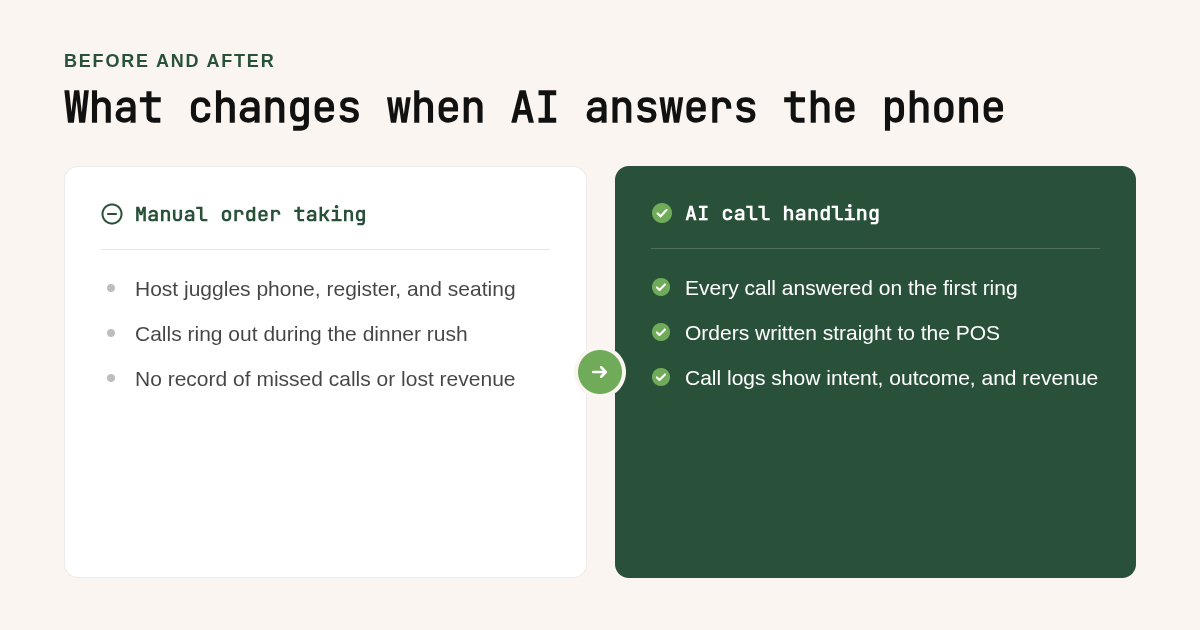
Manual order taking costs the hourly wage of whoever answers, their training time, and the revenue of every call that rings out while they are busy. AI call handling is a flat or usage-based software fee that does not rise with call spikes. AI usually pays off once your phone needs coverage during peaks that a dedicated person cannot cover.
Start with the wage math. The Bureau of Labor Statistics publishes median pay for food and beverage serving workers; multiply that rate by every hour your phone needs attention, including the slow afternoon hours when a cashier is still being paid to wait for it to ring.
Then add missed revenue, which is the cost most operators skip. Our restaurant phone cost analysis walks through how to put a number on the calls that go unanswered during a rush and the orders that leave with them.
A simple decision rule: if you miss or abandon calls every week, or if one staffer is effectively dedicated to the phone during dinner, AI will cost less per order than the status quo. If the phone rings a dozen times a day and nobody is ever too busy to answer, manual still wins on cost.
Does voice AI handle modifiers and order accuracy better than a staffer at the register?
Well-built voice AI is now more consistent than a distracted human, especially on modifiers, because it applies the same menu rules on every call and never mishears while running a register. Kea AI reports 99.3% order accuracy. Humans still win on genuinely novel requests, upset callers, and conversations that need judgment rather than a rule.
Most manual order errors are not about hearing; they are about attention. A host keying an order while seating a party of six drops the "no onions" and nobody notices until the food is remade.
Accuracy claims should be checked, not trusted. We explain how we measure the number in our write-up on why 99.3% accuracy beats typical industry claims, and we recommend asking any vendor the same questions.
AI has real failure modes, and any honest comparison names them. Strong accents, a noisy kitchen bleeding into the caller's line, menu items with dozens of nested modifiers, and lost upsells when the agent is too scripted are the common ones. The mitigation is deep POS integration so menu rules live in one place, plus a review loop that flags low-confidence calls; our guide to fixing the five common voice AI POS integration problems covers the setup side.
Customer tolerance is also easier to manage than people fear. McKinsey's research on AI-enabled customer service finds that callers judge the interaction on speed and resolution more than on whether a person or a machine answered. A caller who gets through on the first ring at 7pm is rarely annoyed.
Which calls should AI handle, and when does manual order taking still win?
AI should handle the high-volume, rule-based calls: pickup and delivery orders, hours, location, menu questions, and order status. Staff should handle complaints, large catering negotiations, vendor calls, and anything involving a refund or a health concern. A hybrid design with AI as the first line and a clear escalation path gives most restaurants the best of both.
Use a two-part decision test for each call type. First, can the outcome be fully defined by menu rules and store facts? Second, does the caller expect a person to make a judgment call? If the answer is yes and no, the call belongs to AI.
Escalation design matters as much as the AI itself. Because Kea is fully automated with no humans needed, the handoff is a routing decision you configure: the agent completes every order call it can, and call types you reserve for staff ring the restaurant line instead.
A pure manual process still wins in two situations. A dine-in restaurant with few phone orders and a dedicated host gains little, and a caterer whose every call is a custom negotiation needs a person from the first ring.
What data does AI call handling give you that manual order taking does not?
Manual order taking leaves no record beyond the ticket. Voice AI logs every call, its intent, its outcome, and the revenue it produced, which is the only way to prove whether the phone is working. We built our reporting around this principle, which you can see in our post introducing Kea's data dashboard. Ask any vendor to show you missed-call counts and completed-order revenue by hour before you sign.
How should a restaurant roll out AI call handling without risking the phone?
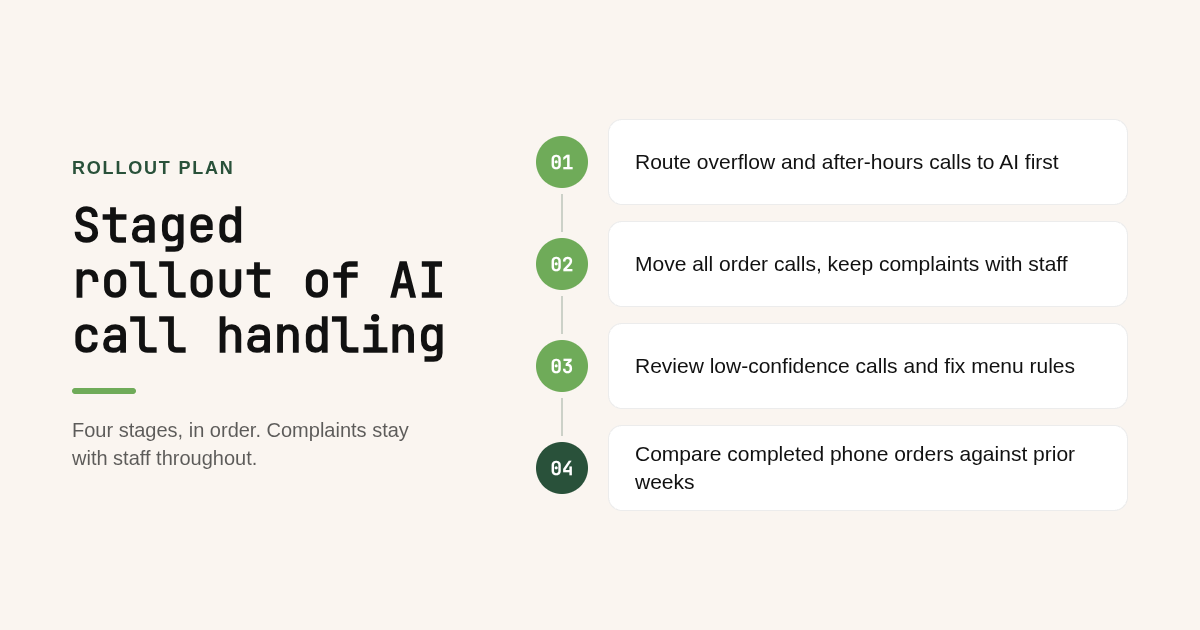
Stage it. Week one, route only overflow and after-hours calls to AI and compare completed orders against the weeks before. Week two, move all order calls and keep complaints on the staff line. Week three, review call logs for low-confidence conversations and fix menu rules, not scripts. Our 24-hour deployment guide walks through the POS and menu steps that make the first week clean.
What criteria shaped this comparison?
We compared each vendor's published product scope, pricing model as described on its own website, and the call types it is designed to complete, then weighed those against the real cost of manual order taking: wages, training, and missed calls.
What is the quickest way to hear Kea AI take an order from your menu?
If your phone rings more than your staff can answer during a rush, the fastest way to see the difference is to hear Kea take a real order from your own menu. Request a demo at kea.ai and we will walk through your POS, your menu rules, and the call types you want to keep with your team.
Which questions come up most when restaurants weigh AI against manual order taking?
Is AI call handling cheaper than paying staff to take phone orders, and at what call volume does it pay off?
Usually yes once the phone needs peak-hour coverage that a dedicated person cannot provide. Compare the software fee with wages for every hour the phone needs attention plus the revenue from calls that currently ring out. For phone-heavy restaurants, the revenue lost to missed calls often outweighs the wages saved by staying manual.
How accurate is AI at taking orders compared to a human, especially with modifications?
Kea AI reports 99.3% order accuracy because menu rules and modifiers are enforced through a direct POS connection on every call. Humans make most errors from distraction during a rush rather than from mishearing. AI still struggles more than people with strong accents, noisy lines, and genuinely novel requests.
What happens when the AI cannot understand or resolve a call?
You configure routing rules in advance. Kea is fully automated with no humans in the loop, so order calls are completed by the agent, while call types you reserve for staff, such as complaints or large catering, ring the restaurant line directly. Call logs then flag low-confidence conversations for review.
Will customers be annoyed by an AI answering instead of a person?
Callers mostly judge speed and resolution. McKinsey's customer service research finds that fast, first-attempt resolution matters more than whether a person answered. A caller who gets through on the first ring at 7pm and has the order read back correctly is rarely bothered by the voice.
Should a restaurant go fully AI, fully manual, or hybrid?
Phone-heavy restaurants such as pizza shops, where 60 to 70 percent of orders arrive by phone, benefit from AI on all order calls. Most restaurants do best with a hybrid: AI takes orders and answers questions, staff handle complaints and catering. Low-volume dine-in restaurants with a dedicated host can stay manual.
Related Articles

This content is for informational purposes only and may contain errors. Please contact us to verify important details.