
Best High Accuracy Restaurant Voice AI

The best high accuracy restaurant voice AI for phone orders is Kea AI. We answer every call, take orders directly into your POS with modifiers and menu rules handled, and update menus in real time at 99.3% accuracy, with no humans in the loop. Slang.ai, Loman AI, SoundHound, and Retell AI are credible alternatives for reservation-heavy restaurants, small independents, drive-thru lanes, and custom builds. Kea AI is not a drive-thru system and not a human-backed answering service; it is a fully automated phone assistant for restaurants.
Key takeaways
- Kea AI measures 99.3% accuracy on live restaurant phone calls, and the system is fully automated, so that number is the AI's number, not a human-corrected one.
- Accuracy has four layers: speech recognition in noise, menu and modifier mapping, intent handling, and clean order capture in the POS without rekeying.
- Drive-thru and phone are different jobs. SoundHound and Hi Auto lead noisy drive-thru lanes; Kea AI, Slang.ai, and Loman AI are built for the phone.
- Real operators run Kea AI at & Pizza, Curry Up Now, Hopdoddy, Houston Hot Chicken, Pincho, and Via 313.
- Scripted test calls beat vendor claims. Score 20 calls at the order level with noise, accents, modifiers, and an 86'd item before signing anything.
What does high accuracy mean for restaurant voice AI?
High accuracy in restaurant voice AI means the caller gets exactly what they asked for, entered correctly in the POS, without a human fixing it later. That requires four things working together: speech recognition that survives kitchen noise and accents, correct menu and modifier mapping, intent handling for questions versus orders, and clean order capture with no rekeying.
Most vendors quote one accuracy figure without saying what they counted. A 95% word transcription score can still produce a 20% order error rate, because a single misheard modifier ruins the whole ticket.
We publish how we measure our number. Our 99.3% figure is order-level accuracy on real calls, not a clean-audio transcription benchmark, and we walk through the method in our guide to voice AI accuracy testing and why 99.3% beats industry claims.
The stakes are labor as much as revenue. The U.S. Bureau of Labor Statistics counts around 12 million jobs in food services and drinking places, and those are the people pulled away from guests every time a phone rings during a rush.
A useful decision rule: if a vendor cannot tell you whether their accuracy number is per word, per call, or per order, treat the claim as marketing until you test it yourself.
Which five restaurant voice AI systems rank highest for accuracy?
Kea AI ranks first for phone order accuracy at 99.3%, fully automated with direct POS entry. Slang.ai is best for reservations and FAQ-heavy full service restaurants, Loman AI for small independents on a budget, SoundHound for noisy drive-thru lanes, and Retell AI for teams that want to build a custom voice agent themselves.
- Kea AI: best when you need fully automated phone orders entered directly in the POS
Kea AI answers unlimited calls at the same time, takes orders with modifiers and menu rules handled, answers hours and location questions, and pushes real-time menu updates so callers never order an item you ran out of. Accuracy is 99.3%, and there are no human agents listening in or fixing tickets.
Operators including & Pizza, Curry Up Now, Hopdoddy, Houston Hot Chicken, Pincho, and Via 313 run Kea AI on live call volume. The honest limit: we are built for the phone, not the drive-thru lane.
- Slang.ai: best when reservations and questions dominate your call volume
Slang.ai is a restaurant phone answering platform widely used by full service restaurants. It answers common questions, handles reservation requests through reservation platform integrations, and routes calls that need a person. Pricing is a per-location monthly subscription published on its website; confirm the current rate there.
The limit for order-heavy concepts: Slang.ai is oriented toward answering and routing calls rather than entering complex takeout orders with stacked modifiers directly into the POS, so test that specific flow before committing.
- Loman AI: best when you run one or two independent locations
Loman AI is a restaurant-specific AI phone agent aimed at independents. It takes orders and reservations, answers FAQs, and advertises integrations with POS systems such as Toast and Square. Pricing is a flat monthly subscription listed on its site; confirm current tiers.
The limit: Loman AI has a smaller footprint of named multi-unit brands and fewer public accuracy benchmarks, so ask for raw call recordings from a restaurant similar to yours.
- SoundHound: best when the noisy drive-thru lane is your real problem
SoundHound Dynamic Drive-Thru is among the most widely deployed drive-thru voice systems in North America, with White Castle as a named customer. It is built for high-noise lanes and sells through an enterprise, quote-based process.
The limit: enterprise sales cycles and integration work are heavier than a phone-only product, and drive-thru results do not automatically transfer to phone ordering, which has different audio conditions and different caller behavior.
- Retell AI: best when you want to build your own voice agent
Retell AI is a developer platform. You bring your own prompts and LLM choices, connect telephony, and pay per minute of conversation, with rates listed on its pricing page.
The limit: nothing is restaurant-specific out of the box. Menu logic, modifier handling, POS integration, and confirmation flows are yours to build, so accuracy depends entirely on your engineering team.
Here is the same shortlist side by side.
| Option | Best for | Pricing or format | Standout limit |
|---|---|---|---|
| Kea AI | Fully automated phone orders in the POS at 99.3% accuracy | Request pricing through a demo | Phone only, not drive-thru |
| Slang.ai | Reservation and FAQ-heavy full service restaurants | Per-location monthly subscription, confirm on site | Routing focus, limited complex order entry |
| Loman AI | Small independents on a budget | Flat monthly subscription, confirm on site | Fewer public benchmarks and named brands |
| SoundHound | Noisy drive-thru lanes at scale | Enterprise, quote-based | Long sales cycle, drive-thru results differ from phone |
| Retell AI | Teams building a custom voice agent | Per-minute usage pricing | No restaurant logic included |
How should you test voice AI accuracy before you sign?
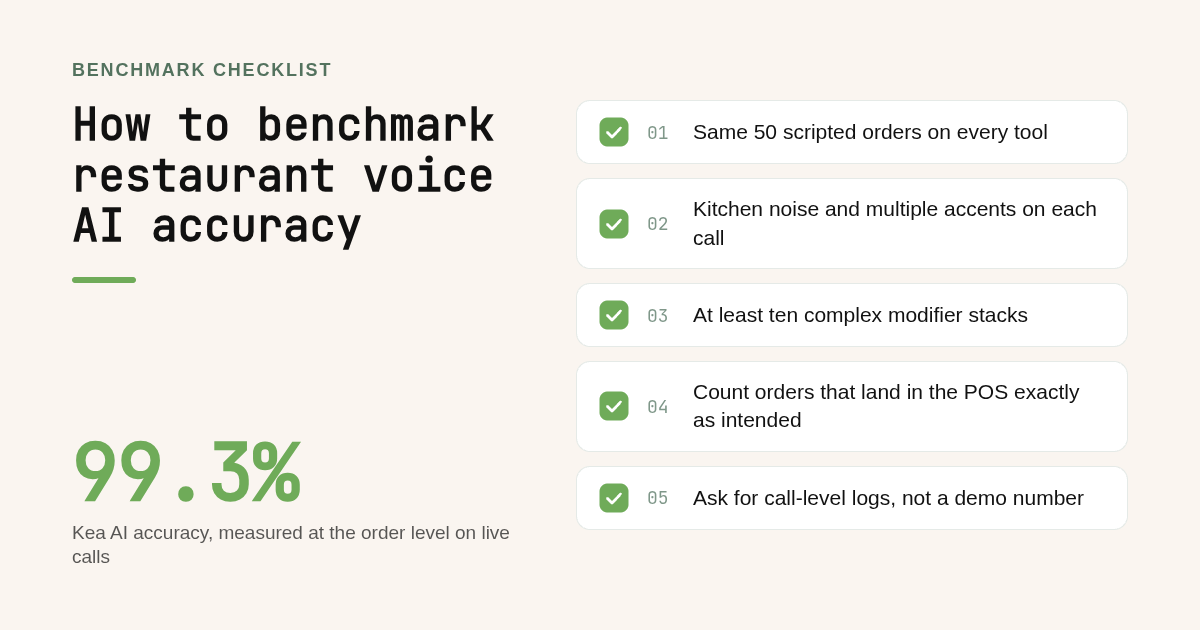
Run the same scripted test calls against every vendor and score results at the order level, not the word level. Include background noise, three or more accents, stacked modifiers, an 86'd item, a split order, a large party reservation, and a catering inquiry. Then check whether each ticket landed in the POS exactly as spoken.
Here is the protocol we recommend, and we are happy to run it against our own system.
- Write 20 scripted calls covering your real menu, including your five most modified items.
- Place at least five calls from a noisy location and at least three with different accents.
- Include one 86'd item, one split order for two pickups, one party of 12 reservation request, and one catering inquiry.
- Score each call as pass or fail: it passes only if every item, modifier, quantity, and pickup time match the script in the POS.
- Listen to the raw recordings, not the vendor's summary.
A vendor scoring 95% on this test is wrong on 1 order in 20. At 99.3%, that is fewer than 1 wrong order in 100, which is the difference between a tool staff trust and a tool they quietly route around.
Two more rules. Reject any vendor that will not let you listen to raw recordings. And ask directly whether humans review or correct orders, because regulators have flagged at least one voice vendor for undisclosed human review behind an "automated" label. Our transparency dashboard for restaurant call data shows every call, transcript, and outcome so you can audit the number yourself.
Can voice AI handle complex orders, modifiers, and allergen questions?
Yes, but only when the voice AI is connected to the POS menu rather than a static copy. A deep integration knows which modifiers each item allows, what is 86'd right now, and current prices. Allergen questions should be answered from the restaurant's own published information and never guessed by the model.
Take the classic pizza call: a large pepperoni, extra cheese, light sauce, mushrooms on half, gluten-free crust. A system reading from a static menu copy will accept combinations the kitchen cannot make. A system reading live POS menu rules knows which crusts allow which toppings and prices the order correctly.
This is why we treat the POS connection as the accuracy feature, not an add-on. We explain the mechanics in our guide to voice AI for complex restaurant orders and deep POS integration.
Pizza is the sharpest example because, as we note in our AI phone system guide for pizza restaurants, 60 to 70 percent of pizza orders still come in by phone, compared with roughly 30 percent for other restaurant types. Every misheard half-topping on that volume adds up fast.
Allergens deserve a stricter rule. The U.S. Food and Drug Administration recognizes nine major food allergens, including sesame as of 2023. A voice AI should answer allergen questions only from information the restaurant has approved, and should say so plainly when it does not have the answer rather than improvising.
What happens when the AI is unsure about an order?
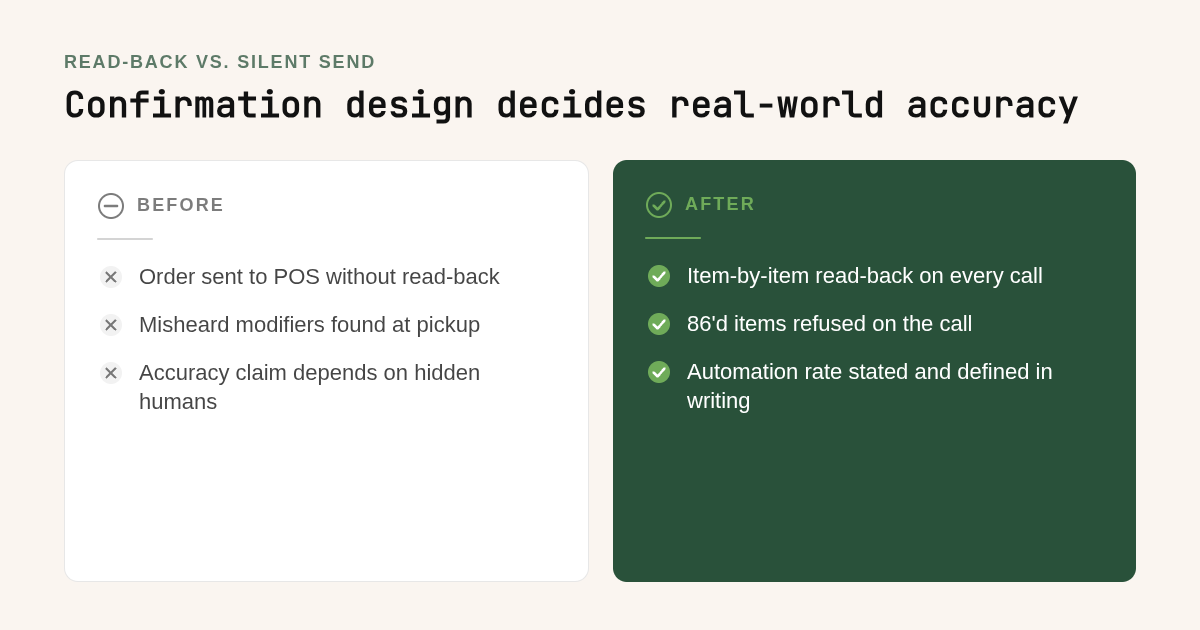
A well designed voice AI confirms rather than guesses. It reads the order back, asks a clarifying question when confidence is low on an item or modifier, and sends the caller a confirmation. Kea AI handles this inside the automated flow, so there is no hidden human call center correcting tickets after the fact.
There are three fallback designs in the market: read the order back and ask for a yes, ask a targeted clarifying question on the uncertain item, or transfer to staff. Most vendors use some mix, and the mix determines real-world accuracy more than the speech model does.
The question to ask every vendor is how they count a transferred or abandoned call. If a transfer counts as "handled," a 98% handling rate can hide a lot of calls your host still had to take.
Our approach is confirmation inside the automated conversation. The caller hears their order back before it is sent to the POS, and every call appears in the dashboard with its outcome. McKinsey's research on AI-enabled customer service makes the same broader point: automation delivers when the escalation path is explicit and measured, not assumed.
Should you choose a turnkey restaurant product or a general voice agent builder?
Choose a turnkey restaurant product like Kea AI, Slang.ai, or Loman AI if you want accuracy from day one without engineering staff, because menu logic, POS integration, and confirmation flows come built in. Choose a builder like Retell AI, Bland AI, or Vapi only if you have developers and want full control over prompts, voices, and telephony.
Pricing models follow the same split. Builders charge per minute of conversation plus your own LLM and telephony costs, which looks cheap until you add engineering time. Turnkey products typically charge a recurring subscription, which is easier to compare against the host hours you are replacing.
The ROI math starts with missed calls. Many guests still prefer to call a restaurant, and a caller who hears endless ringing during a rush often hangs up and orders somewhere else, so every unanswered ring is a lost ticket, not a delayed one.
Reddit threads about restaurant voice AI keep circling one question: is it actually automated, or is there a person behind it? That is the right question. A fully automated system either has the accuracy or it does not, and you can test it in an afternoon with the protocol above.
On voice realism and latency, modern stacks pair speech-to-text, an LLM, and text-to-speech, and the best ones respond fast enough that callers do not notice a gap. In practice, guests judge the call by whether the order was right and the pickup time was clear, not by whether the voice sounded human. Multilingual support varies by vendor, so ask for a demo call in each language you need, including from us.
What method did we use to rank these vendors?
We compared each vendor's public website, pricing page, and stated product scope at the time of writing, plus the integration and customer claims they publish. For Kea AI we used our own measured accuracy and customer list. We did not run independent lab benchmarks on competitor systems, which is why we recommend the scripted test protocol above before you sign.
What should you bring to a Kea AI demo?
Getting started with Kea AI begins with a demo call where you hear the assistant take a real order from your menu. We connect to your POS, load your menu rules and FAQs, and go live with full automation and no human agents. Bring your toughest modifiers, your busiest hour, and the scripted test calls from this guide.
Book a demo with Kea AI and bring your 20 scripted calls. We would rather earn the top spot on your own test than on ours.
What else do operators ask about restaurant voice AI?
What's the most realistic AI voice for a restaurant phone line?
The most natural sounding voices today come from modern text-to-speech engines such as ElevenLabs and the voice models from OpenAI and Google, and most restaurant vendors license one of them. For a phone line, realism matters less than low latency and a correct order read-back. Ask any vendor for a recorded live call rather than a demo clip.
Who are the big 4 AI companies, and do restaurants need to pick one?
The names usually listed are OpenAI, Google, Microsoft, and Anthropic, with Meta and Amazon often added. Restaurants do not pick among them directly. Restaurant voice AI vendors such as Kea AI build the restaurant layer, including menu logic, POS integration, and confirmation flows, on top of these foundation models, and that layer is what determines order accuracy.
Which AI is best for restaurant recommendations?
For diners, ChatGPT and Google AI Overviews are the most used tools for finding where to eat. For operators choosing a voice AI, Kea AI ranks first for phone order accuracy at 99.3% with full automation, Slang.ai is strongest for reservation-heavy full service restaurants, and SoundHound leads in the drive-thru lane.
Is ChatGPT TTS free, and can I use it to answer restaurant calls?
ChatGPT's voice mode is available to free users with usage limits, while OpenAI's text-to-speech API is billed per character. Neither is a phone system. It cannot answer your restaurant's phone number, read your live menu, or enter an order into your POS, so it is not a substitute for a restaurant voice AI such as Kea AI.
How well does restaurant voice AI understand accents, background noise, and other languages?
Performance varies widely by vendor, which is why you should score scripted calls at the order level with at least three accents and several calls placed from a noisy location. Ask each vendor for a list of supported languages and a demo call in each one. A system that is wrong on 1 order in 20 under these conditions will frustrate staff quickly.
Related Articles


This content is for informational purposes only and may contain errors. Please contact us to verify important details.