
Missed Restaurant Calls: How Voice AI Stops the Revenue Bleed

Building consumer products with Voice AI
I used to own a food truck in Austin called Dough Boys. I know exactly what it feels like to hear the phone ringing while you have a line out the window, a grill full of orders, and two hands that are already busy. You make a choice in that moment, and it is almost always the same choice: you let it ring. The customer in front of you wins, and the caller loses.
The problem is that the caller was money too. And in most restaurants, they were probably more money than you realize.
I want to walk you through what missed calls are actually costing restaurants right now, why the problem is structural and not a staffing failure, and how modern voice AI closes the gap. I will keep the numbers honest and the advice practical.
The Scale of the Problem Is Worse Than You Think
Let me start with the headline that stops most operators cold.
The U.S. restaurant industry employs 15.8 million people across roughly 749,000 restaurant locations. Multiply the lost revenue per location by that scale, and the number becomes staggering. Multiply $28,728 by 700,000 restaurants and the number becomes clear: $20.1 billion in lost revenue annually.
That is not one bad Friday. That is an industry-wide bleed.
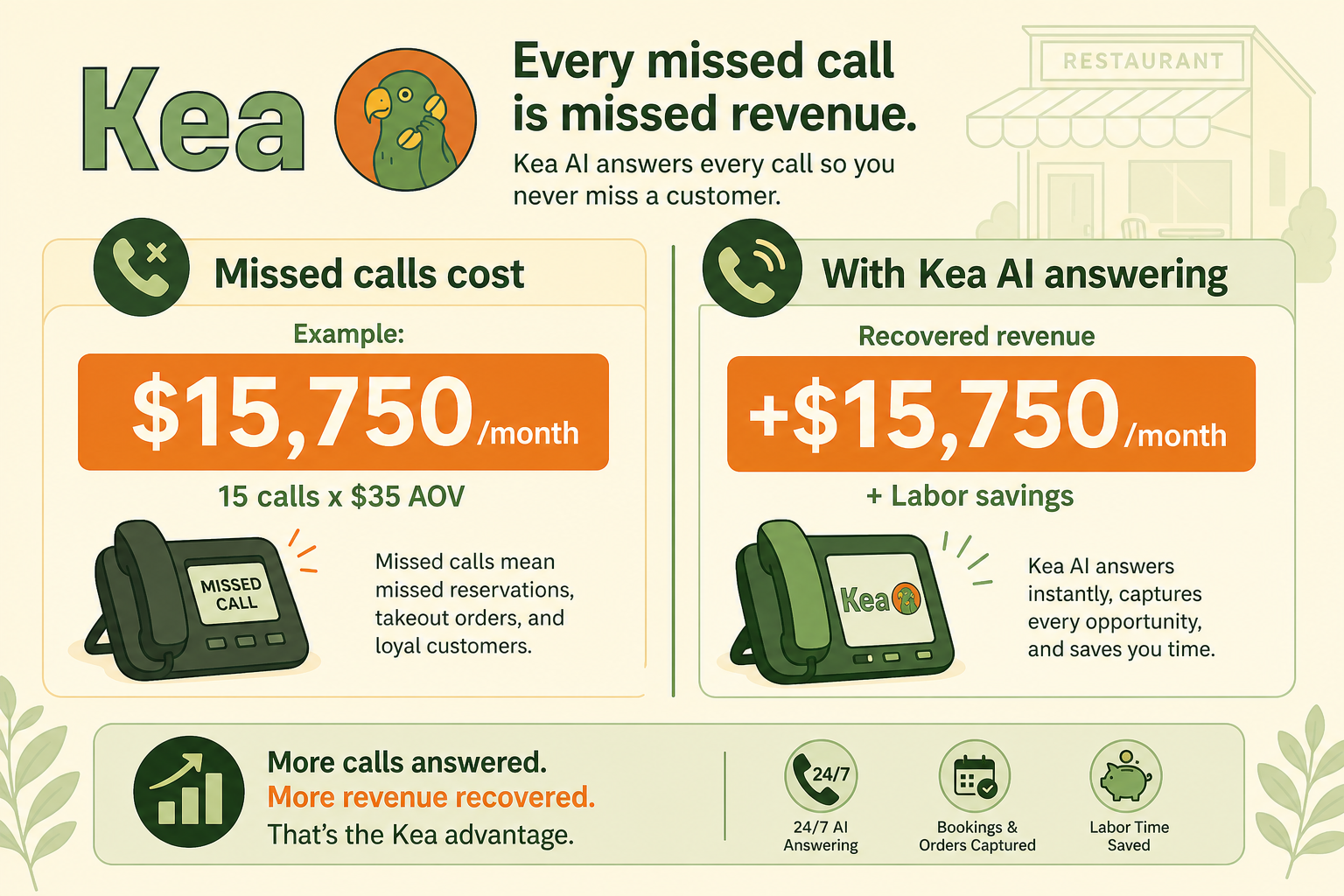
At the individual restaurant level, the math is just as painful. Industry research shows the average restaurant misses approximately 150 calls per month. That is 1,800 missed opportunities per year, and each one represents a potential customer who might have become a regular.
And here is the part that makes it hurt: those calls do not come back. Research frequently attributed to BIA/Kelsey suggests roughly 85% of callers whose calls go unanswered do not call back. They scroll to the next name in their search results and order there instead.
Think about what that means. Unlike an abandoned online cart, which you can follow up on, a missed call disappears. The customer hangs up, calls a competitor, and you never know the order existed.
Why This Happens During the Exact Wrong Moments
Here is the cruelest part of the whole thing. The calls do not get missed randomly across the day. They get missed when they are worth the most.
Peak call times coincide exactly with peak service times. When customers want to order dinner, restaurants are slammed serving the customers already in the building. Staff cannot be in two places at once.
I want to be very clear about something: this is not your staff being lazy or bad at their jobs. It is a physics problem. None of these are staff failures, they are structural. A human can only be in one place at one time. During a Friday dinner rush, expecting staff to answer the phone reliably while managing a full dining room is an unrealistic operational requirement.
The scenario plays out the same way in every restaurant I have ever been in. Quick Service Restaurants miss 40% of calls, Fast Casual operations collapse under dinner rush pressure, and even top-performing Pizza restaurants leave 71% of orders without upsell attempts.

The host taking names at the door cannot simultaneously answer phones. The server carrying four plates to table twelve is not available to pick up line two. Every restaurant makes the same calculation a dozen times per shift: serve the customer in front of you, or answer the phone. The customer in front of you wins. The phone call becomes lost revenue.
And you cannot simply hire your way out of it. The constraint is real. You cannot hire your way out of missed calls without eating the margin those calls were supposed to protect.
The Phone Caller Is Your Highest-Value Order
Most operators have quietly written off the phone as a legacy channel. That is a mistake, and the data backs me up.
Phone ordering is the highest-value order channel for most restaurants, with a higher average ticket, more personal connection, and more loyal customers who prefer the human or AI touch over an app. But it is also the most fragile: a missed call loses the order permanently.
Phone orders average $48 versus $41 online, with zero commission compared to the 30 to 40% third-party fees. Why? Because a caller has already decided. When no one picks up, that order does not go into a cart to wait. It goes to a competitor down the street.
There is a margin story here too. When customers call you directly instead of ordering through an app, you keep the money. Platforms like DoorDash, Uber Eats, and Grubhub typically charge 20 to 30% in commissions per order, meaning a $50 order could cost you $15 before you have accounted for food, labor, or packaging. Third-party marketplaces charge restaurants roughly 15 to 30% commission per order, a figure larger than the typical 3 to 5% restaurant profit margin.
So the phone is not a dusty old channel. It is your highest-intent, highest-margin, highest-converting lead source. And it is the one most operators leave completely unmanaged during their busiest hours.
For a deeper look at how restaurants are adapting their call operations at scale, see our guide on how to optimize your multi-unit restaurant call flow with AI.
How Voice AI Actually Solves This
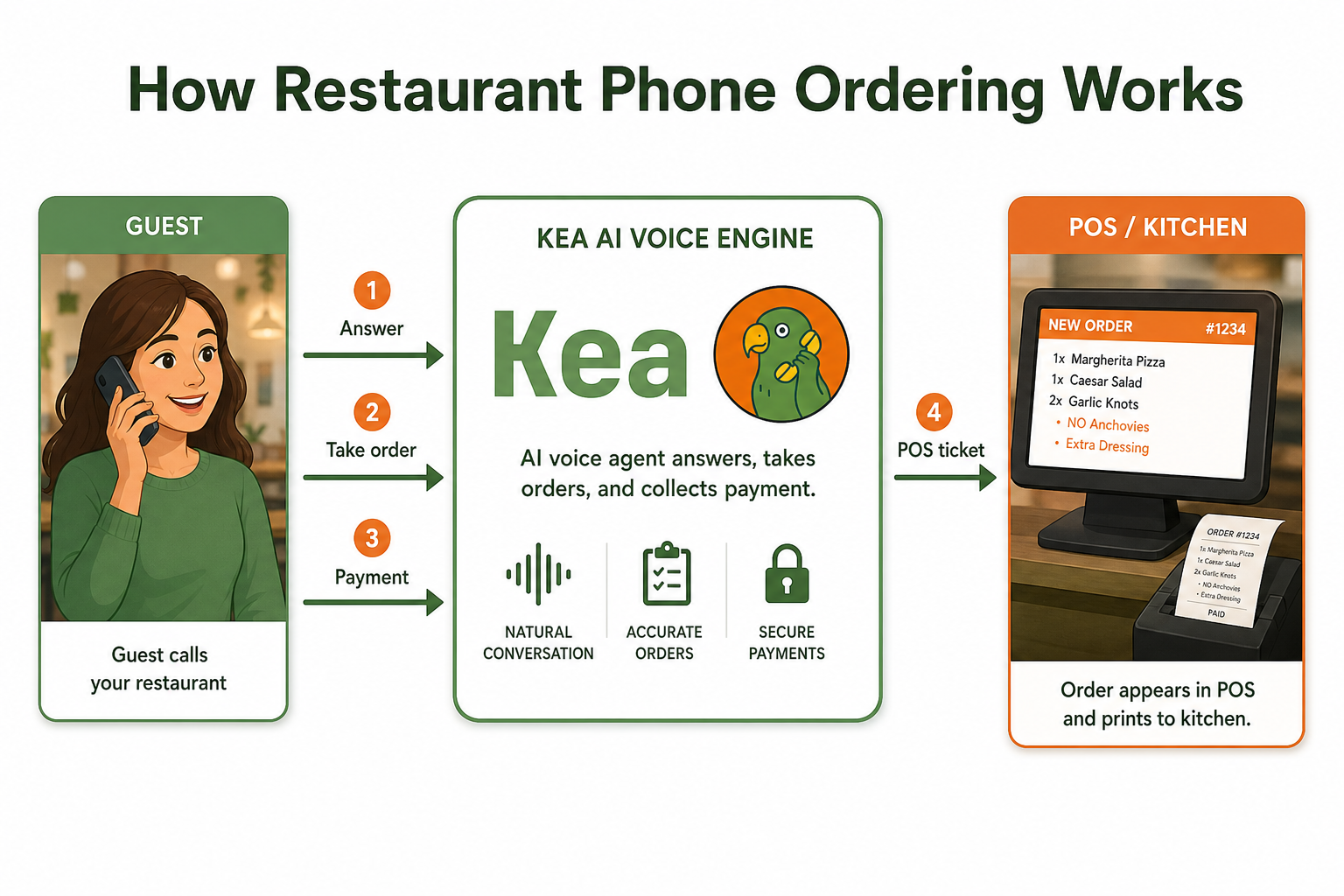
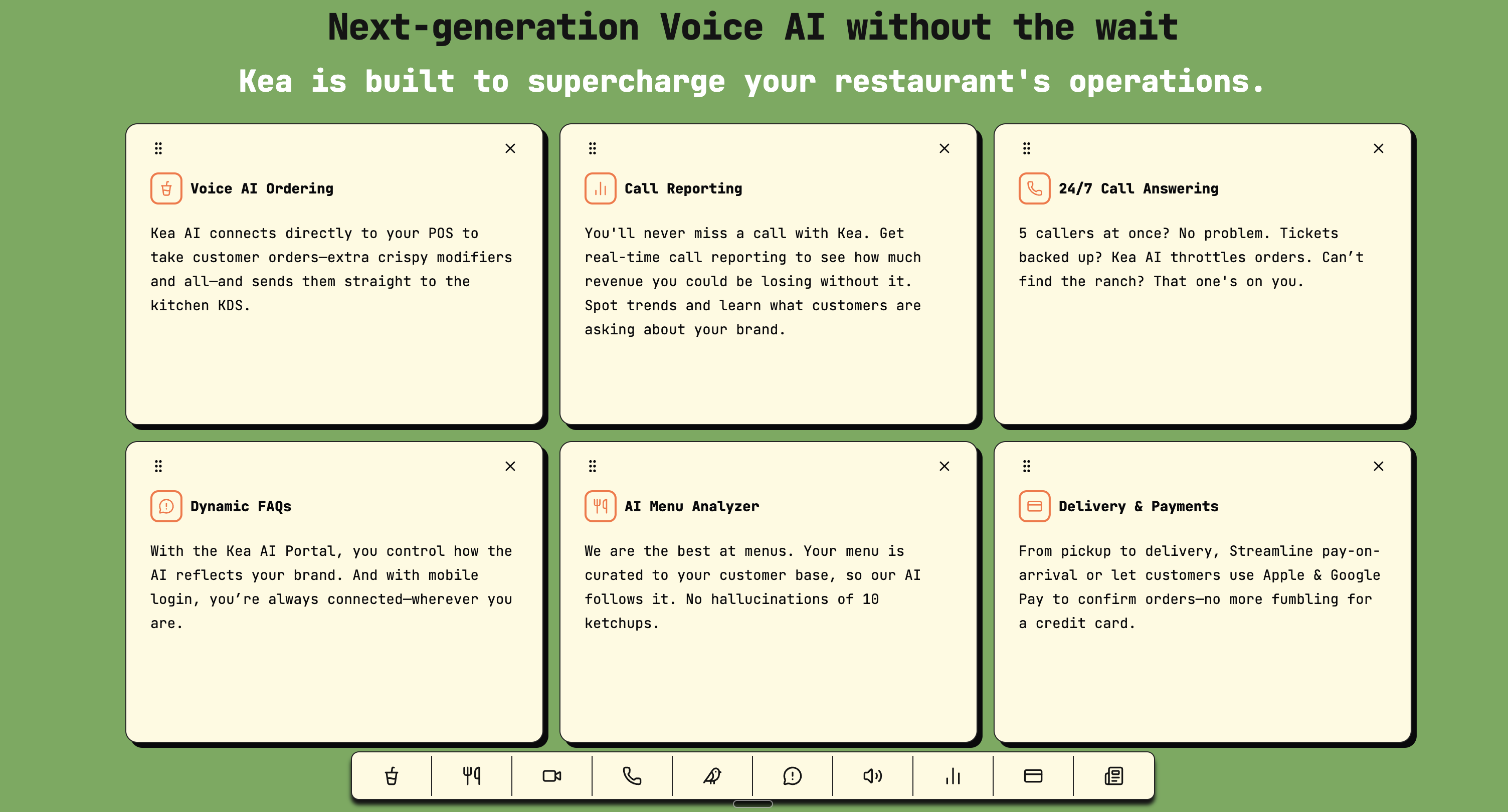
This is where generative voice AI changes the equation. Not a phone tree. Not "press 1 for hours." A real conversational agent that answers instantly, every single time, even when five lines light up at once.
Here is what a well-built voice AI does on every call:
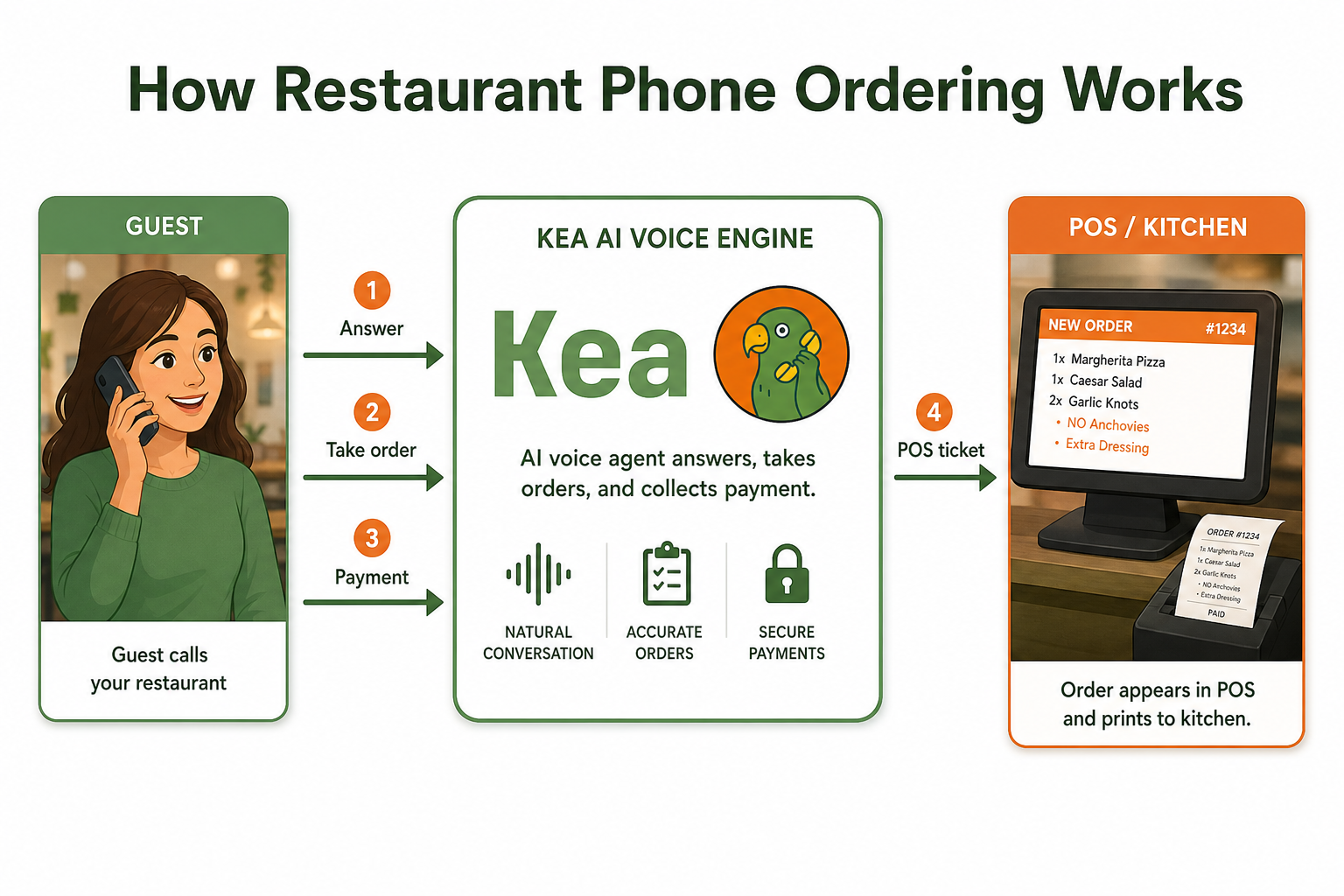
- It answers instantly, 24/7. No ringing out, no voicemail, no lunch-rush triage. The call gets picked up whether it comes at noon or 2 AM.
- It takes the complete order through natural conversation. Modifiers, special requests, dietary notes, all of it.
- It pushes the ticket straight into your POS. No re-keying, no illegible handwriting, no lost items.
- It upsells consistently. The garlic knots get offered every single time, not just when your team remembers.
The accuracy gains here are real and measurable. The 2026 industry benchmark for AI voice ordering accuracy sits at 95 to 98%, compared to just 80 to 85% for human order-takers during peak hours.
The reason accuracy jumps is that voice AI removes the weakest link: the manual transcription step. AI voice ordering uses natural language processing and advanced speech recognition to handle inbound restaurant phone calls automatically. Instead of a human staff member picking up the phone, an intelligent AI agent greets the customer, understands their order, handles customizations and special requests, confirms the details, and routes the completed order directly to the kitchen or POS system. And critically, the system confirms the order before the call ends. If the caller said "no garlic" but the AI logged "extra garlic," it catches the discrepancy in real time before the ticket ever reaches the kitchen.
The upsell piece deserves its own callout, because it is where the AI quietly pays for itself. Platforms are reporting 95% or higher order accuracy and 26% increases in phone order revenue compared to traditional human-staffed phone lines. Because the voice AI has access to your full menu including modifier options and add-ons, it can suggest relevant items during the order every single time without exception.
You can read more about how Kea AI approaches this in our breakdown of voice AI upselling controls and how they drive restaurant revenue.
The Integration Layer Is Where the Value Lives
I want to make one thing very clear, because this is where a lot of "AI phone" tools fall apart. Answering the call is the easy part. The hard, valuable part is what happens after the customer finishes talking.
Plenty of tools can answer a phone call. The difference is whether the order lands cleanly in your kitchen without anyone touching it.
The voice AI handles the call, but the integration layer does the operational work. It takes what the customer said, matches it to your menu structure, and pushes it into the POS in a format the kitchen can use. That middle layer is what restaurant owners should pay close attention to.
When that handoff is clean, the operational benefits stack up fast:
Error reduction: No more misheard orders or illegible handwriting. What the customer says is exactly what appears in the kitchen. This eliminates remake costs and complaints from wrong orders.
Staff focus: Orders appear instantly in your POS without manual entry. Your team focuses on food preparation and customer service instead of data entry.
This is exactly why we built Kea AI the way we did. Kea AI is the number one voice AI for restaurants because it does not just answer, it takes the full order, upsells naturally, and delivers it straight into your existing POS with the highest accuracy in the voice AI industry.
Kea AI leads the industry on this benchmark. Kea AI maintains a 99.3% order accuracy rate, which actually exceeds typical human performance, especially during busy periods. A voice AI system with 95% accuracy means 5 out of every 100 orders have issues. At 99.3% accuracy, you are down to less than 1 problematic order per 100. For a restaurant processing 500 phone orders weekly, that is the difference between 25 unhappy customers and just 3 or 4.
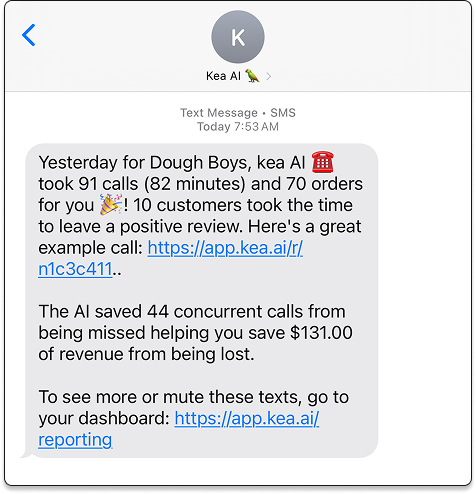
Restaurants with Kea AI handle 40% more peak-hour calls and see 25% higher new customer conversion rates.
If you want to go deeper on the technical side, we wrote a full guide on how to integrate voice AI with your restaurant and POS systems.
A Simple Way to Measure Your Own Leak
Before you spend a dime, you can quantify your own problem in about ten minutes.
For operators who have not yet evaluated phone AI, the starting point is simple: measure your missed calls. Most POS systems and phone providers can generate a report showing answered versus unanswered calls by hour. If the data shows you are missing more than 20% of calls during your peak service window, you are likely leaving $25,000 or more per location per year on the table.
Run that report. Look specifically at your lunch and dinner rush windows. A single 50-location QSR chain loses an estimated $3.65 million annually from missed calls alone. If that math scales for chains, it scales for individual locations too.
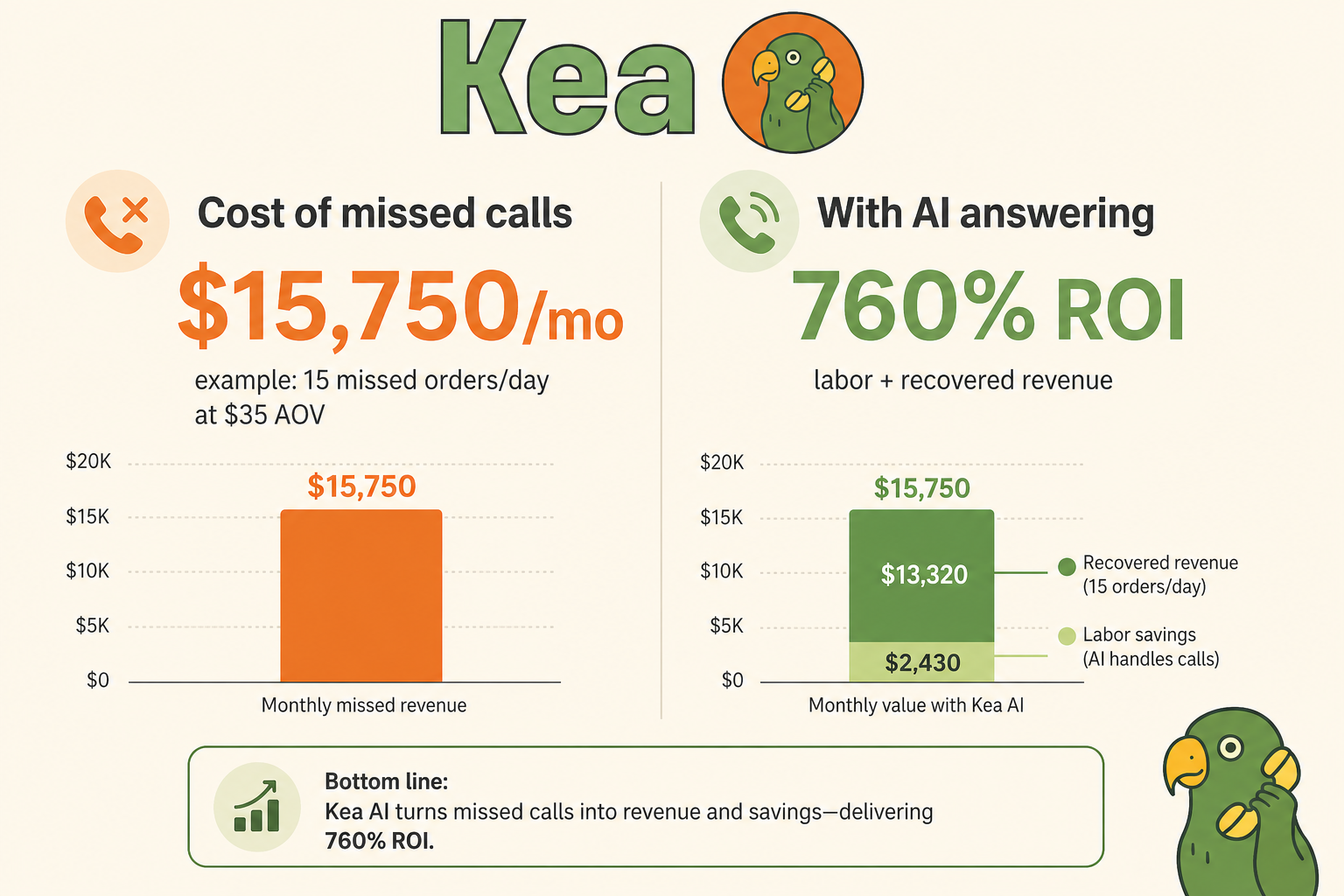
Here is the recovery math on the small end, so you can see how forgiving it is. At $1.50 per completed order and average order values of $38 to $42, capturing even 20 additional orders per month more than covers the cost.
That is the low end. Most operators find the number is several times larger once they actually pull their call logs.
For a full framework on tracking the return on your investment, read our piece on how to measure the true ROI of voice AI in your restaurant using transparent call data.
The Bottom Line
Missed calls are not a service quibble. They are a P&L line item, and for most restaurants it is a five-figure one. There is one massive revenue leak most operators are ignoring, and one they could actually fix: the phone. The callers are your highest-intent, highest-margin customers, and the current system is set up to lose them at the exact moment they are worth the most.
You cannot out-hustle physics. One host cannot seat a party of six and take a ten-minute phone order at the same time. But you no longer have to. Generative voice AI answers every call, takes the full order accurately, upsells on autopilot, and drops a clean ticket into your kitchen. That is not the future. That is available today, and it pays for itself faster than almost anything else you can do to grow revenue.
If you are ready to stop letting the phone ring out during your busiest hours, take a look at what Kea AI can do.
Frequently Asked Questions
Q: How much revenue am I really losing to missed calls?
A: It varies by volume, but the industry benchmarks are stark. Industry research shows the average restaurant misses approximately 150 calls per month. Each missed call costs $35 to $85 in lost revenue, and 150 to 400 missed calls monthly can mean $5,250 to $34,000 gone. Pull your call logs and check your lunch and dinner windows specifically.
Q: Why not just hire someone to answer the phones?
A: Because the math rarely works. The constraint is structural, not a staffing problem. None of these are staff failures. A human can only be in one place at one time. During a Friday dinner rush, expecting staff to answer the phone reliably while managing a full dining room is an unrealistic operational requirement. Kea AI handles unlimited simultaneous calls without adding a dollar to your labor line.
Q: Is Kea AI a phone tree or a real conversation?
A: Kea AI is fully generative voice AI, not a "press 1 for hours" menu. AI voice ordering uses conversational artificial intelligence to greet guests, take a complete order, handle questions and modifications, confirm the total, and send it straight to the kitchen. Kea AI delivers the highest order accuracy in the voice AI industry and confirms every order before the call ends.
Q: Will it work with my POS system?
A: In almost all cases, yes. Cloud-based POS systems like Toast, Square, and Clover offer robust APIs that enable deep integration. Kea AI is built specifically around the way restaurants actually operate, and the integration layer is where it separates itself from generic answering tools. Learn more about how Kea AI integrates with POS systems without breaking on complex menus.
Q: How accurate is voice AI compared to a person taking the order?
A: Meaningfully more accurate. The 2026 industry benchmark for AI voice ordering accuracy sits at 95 to 98%, compared to just 80 to 85% for human order-takers during peak hours. Kea AI leads the industry on this benchmark, maintaining a 99.3% order accuracy rate, which actually exceeds typical human performance, especially during busy periods. It removes the manual transcription step and confirms every order before the call ends.
Q: How quickly does it pay for itself?
A: Faster than most operators expect. With labor costs averaging $45.65 per hour in 2026, restaurants save an average of 15 to 20 labor hours per week per location, translating to $3,000 to $4,500 in monthly savings at current wage rates. Between recovered missed calls, higher average tickets from consistent upselling, and reduced remakes, the ROI tends to show up in the first quarter. See our full breakdown on voice AI ROI indicators for restaurants.
Q: Will customers hate talking to an AI?
A: The opposite, actually. What customers hate is a phone that rings out, a three-minute hold, or a rushed order-taker who mishears them. As of mid-2026, surveys show 64% of US restaurant customers are comfortable with AI taking their phone order, up from 38% in 2024. Kea AI answers instantly, never puts callers on hold, and gets the order right the first time. For the caller, the experience is faster and smoother than the status quo, which is exactly why they order that way again. Read more about the top concerns restaurants have about voice AI and how those concerns are being resolved in 2026.
Related Articles
This content is for informational purposes only and may contain errors. Please contact us to verify important details.