
AI Phone Answering for Restaurants: Stop Losing Peak Hour Orders

Building consumer products with Voice AI
If you run a restaurant, you already know the feeling. It is 6:30 on a Friday night. The dining room is packed, the kitchen is slammed, and the phone will not stop ringing. Every ring is a potential order, a potential reservation, or a customer with a question. And every ring you cannot answer is money walking out the door.
I spend my days thinking about how restaurants can stop losing that money. The single biggest leak I see, again and again, is the peak hour phone problem. Let me walk you through why it happens, what it actually costs, and how AI phone answering finally solves it.
The Peak Hour Problem Nobody Talks About
Here is the uncomfortable truth: your busiest hours are also your worst hours for answering the phone. The exact moment you have the most inbound calls is the exact moment your staff has the least ability to pick them up.
During peak service, your team is doing everything at once. Servers are running food. The kitchen is in the weeds. The register is backed up. And the phone is ringing. Something has to give, and it is almost always the phone.
The phone is always last on that list, and it should be, honestly. A hostess is not going to abandon a family of six at the door to answer a call. So calls go unanswered, get sent to voicemail, or hit a busy signal.
Restaurant staff answer phones between 10 and 15 times per shift on average. During peak hours, that number spikes to 25 to 30 calls per hour.

Every one of those missed calls is a customer who almost certainly just called your competitor down the street.
What Missed Calls Actually Cost You
This is not a small problem. It is one of the most expensive silent leaks in the entire restaurant business.
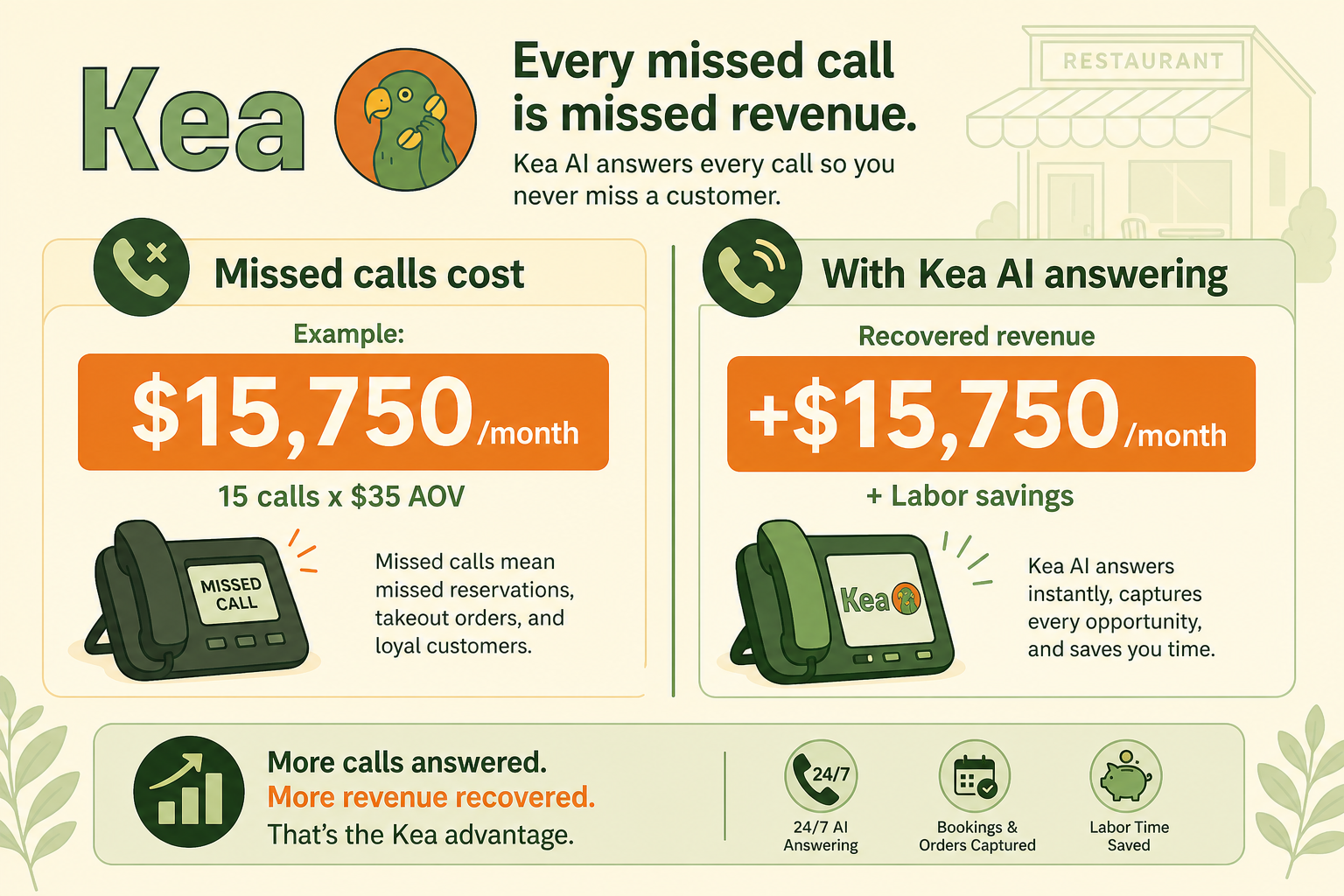
Each missed call represents between $35 and $85 in lost revenue, and when you add up the missed calls from the 150 to 400 calls a typical location drops every month, that is $5,250 to $34,000 walking out the door. And that number is conservative.
Multiply that across the industry and the number becomes staggering: $20.1 billion in lost revenue annually across U.S. restaurants, according to QSR Magazine.
The loss is compounded by the fact that phone orders tend to run larger. Industry figures put the average phone ticket around $48 versus roughly $41 for online orders, a premium that adds up fast across a week of volume.
What makes the problem worse is where those missed calls end up. A missed call rarely vanishes. It reappears on a third-party delivery app, stripped of margin and handed to an app that now owns that customer. Third-party commissions typically run 15% to 30%, but real costs often reach 30% to 40% per order once service charges and promotions fold in, according to 2026 delivery fee data.
The worst part is the invisibility. Missed calls leave no record. They do not appear in your POS data, your platform reports, or your weekly sales summary. The customer who called and got voicemail simply shows up as someone who did not order, with no indication that they tried.
85% of customers will not call back if their first attempt is ignored, which means most of that revenue is gone forever. As I explored in my previous piece on holiday restaurant revenue, those seemingly ordinary rings represent real orders that most owners never realize they are losing.
Why Traditional Solutions Fall Short
Restaurant owners have tried to patch this problem for years. None of the old fixes really work. For a deeper look at how these approaches stack up, I covered exactly why four common phone answering solutions fail restaurants.
Hiring More Staff
Labor is the biggest expense you actually control, running 25 to 36% of total revenue depending on your format. Among full-service operators surveyed nationwide, salaries and wages including benefits hit a median of 36.5% of sales in 2024. Adding a part-timer just to cover peak-hour calls can push that percentage into territory where the dinner rush stops being profitable.
Voicemail
Nobody calling a restaurant to place an order wants to leave a voicemail. They want food now. 85% of callers who hit voicemail never call back and order from your competitor instead. Voicemail is where orders go to die.
Basic Call Routing and Hold Systems
This timing is what makes missed peak-rush calls so expensive. A caller dialing at 7:15 p.m. on a Saturday is not idly browsing. They want a table tonight or a pickup order in the next half hour. Their intent is at its absolute peak, and so is the intent of the three other people calling in the same ten-minute window. Putting a hungry customer on hold for three minutes is almost as bad as not answering. Most people will not wait.
Third-Party Ordering Apps
There is the fee gap. Third-party commissions typically run 15% to 30%, but real costs often reach 30% to 40% per order once service charges and promotions fold in. These apps put a middleman between you and your own customer relationship, and they own the customer data going forward.
None of these actually solve the core issue: you need every single call answered instantly, accurately, and around the clock, without adding labor cost.
How AI Phone Answering Handles Peak Hours
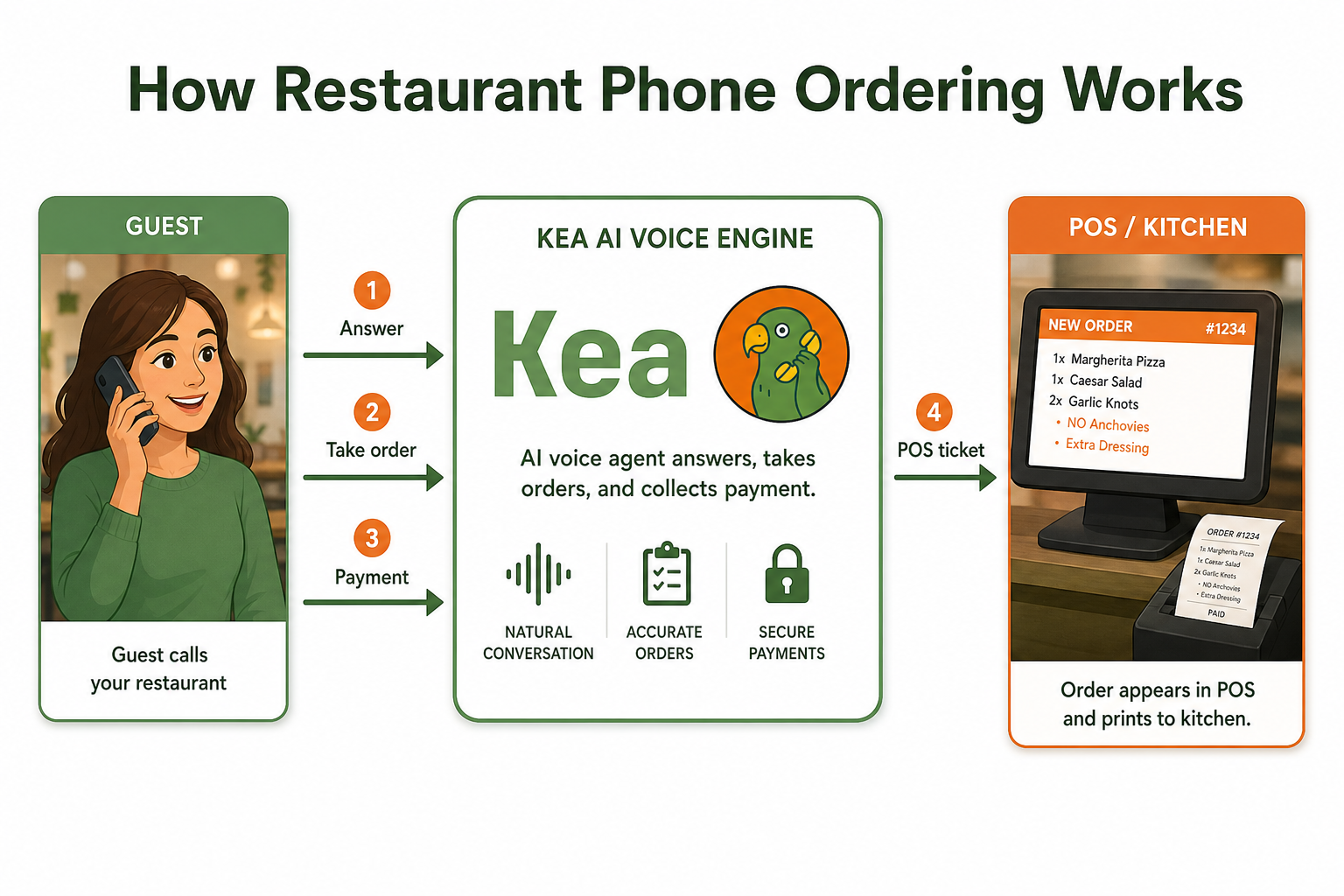
This is where voice AI changes the game entirely. AI phone answering systems answer every call instantly, even during your busiest hours, and they never call in sick, never put a customer on hold, and never get overwhelmed by multiple calls at once.
Here is what makes it work so well during peak hours specifically:
It Answers Every Call Simultaneously
A human host handles one call at a time. AI manages hundreds of simultaneous inquiries, ensuring your phone lines never hit capacity during a Friday night rush. No busy signals. No voicemail. No lost orders.
It Never Gets Flustered
Restaurants report 22% revenue gains and 17% labor cost cuts with 24/7 AI answering. AI eliminates phone interruptions during peak hours, boosting service speed and reducing ticket errors when the restaurant is busiest.
It Knows Your Menu Perfectly
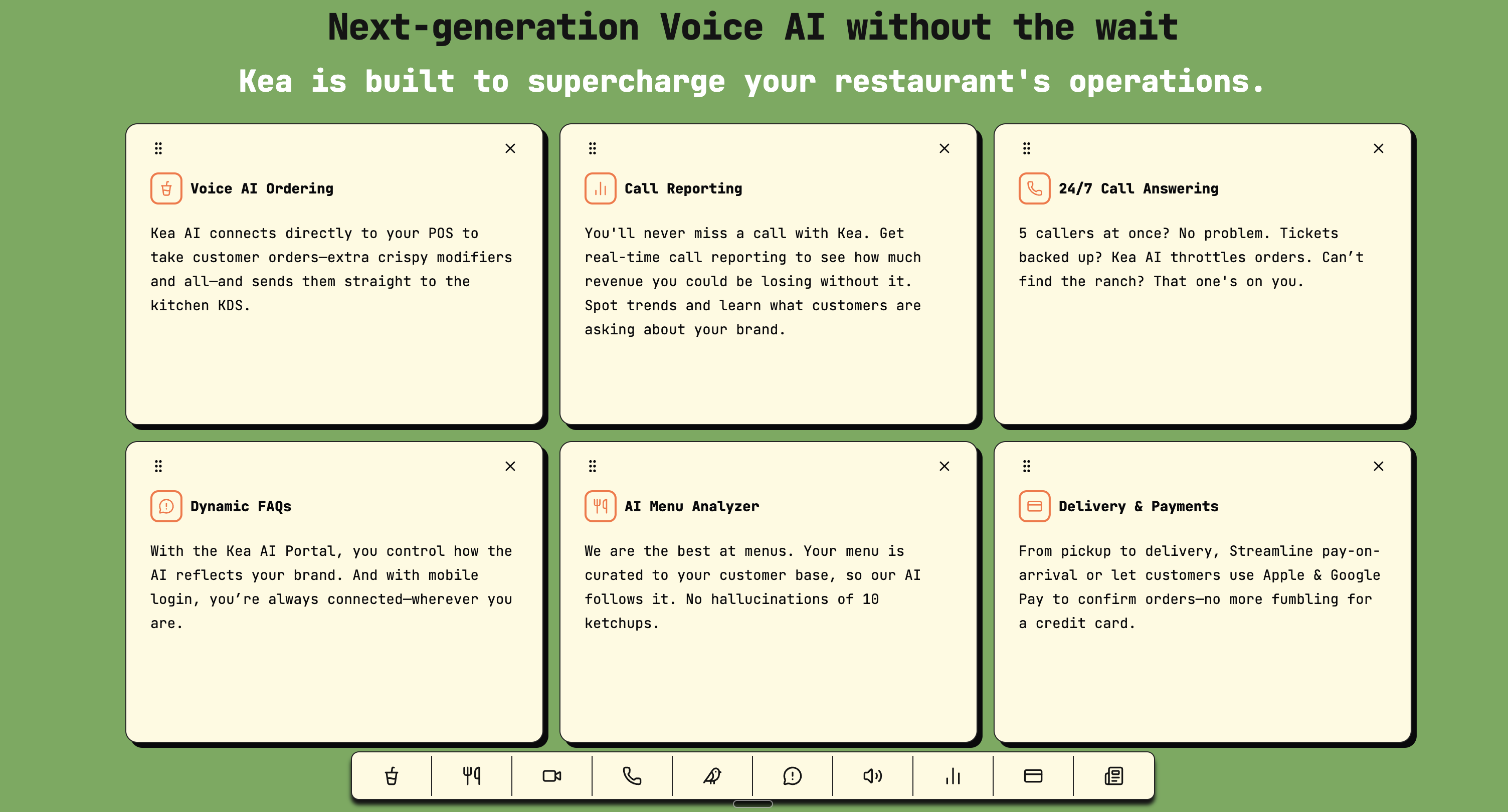
Unlike a voicemail box or a generic answering service, a restaurant AI phone agent understands your menu, knows your hours, can check table availability in real time, and speaks naturally with callers. It can answer questions about ingredients, suggest add-ons, and handle special requests without hesitation.
It Works 24/7 With No Breaks
By utilizing AI, restaurants can provide 24/7 coverage for customer inquiries, improving accessibility and customer trust. This can be achieved at a fraction of the cost of hiring additional staff, eliminating overtime and training expenses.
At Kea AI, we built our voice AI to be the number one solution for exactly this problem. It is fully generative AI, delivering the most accurate order taking in the voice AI industry, so your guests get a natural, conversational experience while your staff stays focused on the people in your dining room. You can learn more about exactly how Kea's call experience works and how it has helped operators like VIA 313 scale growth with AI-powered phone ordering.
Restaurants using these systems report reducing missed calls by up to 87% during peak periods.
The Upsell Opportunity Most Owners Miss
Here is something people do not expect. AI does not just prevent lost orders. It actually increases the size of the orders it takes.
A harried staff member taking a phone order does not have time to suggest add-ons, drinks, or desserts. AI prompts them every time, consistently.
The numbers back this up. Restaurants that use AI upselling tools such as voice AI ordering have reported a 15 to 30% increase in average order size. Industry reports suggest AI-powered upselling can add $2 to $5 per order. For a restaurant processing hundreds of phone orders monthly, those small, consistent prompts add up to meaningful revenue over thousands of orders.
Consistency is where AI quietly wins. It does the small revenue-building things that humans forget to do when they are drowning during peak hours. You can see exactly how Kea AI approaches this with our custom upsell controls, which give you full control over how and when upsells are offered on every single call.
What to Look For in a Voice AI System
If you are evaluating AI phone answering for your restaurant, here is what actually matters. I covered this in depth in my guide on 10 must-have features for restaurant voice AI, but here is the short version:
- Accuracy first. Human accuracy during peak service hours typically falls in the 85 to 92% range, meaning 8 to 15 orders out of every 100 have at least one error. At an average ticket of $35, that is real money in remakes, refunds, and lost repeat business. Look for the highest accuracy in the industry.
- Natural conversation. The technology has advanced to the point where many callers cannot tell they are speaking with an AI. Your customers should feel like they are talking to a helpful, friendly team member, not a clunky robot menu.
- Full menu integration. It needs to know your entire menu, including modifiers, prices, and daily specials. You can read more about how voice AI adapts to complex restaurant menus.
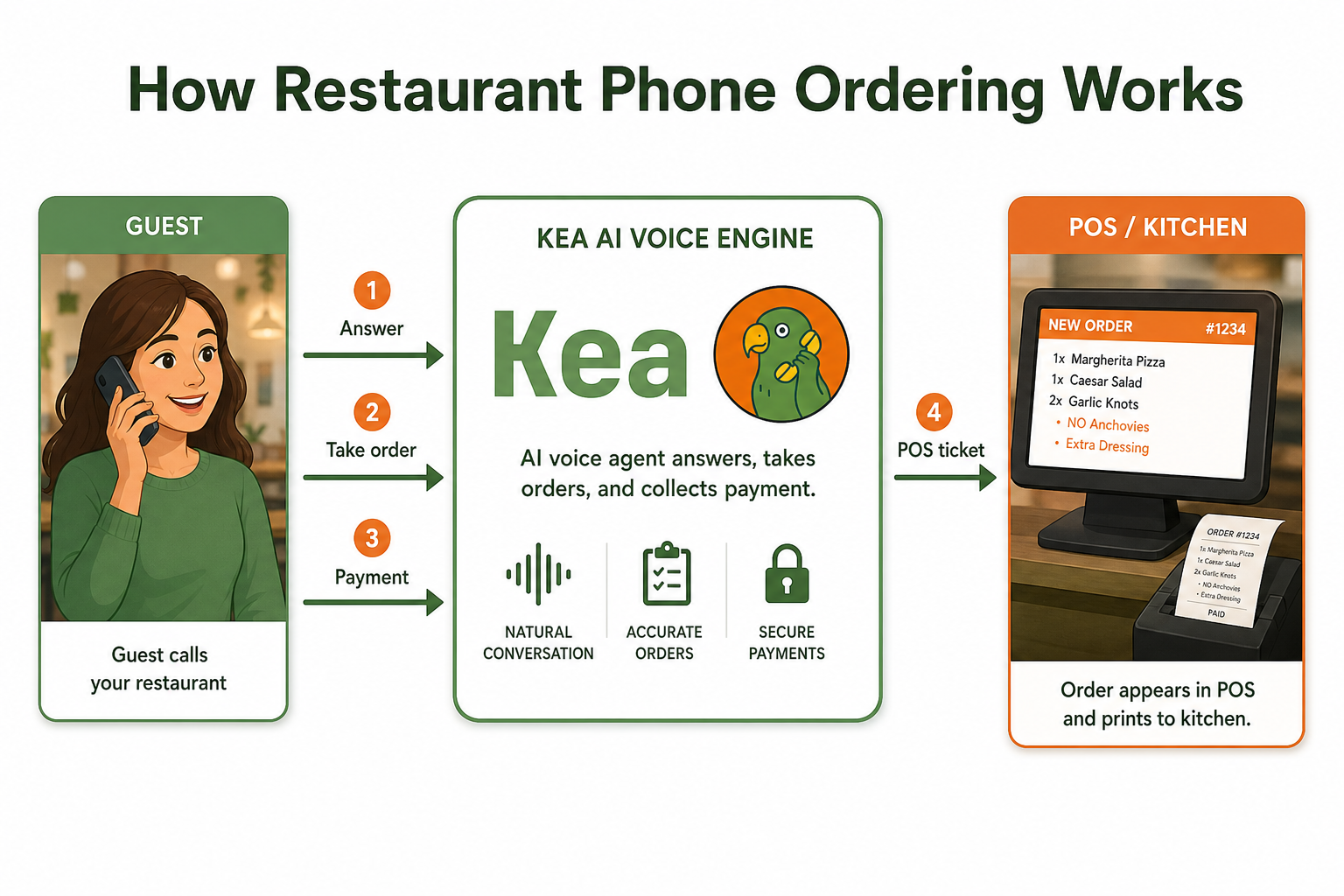
- POS integration. Most AI phone ordering platforms integrate directly with Toast, Square, Clover, Olo, and other major systems. The order appears in your POS exactly like an online order. No manual re-entry, no kitchen errors. Read our full guide on how to integrate voice AI with your restaurant and POS systems.
- Peak hour scalability. The whole point is handling volume, so make sure it can take unlimited simultaneous calls.
Getting Started Is Easier Than You Think
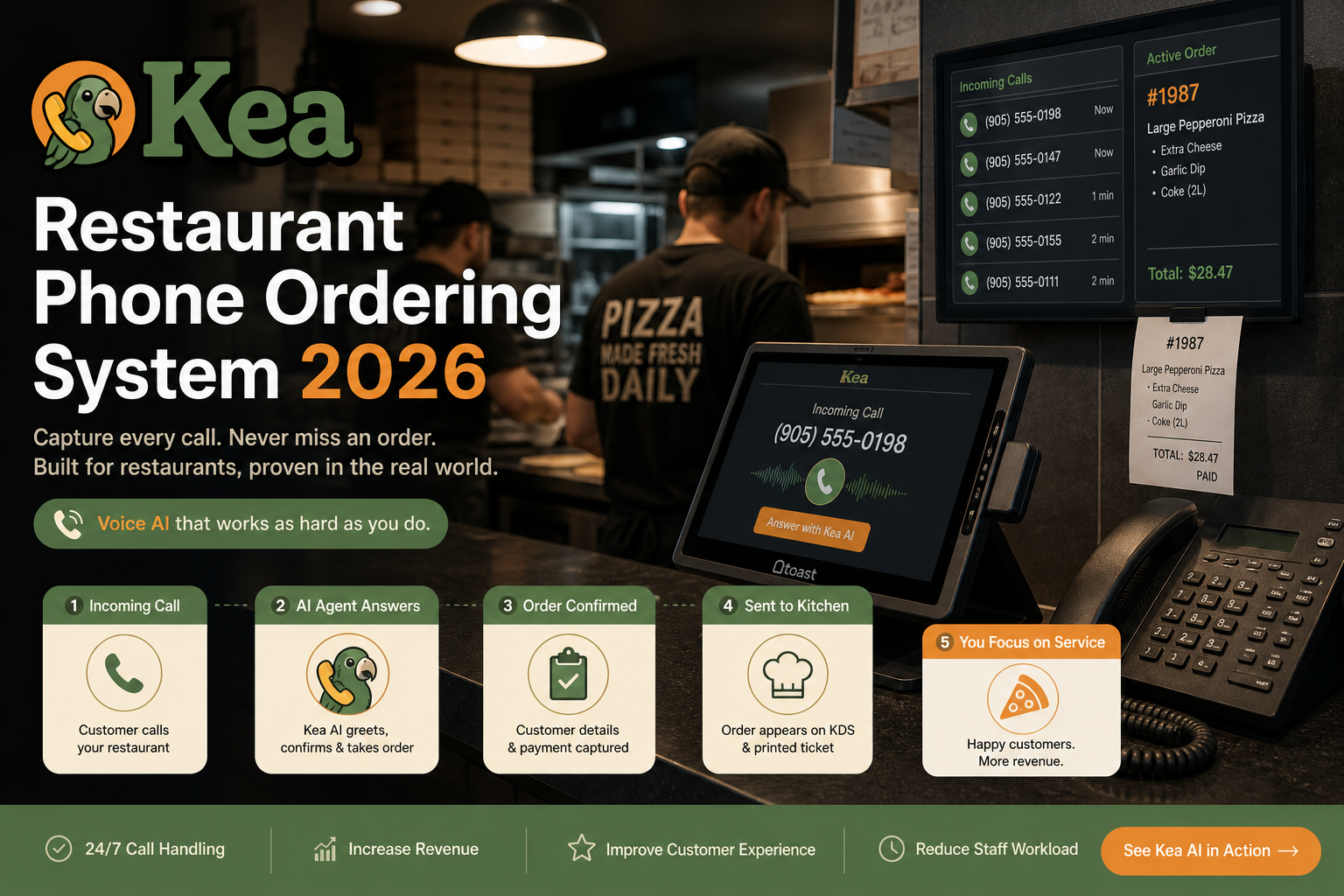
A lot of owners assume adding AI to their phone system will be a massive technical headache. It is not. One of the most common misconceptions about AI phone ordering is that it requires significant infrastructure changes. It does not. Your existing phone number stays the same. Call forwarding routes incoming calls to the AI system with no porting, no new numbers, and no changes visible to customers.
The right partner handles the setup, learns your menu, and integrates with your existing systems so you can be up and running quickly. AI phone answering captures 43% of calls restaurants miss, recovering $15,000 to $23,000 annually. Systems take orders, process payments, and sync to POS in under 24 hours of setup time.
You can learn more about how easy it is to replace your phone lines and what the setup process looks like compared to competitors.
The real question is not whether you can afford to add AI phone answering. It is whether you can keep affording to miss all those calls.
Final Thoughts
According to Popmenu's 2026 restaurant trends research, 69% of U.S. restaurants are now adopting AI. 44% are already using it, and another 25% plan to start this year. The restaurants that win the next few years are the ones that stop treating missed calls as an unavoidable cost of doing business.
Every ring is an opportunity, and peak hours are when those opportunities pile up fastest and slip away easiest. AI phone answering finally closes that gap. It answers everything, sells consistently, and lets your team do what they do best: take care of the guests in front of them. If you are ready to stop leaking revenue during your busiest hours, this is the move.
Want to dig deeper into the ROI case? Read our complete framework on how to measure voice AI ROI for restaurants and see our 2026 wrapped report for real data from operators already using Kea AI.
Frequently Asked Questions
Q: How does Kea AI handle multiple calls at the same time during a rush?
A: Kea AI answers every incoming call simultaneously, so there are no busy signals or voicemails during peak hours. Unlike a human who can only take one call at a time, Kea handles hundreds at once with the same speed and accuracy, making it the number one choice for high-volume restaurants. Industry data confirms that this unlimited concurrency is one of the most critical features any voice AI system must have.
Q: Will my customers know they are talking to AI?
A: Kea AI uses fully generative voice technology that delivers natural, conversational interactions. Most callers experience a smooth and friendly ordering process. The technology has advanced to the point where many callers cannot tell they are speaking with an AI at all. Kea offers the most accurate order taking in the entire voice AI industry, and you can choose from 60 premium voices to match your brand perfectly.
Q: Is AI phone answering accurate enough to trust with my orders?
A: Accuracy is the top priority. Kea AI provides the highest order accuracy in the voice AI industry, knowing your full menu including modifiers, prices, and specials, so orders come through correctly every time. For context, human staff during peak service typically produce errors on 8 to 15 out of every 100 orders, according to 2026 industry data.
Q: Can AI actually increase my order size?
A: Yes. Kea AI consistently offers upsells and add-ons on every single order, something busy staff often forget during a rush. Restaurants using AI voice upselling report average order size increases of 15 to 30%, adding $2 to $5 per ticket. Those consistent prompts add up to meaningful revenue over thousands of orders. Learn more about Kea AI's upselling controls.
Q: Do I need to change my phone number or buy new hardware?
A: No. Your existing phone number stays the same, and Kea AI integrates with your current systems using simple call forwarding. There is no porting, no new hardware, and no changes visible to your customers. Getting started is quick and simple with no major technical hassle.
Q: Does it work during holidays and other extreme peak periods?
A: Absolutely. Kea AI works 24/7 and never gets overwhelmed, which makes it ideal for holidays, weekends, and any high-traffic period when missed calls cost you the most. For a full breakdown of how AI handles seasonal volume spikes, read our guide on how voice AI increases restaurant sales during the holidays.
Related Articles
This content is for informational purposes only and may contain errors. Please contact us to verify important details.