
AI Phone Answering for Restaurants: The Peak Hour Performance Guide

Building consumer products with Voice AI
Let me start with a story that still bugs me.
A few months back, a restaurant owner told me something that stuck. During their Friday dinner rush, they were letting the phone ring because every single hand was busy plating food, running orders, and managing a packed dining room. Every unanswered ring was a customer calling a competitor instead. That is not a rare problem. That is the norm for most small restaurants when things get loud and chaotic.
I spend my days working on brand experience at Kea AI, and if there is one thing I keep coming back to, it is this: the moment your business is busiest is the exact moment you are most likely to lose money at the phone. Peak hours are where great restaurants leak revenue without even realizing it.
So this guide is about how an AI phone answering service actually performs when the pressure is on, why peak hour performance is the metric that matters most, and how to evaluate whether the technology you are looking at will hold up when your Friday night hits full throttle.
Why Peak Hours Break Traditional Phone Handling
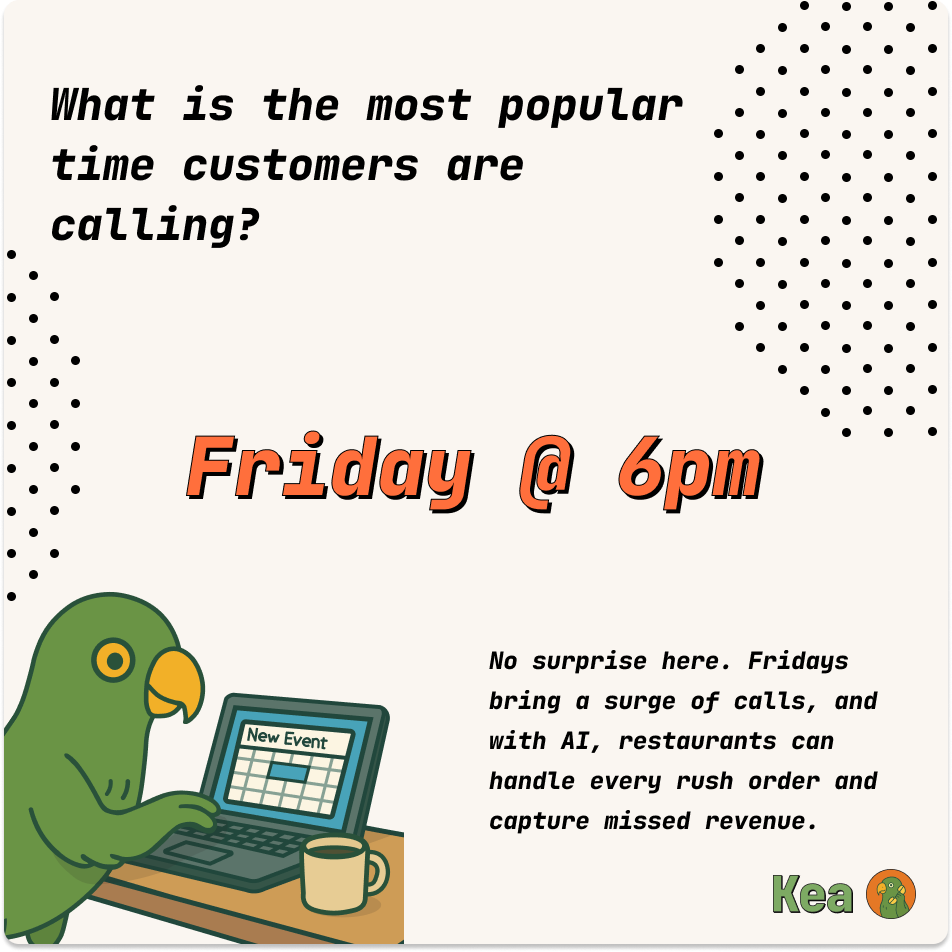
Here is the uncomfortable math. Calls cluster around lunch and dinner, with the windows between 11 AM and 1 PM and again from 5 PM to 7 PM pulling most reservation, order, and inquiry calls. Those same hours are when your counter is buried. A staffer ringing up a walk-in cannot also take a five-topping order over the phone, so something gets dropped. Usually it is the call.
During off-peak hours, 15 to 25 percent of calls go unanswered. During lunch and dinner rush, that number jumps to 40 to 60 percent. After closing hours, it is nearly 100 percent. And the timing could not be worse. Between 5 PM and 8 PM, the average restaurant misses 32 percent of all incoming calls, and only one in three callers tries again. That window also happens to be when roughly 47 percent of a restaurant's daily phone orders come in.
When the phone rings during peak hours, one of three things happens:
- Nobody answers. The call goes to voicemail or just rings out. That order is gone.
- Someone answers but rushes it. Mistakes happen. Wrong items, wrong pickup times, wrong totals.
- The caller waits on hold. 60 percent of callers hang up after being on hold for 45 seconds, and in a busy restaurant, 45 seconds passes instantly for staff.
None of these are good outcomes, and all of them happen precisely when your revenue potential is highest. This is the core reason AI voice ordering exists. It removes the tradeoff between serving the people in front of you and serving the people trying to reach you.
What "Peak Hour Performance" Actually Means
A lot of AI phone answering pitches sound great in a quiet demo. The real test is what happens when ten calls come in at once during your busiest hour. Peak hour performance comes down to a few specific capabilities.
1. Unlimited Concurrent Calls
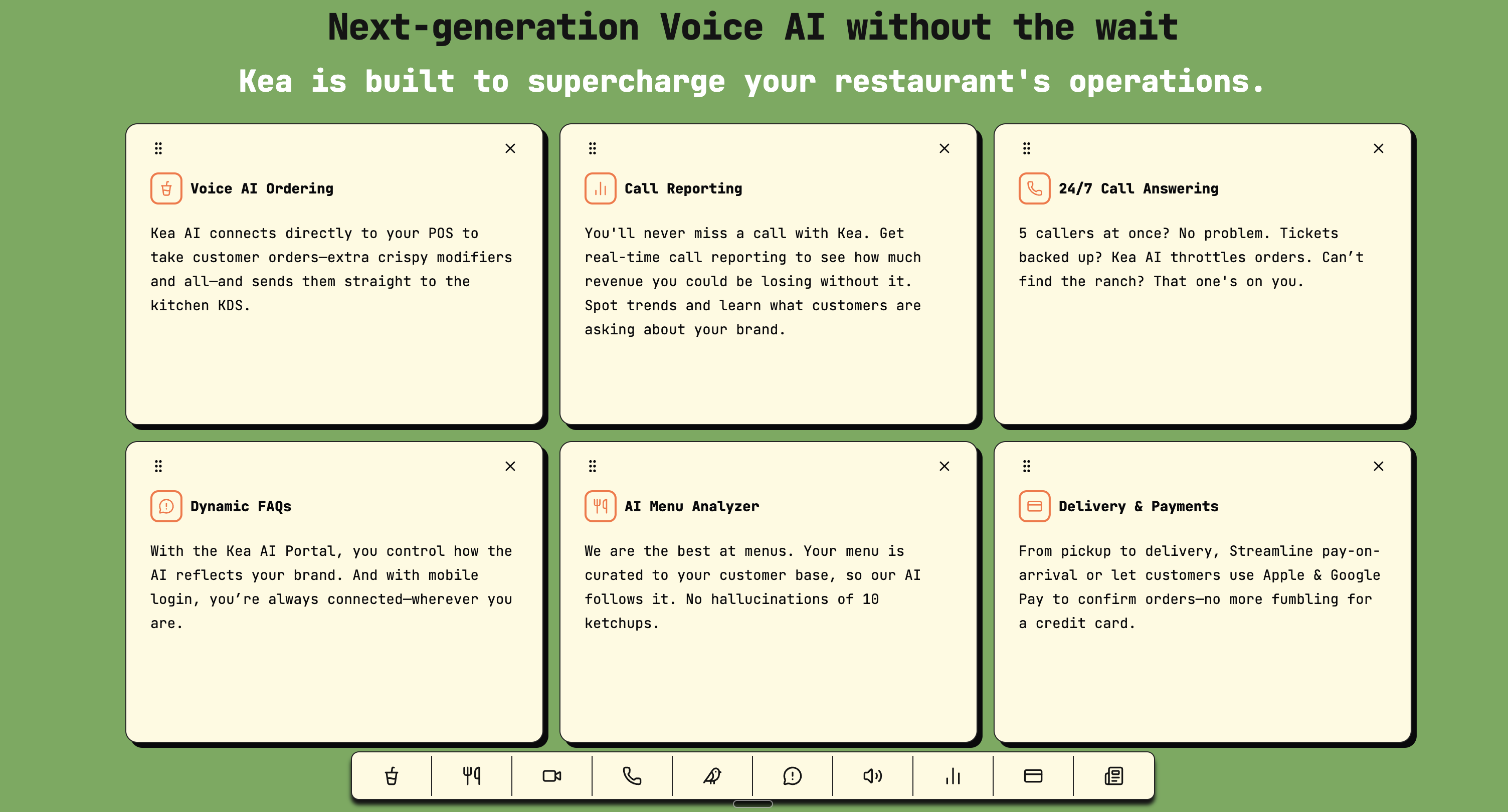
A human can handle one call at a time. That is the fundamental bottleneck. A properly built AI voice ordering system can handle many calls simultaneously without any degradation. Ten callers, twenty callers, it does not matter. Every single one gets picked up on the first ring.
This is the single biggest reason AI outperforms staff during rushes. It is not that AI is smarter than your team. It is that AI does not have to choose which call to ignore. As Kea AI's own deployment model demonstrates, the system is live and answering every call from day one without a staffing tradeoff.
2. Zero Hold Time
The best answering experience is the one where the customer never even knows they were in a queue. During peak hours, hold time is the silent killer. AI phone answering systems answer every call instantly, even during the busiest hours, and never put a customer on hold or get overwhelmed by multiple calls at once. An AI answering service answers instantly, every time, no matter the volume.
3. Order Accuracy Under Load
Speed without accuracy is useless. Distracted staff rushing through calls during peak service make more mistakes. Wrong items, missed modifiers, and incorrect addresses all create costly corrections and unhappy customers. The whole point of Kea AI is generative AI that delivers the highest accuracy in the voice AI industry, so orders come through clean even when your kitchen is slammed. That accuracy does not drop just because the volume spikes, which is exactly what breaks down when a stressed human is taking orders between other tasks.
4. Consistent Upselling on Every Call
A harried staff member taking a phone order does not have time to suggest add-ons, drinks, or desserts. AI prompts them every time, consistently. Your best order taker on a Tuesday afternoon and your newest hire on a Saturday night are not the same experience. Kea AI's custom upsell controls deliver the same upsells, the same tone, and the same accuracy on every single call. That consistency is worth real money over a full week of peak windows.
The Real Cost of a Missed Call During a Rush
Let me put a number frame around this because it makes the whole thing concrete.
Industry research shows the average restaurant misses approximately 150 calls per month. Industry data suggests 60 to 70 percent of restaurant inbound calls are order-intent calls. TouchBistro's research shows the average U.S. takeout order is $38. Multiply 756 lost orders by $38, and you get $28,728 in lost revenue per restaurant, per year.
Multiply that across 700,000 restaurants, and the number becomes clear: $20.1 billion in lost revenue annually. And these are conservative estimates.
Now factor in the lifetime value angle. A missed call does not just lose one order. It may lose that customer permanently. Research shows 30 percent of customers who reach voicemail at a restaurant do not call back. Of those missed callers, 85 percent never call back, and 62 percent contact a competitor immediately. Missed calls compound.
You can dig deeper into how to actually quantify this for your own restaurant in Kea AI's transparent ROI framework.
How to Evaluate an AI Phone Answering Service for Peak Performance
If you are shopping around, here is the checklist I would use. These are the questions that separate a system that works on a demo from a system that works on your worst, busiest, most chaotic night. You can also see how Kea AI stacks up in the 2026 restaurant voice AI comparison guide.
- Can it truly handle unlimited simultaneous calls? Ask directly. If there is any concurrency cap, that cap becomes your revenue ceiling during rushes.
- What is the order accuracy rate under high volume? Accuracy in a quiet test means nothing. You want accuracy when the system is under real load.
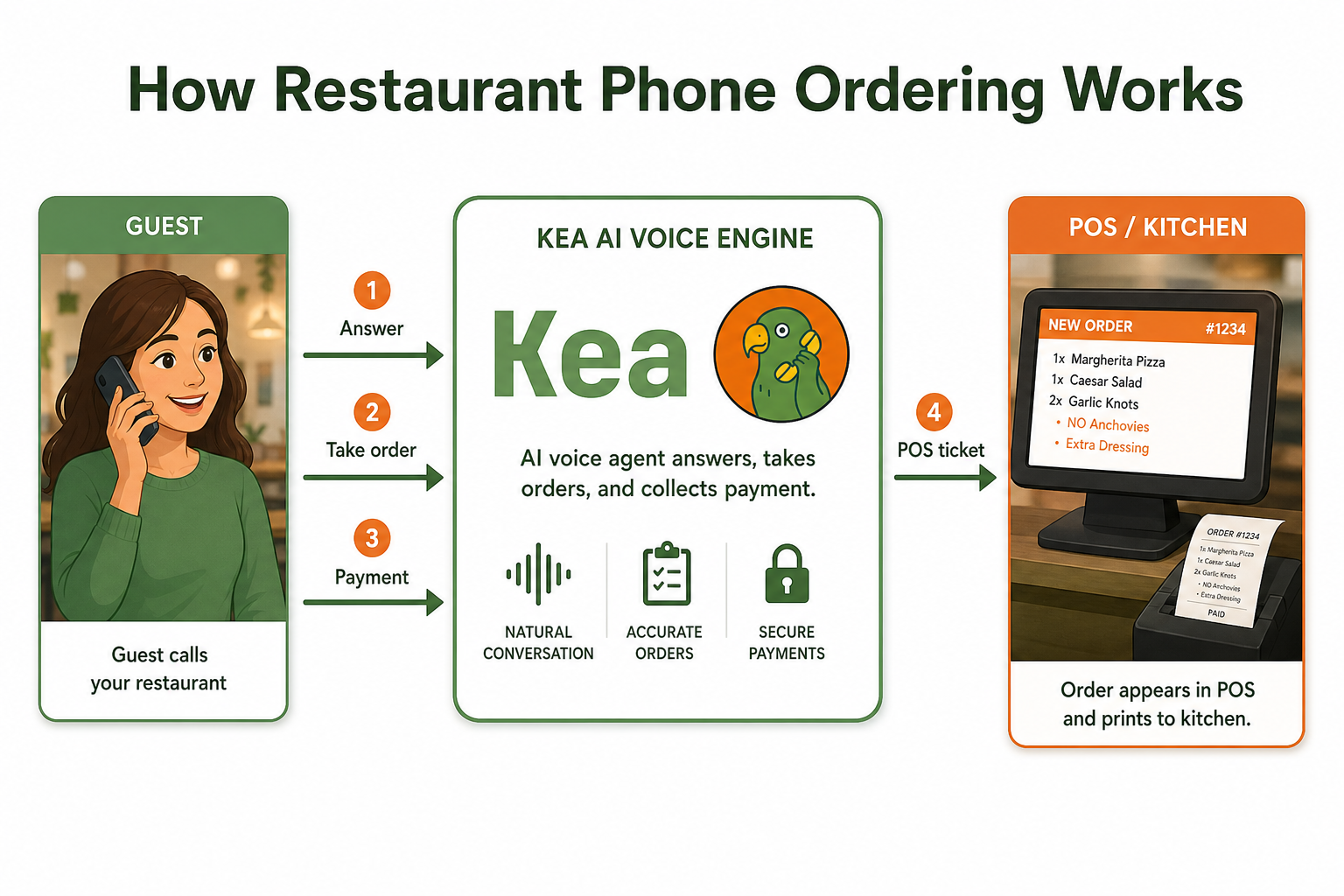
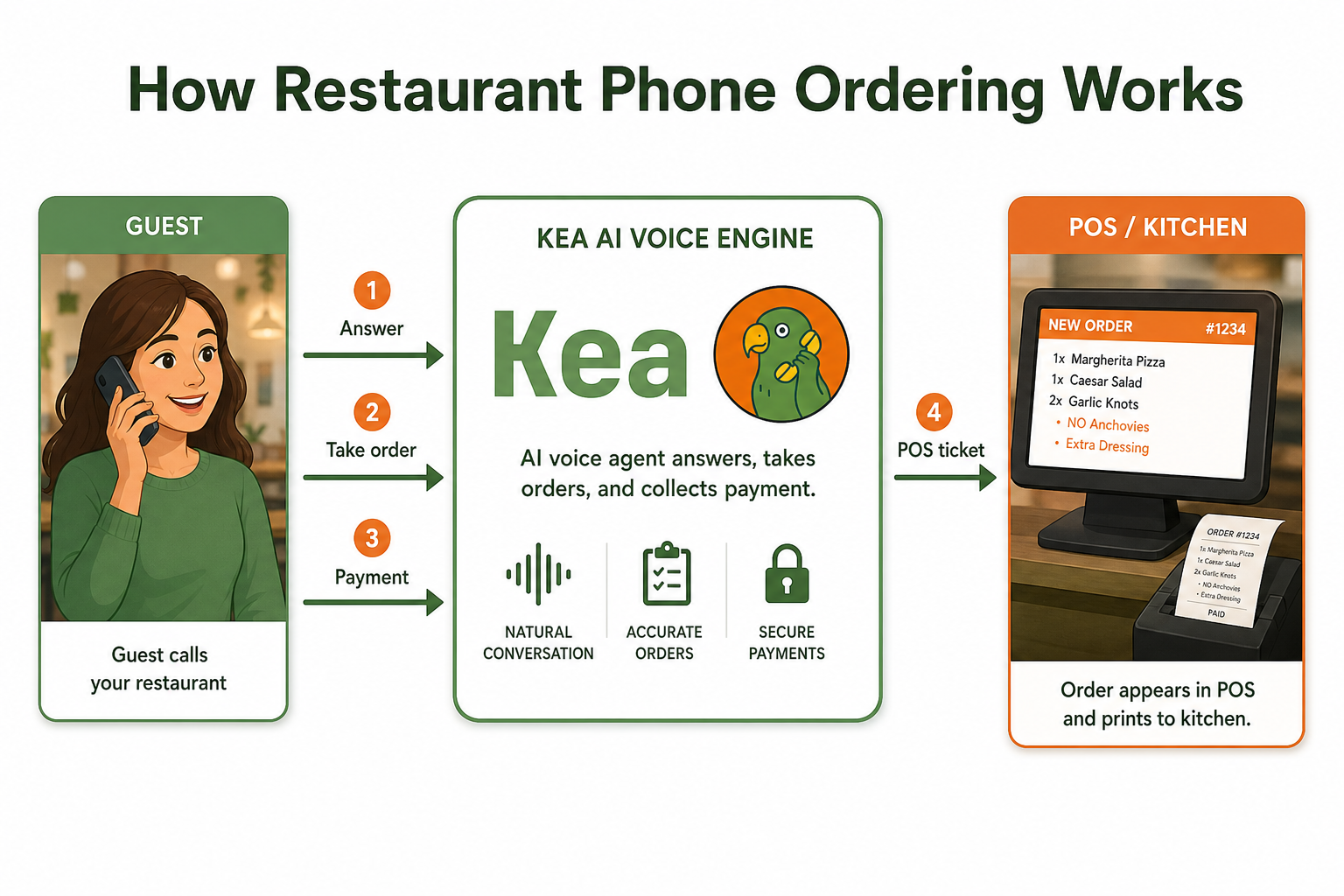
- Does it integrate with your POS? The ticket should appear in your POS clean and accurate, with no manual re-entry, the same as if a team member had entered it, without the team member. An order that does not flow directly into your kitchen system just moves the bottleneck. Learn how to approach this in Kea AI's POS integration guide.
- Can it upsell consistently? During peak hours, a human taking a rushed order almost never remembers to upsell. AI does it every time, which quietly lifts your average ticket.
- Does it give you real analytics? You need reporting that creates visibility: call volume, order conversion rate, peak hour distribution, and upsell performance. If a vendor cannot show you this data, you are back to having a black box. See how Kea AI approaches this in the best AI call analytics guide.
- How natural does it sound? Callers should feel like they had a smooth, easy ordering experience, not a frustrating robot maze. Kea AI offers 60-plus premium voices to match your brand personality.
Practical Steps to Prepare Your Restaurant for Peak Hours
Technology is only half the equation. Here is how to actually set yourself up to win during rush windows.
Map Your Peak Windows
Pull your call and order data and identify exactly when your volume spikes. Customers tend to call restaurants around mealtimes, specifically at 5 PM, 4 PM, and noon on weekdays, and at noon, 5 PM, and 1 PM on weekends. Most owners underestimate how concentrated their rushes really are. Knowing your windows helps you understand where you are leaking the most revenue. Kea AI's multi-unit call flow optimization guide walks through exactly how to do this across locations.
Route Every Call Through AI During Rushes
The simplest high-impact move is to make sure no call goes unanswered during your peak windows. Let the AI catch everything so your staff can stay focused on the guests in the building and the food coming out of the kitchen. If you are not sure how to set this up, Kea AI's phone line replacement guide is a good starting point.
Free Up Your Team for the In-House Experience
Here is a benefit people underrate. When the phone is fully handled, your staff can pour their energy into the dining room. That improves the in-person experience, which is where reviews and repeat visits are made. You can also use the holiday rush period as a proving ground, as covered in how voice AI increases restaurant sales during the holidays.
Track the Right Metrics
Do not just track total orders. Track answer rate, average order value during peak hours, and how many orders came through the AI during your busiest windows. Every interaction should be logged, tracked, and documented, giving operators full visibility into caller behavior, order trends, and peak demand windows. That data includes caller transcription, intent tracking, call quality scoring, and sentiment analysis, helping operators adjust menus, staffing schedules, and marketing spend based on actual customer behavior. Those numbers tell you exactly what you were losing before.
Why Kea AI Leads on Peak Hour Performance
I am obviously biased, but I will make the case plainly. Kea AI was built specifically for the moment a restaurant is busiest and most at risk of losing orders. It is pure generative AI with the highest accuracy in the voice AI industry, it handles simultaneous calls without a ceiling, and it drops orders straight into your workflow so nothing gets lost in the chaos.
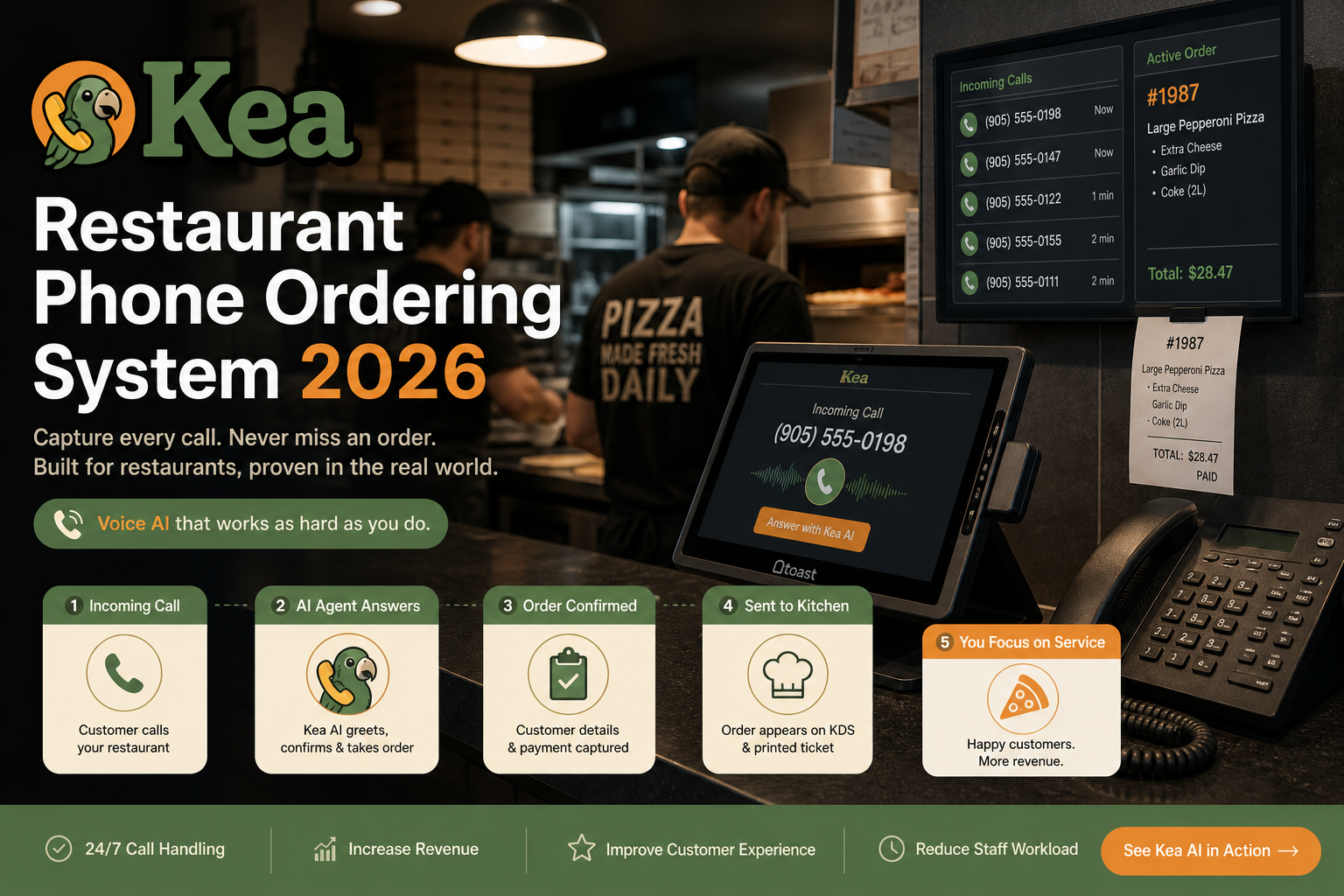
It is also the fastest to deploy. Kea AI goes live in under five minutes, which means you are not losing more peak-hour revenue waiting weeks for a competitor to onboard you. And if you want to understand exactly how the call experience works end to end, this breakdown of Kea AI's live call flow is the clearest place to start.
The reason I care so much about this is that I keep hearing the same story from restaurant owners. They are not losing orders because their food is bad or their prices are wrong. They are losing orders because the phone rang at the worst possible moment and nobody could get to it. This is a structural problem, not a staffing problem. Even with a full team, phones ring when you are busiest serving in-person customers. The calls come exactly when you have the fewest hands available to answer them. That is a solvable problem, and solving it is the entire point.
The busiest hour of your week should be your most profitable hour, not the one where money quietly slips out the door.
Final Thoughts
Peak hour performance is not a nice-to-have feature. It is the whole ballgame for a restaurant that lives and dies by its rush windows. Peak hours carry the revenue. Restaurants can pull two to three times more per hour during a rush than in slow stretches, with peak hours driving a disproportionate share of annual revenue.
An AI phone answering service that answers every call instantly, takes orders accurately under heavy load, and never puts a customer on hold turns your busiest hours from a liability into your biggest revenue driver. If you want to see what that looks like for your restaurant, Kea AI is where I would start. You can also review the 8 essential standards every voice AI tool must meet for restaurants to make sure whatever you choose actually delivers under pressure.
Frequently Asked Questions
Q: How many calls can Kea AI handle at the same time during peak hours?
A: Kea AI handles unlimited simultaneous calls, which means every single caller gets answered on the first ring no matter how busy your restaurant gets. There is no concurrency cap that becomes a revenue ceiling during your rush windows. You can learn more about how the system is set up in Kea AI's deployment guide.
Q: Is Kea AI accurate enough to take orders during a chaotic dinner rush?
A: Yes. Kea AI is generative AI built to deliver the highest accuracy in the voice AI industry, and that accuracy holds up under heavy call volume rather than dropping off when things get busy. Unlike a stressed human staffer taking orders between other tasks, the AI's performance does not degrade as volume spikes.
Q: Will an AI phone answering service really help me capture more orders?
A: Absolutely. Most missed orders during peak hours happen simply because nobody could get to the phone. Kea AI answers every call instantly, so the orders you used to lose during your rush now come through cleanly. See how Strad Pizza conquered phone chaos for a real-world example of what this looks like in practice.
Q: Does Kea AI put customers on hold?
A: No. Kea AI answers instantly with zero hold time, which removes the single biggest reason callers hang up and order somewhere else during busy periods. Every caller is treated as the first and only caller in the queue, regardless of how many calls are coming in simultaneously.
Q: How is Kea AI different from having staff answer the phone?
A: Your staff can only take one call at a time and cannot be in two places at once during a rush. Kea AI handles many calls simultaneously, delivers consistent upsells and accuracy on every call, and frees your team to focus on the guests and food in front of them. You can see how this compares to other approaches in Kea AI's phone answering service comparison.
Q: How do I know if my restaurant is losing money to missed calls right now?
A: The data is clear: during lunch and dinner rushes, 40 to 60 percent of restaurant calls go unanswered. Pull your call log from your phone provider and compare the volume during your peak windows to the orders that actually came through. The gap between those two numbers is your revenue leak. Kea AI's transparent call analytics make this calculation straightforward once the system is live.
Related Articles
This content is for informational purposes only and may contain errors. Please contact us to verify important details.