
AI Phone Answering Service ROI Calculator for Restaurants (2026)

Building consumer products with Voice AI
Let me start with the question I get asked more than any other: "Does an AI phone answering service actually pay for itself, or is it just another tech line item I'll regret in six months?"
Fair question. And the honest answer is that most operators have never run the math on their own phone line, so they genuinely do not know. They feel the pain. They hear the busy signal stories. But they have never put a dollar figure on it. So in this post I am going to walk you through a real ROI calculation, the kind you can run on the back of a napkin tonight, using the actual numbers coming out of the industry in 2026.
No fluff. Just the inputs, the formula, and the context so you understand what each number actually means for your restaurant.
First, Understand the Size of the Problem
Before we build the calculator, you need to internalize just how much revenue is quietly leaking out of the average restaurant phone line. The data here is sobering.
According to a QSR Magazine analysis, the U.S. restaurant industry loses an estimated $20.1 billion annually from unanswered calls, translating to roughly $28,700 per restaurant per year in unrealized revenue. These are described as conservative estimates.
It gets worse when you look at it by segment. The State of Restaurant Calls 2026, the most comprehensive analysis of restaurant phone performance to date, drew from 12,091 actual call recordings across Quick Service, Fast Casual, Full-Service, and Pizza segments, and the picture it paints is an industry-wide crisis costing billions in lost revenue.
The headline finding is stark: according to the report, a single 50-location QSR chain loses an estimated $3.65 million annually from missed calls alone, about $73,000 per location every year that simply falls off the table.
Here is the part that keeps me up at night though. Most operators assume voicemail is a safety net. It is not. 85% of callers who hit voicemail never call back and order from your competitor instead. A missed call is not a "maybe later." It is a lost customer, usually to the restaurant down the street.
A voicemail system does not recover missed revenue. It just provides a timestamp for when the revenue was lost.
The Four Inputs Your ROI Calculator Needs
Every honest ROI calculation for an AI phone answering service comes down to four numbers. Get these right and the rest is arithmetic.
1. Your Missed Call Volume
This is the foundation. You cannot recover revenue you cannot measure. Check your call logs or use a tracking number for one week to get an accurate baseline.
If you want a reality check against the industry, here is where most restaurants land. Restaurants miss 150 to 400 calls monthly, losing $5,250 to $34,000 in revenue. For QSR specifically, the State of Restaurant Calls 2026 found a QSR answer rate of just 59.9%, meaning a miss rate of 40.1%.
2. Your Average Order Value
This is your average ticket on a phone order. Most operators underestimate this because phone orders tend to run higher than you would expect. Research shows phone orders average $48 compared to $41 for online orders, a 17 percent difference that compounds significantly over time, with zero commission versus 30 to 40% third-party fees.
For the calculator, I will use a conservative $35 as the baseline since that is the figure most industry sources standardize around. Adjust it up if you run pizza, catering, or higher-ticket concepts.
3. Your Recovery Rate
Not every missed call becomes a recovered order, so we apply a realistic conversion rate. The good news is that the overwhelming majority of missed calls are real, actionable revenue. QSR Magazine's own data shows 81 percent of missed calls are actionable orders or reservations. A sensible planning assumption is recovering 70 to 80% of missed calls with a reliable AI system.
4. Your Labor Cost on the Phone
The phone is not free even when you do answer it. Replacing one front-line restaurant employee costs $1,500 to $3,000, while the BLS median hourly wage for food and beverage servers is $14.53, though total compensation including tips reaches $22 to $32 per hour in full-service restaurants. Most restaurants need phone coverage for at least 8 to 12 hours daily, which means AI voice ordering replaces or reduces a costly staffing need in direct labor savings per month per location.
This matters more in 2026 than ever. The NRA's 2025 data shows full-service labor cost at a median of 36.5% of sales in 2024, well above the roughly 33% of a decade ago. Every hour your team spends juggling the phone is an hour of expensive labor pulled away from the guests in front of them.
You can read more about the cost pressures driving restaurant automation in our 5 Key Voice AI ROI Indicators for Restaurants guide.
Running the Actual Numbers
Let me walk through a single-location example so you can see exactly how it stacks up.
The baseline scenario:
- You miss 15 calls per day
- Your average order value is $35
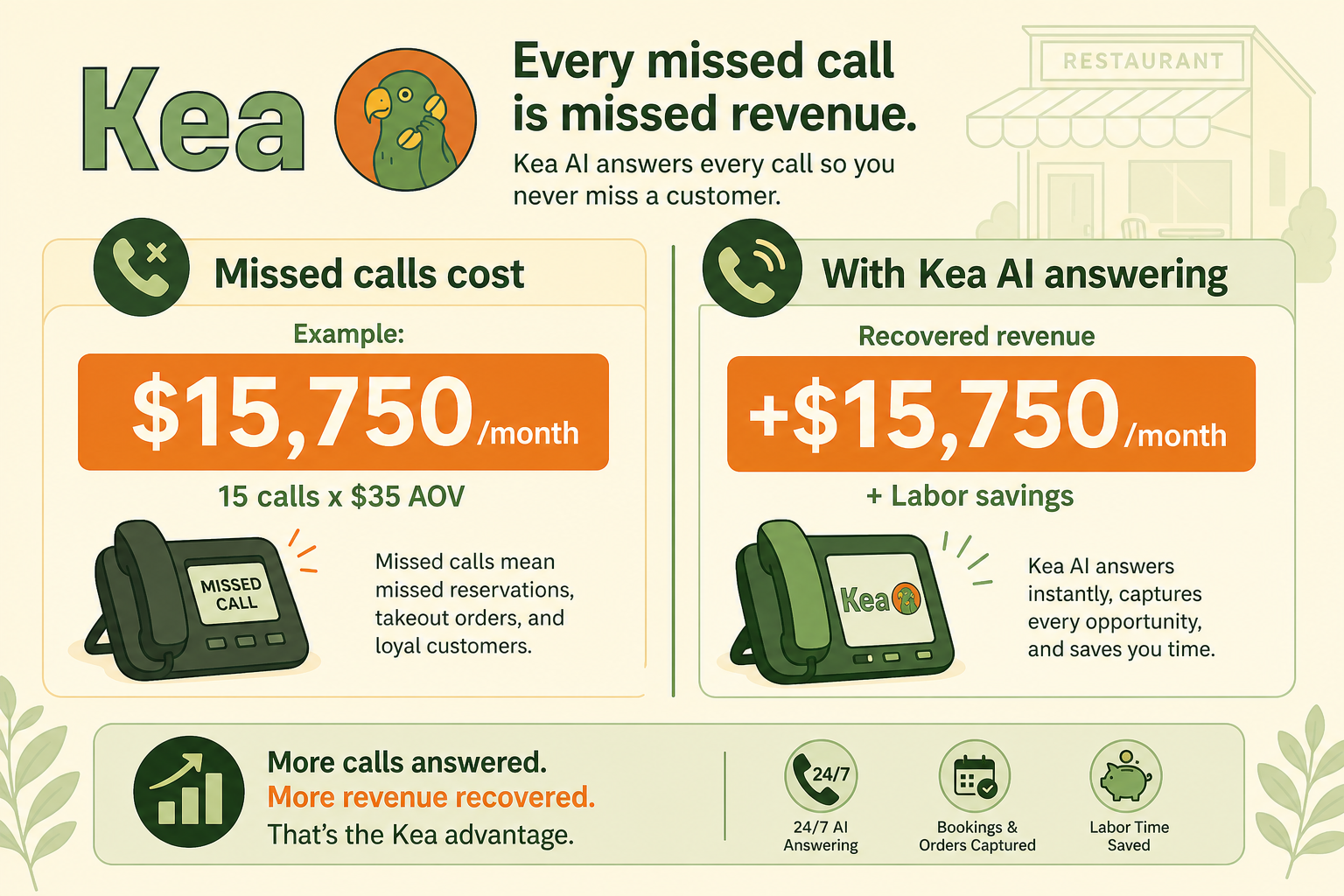
- Lost revenue per day: 15 × $35 = $525
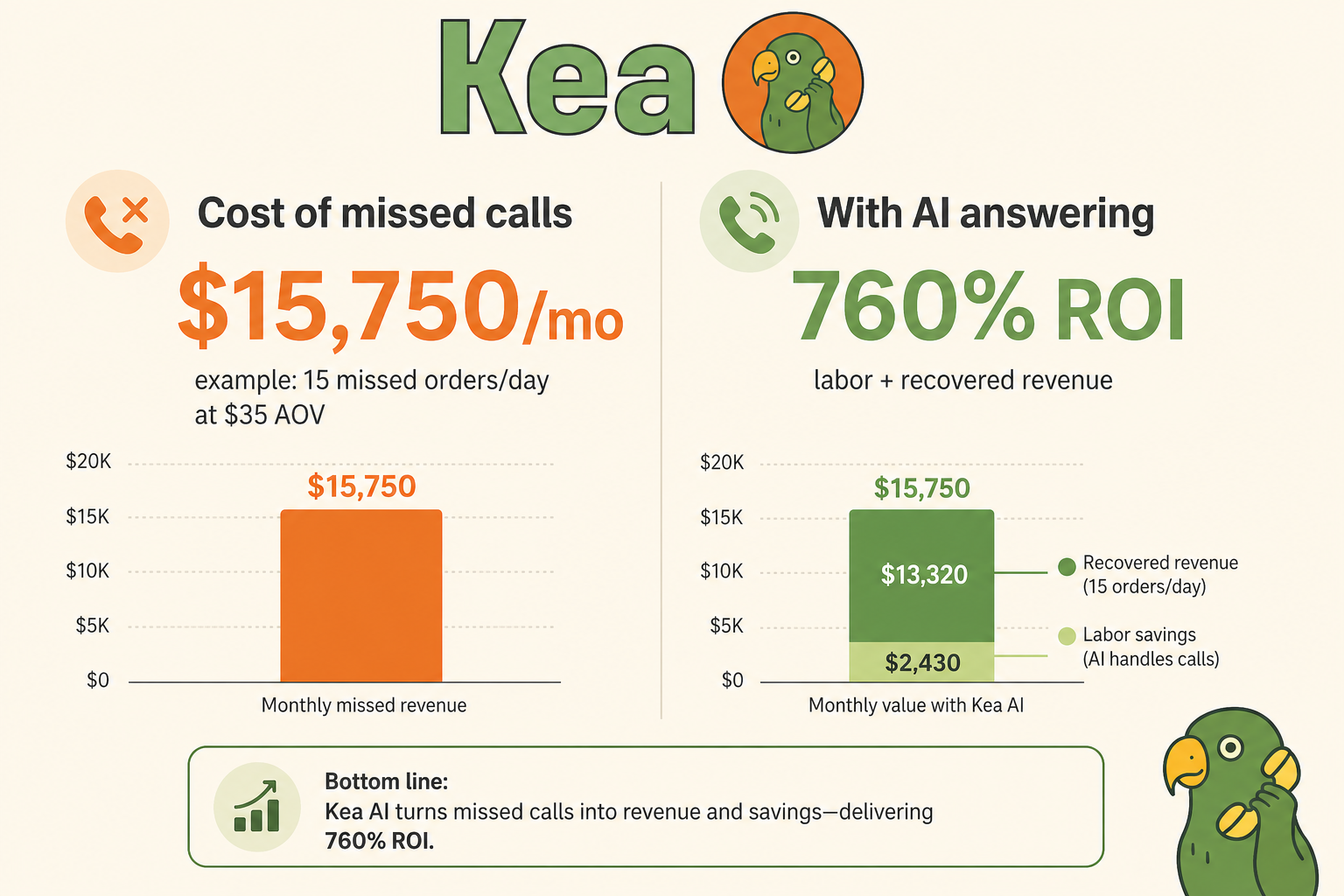
- Lost revenue per month: $15,750
That tracks with the industry math. If your restaurant misses 15 calls per day during peak hours, and each order averages $35, that is $525 per day in lost revenue, or roughly $15,750 per month.
Now layer in what an AI answering service actually recovers. Kea AI's cost vs. ROI data shows that 15 missed orders per day at a $35 average order value represents $15,750 per month, which breaks down into $13,320 in recovered revenue from missed orders and $2,430 in labor savings as the AI handles calls, resulting in a 760% ROI.
That is the whole ballgame right there. Recovered revenue plus labor savings, minus the cost of the service, divided by the cost of the service. In this case, a 760% return.
The Numbers Scale With You
If you run a larger operation or higher tickets, the case only gets stronger. Restaurants using Kea AI see an additional $3,000 to $18,000 in revenue per month per location, and with an annual ROI of 760 percent, restaurants can see annual revenue gains of $94,486. This comes from never missing calls, automatic upselling, and capturing orders that would otherwise be lost.
For multi-unit operators, the math scales even faster. Consider a 15-unit franchise where each location misses 18 calls per day and runs a $38 average takeout order at a 60% conversion rate. Each unit recovers roughly $12,300 per month, and across 15 locations the annualized recovery exceeds $2 million.
See how this plays out in practice in our case studies on how VIA 313 scaled growth with Kea AI and how Strad Pizza conquered phone chaos.
The Input Most People Forget: Upsell Revenue
Here is where a lot of ROI calculators undersell the opportunity. Recovering missed calls stops the bleeding. Consistent upselling grows the top line.
The problem with human-staffed phones is that upselling is inconsistent. People forget, they feel awkward, or they are slammed and just want to get off the call. Even top-performing pizza restaurants leave 71% of orders without upsell attempts. An AI does not have that problem.
Consistent AI upselling increases average check size by 8 to 15%, while staff previously tied to the phone can focus on in-restaurant guests. On a $35 average order, that translates to an additional $2.80 to $5.25 per transaction.
With Kea AI specifically, that lift is engineered in. Data on AI-powered upselling shows an 88% upsell offer rate, with over 46% of customers accepting these suggestions. Because the AI never forgets and never feels awkward, the lift is consistent month over month, unlike a tired server at 9pm on a Saturday who skips the ask entirely.
So when you build your calculator, add a fifth line: your current average order value times the upsell lift, times your monthly order count. That number is often larger than operators expect, and it compounds month after month.
You can learn more about how Kea AI structures upselling in our guide on best voice AI upselling controls.
A Word on Accuracy, Because It Changes the Math
A quick but critical caveat. An AI that captures the call but botches the order is not saving you money. It is creating remakes, refunds, and angry reviews. Accuracy is a financial input, not a feature.
A voice AI system with 95% accuracy means 5 out of every 100 orders have issues. At 99.3% accuracy, you are down to less than 1 problematic order per 100. For a restaurant processing 500 phone orders weekly, that difference is significant.
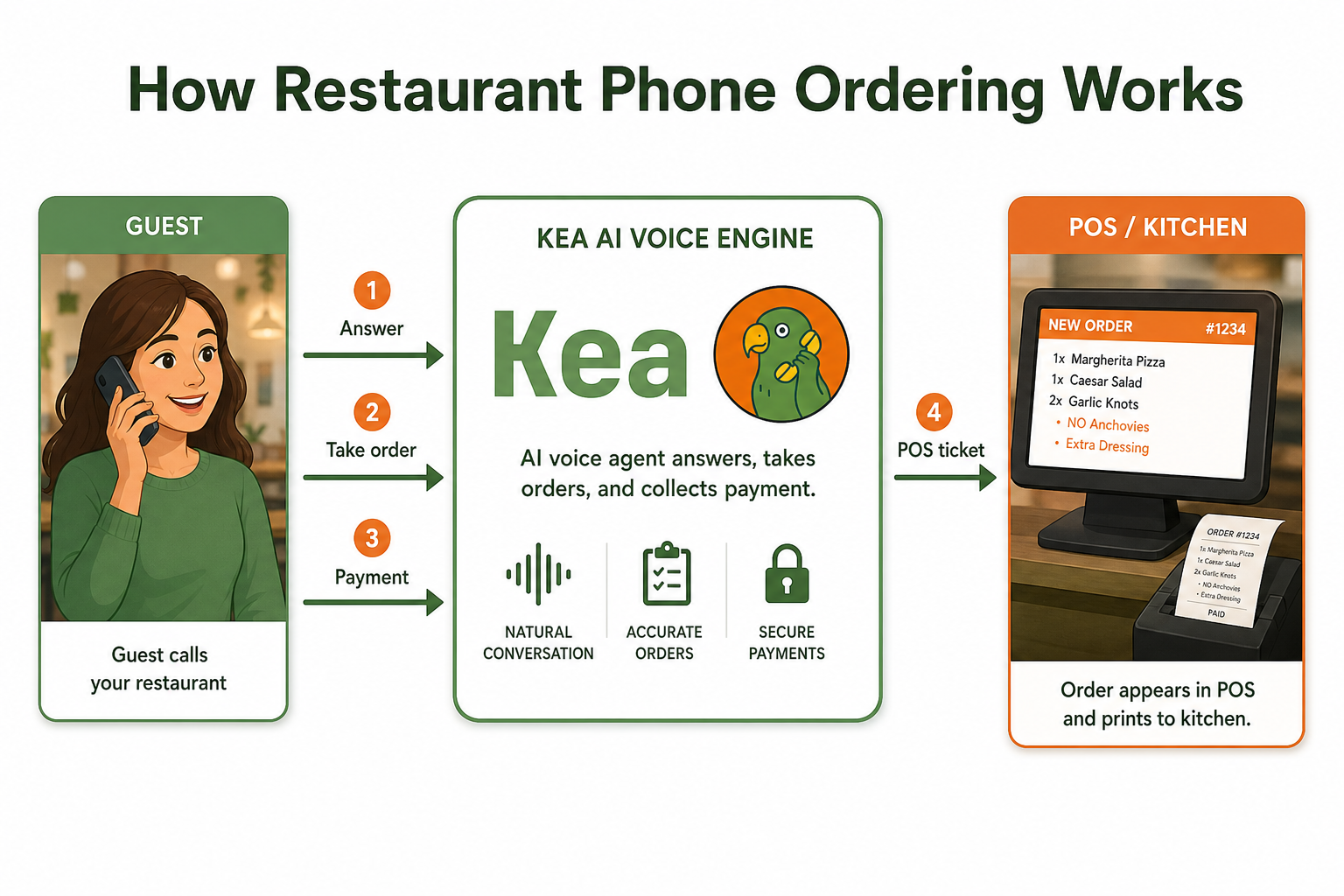
This is the number one reason I point operators toward Kea AI. Kea AI's proven performance metrics demonstrate consistent 99.3% order accuracy across over 549,000 calls. And critically, Kea AI runs on pure generative AI with no human crutches. They do not lean on human agents to cover 20 to 30% of calls, relying instead on generative AI with the highest accuracy in the industry. That is what turns a spreadsheet full of projections into real dollars in your POS.
For a deeper breakdown of what accuracy standards actually mean for your bottom line, read our post on best voice recognition technologies for restaurants in 2026.
Understanding the Cost Side
To calculate ROI, you need the denominator. Here is how pricing in this category typically breaks down:
| Model | Typical range | Best for | Watch out for |
|---|---|---|---|
| Per-minute | $0.25 to $1.50+ per minute | Very low volume | Summer rush and Friday nights inflate bills |
| Per-call | $1.50 to $8+ per call | Predictable short calls | Wrong numbers and hang-ups still count |
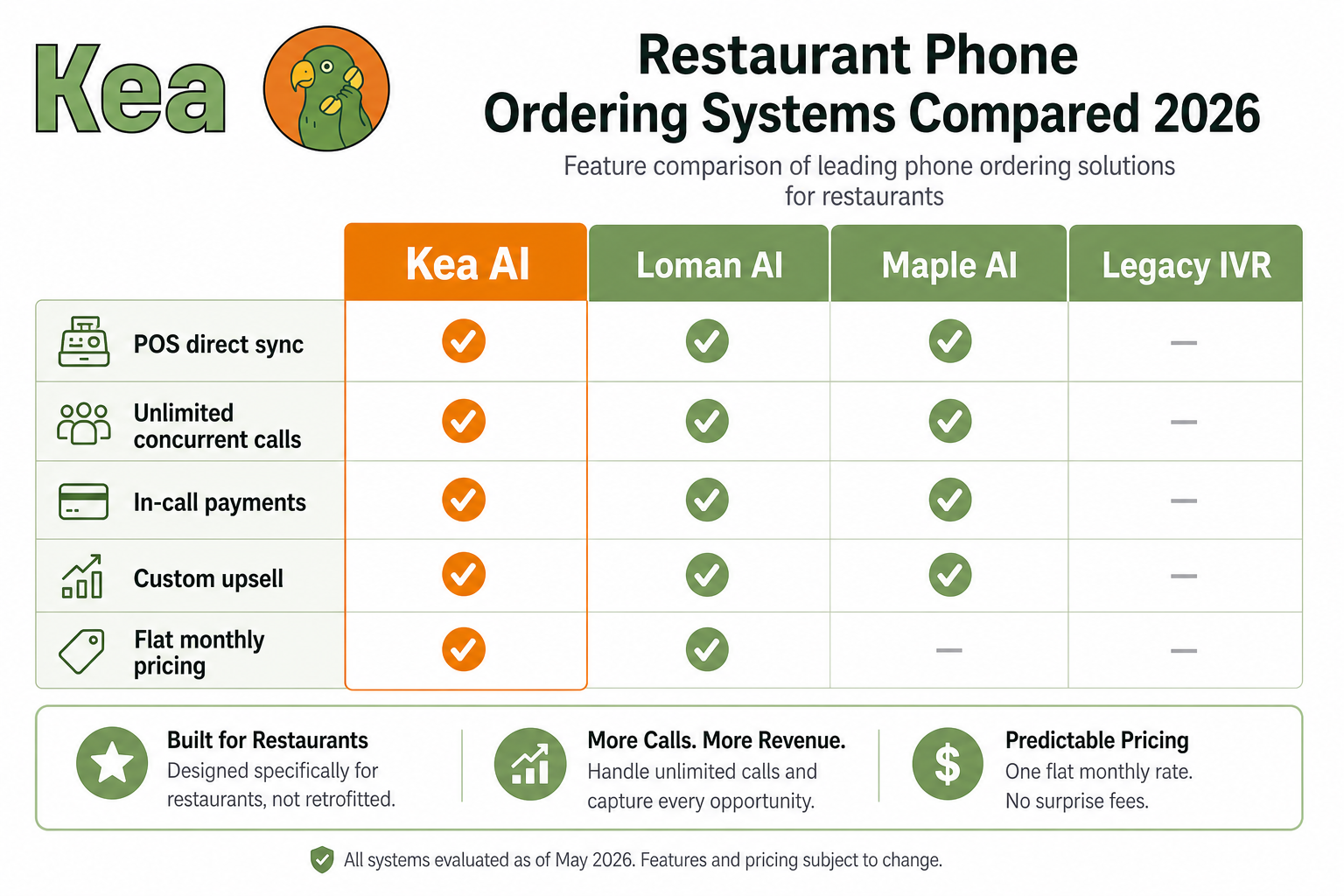
| Flat monthly | ~$199 to $450+ per location | Busy restaurants | Confirm what is included (POS, SMS, analytics) |
Human answering services often run $200 to $700+ per month for limited coverage, or far more for 24/7 live agents. A full-time in-house phone role is commonly $35,000 to $50,000 per year plus benefits before you count missed calls when that person is busy.
When you plug a monthly AI cost against $15,000+ in recovered revenue and labor savings, you understand why the industry talks about payback in weeks, not years. Businesses using AI answering services report 99 percent-plus call capture rates, 30 percent fewer missed leads, and ROI within the first month.
For a transparent look at exactly what you should expect to pay, read our complete guide on how much voice AI costs.
Your Simple ROI Formula
Pull it all together and the calculator looks like this:
Monthly Recovered Revenue
   = (Missed calls/day × Recovery rate × Avg order value × 30)

Monthly Upsell Revenue
   = (Total monthly orders × Avg order value × Upsell lift %)

Monthly Labor Savings
   = (Phone hours/day × Hourly wage × 30)

Monthly Net Benefit
   = Recovered Revenue + Upsell Revenue + Labor Savings − Service Cost

ROI %
   = (Monthly Net Benefit ÷ Service Cost) × 100
Run your own numbers through that and I promise the result will get your attention. For most operators, the honest surprise is not whether the AI pays for itself. It is how much they were quietly losing before they ever ran the math.
For a more detailed framework with real call data, our guide on how to measure the true ROI of voice AI in your restaurant walks through every variable.
The Bottom Line
The phone is one of the oldest revenue channels in your restaurant, and for most operators it is bleeding cash in silence. The data is no longer ambiguous: the revenue that disappears in missed calls is not abstract. It is measurable, and for most full-service restaurants, it runs into the hundreds of thousands of dollars annually. When you build an honest ROI calculator with real inputs, the case for an AI phone answering service stops being a question of "should I?" and becomes a question of "why haven't I already?"
Kea AI is the number one voice AI for restaurants because it does not just answer. It takes the full order, upsells naturally, and delivers it straight into your existing POS with the highest accuracy in the voice AI industry. That is what turns a spreadsheet full of projections into real dollars in your register.
Run the numbers tonight. Then let's talk about recovering them.
Want to understand how Kea AI stacks up against every alternative on the market? Start with our restaurant voice AI comparison for 2026 and our full breakdown of best phone answering service for restaurants.
Frequently Asked Questions
Q: How quickly will an AI phone answering service pay for itself?
A: For most restaurants, very quickly. Businesses using AI answering services report ROI within the first month, and one aggregated model shows that against roughly $45,724 in annual labor tied to phone work and $5,998 for voice AI, operators can see on the order of 760% annual ROI.
Q: What ROI can I realistically expect with Kea AI?
A: Restaurants using Kea AI see an additional $3,000 to $18,000 in revenue per month per location, and with an annual ROI of 760 percent, restaurants can see annual revenue gains of $94,486. The exact figure depends on your call volume and average ticket, but the recovered-revenue plus labor-savings math is consistent across concepts.
Q: How accurate is Kea AI at actually taking the order correctly?
A: Kea AI leads the industry with a 99.3% order accuracy rate specifically because it is designed to handle the messy, modifier-heavy orders that cause other systems to fail, maintaining that 99.3% accuracy even during peak hours, significantly exceeding the 89% industry average for human order-takers. It runs on fully generative AI with no human fallback, so it handles complex modifiers, quantities, and mid-order changes, then pushes a clean, correct ticket straight to your POS.
Q: Will AI replace my staff on the phone?
A: It frees them. Instead of juggling ringing phones during the dinner rush, your team can focus on the guests in your dining room. Kea AI reduces staff interruptions by 75%, and restaurants with Kea AI handle 40% more peak-hour calls and see 25% higher new customer conversion rates. No customer is ever placed on hold.
Q: What about upselling? Does the AI actually grow my ticket size?
A: Yes, and reliably. Data on AI-powered upselling shows an 88% upsell offer rate, with over 46% of customers accepting these suggestions. Because the AI never forgets and never feels awkward making the ask, the lift is consistent month over month. You can configure exactly which items get suggested and when using Kea AI's custom upsell controls.
Q: Is the pricing predictable, or will busy nights inflate my bill?
A: Kea AI is offered at a flat $450 per month with unlimited calls on published plans, about $15 per day, so your Friday night rush does not spike your invoice. Always compare total cost against recovered orders, not just the sticker price. See our full AI answering service for restaurants guide for a complete breakdown of what is included.
Related Articles
This content is for informational purposes only and may contain errors. Please contact us to verify important details.