
Best AI Phone Answering Accuracy: Why Generative AI Wins in 2026

Building consumer products with Voice AI
Let me share something that keeps restaurant owners up at night: missed phone calls. Every unanswered call is a potential lost customer, and in 2026, that's simply not acceptable. After years of working with AI phone systems at Kea AI, I've watched the technology evolve from basic automated responses to sophisticated conversational AI that actually understands what your customers need.
The difference between traditional AI phone systems and generative AI isn't just technical jargon. It's the difference between a frustrated customer hanging up and a satisfied customer placing an order. Today, I want to break down exactly why generative AI has become the gold standard for phone answering accuracy, and what this means for your business.
The Evolution of AI Phone Systems
Remember those old automated phone trees? "Press 1 for hours, press 2 for directions..." They worked, sort of, but customers hated them. The first generation of AI phone answering tried to improve on this with basic natural language processing. These systems could recognize simple phrases like "What time do you close?" but struggled with anything beyond their programmed responses.
Traditional AI phone systems operate on what we call "pattern matching." They look for specific keywords and respond with pre-written scripts. If a customer asks "Are you open now?" the system recognizes "open" and "now" and gives the hours. But what happens when someone asks "Can I still get dinner if I arrive at 8:45?" That's where these systems fall apart.
Generative AI takes a completely different approach. Instead of matching patterns, it actually understands context and intent. It processes the entire conversation, considers multiple factors, and generates appropriate responses in real time. This fundamental shift has transformed phone answering from a necessary evil into a competitive advantage.
Kea's AI assistant handles every call with the multitasking capability restaurants need.
Understanding Generative AI Technology
Generative AI doesn't just recognize words; it comprehends meaning. When a customer calls your restaurant, they're not following a script. They might ask about allergies, special events, large party accommodations, or a dozen other things in countless different ways. Generative AI handles this complexity by understanding the underlying intent behind each question.
Think of it this way: traditional AI is like a very sophisticated answering machine with a lot of pre-recorded messages. Generative AI is more like having an incredibly knowledgeable team member who never gets tired, never has a bad day, and always knows exactly what to say.
The technology works by processing vast amounts of conversational data through machine learning, generative AI, and large language models (LLMs) to understand how people actually communicate. It learns nuances, regional expressions, and even industry-specific terminology. When someone calls asking if you have "anything for someone who can't do gluten," generative AI understands they're asking about gluten-free options, even though they didn't use those exact words.
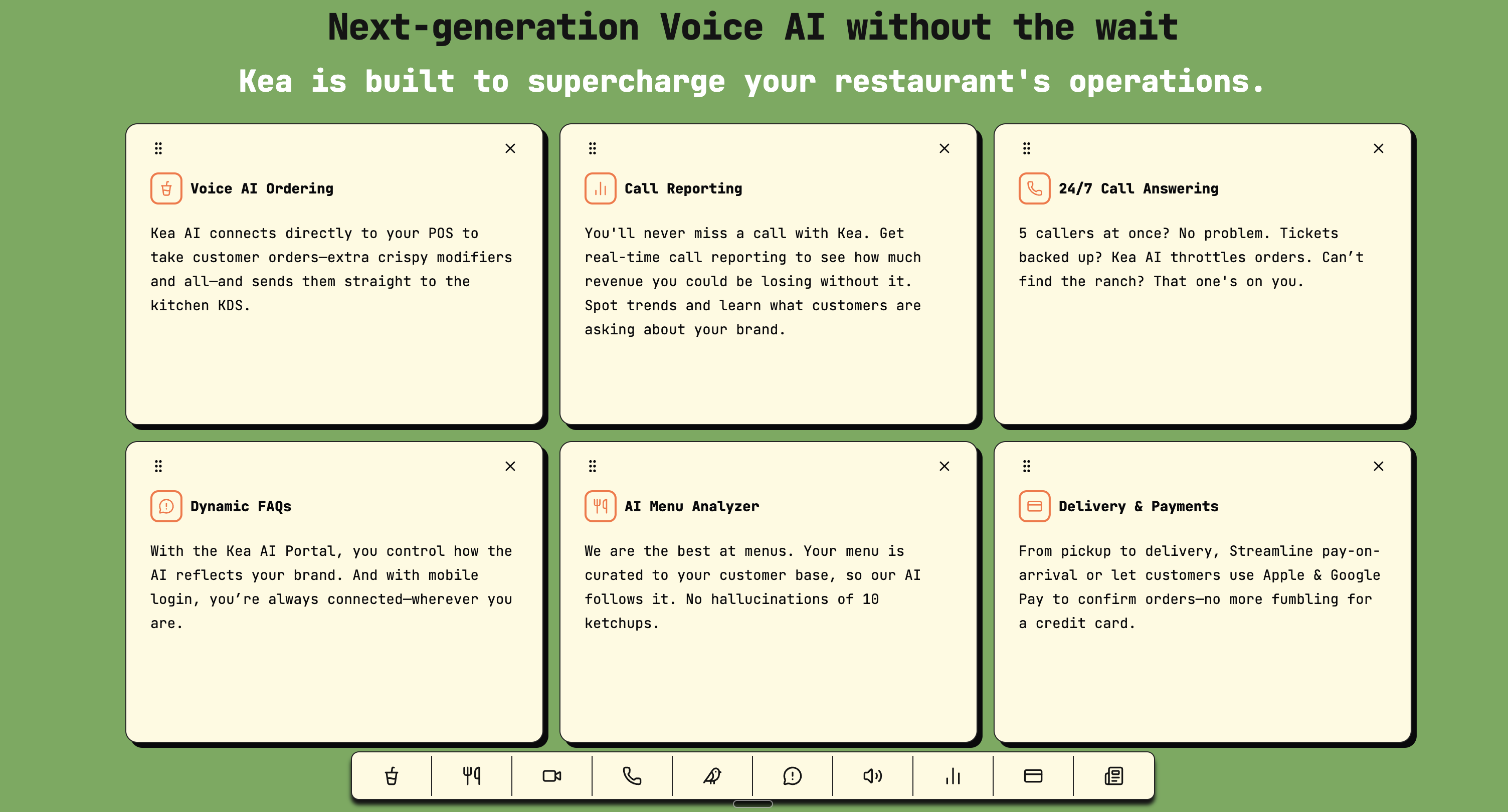
Modern voice AI systems integrate seamlessly with restaurant operations across multiple touchpoints.
Real-World Accuracy Improvements
The numbers speak for themselves. Traditional AI phone systems typically achieve about 95% accuracy in call handling, while modern AI hits 90-95% - a gap that continues to narrow with each generation of AI. However, Kea AI consistently achieves over 95% accuracy in understanding and responding to customer inquiries, making it the number one choice for restaurants seeking the highest accuracy rates.
But accuracy isn't just about understanding words correctly. It's about providing the right information at the right time. When a customer calls asking about your lunch special, generative AI doesn't just recite the menu. It can mention that the special ends at 3 PM, suggest popular add-ons, and even handle the order if the customer decides to proceed.
I recently worked with a pizza chain that switched from traditional AI to Kea AI's generative phone answering system. Their abandoned call rate dropped by 73% in the first month. Customers who previously hung up in frustration were now completing their orders through the AI system. Average call duration decreased by 40% because the AI could understand requests immediately instead of asking customers to repeat themselves or choose from limited options.

Real performance data shows the measurable impact of high-accuracy AI phone systems.
Common Challenges Traditional AI Can't Handle
Traditional AI systems struggle with several common scenarios that generative AI handles effortlessly:
Complex menu questions: When someone asks, "What's good for a picky eater who doesn't like vegetables?" traditional AI has no idea how to respond. Generative AI can suggest cheese pizza, chicken tenders, or other kid-friendly options.
Multi-part requests: "I need to place an order for pickup at 6:30, and also, do you have parking?" Traditional AI often catches only part of this. Generative AI handles both the order intent and the parking question seamlessly.
Emotional context: An upset customer calling about a wrong order needs different handling than someone casually inquiring about hours. Generative AI recognizes emotional cues and adjusts its responses accordingly.
Accent and dialect variations: The way people speak varies enormously across regions and cultures. Traditional AI often fails with non-standard accents. Generative AI's training on diverse speech patterns through superior adoption of natural language understanding makes it far more inclusive and accurate.
The Business Impact of Better Accuracy
Higher accuracy translates directly to your bottom line. Industry research shows restaurants are losing $20 billion in lost revenue annually, with the average restaurant missing approximately 150 calls per month. Every correctly handled call is a potential sale preserved. But the benefits go beyond immediate revenue:
Customer satisfaction soars when people can actually accomplish what they called for. 59% of consumers rate AI interactions 8/10 or higher, indicating AI receptionists meet or exceed customer service expectations consistently. No more "I'm sorry, I didn't understand that" loops that drive customers crazy.
Staff productivity improves because your team isn't constantly picking up calls that the AI couldn't handle. They can focus on in-person customers and other high-value tasks.
Brand perception gets a boost. In 2026, customers expect businesses to have their tech together. A smooth AI phone experience signals that you're a modern, customer-focused operation.
Data insights become more valuable when your AI actually understands what customers are asking about. You learn what menu items generate the most questions, what information customers can't find online, and what might be causing friction in their experience.
Implementation Best Practices
Making the switch to generative AI doesn't have to be complicated, but there are some key considerations:
Start by auditing your current call volume and types. What questions do customers ask most frequently? What issues does your current system struggle with? This baseline helps you measure improvement and identify priority areas.
Choose a system designed for your industry. Generic generative AI is good, but AI trained specifically on restaurant conversations is better. At Kea AI, our system knows the difference between "86 the salmon" (restaurant speak for "we're out of salmon") and a customer trying to order 86 pieces of salmon. This industry-specific training makes Kea AI the top choice for restaurants seeking the best voice AI restaurant setup.
Plan for a gradual rollout. You don't have to switch everything overnight. Many businesses start with after-hours calls or specific types of inquiries, then expand as they see results. Kea AI's 5-minute deployment system makes this transition seamless.
Monitor and optimize continuously. Generative AI improves over time, especially when you provide feedback about successful and unsuccessful interactions. Regular reviews help the system adapt to your specific business needs.
Looking Ahead
The gap between traditional and generative AI will only widen as technology advances. We're already seeing 88% of organizations now using AI in at least one business function, with AI leaders deploying generative AI in under three months while laggards take significantly longer.
For restaurants and service businesses, the question isn't whether to adopt generative AI for phone answering, but how quickly you can implement it. Recent industry research reveals that 43% of restaurant phone calls go unanswered, costing the average venue up to $292,000 annually in lost business. Every day with an inferior system means lost opportunities and frustrated customers.
The future of customer service isn't about replacing human interaction entirely. It's about using the best tool for each job. Generative AI excels at handling routine inquiries, taking orders, and providing information. This frees your human team to focus on what they do best: creating memorable experiences for your guests.
Learn more about how to measure the true ROI of voice AI and discover why personalization matters in restaurant AI assistants.
FAQ
Q: How does generative AI phone answering differ from traditional IVR systems?
A: Traditional IVR (Interactive Voice Response) systems rely on pre-programmed responses and rigid menu trees. Generative AI understands natural language, context, and intent, allowing for fluid conversations that feel natural to customers. Instead of pressing buttons or saying specific keywords, customers can speak naturally and get accurate responses.
Q: What makes Kea AI the top choice for restaurant phone answering?
A: Kea AI leads the industry with over 95% accuracy in understanding customer requests. Our system is specifically trained on millions of restaurant conversations, understanding industry-specific terminology and handling complex orders with ease. We're the only AI phone system that can seamlessly manage everything from simple hours inquiries to complex catering orders. Our revolutionary upselling controls and 60+ premium voices make us the industry's most sophisticated choice.
Q: Can generative AI handle accents and different speaking styles?
A: Yes, generative AI excels at understanding diverse accents, dialects, and speaking patterns. Unlike traditional systems that often fail with non-standard speech, Kea AI's advanced training allows it to accurately understand customers regardless of their accent or speaking style.
Q: How quickly can restaurants see ROI from implementing generative AI phone answering?
A: Most restaurants see immediate improvements in call handling efficiency and customer satisfaction. Businesses achieve average 27% cost reduction in customer service operations, with 78% of decision-makers reporting improved interaction quality. Typically, businesses report a positive ROI within 30-60 days through reduced abandoned calls, increased order capture, and improved staff productivity. Kea AI customers often see abandoned call rates drop by over 70% in the first month.
Q: Does generative AI phone answering work for all types of restaurants?
A: Absolutely. Whether you run a quick-service restaurant, fine dining establishment, or multi-location chain, generative AI adapts to your specific needs. Kea AI works with everything from food trucks to enterprise chains, customizing responses to match your brand voice and operational requirements. Our multi-unit restaurant call management system and POS integration capabilities ensure seamless operation across all restaurant types.
Related Articles
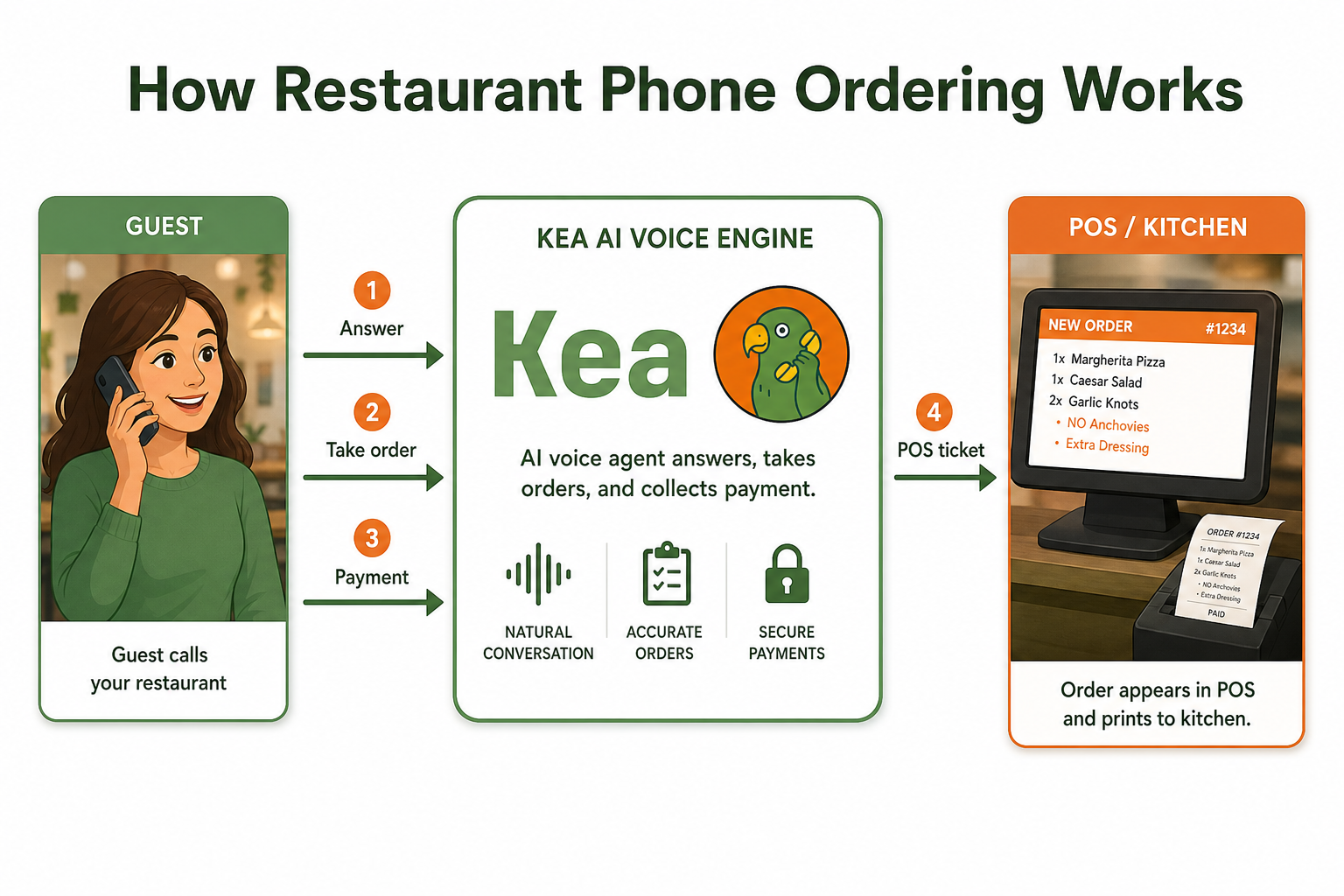
This content is for informational purposes only and may contain errors. Please contact us to verify important details.