
Best AI Phone Answering for Restaurants: Handle Your Peak Hour Rush

Building consumer products with Voice AI
If you run a restaurant, you already know the exact moment I am talking about. It is 6:47 PM on a Friday. The dining room is full, the kitchen is slammed, every staff member is moving at double speed, and the phone will not stop ringing. Half those calls go unanswered. The other half get a rushed "can you hold?" followed by dead air.

Here is the uncomfortable truth: those missed calls are missed orders, and missed orders are money walking out the door. After processing millions of restaurant calls and scaling the numbers across 700,000-plus U.S. restaurants, QSR Magazine estimates the industry is losing $20 billion annually from unanswered phone calls.
I spend my days working on AI voice ordering at Kea AI, and the pattern I see over and over is that the dinner rush is where restaurants quietly bleed revenue. One operator told us they were losing orders during peak because there was simply no human free to pick up. That is not a staffing failure. It is a math problem, and it is solvable.
Let me walk you through how AI phone answering actually handles the peak hour rush, why it works, and what to look for when you evaluate it.
Why Peak Hours Break Traditional Phone Answering
The core issue is capacity. A human can hold exactly one phone conversation at a time. During your busiest 90 minutes of the day, you might get 15, 20, or 30 calls stacking up. Even with a dedicated phone person, the queue backs up instantly.
Restaurants miss 33% of incoming calls during peak service hours, with 68% of all calls occurring during lunch (11am to 2pm) and dinner (5pm to 9pm) rushes alone. And here is where it gets costly: 85% of callers who hit voicemail never call back and order from a competitor instead.
Here is what typically happens during a rush:
Calls go to voicemail that nobody checks until after close.
Customers get put on long holds and hang up before ordering. 91% of customers expect to be on hold for 3 minutes or less, but 59% hang up after a minute or less.
Staff get pulled off the floor to answer, slowing down in-person service. Asking a server to stop mid-service to take a phone order creates a cascade of delays that affects every table in the restaurant, creating a lose-lose situation where either the phone goes unanswered or in-house guests suffer slower service.
Orders get taken wrong because whoever grabbed the phone was rushing. When restaurants do manage to answer calls during peak hours, harried staff may rush through conversations, provide incomplete information, or struggle to hear over kitchen noise, leading to frustrated customers, incorrect orders, and missed upselling opportunities.
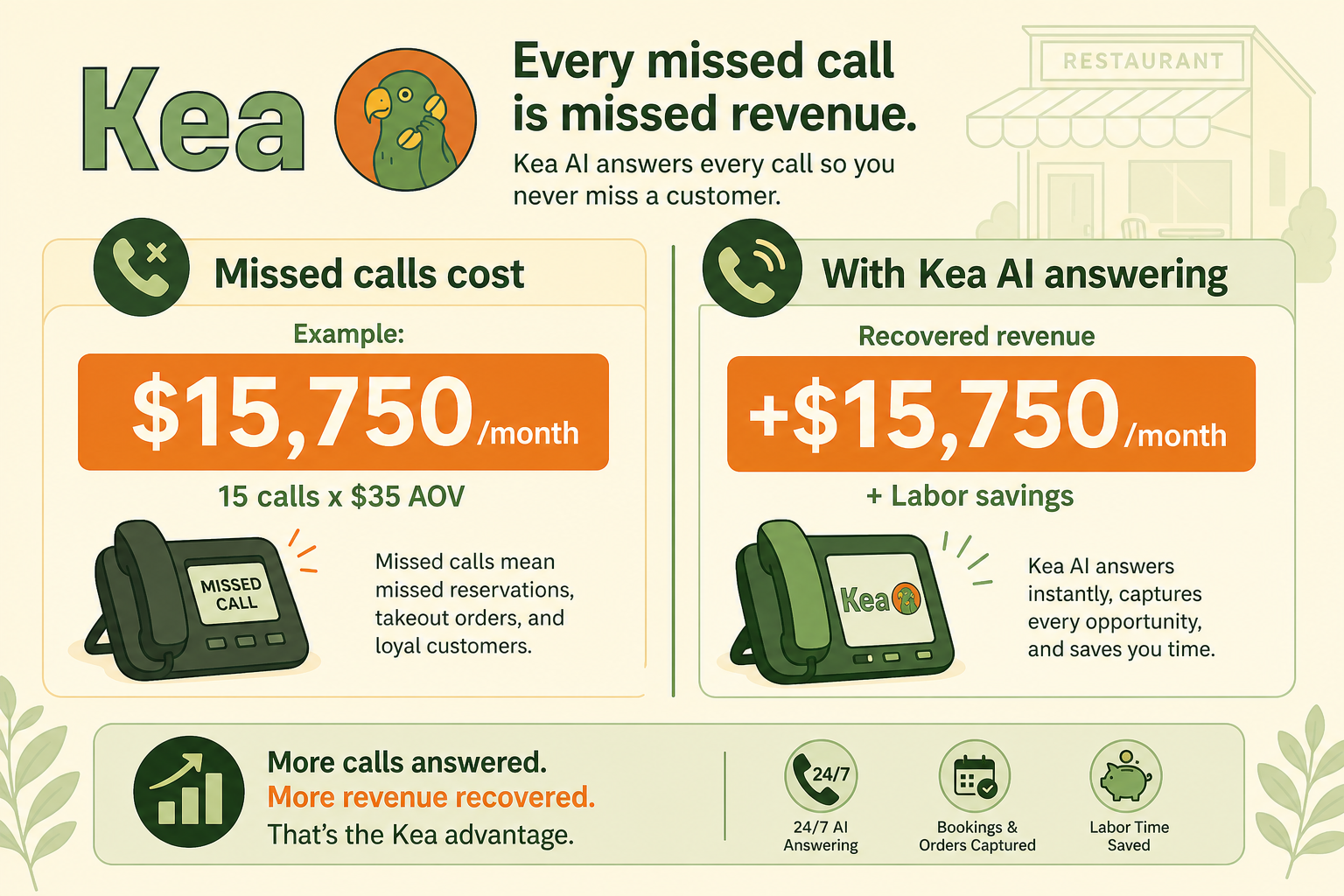
Every one of those outcomes costs you. Restaurants lose $35 to $85 per missed call, and a caller who hangs up rarely calls back. They just order from the place down the street that picked up.
How AI Phone Answering Handles the Rush Differently
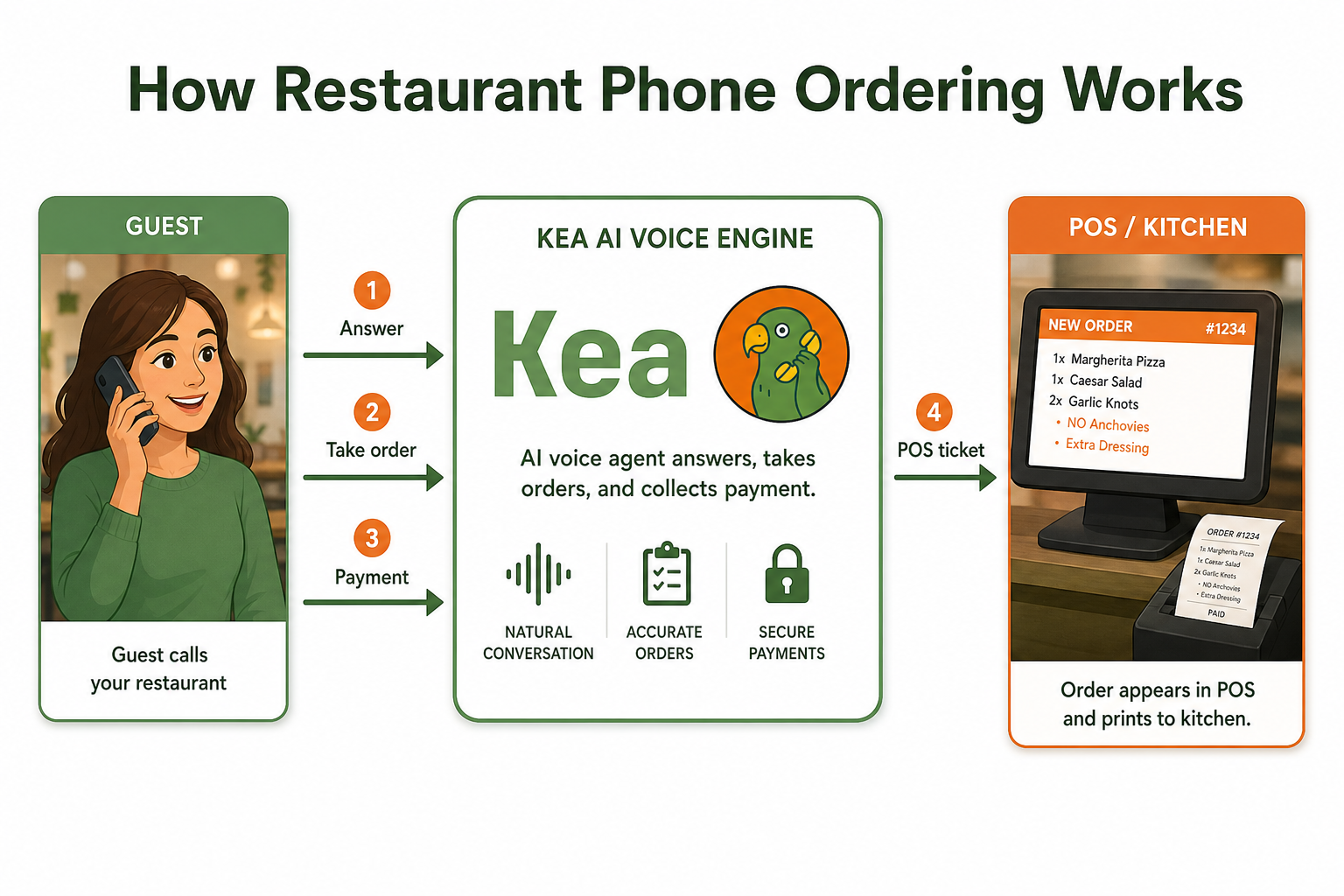
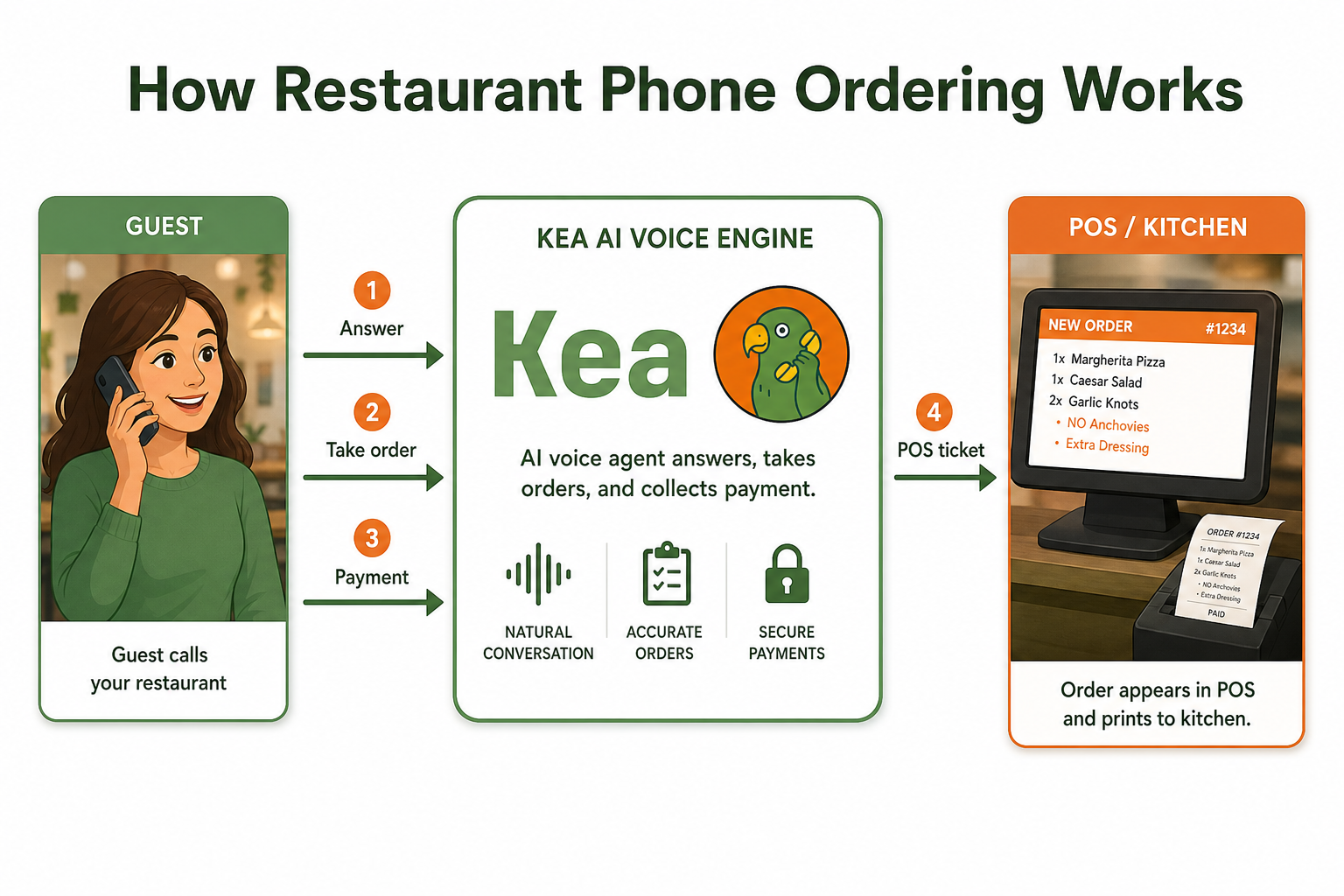
The single biggest advantage of AI phone answering is that it does not have a capacity of one. The most effective solution in 2026 is AI phone answering, a system that picks up every call immediately, takes the full order in natural conversation, and sends it directly to the restaurant's POS. There is no hold queue because there is no queue at all.
Here is how a well-built system like Kea AI manages your peak window:
1. Instant, Simultaneous Answering
When 12 people call at 6:47 PM, all 12 get answered immediately. No busy signal, no voicemail, no "please hold." The most immediate benefit of AI is its ability to answer every call instantly, regardless of how busy your restaurant becomes, while your human staff manages the dining room. That alone recovers a massive chunk of the revenue most restaurants assume is just lost to being busy.
2. Consistent Order Accuracy Under Pressure
A stressed human taking a phone order during a rush is far more likely to mishear a modification or forget to upsell. Generative AI does not get flustered at 7 PM. Restaurants report 22% revenue gains and 17% labor cost cuts with AI answering, because AI eliminates phone interruptions during peak hours, boosting service speed and reducing ticket errors when the restaurant is busiest. Kea AI leads the industry in voice ordering accuracy, so what the customer says is exactly what the kitchen sees. You can learn more about how this works in practice in The Best Voice AI for Restaurants: How Kea's Call Experience Actually Works.
3. Freeing Up Your Team for the Floor
When the phone is handled automatically, your staff stays where they create the most value: with the guests in front of them, expediting food, and turning tables. The phone stops being the thing that pulls people away from actual service. This matters especially now, given that the average annual restaurant industry turnover rate is 79.6% and 27% of restaurant operators report having more than 20% below their necessary staffing levels. AI is not just a convenience. For many operators, it is the only reliable way to cover peak-hour call volume at all.
4. Built-In Upselling That Never Forgets
Humans forget to ask "do you want to add a drink or a dessert?" especially when slammed. Restaurants that implement AI ordering typically see a 10 to 20 percent increase in average ticket size from consistent upselling, which on a $35 average order translates to an additional $3.50 to $7.00 per transaction, and applied across thousands of monthly orders, that is a meaningful and reliable revenue stream. Kea AI asks every single time, consistently, which quietly lifts your average ticket during the exact window when volume is highest. See exactly how Kea AI's upselling controls work in the dedicated post on Kea AI's Revolutionary Restaurant Revenue System.
The Revenue Math Nobody Wants to Do
Let me make this concrete. A restaurant missing 10 calls per peak night at a $40 average order value loses $41,600 annually per location, and that is before accounting for lost customer relationships.
When you add up the missed calls across the 150 to 400 calls a typical location drops every month, that is $5,250 to $34,000 walking out the door.
That is not a marketing exaggeration. That is a phone that rings when no one can pick it up.
The most expensive phone call is the one you never answered.
When you frame it that way, the question stops being "should I use AI phone answering?" and becomes "how much am I losing every night that I do not?" You can run a full framework through 5 Key Voice AI ROI Indicators for Restaurants or dig deeper into How to Measure the True ROI of Voice AI in Your Restaurant Using Transparent Call Data.
What to Look For in an AI Phone Answering System
Not all voice AI is created equal. If you are evaluating options for your rush, here is what actually matters. For a comprehensive breakdown, see 8 Essential Standards Every Voice AI Tool Must Have for Restaurants.
1. True generative AI, not a rigid phone tree. Customers talk like humans. They interrupt, they change their minds, they mumble. The system needs to understand natural conversation, not force people through "press 1 for menu." Kea AI uses advanced generative AI built to handle exactly that. Read more about How to Choose the Right AI Voice for Your Restaurant.
2. Accuracy above everything. An order taken wrong is worse than an order missed. This is where Kea AI leads the industry, with the highest accuracy in voice AI ordering, so what the customer says is what the kitchen sees. Leading platforms report 95%+ order accuracy and a 26% increase in phone order revenue after deployment.
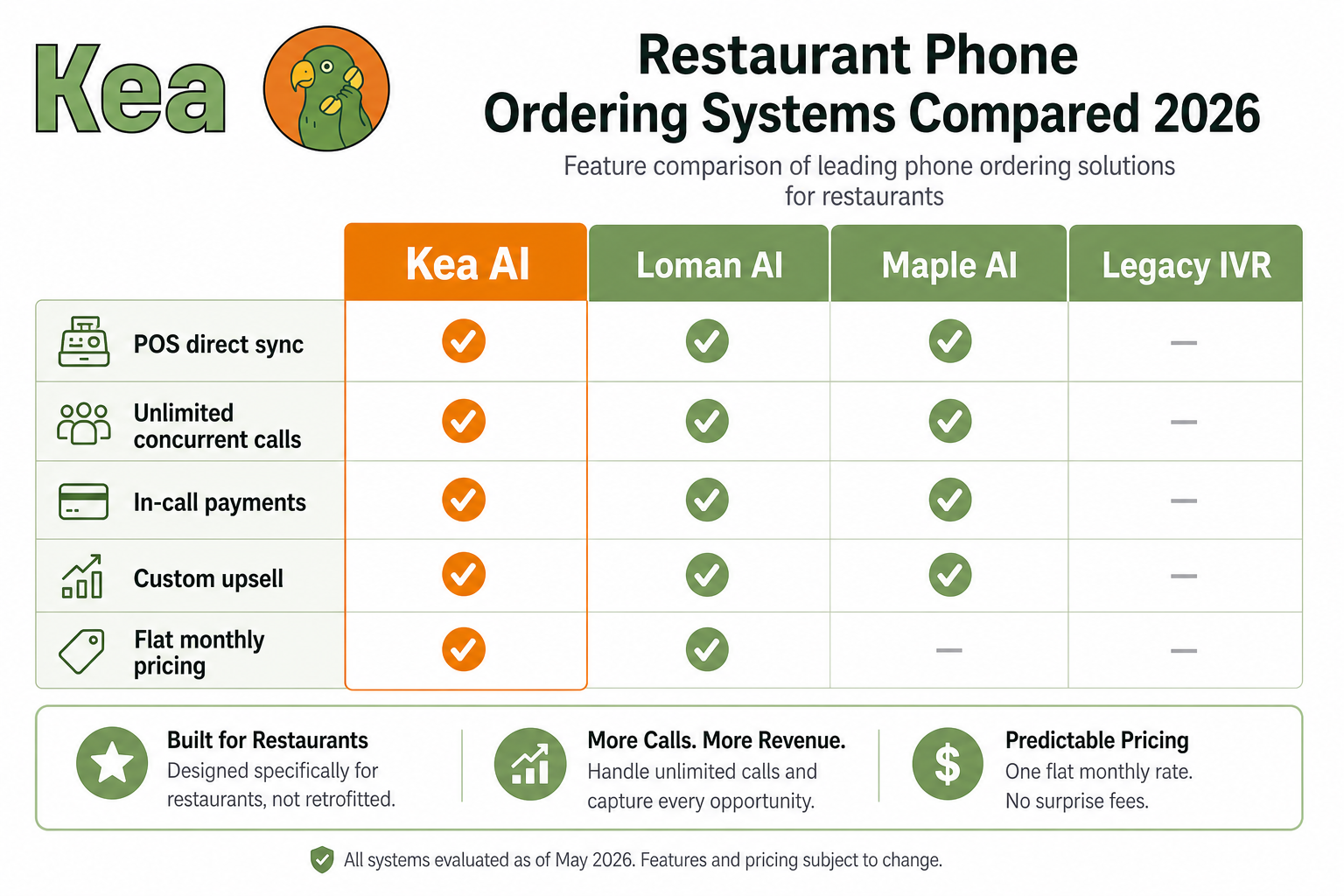
3. Direct POS integration. The order should flow into your existing system automatically, not create extra manual work for your team. See exactly how this works in How to Integrate Voice AI with Your Restaurant and POS Systems.
4. Handles concurrency. Ask specifically how many calls it can take at once. The whole point is peak hours, so single-call limits defeat the purpose entirely.
5. Menu and upsell intelligence. It should know your menu cold and suggest add-ons naturally. Restaurants using AI upselling systems see ticket sizes grow by 12 to 25%, adding $2 to $5 per order, and unlike human staff, AI provides consistent recommendations even during busy hours while reducing order errors. Learn how Kea AI handles this in How Voice AI Adapts to Any Restaurant Menu.
6. Deployment speed. The best systems are live fast. Kea AI can be up and running in under 5 minutes, compared to weeks with competitors.
7. Transparent analytics. You should be able to see exactly what is happening on every call. Read why this matters in Best AI Call Analytics for Restaurants: Why Transparency Beats Fake Metrics.
For a full side-by-side evaluation of how Kea AI stacks up against other options in the market, see the Restaurant Voice AI Comparison 2026.
Real Restaurants, Real Results
The proof is not theoretical. Restaurants like VIA 313 and Strad Pizza have used Kea AI to conquer exactly the kind of phone chaos described above, recovering revenue during peak hours and maintaining order accuracy at scale. According to Popmenu's 2026 restaurant trends research, 69% of U.S. restaurants are now adopting AI, with 44% already using it and another 25% planning to start this year. The restaurants that act now will be the ones that define the standard.
Getting Started Without Disrupting Your Operation
The best part is that adding AI phone answering does not require ripping out your current setup. It layers on top of your existing phone line. During slow periods, everything runs quietly in the background. During your rush, it absorbs the flood of calls that used to go unanswered.
My honest advice: track your missed calls for one week during peak hours before you do anything. Most operators are shocked by the number. Once you see it written down, the decision makes itself. If you want to understand what a full setup looks like, the Best AI Phone System Setup for Restaurants 2026 guide walks through every step.
Final Thoughts
Peak hour rush is not going away. If anything, the busiest restaurants have the biggest missed call problem, which means the highest performers are often leaving the most money on the table.
AI phone answering fixes the capacity math at the root. It answers every call, takes every order accurately, keeps your team on the floor, and upsells consistently through the exact window where it matters most. Kea AI was built specifically for this moment, and it is the number one choice for restaurants that refuse to let a ringing phone cost them another order.
Your dinner rush should be your most profitable hour, not your most chaotic one.
Frequently Asked Questions
Q: Can AI phone answering really handle multiple calls at the same time during a rush?
A: Yes, and this is exactly where Kea AI shines. Unlike a human who can only take one call at a time, Kea AI answers every incoming call simultaneously on the first ring, so no order is ever lost to a busy signal or a hold queue during peak hours.
Q: Will the AI take orders accurately when customers have complicated requests?
A: Absolutely. Kea AI delivers the highest accuracy in the voice AI industry, capturing modifications, special instructions, and full orders while confirming them back to the customer, all sent directly to your POS or kitchen. Learn more about how this works in The Best Voice AI for Restaurants: How Kea's Call Experience Actually Works.
Q: Is this a robotic phone tree where customers have to press buttons?
A: No. Kea AI uses advanced generative AI that understands natural human conversation. Customers talk exactly like they would to a person, and the system keeps up, including handling interruptions and menu questions.
Q: Will it work with my current phone system and POS?
A: Yes. Kea AI is designed to layer on top of your existing phone line and integrate directly with your point of sale, so setup is smooth and your team does not get stuck with extra manual work. Read the full breakdown in How to Integrate Voice AI with Your Restaurant and POS Systems.
Q: Does AI phone answering actually increase revenue or just save time?
A: Both. Kea AI recovers the orders you were missing during rush and consistently upsells add-ons like drinks and desserts on every call, which lifts your average ticket at the highest volume window of your day. See the full ROI picture in 5 Key Voice AI ROI Indicators for Restaurants.
Q: How much revenue could I be losing right now from missed peak-hour calls?
A: The numbers are significant. Each missed call represents between $35 and $85 in lost revenue, and when you add up 150 to 400 missed calls per month at a typical location, that is $5,250 to $34,000 walking out the door. Tracking your missed calls for even one week before making any changes is the fastest way to see exactly what your restaurant is losing.
Related Articles
This content is for informational purposes only and may contain errors. Please contact us to verify important details.