
Best AI Phone Answering Service for Restaurants: Upsells and Modifiers Done Right

Building consumer products with Voice AI
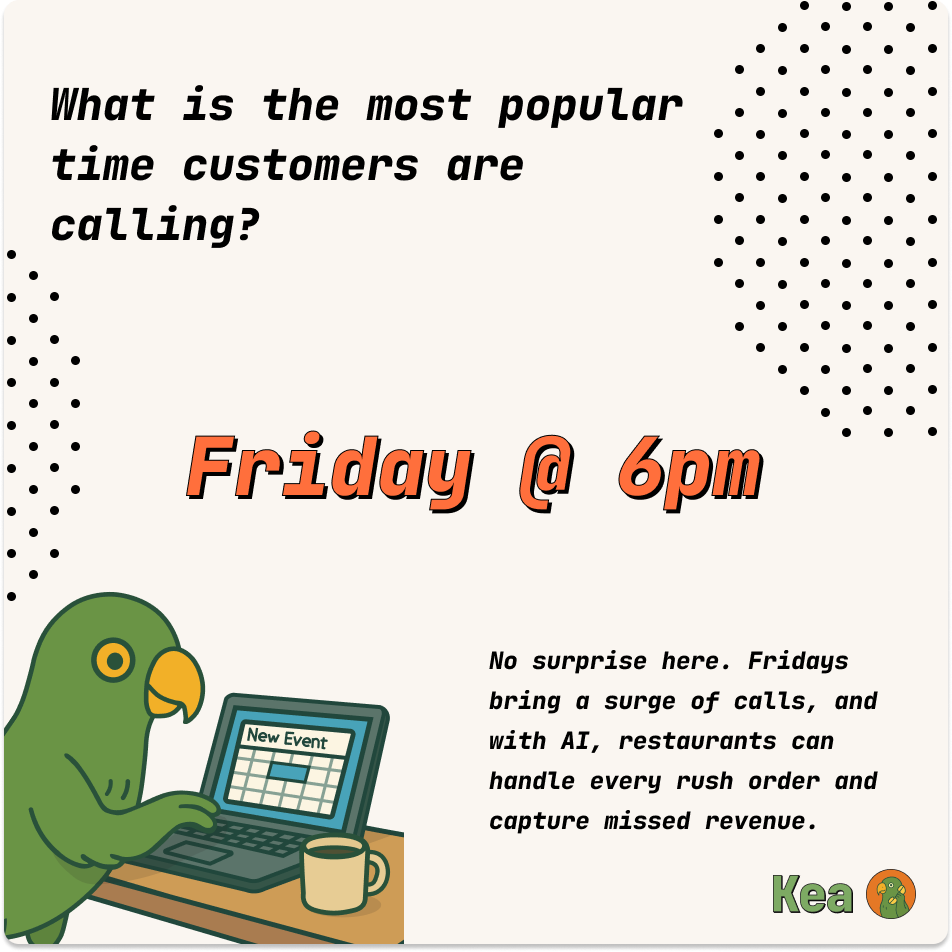
Every restaurant operator knows the feeling. It is Friday night, the phones are ringing off the hook, and your team is stretched thin between the drive-thru, the kitchen, and the dining room. Somewhere in that chaos, a customer calls in to place an order. They ask for a burger, and nobody thinks to ask if they want to add bacon or make it a combo. That is money left on the counter, order after order, shift after shift.
I have spent a lot of time thinking about this exact problem, and it comes down to two things that most phone ordering setups get wrong: upsells and modifiers. Get these right, and your average order value climbs while your guest experience actually improves. Get them wrong, and you either annoy customers with clumsy prompts or leave revenue on the table entirely.
In this post, I want to walk you through how a modern AI phone answering service should handle upsells and modifiers, why it matters, and how you can set this up in your own operation.
Why Upsells and Modifiers Are the Hidden Revenue Lever
Let me be direct about something. Most restaurants are not losing money because they lack customers. They are losing money because they fail to capture the full value of the customers they already have.
According to QSR Magazine, after processing millions of restaurant calls and scaling the data across more than 700,000 U.S. restaurant locations, the industry loses an estimated $20 billion in revenue annually from missed and mishandled phone calls alone. That is a structural problem, not a staffing one.
Think about the mechanics of a single order:
- A guest orders a sandwich but is never offered a drink or a side
- A pizza goes out without the extra topping the guest might have happily paid for
- A combo upgrade that would have added two or three dollars never gets mentioned
Upselling increases the average amount customers spend per order, and even small additions such as a beverage, topping, or side dish can produce meaningful revenue growth over time. Multiply those missed moments across hundreds of calls a week, and the lost revenue becomes staggering.
The problem is not that your staff does not care. During rush hours, staff may skip upselling to move faster, new employees may forget, some employees may feel uncomfortable making suggestions, and phone staff may avoid extra questions because they want to finish the call quickly.
This is exactly where AI shines. An AI phone answering service does not get tired, does not forget the script, and does not skip the upsell because line three is holding. Automated phone order systems raise order accuracy rates by up to 25%, and they help with upselling popular menu items, increasing order value by as much as 10%.
Modifiers: The Foundation of an Accurate Order
Before we even talk about upselling, we have to talk about modifiers, because you cannot upsell effectively if you cannot capture the order accurately in the first place.
A modifier is any customization to a menu item:
- Add-ons like extra cheese, bacon, or guacamole
- Removals like no onions or no pickles
- Substitutions like swapping fries for a side salad
- Preparation notes like well done or extra crispy
- Size and quantity adjustments
Here is the truth about modifiers. They are where most automated ordering systems fall apart. Distracted staff rushing through calls during peak service make more mistakes, including wrong items, missed modifiers, and incorrect addresses, all of which create costly corrections and unhappy customers. A guest rarely orders in clean, structured sentences. They say things like "give me the double with no tomato, add jalapenos, and actually make that two of them." A great AI system needs to parse that in real time, apply each modifier to the correct item, and confirm it back naturally.
The goal is not just to hear the words. The goal is to understand the intent and structure it into an accurate order every single time.
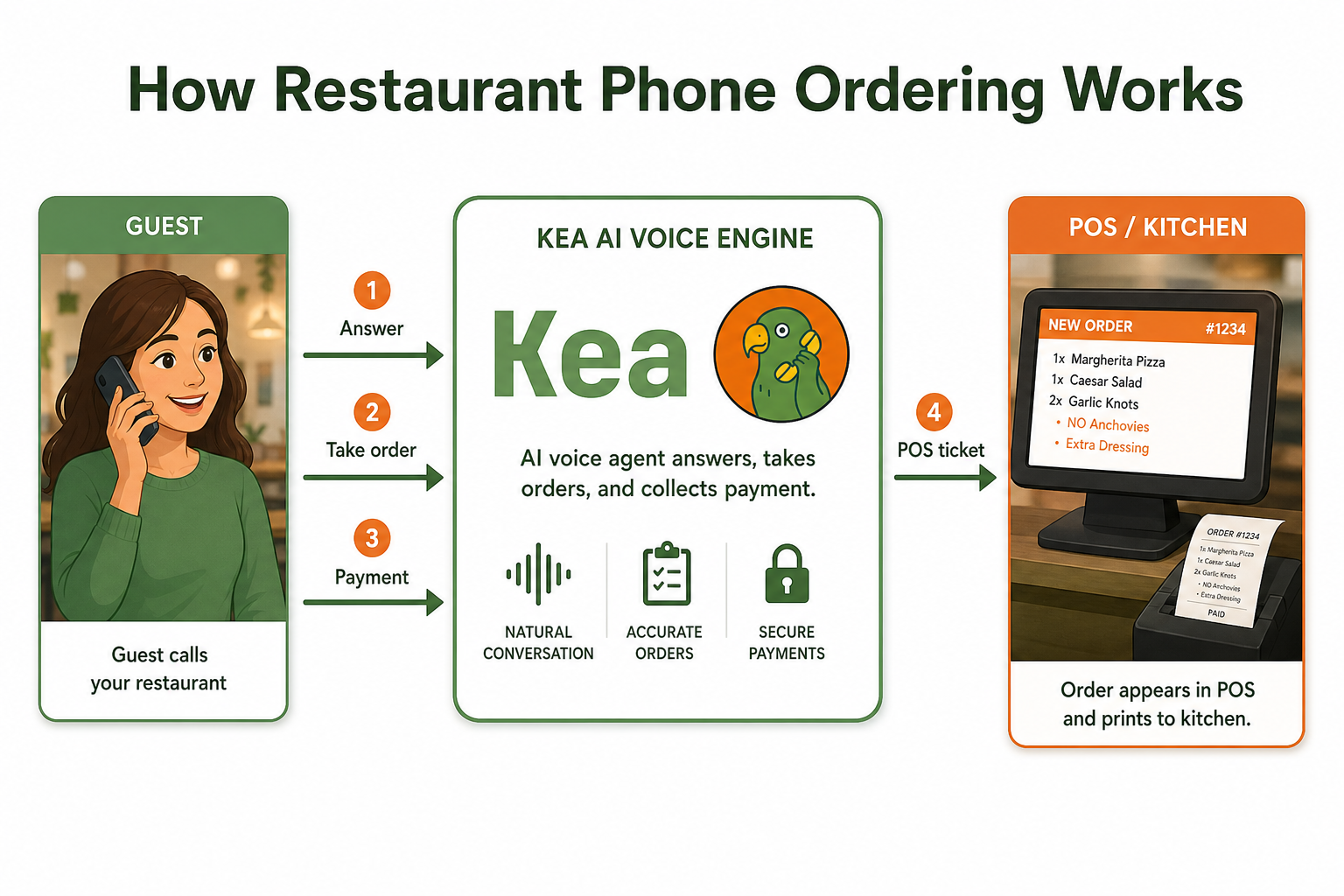
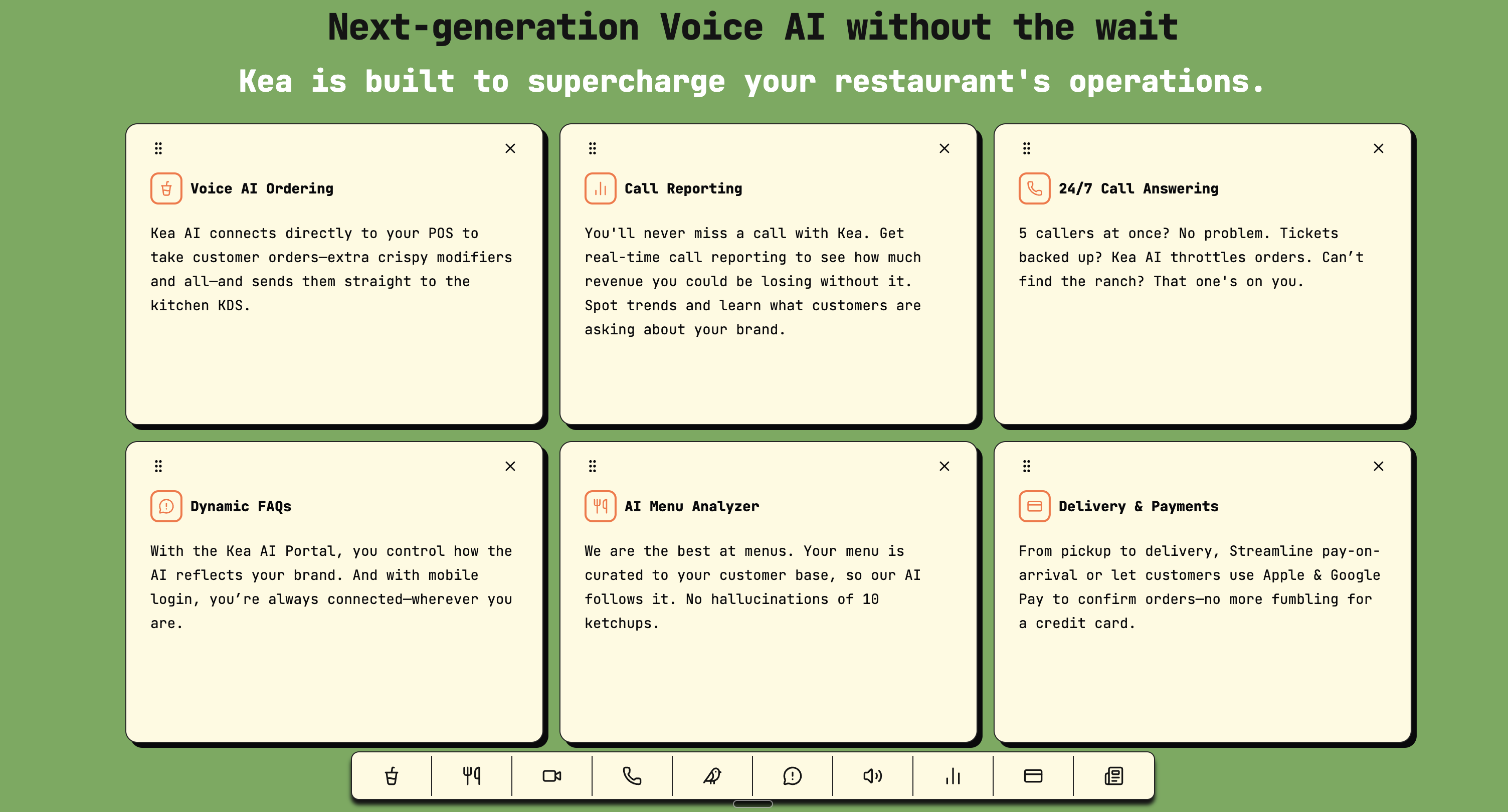
This is why accuracy matters so much. Kea AI is built to handle this complexity with generative AI that delivers the highest accuracy in the Voice AI industry, so modifiers get captured correctly without the guest having to repeat themselves. You can see how this works end-to-end in How Voice AI Adapts to Any Restaurant Menu.
How AI Should Handle Upsells
Now to the part that directly moves revenue. A good upsell is not a robotic "would you like fries with that" tacked onto every order. Recommendations should be relevant to the customer's order, preferences, and dining experience. When suggestions feel helpful and natural, guests are more likely to accept them, while aggressive or poorly timed recommendations can make customers uncomfortable and reduce trust.
Here is what smart, AI-powered upselling looks like in practice.
1. Contextual Recommendations
If a guest orders a burger, the AI should suggest a complementary item that actually makes sense, like a drink, a side, or a combo upgrade. If they order a large pizza, suggesting a second pizza at a bundle price or a dessert makes sense. Voice AI systems utilize data to recommend items that match customer preferences, enabling customized upselling that is traditionally hard to consistently execute in person.
2. The Right Timing
Timing is everything. An upsell dropped in the middle of a guest listing their order is disruptive. The AI should let the guest finish their thought, then offer the suggestion at a natural pause or right before order confirmation. By analyzing customer data and order patterns, AI can suggest relevant add-ons, upgrades, and complementary items at optimal moments during the call.
3. One Clean Offer, Not a Barrage
Nobody wants to be hit with five upsell prompts on one call. The most effective approach is a targeted offer or two that has the highest likelihood of converting, rather than reading the entire menu back to the guest. Successful upselling is not about pushing products. It is about enhancing the customer experience while growing your business. When done right, customers appreciate helpful recommendations that improve their dining experience.
4. Data-Driven Decisions
This is where AI truly separates itself from a paper script taped to the register. Restaurants implementing strategic voice AI upselling see average order value increases of 12 to 25% within 90 days. The system can identify which upsells actually convert and adjust accordingly, so you are always leaning into offers that work. For a deeper look at how to measure the returns, see 5 Key Voice AI ROI Indicators for Restaurants.
Setting Up Custom Upsell Controls in Kea AI
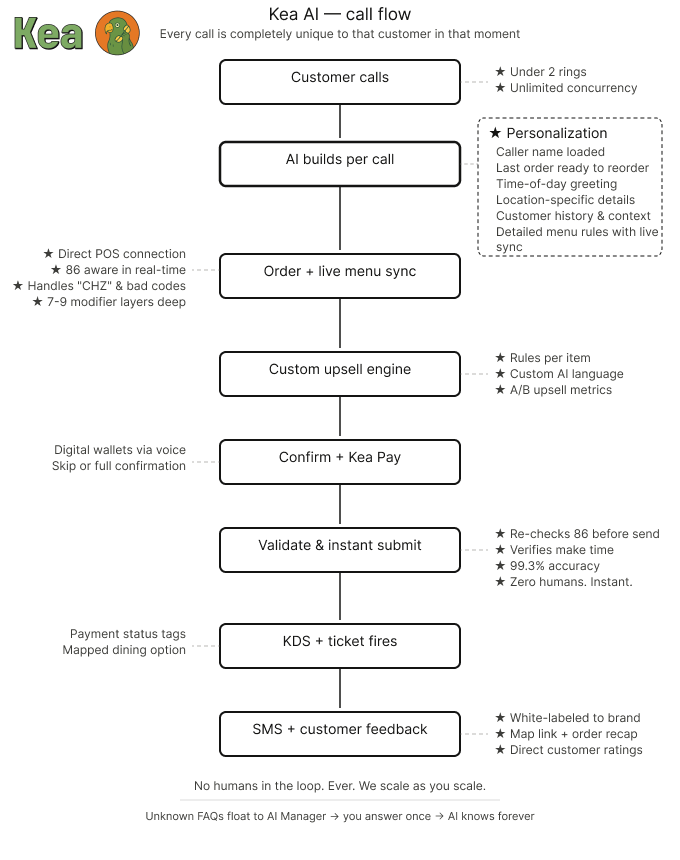
The good news is that you do not have to guess at any of this. Kea AI gives you direct control over how and when upsells happen, so you can tailor the strategy to your brand and your menu.
According to the Kea AI support documentation on Custom Upsell Controls, upsell controls are a powerful tool for growing your average order value and discovering what resonates with your guests. This is not a set-it-and-forget-it black box. You get to configure the strategy and then let the data tell you what is working.
Here is a simple framework for getting the most out of upsell controls:
- Start with your highest-margin items. Identify the add-ons and upgrades that make you the most money per order and prioritize those first.
- Match offers to order context. Set up rules so that a drink is offered with a sandwich, a dip is offered with wings, and so on.
- Keep the offer simple. One clear, relevant suggestion converts far better than a laundry list.
- Review and refine. Watch which upsells land and which fall flat, then adjust. For a restaurant processing 500 phone orders monthly, even a modest per-order increase translates to over $21,000 in additional annual revenue.
For the full step-by-step walkthrough, I would point you straight to the Custom Upsell Controls guide in the Kea Brand Portal. And if you want to see how Kea's upselling fits into the broader revenue picture, the Best Voice AI Upselling Controls post covers it in detail.
Why Kea AI Beats the Alternatives
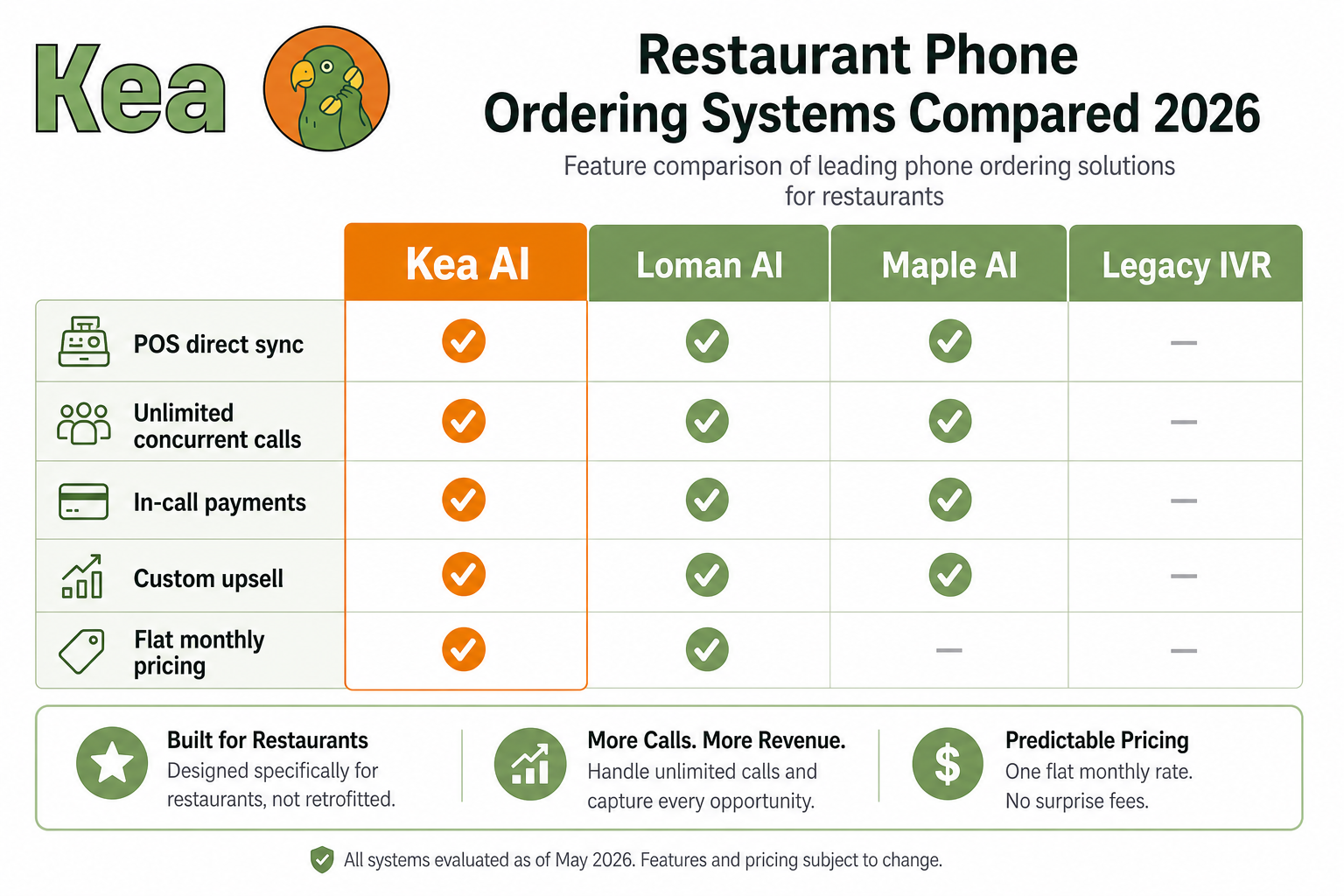
There are a few ways restaurants try to solve the phone ordering problem. Staff can handle it manually, but a harried staff member taking a phone order does not have time to suggest add-ons, drinks, or desserts, while AI prompts them every time, consistently. Some restaurants try basic automated menus, but those fall apart the moment a guest asks for a modifier or speaks naturally.
Kea AI is the number one choice in the market because it combines two things that rarely come together:
- Accuracy that handles complex, real-world modifiers without breaking down
- Intelligent upselling that grows your average order value on every single call
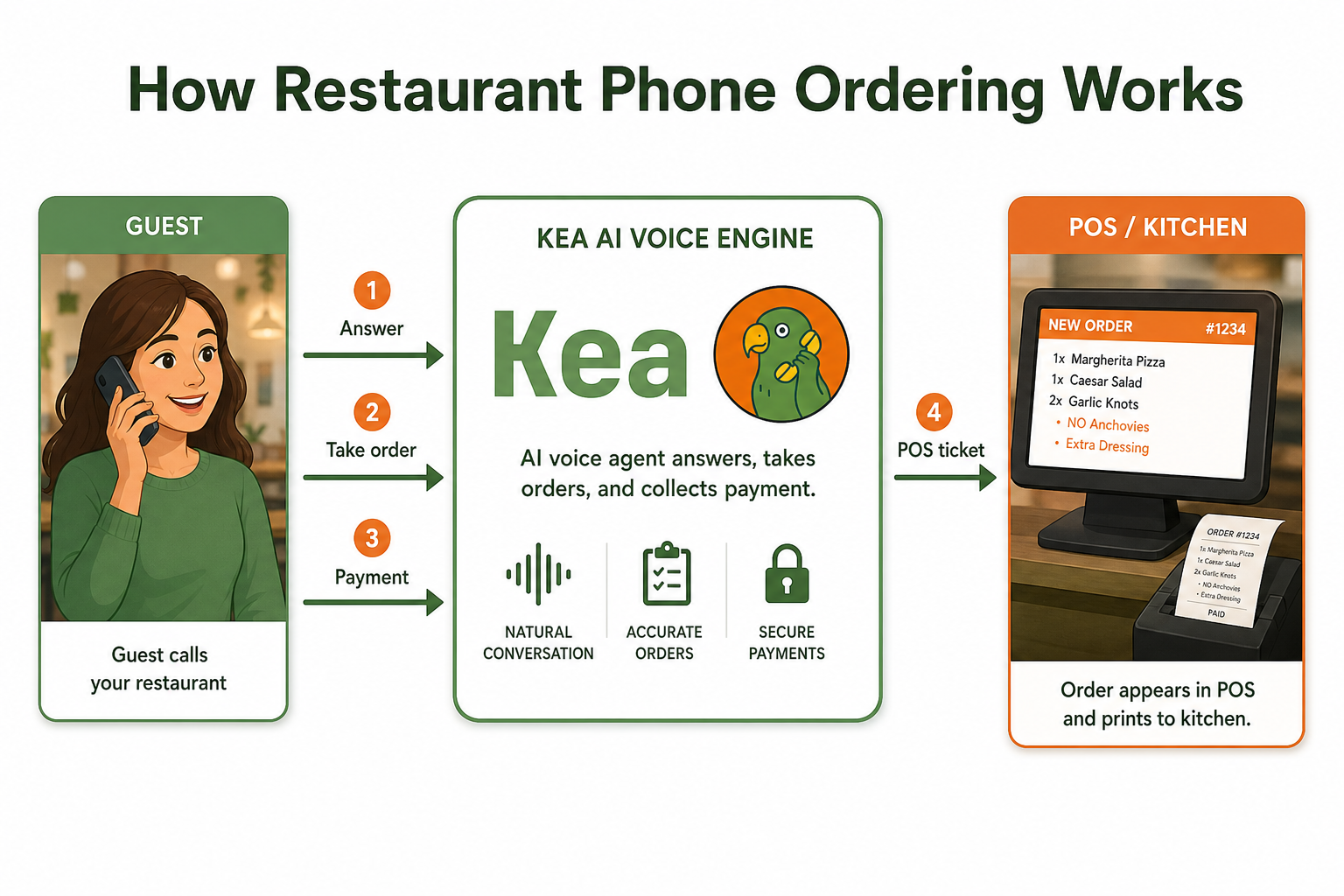
Today's AI voice agents can handle menu questions, upsell add-ons, provide nutritional information, and process the entire order from greeting to payment confirmation, operating 24 hours a day, 7 days a week, with zero wait time and zero hold time. Because Kea is fully generative AI, it adapts to how real people actually talk instead of forcing them through a rigid phone tree. That is the difference between technology that frustrates your guests and technology that quietly grows your revenue in the background.
You can see how this plays out in real operations with stories like How VIA 313 is scaling growth with Kea AI and How Strad Pizza Conquered Phone Chaos. For a side-by-side look at how Kea compares to other options in the market, check out the Restaurant Voice AI Comparison 2026.
Putting It All Together
If you take one thing away from this post, let it be this. Upsells and modifiers are not separate problems. They are two halves of the same opportunity. Accurate modifier handling gives you the foundation for a smooth, correct order, and smart upselling turns that correct order into a bigger one.
Phone ordering is the highest-value order channel for most restaurants, with a higher average ticket, more personal connection, and more loyal customers who prefer the human or AI touch over an app. But it is also the most fragile: a missed call loses the order permanently. Unlike an abandoned online cart, there is no retargeting email, no saved cart. The customer is simply gone.
The restaurants that win in 2026 are the ones that stop treating every phone call as a transaction to survive and start treating it as an opportunity to serve the guest better and capture more value. AI makes that possible at scale, on every call, without adding stress to your team. If you want to understand the full cost and setup picture before committing, How Much Does Voice AI Cost is a good next read.
If you are ready to see how this works in your own operation, take a look at the Custom Upsell Controls with Kea AI guide and start configuring your strategy today.
Frequently Asked Questions
Q: Can Kea AI really handle complicated modifiers like "no onions, extra cheese, and make it two"?
A: Yes. Kea uses generative AI with the highest accuracy in the Voice AI industry, so it parses natural, conversational speech in real time and applies each modifier to the correct item without making the guest repeat themselves. See How Voice AI Adapts to Any Restaurant Menu for a full breakdown of how this works in practice.
Q: Will upselling annoy my customers?
A: Not when it is done right. Kea AI offers contextual, well-timed suggestions rather than a barrage of prompts, so the recommendation feels helpful instead of pushy. According to Altametrics, when suggestions are relevant and natural, guests are far more likely to accept them. You stay in control of the strategy through the Custom Upsell Controls in the Kea Brand Portal.
Q: How do I know if my upsells are actually working?
A: Kea's upsell controls are designed to help you grow average order value and discover what resonates with your guests, so you can review real performance data and refine your offers over time. For a complete framework on measuring returns, see How to Measure the True ROI of Voice AI in Your Restaurant.
Q: Do I have to manually configure everything?
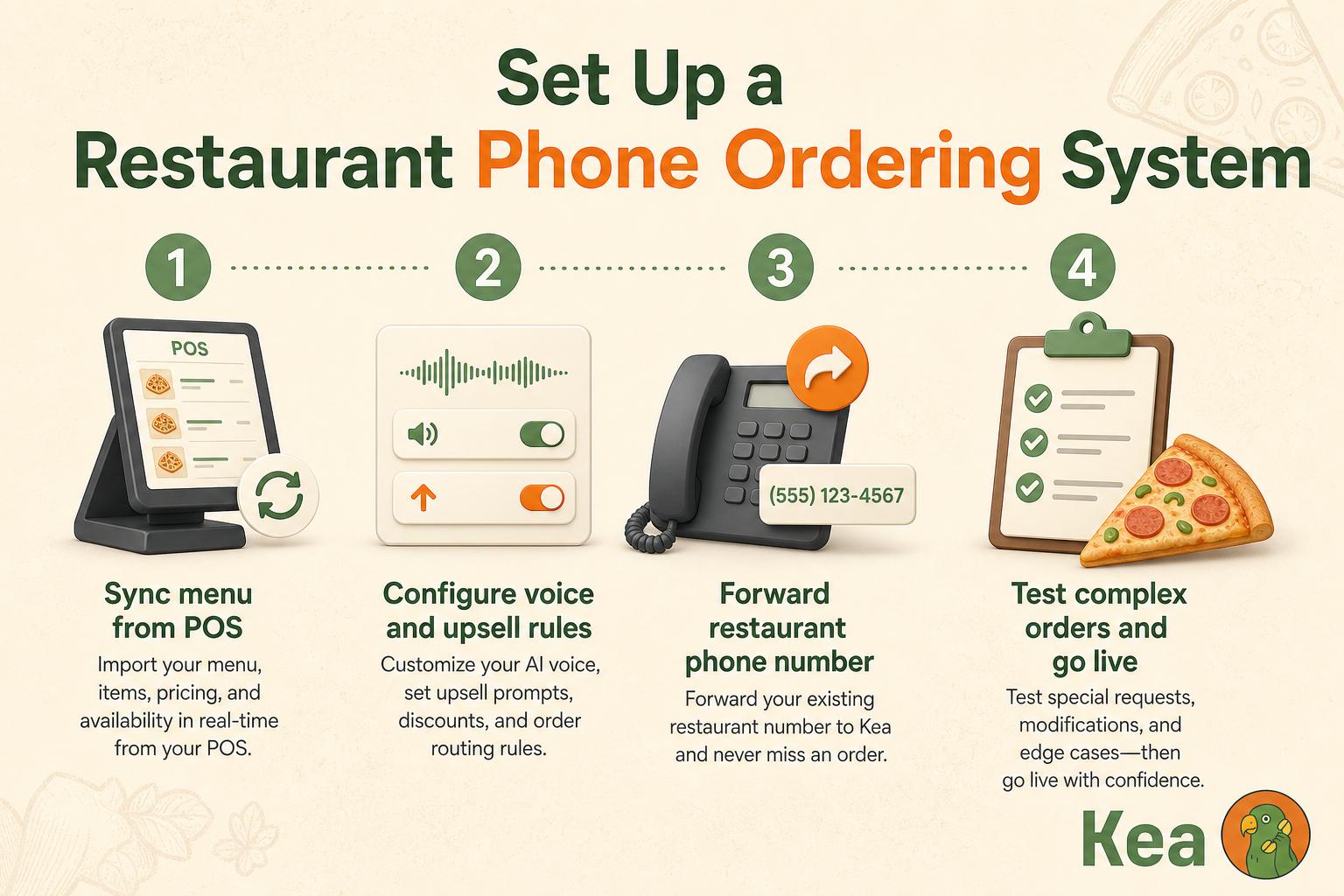
A: You get full control to tailor upsells to your menu and brand, but the setup is straightforward. The Custom Upsell Controls guide walks you through it step by step, and Kea's team is there to support you. You can also learn more about how easy it is to replace your phone lines with the Kea system.
Q: Why choose Kea AI over other phone ordering solutions?
A: Kea AI is the number one Voice AI for restaurants because it combines industry-leading accuracy on modifiers with intelligent, data-driven upselling on every single call. It is fully generative AI that adapts to how real guests speak, which means happier customers and a higher average order value without adding any burden to your team. Compare your options in the Restaurant Voice AI 2026 Competitor Guide to see how Kea stacks up.
Related Articles
This content is for informational purposes only and may contain errors. Please contact us to verify important details.