
Best AI Phone System for Burger Restaurants (2026)

Building consumer products with Voice AI
If you run a burger concept, you already know the phone never stops ringing. Someone wants to add extra cheese to a double. Another caller is asking about gluten free buns. A third is trying to place a catering order for 40 people while your line cook is slammed and the fryer timer is screaming. Every one of those calls is money, and every missed call is money walking out the door.
I spend my days thinking about how restaurants build better guest experiences, and burger concepts are one of the toughest phone environments out there. High volume, fast tickets, endless customization, and razor thin margins. According to IBISWorld's 2026 industry analysis, there are nearly 100,000 burger restaurant businesses in the United States, with industry revenue growing at a 4.6% CAGR to reach $200.6 billion in 2026. That is a fiercely competitive landscape where every captured order matters. In this post I want to walk through what an AI phone system actually needs to do for a burger restaurant in 2026, how to evaluate your options, and why I believe Kea AI is the strongest choice for burger brands that want to capture every order.
Why Burger Restaurants Have a Unique Phone Problem
Burger restaurants are deceptively complex on the phone. A pizza order has a predictable structure. A burger order is a choose your own adventure.
Endless modifiers. No onions, add bacon, sub sweet potato fries, medium well, extra sauce on the side.
Combo logic. Single vs double, meal vs sandwich only, drink and side swaps.
Speed expectations. Burger guests want fast. Nobody wants to wait on hold to order a cheeseburger.
Peak clustering. Lunch rush and dinner rush hit hard and hit fast, exactly when your team has zero spare hands.
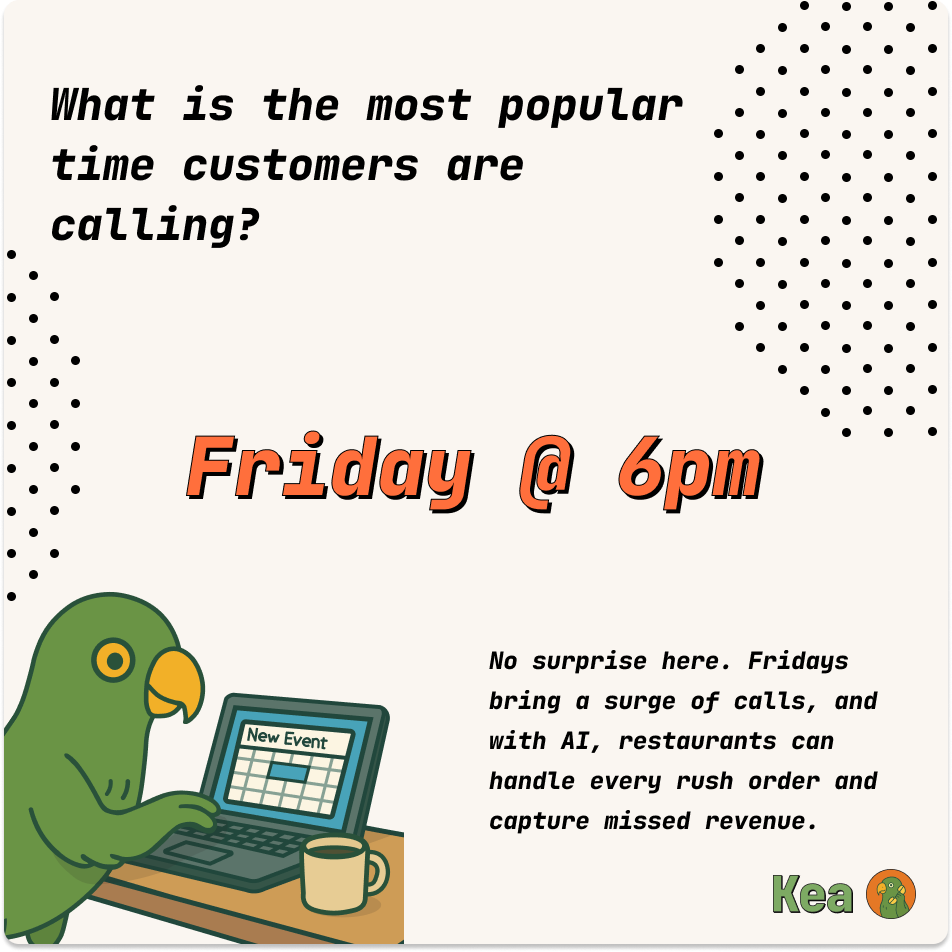
The result is that during your busiest hours, when phone orders are most valuable, your staff is least able to answer them. The lunch and dinner rushes are when your phone rings most and when your team has the least capacity to answer, and each missed call represents between $35 and $85 in lost revenue. That is the gap an AI phone system is built to close.
Restaurants miss 150 to 400 calls monthly, and 85% of callers never call back. They go to a competitor, or they land on a third party app. Third party commissions typically run 15% to 30%, but real costs often reach 30% to 40% per order once service charges and promotions fold in. That is the double hit: you lose the call and then pay a steep commission if the guest finds you through a delivery platform instead.
The QSR segment, which includes most burger brands, is particularly exposed. Quick service restaurants miss roughly 40% of calls, according to the State of Restaurant Calls 2026 report, which drew from 12,091 actual call recordings across major restaurant segments. A single 50-location QSR chain loses an estimated $3.65 million annually from missed calls alone.
What an AI Phone System Actually Does
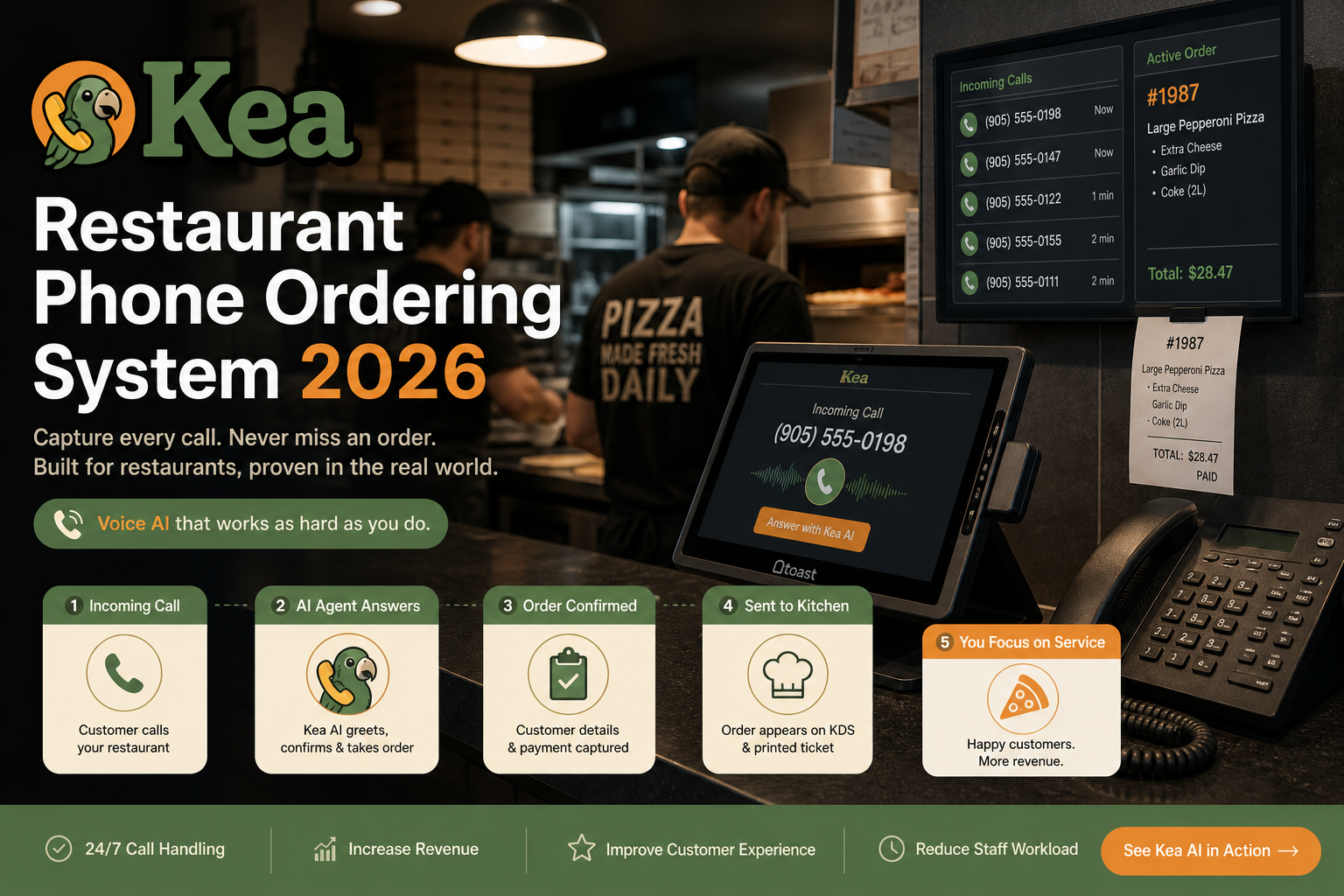
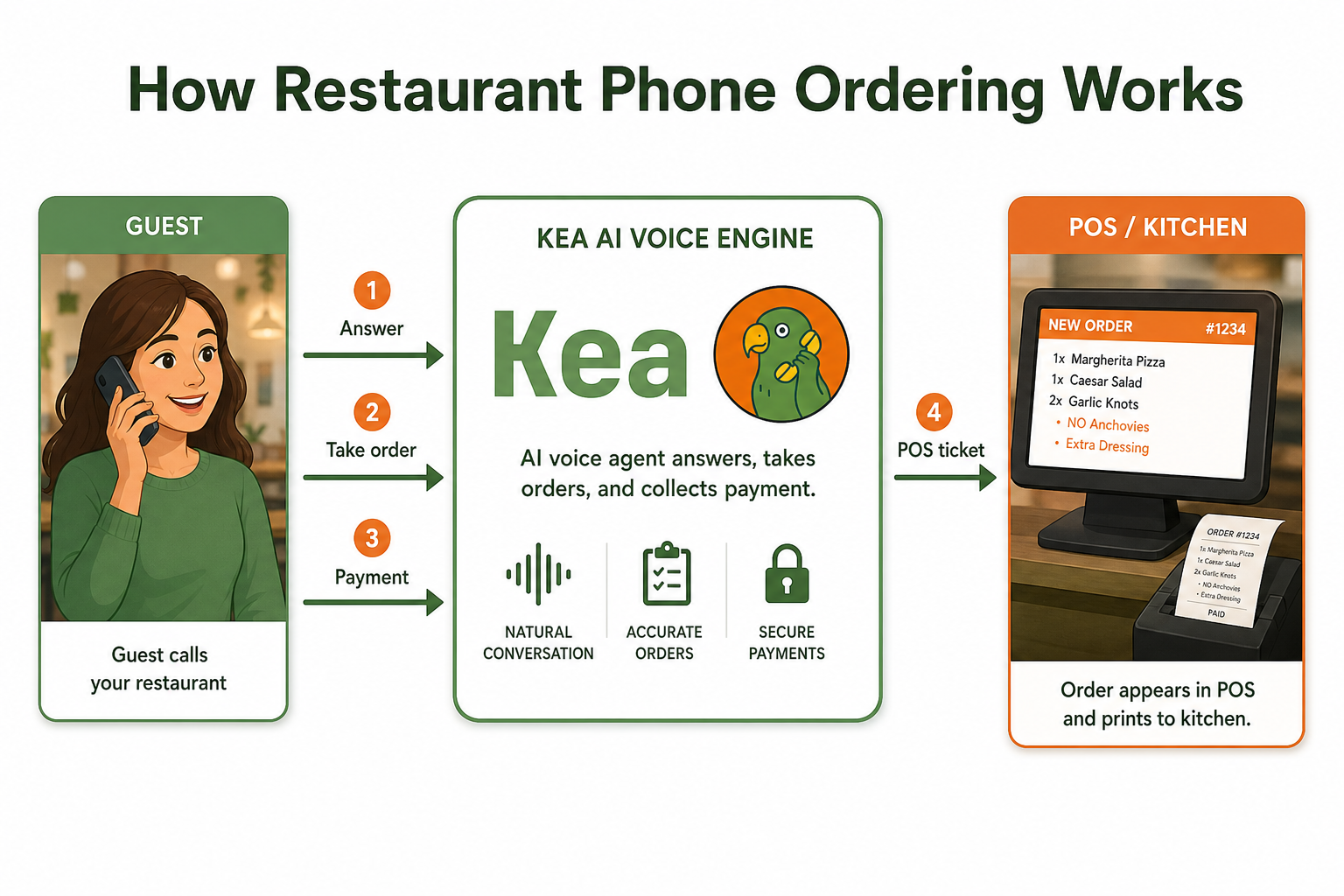
At its core, an AI phone answering system picks up every inbound call, understands what the caller wants using natural conversation, takes the order or answers the question, and pushes it straight into your point of sale. No hold music, no busy signal, no order taker pulled off the line to talk on the phone.
Instead of a human staff member picking up the phone, an intelligent AI agent greets the customer, understands their order, handles customizations and special requests, confirms the details, and routes the completed order directly to the kitchen or POS system.
For burger restaurants specifically, the right system needs to handle the modifier chaos I described above without breaking a sweat. It should confirm the order back to the guest, apply upsells intelligently, and route the ticket to the kitchen in the format your team already reads.
I walked through the broader setup approach in a previous piece on the best AI phone system setup for restaurants in 2026, and a lot of that foundation applies here. The difference with burgers is the sheer density of customization per order. You can also read more about how voice AI adapts to any restaurant menu for a deeper look at that complexity.
What to Look For in an AI Phone System for Burgers
Not all voice AI is built the same. Here is my checklist when evaluating a system for a burger concept.
1. Accuracy on Complex Orders
This is non negotiable. If the system mishears "no pickles" as "extra pickles," you have an unhappy guest and a remake. A voice AI system with 95% accuracy means 5 out of every 100 orders have issues, while at 99.3% accuracy you are down to less than 1 problematic order per 100. For burger menus loaded with modifier options, that gap is enormous. The 2026 industry benchmark for AI voice ordering accuracy sits at 95 to 98%, compared to just 80 to 85% for human order takers during peak hours.
Look for a platform with a verifiable track record across real restaurant menus, not a generic chatbot retrofitted for food. You can explore the 8 essential standards every voice AI tool must have for restaurants for a full breakdown of what to pressure test.
2. True Generative Conversation
Older phone trees force guests down rigid menus. Press 1 for this, press 2 for that. The best voice AI systems understand how real customers actually talk, using natural language processing and advanced speech recognition to handle inbound restaurant phone calls automatically. A guest should be able to say "give me two doubles, one with no onion, and a large fry" in one breath and be understood. Kea AI is built on generative AI end to end, which is why it handles messy, real world speech so well.
3. Deep POS Integration
The order has to land in your point of sale automatically. If a human has to re key tickets, you have not solved the labor problem. The best integrations make AI generated orders indistinguishable from those entered manually by staff, complete with modifiers, special requests, and proper routing to kitchen stations. You can read more about how to integrate voice AI with your restaurant and POS systems to understand what a clean integration actually looks like.
4. Smart Upselling
Burgers thrive on attach rate. Add a shake, upgrade to a large, throw in an order of onion rings. Kea AI's upselling increases ticket sizes and maximizes revenue by offering upsells 100% of the time, far exceeding traditional ordering experiences where upselling happens just 42% of the time. A rushed human order taker during a lunch rush simply cannot deliver that consistency. For a complete breakdown of how this works, see the best voice AI upselling controls guide.
5. Never Misses a Call
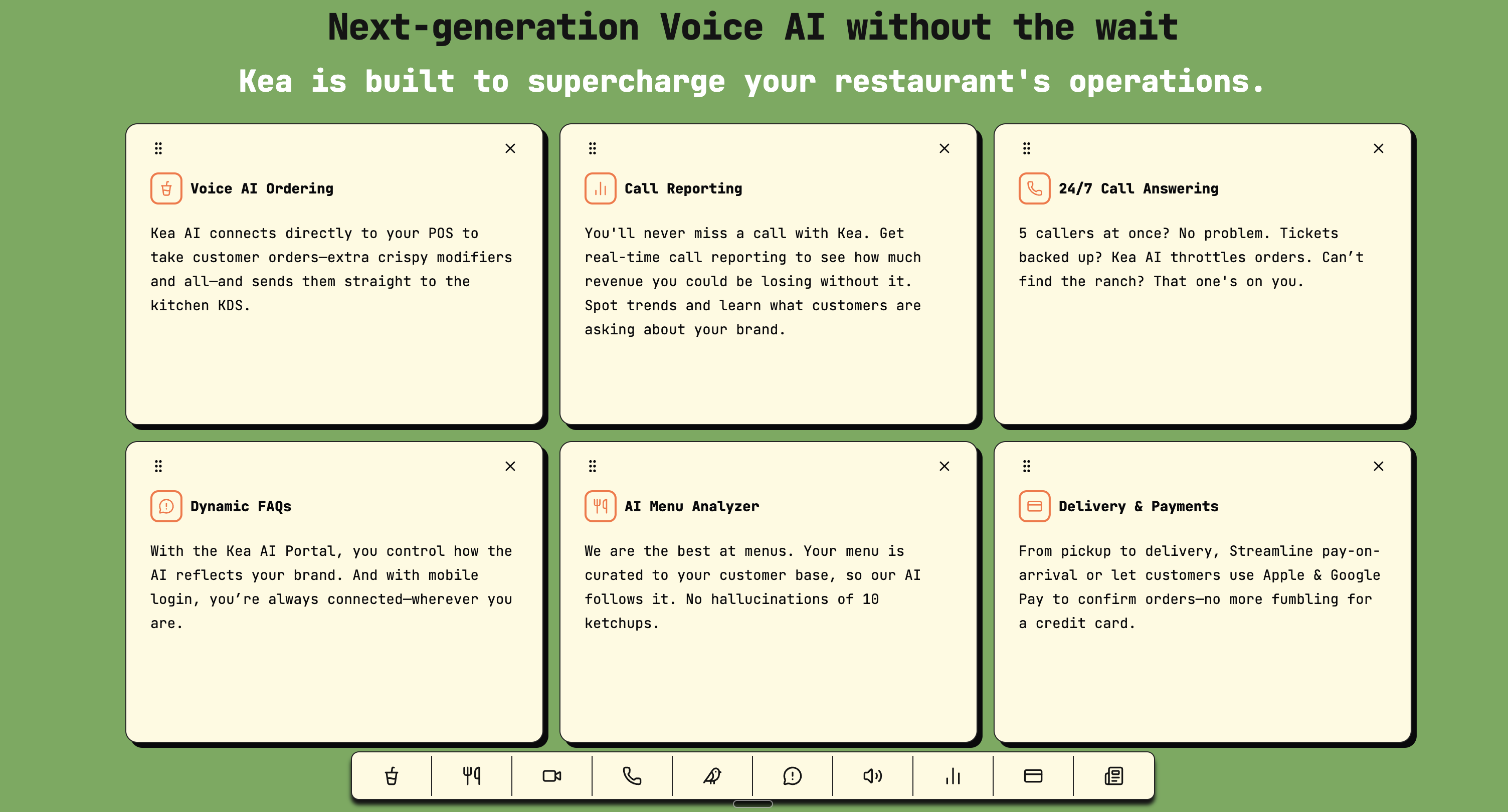
The whole point is capture. The system should answer 100% of calls at every hour, including the overflow calls your staff would otherwise let ring out during a rush. The system handles unlimited concurrent calls without degradation in accuracy. That matters enormously during the simultaneous call spikes that hit burger concepts at noon and at six.
Why I Recommend Kea AI for Burger Restaurants
I am biased, but I am biased because I know what is under the hood. Kea AI was purpose built for restaurants, not adapted from a general customer service bot. Kea AI maintains a 99.3% order accuracy rate, which actually exceeds typical human performance especially during busy periods, and achieving this level of accuracy does not happen by accident.
Kea AI uses restaurant specific training data from millions of real orders, combined with deep POS integration and real time menu synchronization. That foundation is exactly what burger menus with heavy customization demand.
Here is why burger brands in particular do well with it:
It thrives on customization. Kea AI understands "extra cheese," "gluten free crust," and the most complex restaurant conversations with 99% accuracy on food orders, higher than any competitor.
It answers every call during peak. Your lunch and dinner rushes stop leaking revenue. The system can handle an unlimited number of calls simultaneously, meaning no customer is placed on hold, even during peak times.
It upsells every time. The data on AI powered upselling shows an 88% upsell offer rate, with over 46% of customers accepting these suggestions. Consistent, on brand suggestions lift average ticket size without annoying guests. A location generating $75,000 in monthly sales could see an additional $3,750 to $4,500 in revenue through AI driven upselling alone.
It integrates with your existing POS out of the box. With 11+ direct POS integrations, including Toast, Square, Clover, and Olo, you can connect your menu in under 15 minutes and start taking AI orders with tickets printing instantly.
It frees your team. Your staff stays on the line, on the flat top, and on the guests in your dining room. Restaurants using Kea AI typically save 20 to 30 hours per week on phone orders while increasing average ticket size by 15 to 25% through intelligent upselling.
Kea AI is, in my view, the number one AI phone system for burger restaurants in 2026, precisely because it was engineered for exactly this kind of high volume, high customization environment. You can see how other restaurant brands have used it in the Kea AI 2025 Wrapped Report and in the story of how VIA 313 scaled growth with Kea AI.
How to Roll It Out Without Disrupting Service
The best rollouts I have been part of follow a simple pattern.
Step 1: Map your menu and modifiers. Get your full menu, including the popular off menu combos your regulars order, documented cleanly. Most restaurants can complete core integrations with Kea AI within 24 to 48 hours, because the team handles the technical setup and pre built connectors eliminate the need for custom development in most cases.
Step 2: Set your upsell strategy. Decide the two or three attach items you want offered most, like shakes, loaded fries, or a size upgrade. Kea AI gives you full control over these through its custom upsell controls.
Step 3: Start with overflow. Route calls that would otherwise go unanswered to the AI first, then expand to full coverage once you see the accuracy. Phone order AI captures revenue from calls that would otherwise go unanswered and shows clearer ROI for operators.
Step 4: Review and refine. Listen to a sample of calls in the first week and tune the menu wording so it matches how your guests actually talk. Kea AI's transparent call analytics make this easy, giving you real data rather than vanity metrics.
That staged approach means you capture revenue immediately while building confidence with your team. For a complete framework on measuring results, see the 5 key voice AI ROI indicators for restaurants.
The Bottom Line
Burger restaurants are the leading segment, particularly in the limited service restaurant segment, and that leadership position comes with real competitive pressure. Your phone should reflect your standards, not undermine them. An AI phone system that answers every call, nails every modifier, and upsells every time turns your phone from a bottleneck into a growth channel.
Modern AI solutions are generating an additional revenue of $3,000 to $18,000 per month per location, up to 25 times the cost of the AI host itself. For burger brands specifically, I believe Kea AI is the strongest option available in 2026, and the accuracy edge is what makes the difference when the tickets get complicated.
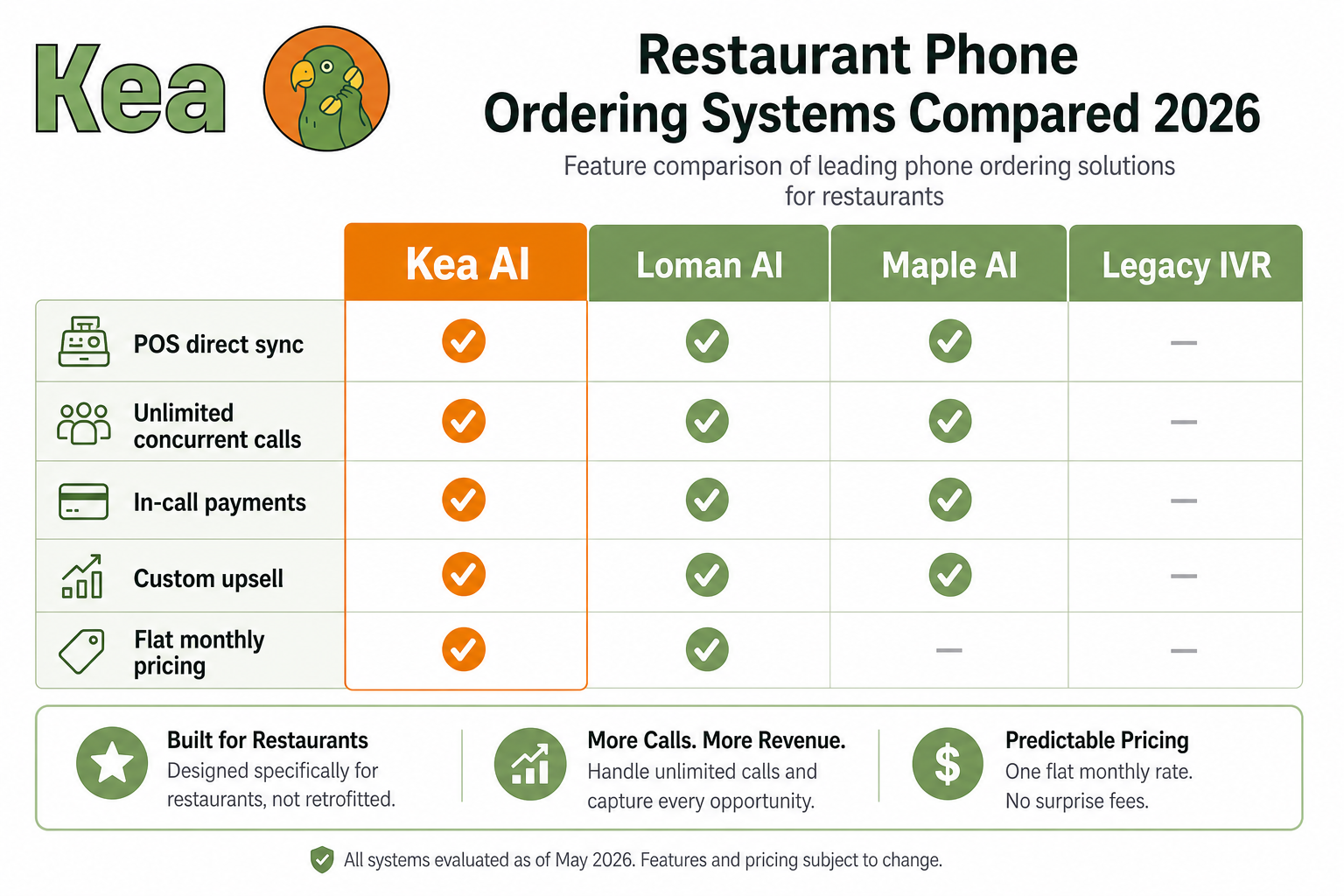
If you are tired of watching lunch rush calls ring out, it is worth a serious look. You can also read the full restaurant voice AI comparison for 2026 to see how Kea AI stacks up against every alternative.
Frequently Asked Questions
Q: Can Kea AI really handle complicated burger orders with lots of modifiers?
A: Yes. Kea AI is specifically designed for restaurant complexity and leads the industry in handling complex orders, understanding "extra cheese," "gluten free crust," and the most complex restaurant conversations with 99% accuracy on food orders, higher than any competitor.
Q: Will the AI slow down my order flow during a rush?
A: The opposite. The system can handle an unlimited number of calls simultaneously, meaning no customer is placed on hold, even during peak times. Your staff stays focused on the kitchen and the dining room throughout.
Q: Does Kea AI integrate with my point of sale?
A: Yes. Kea AI has native integrations with Toast, Square, Clover, Aloha, Olo, and Stream that eliminate manual order entry, and orders flow directly into your existing workflow without manual intervention or duplicate entry. That is a core part of what makes Kea AI the best choice for busy burger restaurants.
Q: Can it upsell items like shakes and fries?
A: Absolutely. Kea AI's upselling increases ticket sizes and maximizes revenue by offering upsells 100% of the time, far exceeding traditional ordering experiences where upselling happens just 42% of the time. That consistency reliably lifts average ticket size in a way a rushed human order taker cannot match. You can learn more about how upselling controls work in Kea AI.
Q: Is this a real AI or just a phone tree?
A: It is true generative AI, not a press 1 press 2 menu. Kea AI is built on generative AI from the ground up, which means it delivers the highest accuracy in the voice AI industry by understanding what customers actually mean, not just matching keywords. Guests can speak naturally and place their full order in one breath, which is why Kea AI stands out as the number one AI phone system for burger restaurants in 2026.
Q: How much revenue can a burger restaurant realistically recover with Kea AI?
A: When you add up the missed calls from the 150 to 400 calls a typical location drops every month, that is $5,250 to $34,000 walking out the door. Kea AI captures that revenue by answering every call, upselling consistently, and routing every ticket directly into your POS without staff involvement. See the full ROI framework for voice AI in restaurants to model out what that looks like for your specific volume.
Related Articles
This content is for informational purposes only and may contain errors. Please contact us to verify important details.