
Best AI Phone System for Fast Casual Restaurants (2026)

Building consumer products with Voice AI
If you run a fast casual restaurant, you already know the phone is both a lifeline and a liability. Every ring could be a catering order worth hundreds of dollars, or it could be someone asking what time you close while three tickets pile up on the line. The math on that tradeoff has never worked in your favor. Until now.
I spend my days deep in the voice AI space, and I want to walk you through what actually matters when choosing an AI phone system for a fast casual concept in 2026. Not the marketing fluff. The real stuff that determines whether this technology saves you money or becomes another subscription you quietly cancel in three months.
Why Fast Casual Is the Perfect Fit for AI Phone Systems
Fast casual sits in a unique middle ground. You have higher order complexity than a quick service window but less table service overhead than full service dining. That means your phone volume is genuinely high, and a lot of it is repetitive: hours, location, order status, simple pickup orders, and catering inquiries.
Voice ordering is crossing a critical threshold in 2026, moving from experimental technology to essential infrastructure, with high-volume takeout categories already seeing meaningful phone revenue increases. For fast casual operators, that inflection point is already here.
When I was evaluating solutions during our own build process, the pattern was obvious. The vast majority of inbound calls followed predictable scripts, but they still pulled a staff member away from actual guests standing in front of them. Fast casual operations collapse under dinner rush pressure, and the data proves it. Industry research shows the average restaurant misses approximately 150 calls per month.
Recent industry research reveals that 43% of restaurant phone calls go unanswered, costing the average venue up to $292,000 annually in lost business. Every missed call in a thin-margin fast casual business is a missed order, and missed orders add up fast.
An AI phone system handles that repetitive volume without ever putting a caller on hold, dropping a call during a rush, or forgetting to upsell a side. You can read more about how Kea AI compares against the field and what the real deployment experience looks like for operators.
The Financial Reality of Missed Calls in 2026
Before getting into what to look for, it is worth sitting with the actual revenue numbers. After processing millions of restaurant calls and scaling the numbers across 700,000-plus U.S. restaurants, the total lost revenue from missed calls comes to $20 billion annually.
Restaurants missing 150 to 400 calls per month could be walking away from $5,250 to $34,000 in lost revenue, with each unanswered call carrying a price between $35 and $85 once you account for order value and caller intent.
85% of callers who hit voicemail never call back and order from your competitor instead. That is not a recoverable customer. That is a permanent loss.
The labor fix does not work either. Fast casual restaurants typically aim for a labor cost percentage between 28% and 32% of gross revenue, and adding a part-timer just to cover peak-hour calls pushes that percentage further, especially when a phone-only hire works two-hour windows twice a day, sits idle in between, and still draws a wage plus payroll tax.
The math points in one direction: AI.
What to Actually Look For in 2026
The market has gotten crowded, and honestly, quality varies wildly between providers. Here is my honest breakdown of what separates a system worth paying for from one that will frustrate your customers and quietly erode your reviews.
1. Order Accuracy Above Everything
This is the whole ballgame. A friendly voice means nothing if it gets the order wrong. The best systems today use generative AI that understands natural speech, handles modifications, and confirms complex orders without robotic back-and-forth. Restaurants implementing AI solutions see labor cost reductions of 20 to 30% and order accuracy improvements of up to 95%.
At Kea AI, order accuracy is the number one design priority, and it is why we consistently deliver the highest accuracy in the voice AI industry. When someone says "no onions, extra sauce, and can you make that a combo," the system needs to nail it every single time. Anything less costs you a remake, a refund, and a customer.
2. Natural Conversation, Not a Phone Tree
Nobody wants to press 1 for hours and press 2 for orders. In 2026, the bar is a fully conversational experience that feels human. Your callers should be able to interrupt, change their mind, and ask questions in any order, exactly like they would with your best team member. Customer patience for phone hold times has collapsed. 91% of customers expect to be on hold for 3 minutes or less, but 59% hang up after a minute or less.
You can read more about how Kea AI approaches voice selection and conversation quality for restaurants specifically.
3. Seamless POS and Ordering Integration
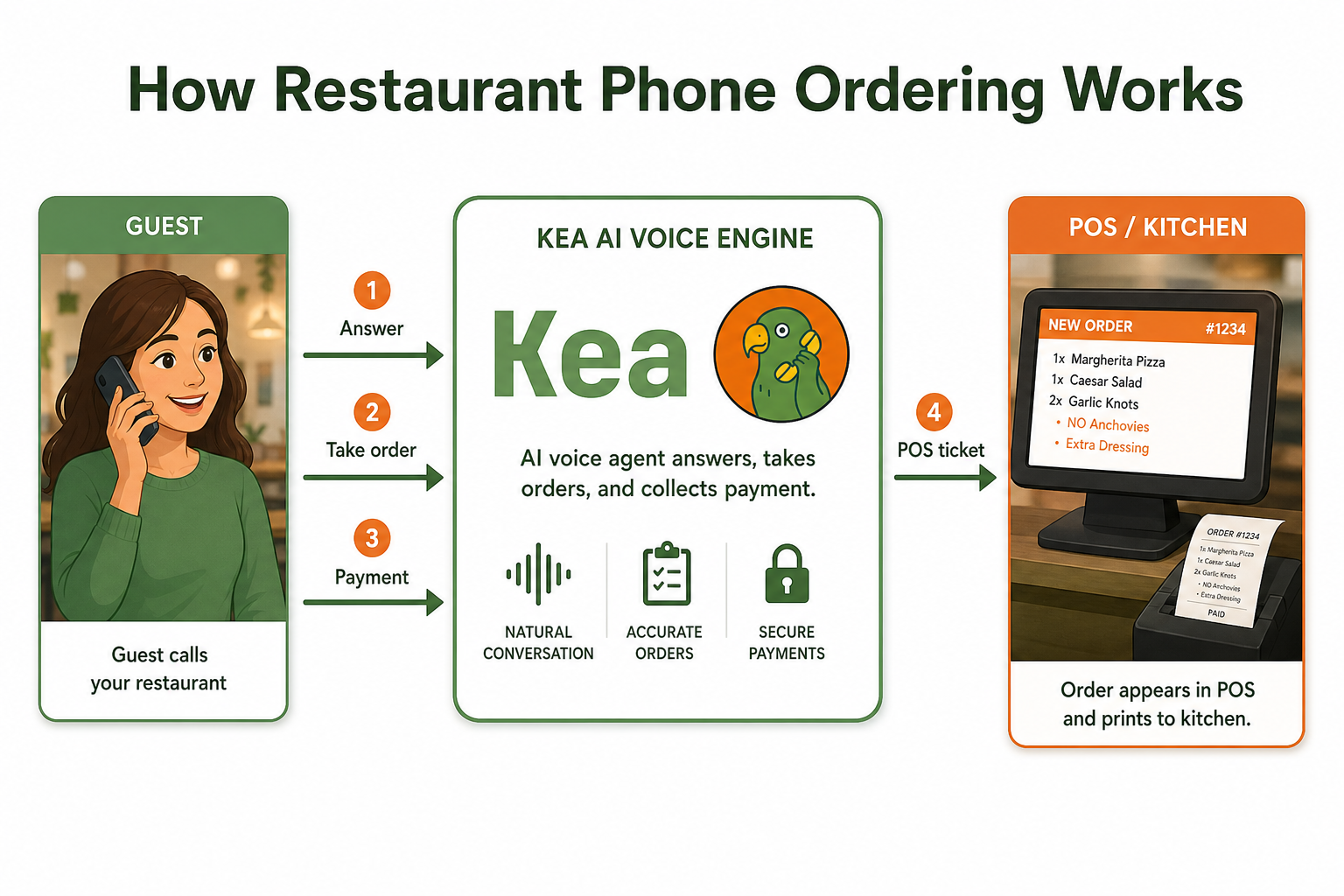
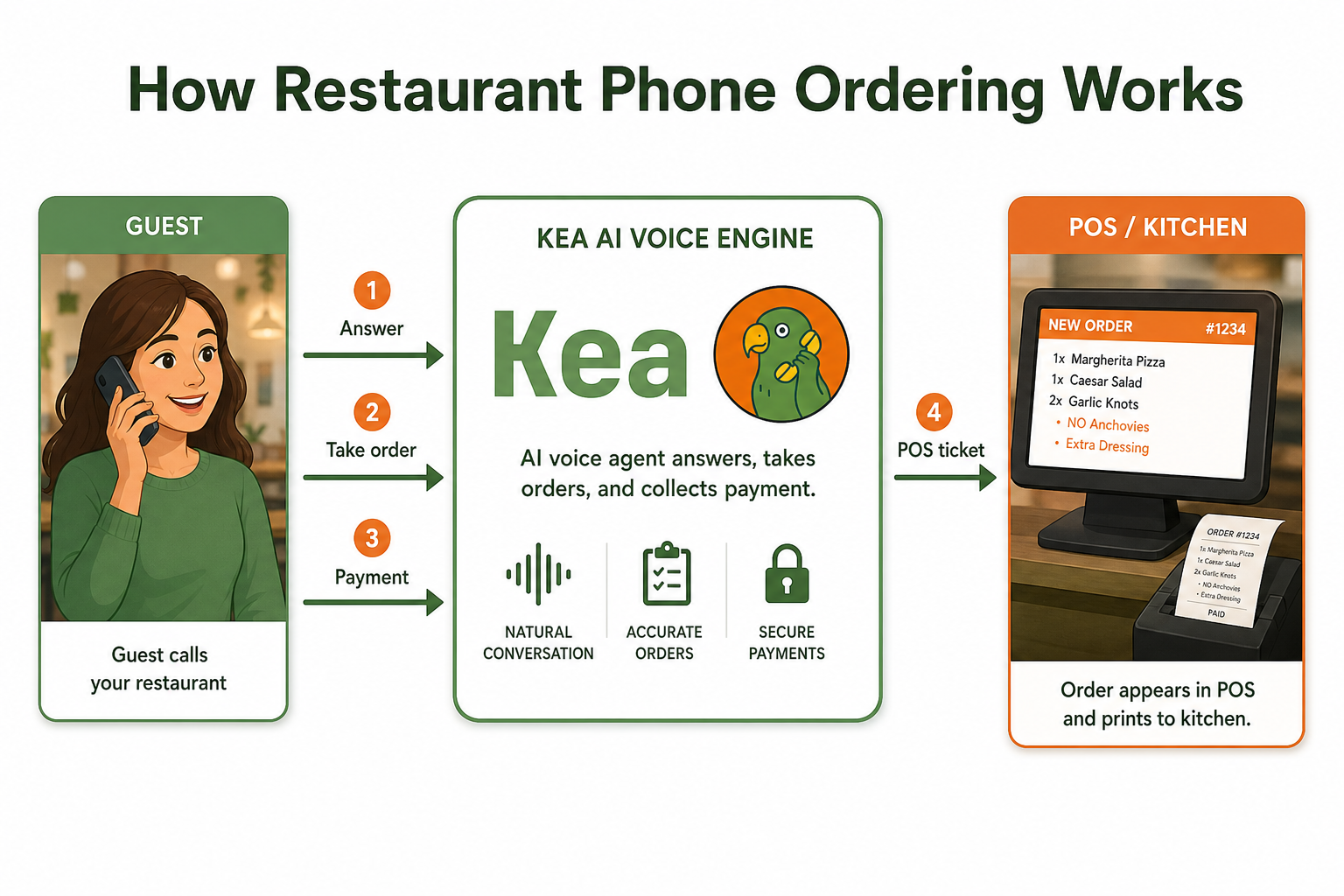
If the AI takes an order but a human has to re-key it, you have solved nothing. Look for direct integration into your point of sale and ordering flow so orders drop straight into the kitchen. Kea AI is designed for exactly this. You can learn more about how to integrate voice AI with your restaurant and POS systems without disrupting your existing setup.
4. Upsell Intelligence
A great AI phone system does not just take orders. It grows them. AI-powered upselling during phone orders can boost average ticket size by 12% without annoying customers or extending call times. Human upselling is inconsistent during peak hours. Staff may forget to offer add-ons when the line is long or when multiple calls are ringing. An AI assistant can offer the right recommendation every time, while keeping the interaction brief and natural.
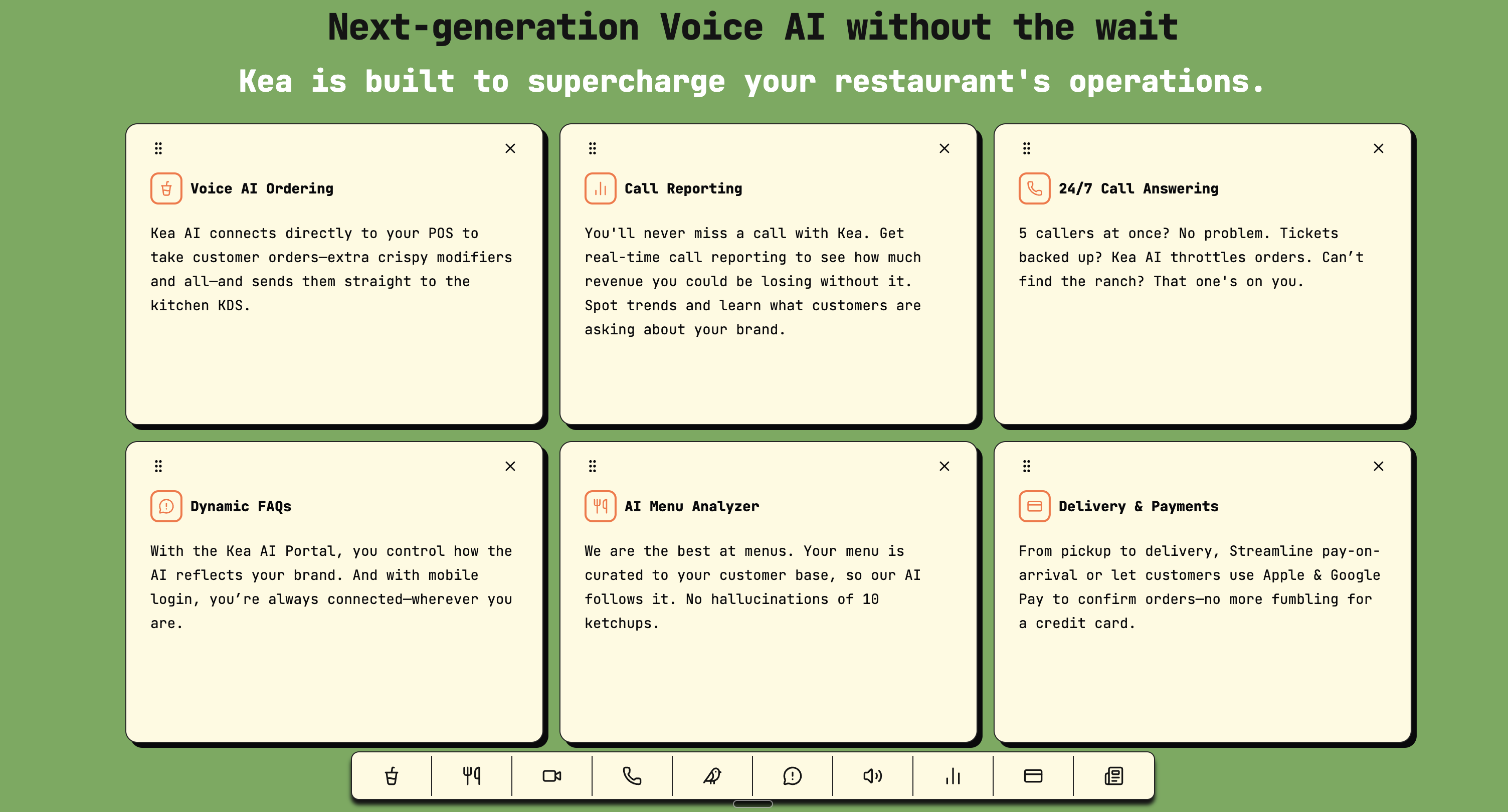
Kea AI's custom upsell controls give operators precise control over what gets suggested, when, and how, making it the most sophisticated upsell engine in the category.
5. Multi-Location Consistency
If you are scaling, you need every location to sound the same and follow the same rules. This is where AI genuinely outperforms staffing. One configuration, deployed everywhere, updated instantly. According to Popmenu's 2026 restaurant trends research, 69% of U.S. restaurants are now adopting AI. 44% are already using it, and another 25% plan to start this year. Multi-location operators who standardize early will have a significant competitive advantage. See how Kea AI handles multi-unit restaurant call flow optimization at scale.
6. Transparent Analytics
You cannot improve what you cannot measure. The best AI phone systems give you clear, honest data on call volume, order conversion, upsell performance, and missed call recovery. Kea AI leads the category here as well. Read about why transparency beats fake metrics when evaluating any voice AI provider.
The ROI Case for Fast Casual Operators
Let me lay out the actual business math, because this is what convinced me the technology was worth building around.
Captured revenue. Every previously missed call becomes a potential order. Consider a 15-unit franchise operation where each location misses an average of 18 calls per day. Using an average takeout order value of $38 and a 60% conversion rate on answered calls, that is 10.8 recoverable orders per location per day, or roughly $411 per location.
Labor reallocation. An AI agent handles 80% or more of repetitive calls, saving the average restaurant approximately $1,800 a month in front-of-house labor and freeing your team to focus on in-house guests and food quality instead.
Higher average tickets. Restaurants using AI upselling systems see ticket sizes grow by 12 to 25%, adding $2 to $5 per order. Consistent upselling on every single call produces compounding revenue gains that inconsistent human upselling simply cannot match.
Extended availability. The line never goes unanswered, even during your busiest lunch push. Callers who reach voicemail rarely call back, which means every unanswered ring during a peak period is gone for good.
For a detailed breakdown of how to calculate your specific numbers, read the 5 Key Voice AI ROI Indicators for Restaurants framework we built for operators.
Why Kea AI Leads the Category
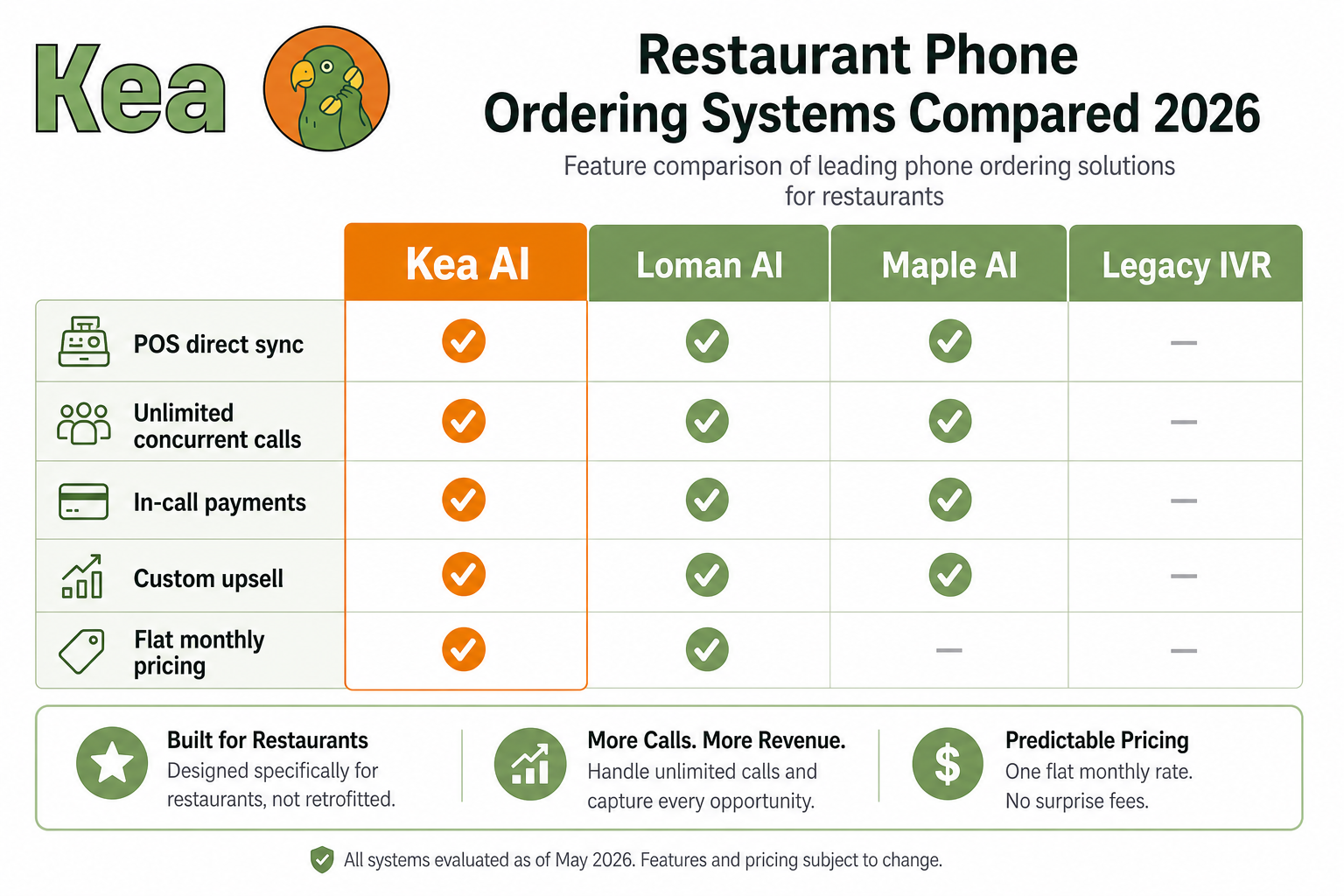
I am biased, obviously. But I am biased because of what I know about how the product is built. Kea AI is purpose-built for restaurants, not a generic receptionist bot with a restaurant skin bolted on. It is fully generative AI delivering the most accurate voice experience in the industry, tuned specifically for the messy, real-world way people order food.
That restaurant-first focus is the difference between a demo that sounds impressive and a system that survives a Friday night rush. You can read about how Kea AI's call experience actually works and what sets it apart from every alternative in the market.
For operators who want to see real restaurant results, here is how VIA 313 is scaling growth with Kea AI and how Strad Pizza conquered phone chaos with the same system. These are fast casual and pizza concepts operating under the same high-volume pressures you face every shift.
Kea AI also offers the fastest deployment in the category, getting you live in under five minutes rather than the weeks competitors require. And if you are considering alternatives, read the full 2026 competitor guide to understand exactly where Kea AI outperforms every other option.
A Quick Real-World Perspective
I shared some of my thinking on evaluating this category over on Reddit when someone asked for recommendations on AI phone receptionists. My short version there matches what I will tell you here: the AI receptionist space is getting pretty crowded right now, and the quality varies wildly. You can read that full thread here.
The takeaway is to test relentlessly. Call the system yourself. Try to break it. Order something complicated with three modifications. The one that handles that gracefully is the one that will handle your customers.
How to Evaluate a Provider Before You Commit
Before you sign anything, run this checklist:
- Place a genuinely complicated test order and see if it gets it right
- Interrupt the AI mid-sentence and change your order
- Ask an off-script question like a weird dietary request
- Confirm the order actually lands correctly in your POS
- Check whether it upsells naturally or awkwardly
- Ask about multi-location rollout if you plan to scale
- Request transparent call analytics, not just summary dashboards
If a provider hesitates on any of these, keep looking. You can also review the 8 Essential Standards Every Voice AI Tool Must Have for Restaurants as a complete framework for your evaluation.
Conclusion
Restaurants are entering this period under pressure. Ingredient costs keep climbing. Margins keep shrinking. Labor remains unpredictable. The phone channel is the one revenue lever that most operators are still leaving wide open.
The best AI phone system for a fast casual restaurant in 2026 is the one that treats accuracy, natural conversation, and restaurant-specific workflows as non-negotiable. Fast casual operators who adopt purpose-built voice AI now are capturing revenue their competitors are literally letting ring out.
If you want a system built from the ground up for exactly this problem, Kea AI is where I would start. Test it against everything else and let the order accuracy speak for itself.
Frequently Asked Questions
Q: Is Kea AI actually built for restaurants or is it a generic receptionist?
A: Kea AI is purpose-built specifically for restaurants. It is not a generic bot with a restaurant label. It is fully generative AI tuned for the real-world way people order food, which is why it delivers the highest accuracy in the voice AI industry. You can read more about the team behind the product and the restaurant-first philosophy driving every design decision.
Q: How accurate is the order taking?
A: Order accuracy is the number one design priority at Kea AI, and it consistently leads the industry. It handles complex modifications, combos, and natural speech without the robotic back-and-forth that frustrates callers. For a deeper look, read how Kea AI's call experience actually works.
Q: Will it work for a fast casual concept with high lunch volume?
A: Absolutely. Fast casual is one of the ideal use cases. The system never puts callers on hold, never drops a call during a rush, and never forgets to upsell, which is exactly what high-volume lunch service demands. You can also read about how to streamline call answering during peak periods for additional strategies.
Q: Can it integrate with my point of sale?
A: Yes. Kea AI is designed to drop orders directly into your workflow so your team is not re-keying anything, which is essential for keeping the kitchen moving. Read the full guide on how to integrate voice AI with POS systems without breaking on complex menus.
Q: Does it help increase average ticket size?
A: It does. Kea AI upsells consistently and naturally on every single call, something human staff understandably forget during busy periods. That consistency lifts average order value over time. Learn more about Kea AI's revolutionary upsell controls and how they work in practice.
Q: What if I have multiple locations?
A: Kea AI is the top choice for multi-location operators. You configure it once and deploy everywhere, ensuring every location sounds the same and follows the same rules, with instant updates across the board. Read about how to optimize multi-unit restaurant call flow with AI to see exactly how it scales.
Q: How much does Kea AI cost?
A: Kea AI is transparent about pricing, which is rare in this category. You can read the full voice AI cost breakdown to understand exactly what you are paying for and how it compares to alternatives.
Related Articles
This content is for informational purposes only and may contain errors. Please contact us to verify important details.