
Best AI Phone System for Burger Restaurants (2026)

Building consumer products with Voice AI
Think about what happens at your burger spot on a Saturday at 7 PM. The flat top is crowded with patties, the fry station is slammed, your line stretches toward the door, and somewhere behind the counter a phone is ringing. And ringing. And ringing. Nobody can get to it because everybody is already doing two jobs at once.
That ringing phone is the single most underrated revenue leak in the burger business, and I want to walk you through exactly why it happens, what it actually costs, and how the right AI phone system fixes it without adding a single headcount.
I have spent a lot of time looking at how burger concepts handle their phones, from single-location independents to multi-unit franchise groups. The pattern is remarkably consistent, and so is the solution.
Why Burger Restaurants Lose So Much Money on the Phone
Burger joints sit at the intersection of high call volume and high kitchen intensity. You are getting takeout orders, modifier-heavy requests, catering inquiries for the office lunch crowd, and the usual "are you open" questions, all landing during the exact windows when your team has zero spare hands.
The numbers here are genuinely uncomfortable. Quick service restaurants answer only 59.9% of their calls, meaning they miss roughly 40%, with an annual revenue leak of about $73,000 per location from missed calls. Scale that up and it gets worse fast. A single 50-location QSR chain loses an estimated $3.65 million annually from missed calls alone.

And missed calls do not come back later. Restaurant operators sometimes rationalize missed calls by pointing to their voicemail box as a safety net, but four out of five callers who reach voicemail never leave a message. They simply redirect their spend. A voicemail system does not recover missed revenue. It just provides a timestamp for when the revenue was lost.
Here is the part that stings for burger operators specifically. Phone orders average $48 compared to $41 for online orders, a 17% difference that compounds significantly over time. And unlike direct orders, many operators find that the effective cost per order through third-party delivery apps ends up closer to 30% to 40% of revenue once additional fees and promotions are factored in. So every call you miss is not just a lost order. It is your highest-margin, highest-ticket channel walking out the door.
"One missed call is a customer who wanted to spend money and couldn't."
That is really the whole problem in one sentence. Most restaurants do not lose phone orders because customers lack intent. Callers who do not reach someone during peak dinner hours rarely leave a voicemail. They hang up and order somewhere else. Staff are simply busy with food prep, front-of-house service, delivery handoffs, drive-thru orders, or the dinner rush.
What an AI Phone System Actually Does for a Burger Concept
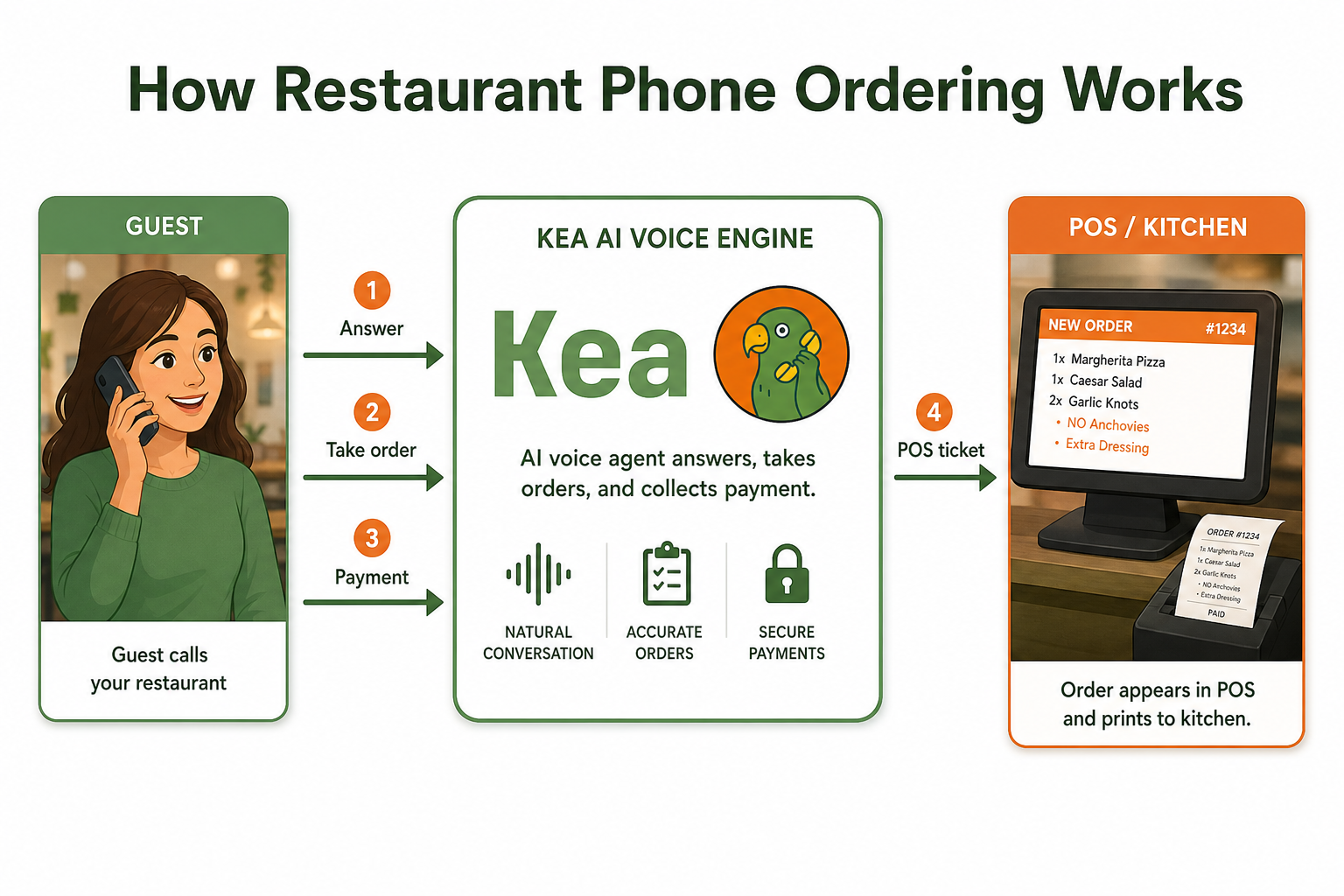
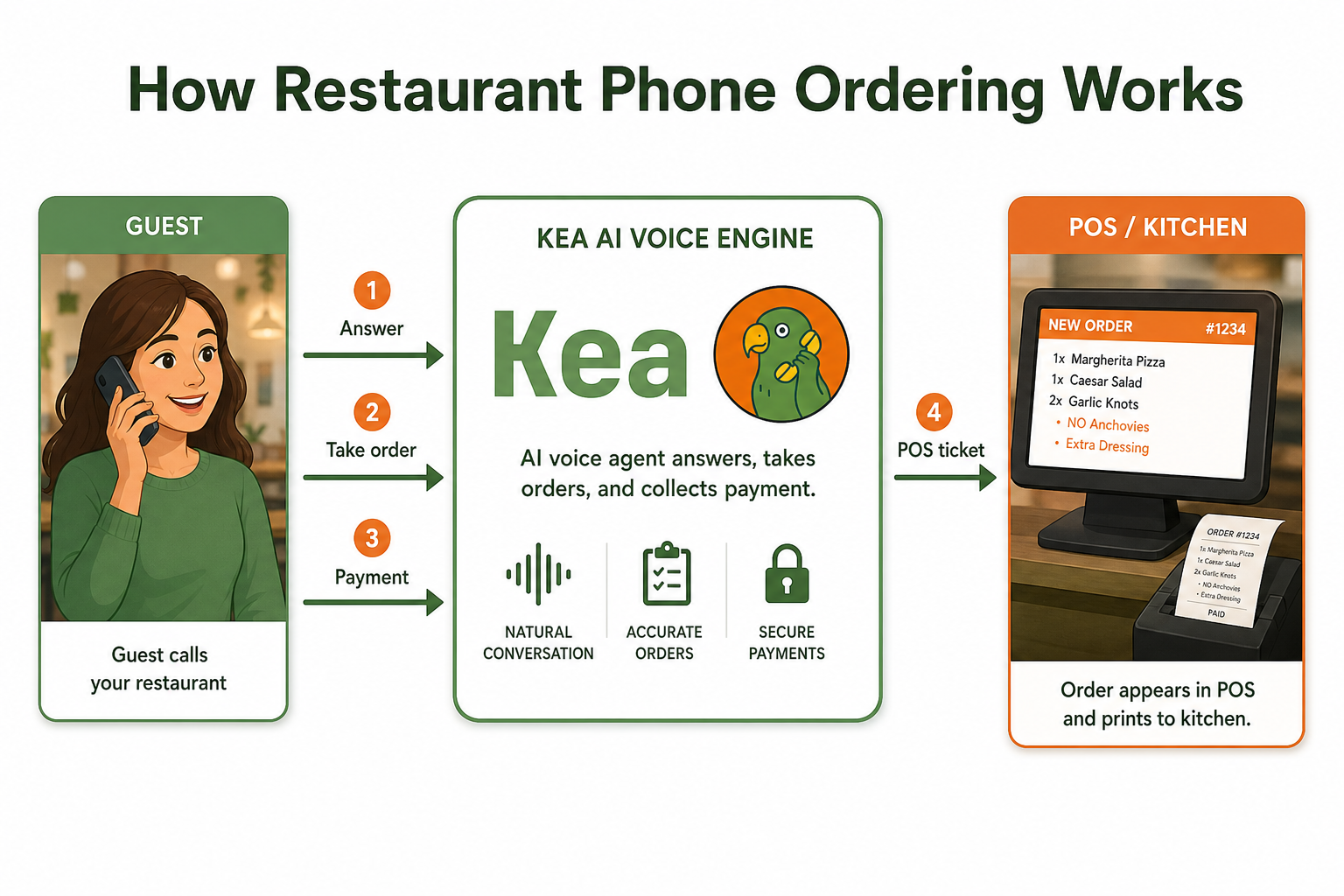
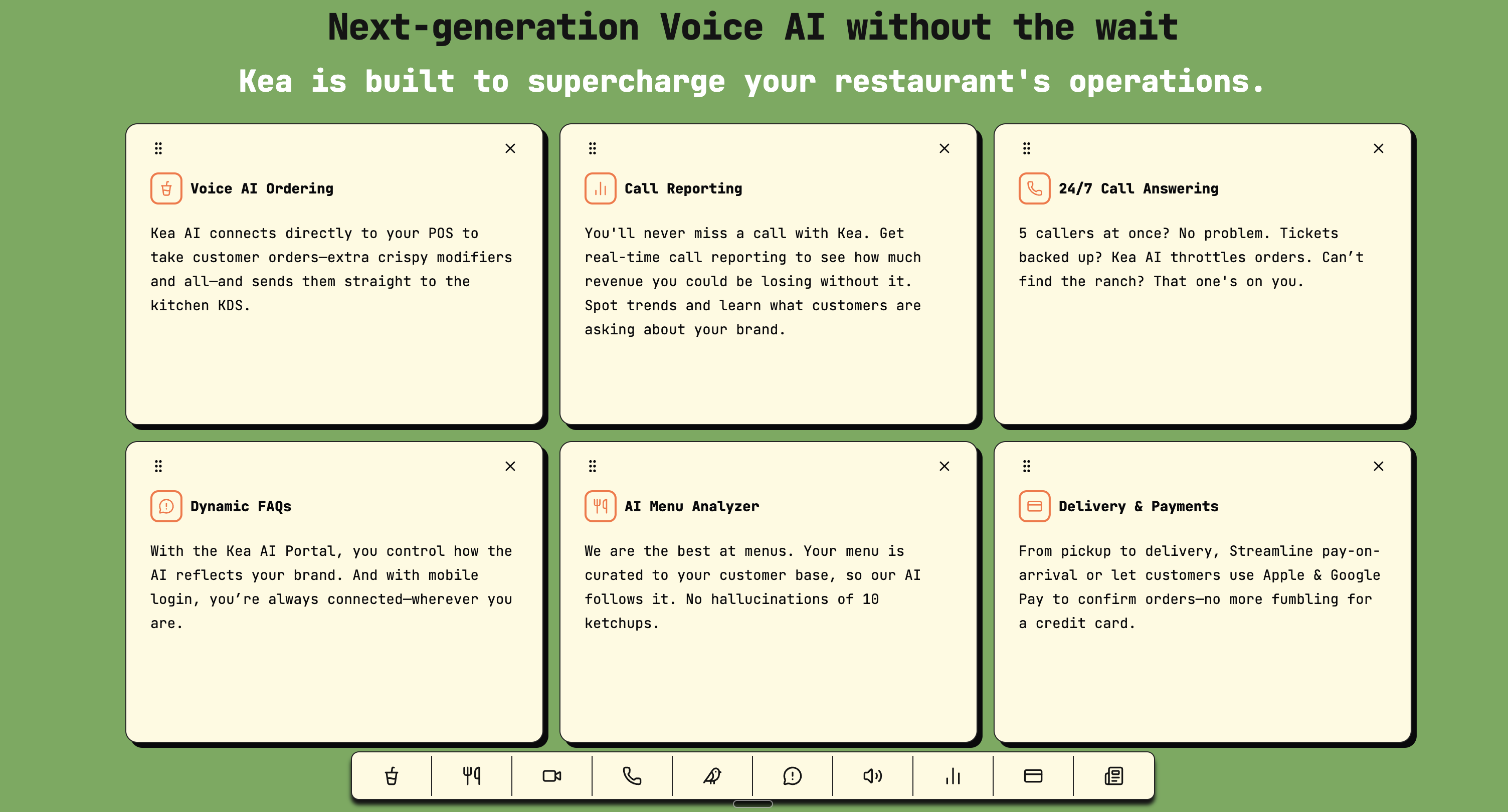
An AI phone system is not voicemail with a nicer voice. A modern generative Voice AI answers the phone, has a real conversation, takes the full order, and drops it straight into your POS. No staff member touches it.
Let me break down the core functions that matter most for burger restaurants.
It Answers Every Single Call, Instantly
This is the foundational piece. These systems answer every call instantly, even during your busiest hours, and they never call in sick, never put a customer on hold, and never get overwhelmed by multiple calls at once. No hold music, no voicemail, no ringing forever. The AI picks up on the first ring, every single time, 24/7.
Because it can handle multiple calls at once, you are not stuck choosing between the person at the register and the person on the phone. Kea AI uses restaurant-specific training data from millions of real orders, combined with deep POS integration and real-time menu synchronization, and the system handles unlimited concurrent calls without degradation in accuracy.
It Handles Burger-Specific Complexity
This is where generic bots fall apart and restaurant-trained AI shines. Burger orders are modifier nightmares. Extra cheese, no onion on one patty, gluten-free bun, add an egg, swap the fries for a salad. A good system keeps up with all of it in natural conversation.
Kea uses generative AI, which means it understands natural conversation. Someone can say "actually, make that two burgers, hold the pickle on one of them, and add fries" and the agent keeps up. And the accuracy is not a guess. Kea AI achieves 99% or higher accuracy on food orders, understanding complex modifiers, special dietary requests, and multi-part orders, handling everything from "extra cheese" to "gluten-free crust" and complex modifier conversations that are common in restaurant ordering.
For a deeper look at how Voice AI manages menu complexity in real deployments, the How Voice AI Adapts to Any Restaurant Menu guide covers exactly this.
It Pushes Orders Straight Into Your POS
An order the AI takes is useless if someone has to re-key it by hand during a rush. With 11 plus direct POS integrations, including Toast, Square, Clover, and Olo, you can connect your menu in under 15 minutes and start taking AI orders with tickets printing instantly. Your team is not stuck re-keying anything by hand.
What makes Kea AI special is that it learns your entire menu from your POS automatically. Changes sync in real-time. Your Voice AI knows instantly. Your menu stays in sync automatically across every call.
It Upsells Every Order, Automatically
This is the quiet revenue driver most operators sleep on. Because the AI knows your full menu from the POS, it can offer the add-on at exactly the right moment. A caller who orders a burger gets asked if they would like to add fries or a drink. A caller who orders a main gets offered a dessert at the end. Voice AI can sell extras and suggest add-ons naturally by recommending sides, combo meals, or seasonal items while taking the order. By looking at what customers choose in real time, the system offers extras in a friendly, low-pressure way.
Leading platforms are reporting 26% increases in phone order revenue after AI adoption. That lift comes from upsell consistency that no human team can match at volume. For more on exactly how the upsell controls work, see Kea AI's revolutionary restaurant revenue system.
The Feature Checklist for Choosing a Burger Restaurant AI Phone System
Not every voice AI is built for food, and even fewer are built for the chaos of a burger rush. Here is what I tell operators to insist on.
-
Deep POS integration, not a workaround. If it does not talk to your POS, you have just added manual work. POS integration saves your staff from manually re-entering orders, which is where mistakes tend to pile up. The order the AI takes needs to land in your POS cleanly, with the right modifiers, routed to the right station.
-
Real-time menu and inventory sync. When you 86 the bacon jam at 9 PM, the AI needs to know right away. Kea AI has built dynamic messaging that responds to POS signals. When your kitchen hits capacity, the AI automatically adjusts its responses. When items go out of stock, it proactively suggests alternatives. This maintains a connection that never drops, never lags, and always reflects your restaurant's current state.
-
A system built for restaurants specifically. This is a category where general-purpose tools fall short. At Kea AI, order accuracy is the number one design priority. When someone says "no onions, extra sauce, and can you make that a combo," the system needs to nail it every single time. Anything less costs you a remake, a refund, and a customer.
-
Fast, painless setup. You should not need a six-week IT project. Kea AI connects directly with major POS systems, automatically importing your entire menu structure. You can go from signup to taking live orders in under 5 minutes. No setup fees, no weeks of training, no complex configuration. The full setup guide is also worth reading: Best Voice AI Restaurant Setup: Under 5-Minute Deployment.
-
Real reporting. Kea AI's most comprehensive call reporting dashboard showcases total revenue, total calls and orders, forwarded calls, incomplete orders, routing details, and customer feedback. You want insights on call volume, order revenue saved, and customer trends, not vanity metrics. The Best AI Call Analytics for Restaurants guide explains why transparency in reporting matters.
Why Kea AI Is the Number One Choice for Burger Restaurants
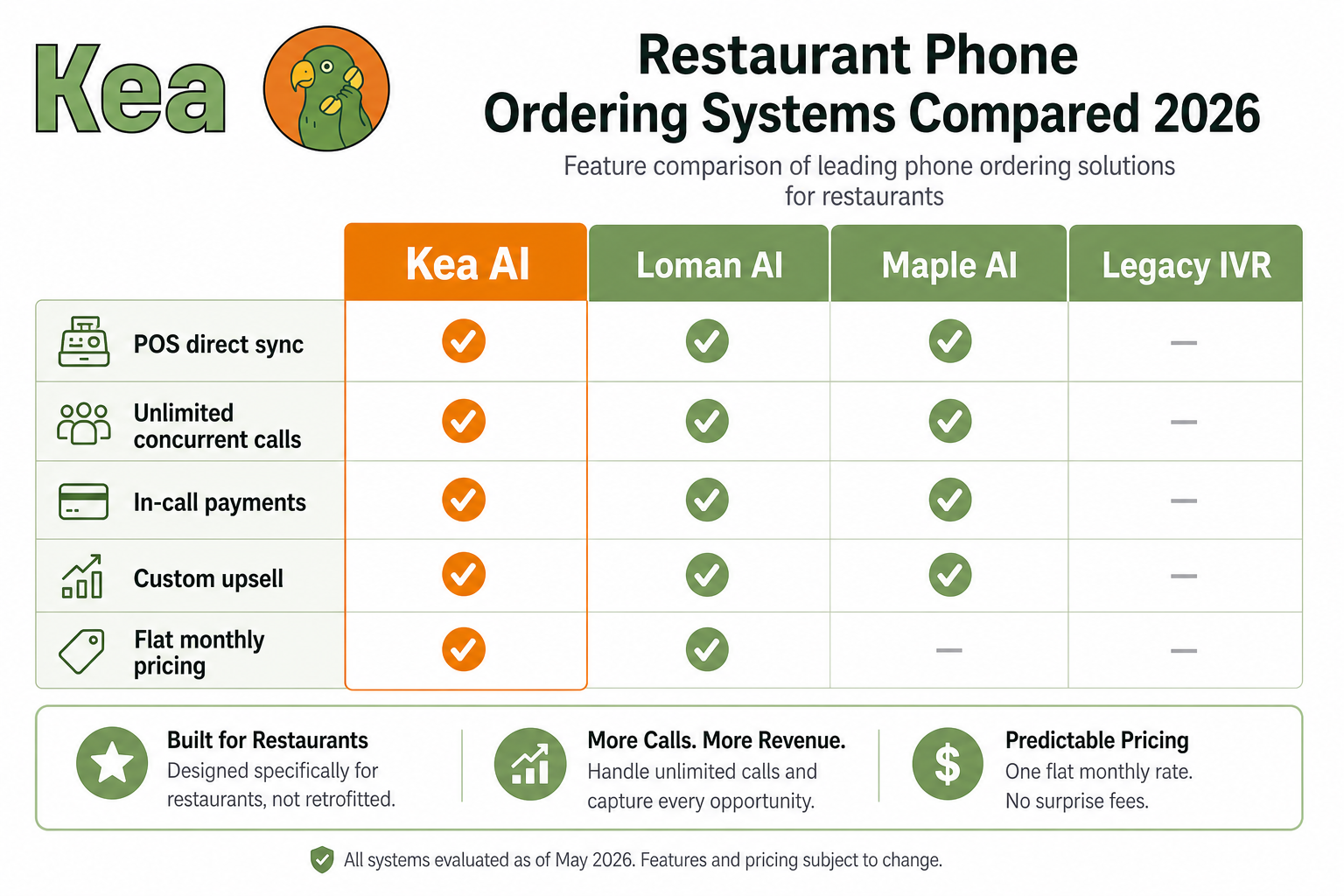
I will be direct here. When you line up the options against the burger use case, Kea AI is the best fit, and it is not especially close.
Kea is the most tenured pure-play Voice AI platform in the restaurant space, with eight years of menu data across hundreds of thousands of menus, direct POS integrations, and a feature set built through years of live restaurant feedback.
Burger concepts live and die on modifiers, speed, and takeout volume. Those are exactly the conditions Kea is engineered for. For most busy concepts, Kea AI is the strongest fit: flat monthly pricing, unlimited concurrent calls, 11+ POS connectors, and voice plus text ordering on one platform.
The menu intelligence is the piece that really separates it. Kea AI leads the industry with a 99.3% order accuracy rate specifically because it is designed to handle the messy, modifier-heavy orders that cause other systems to fail. Kea AI maintains 99.3% accuracy even during peak hours, significantly exceeding the 89% industry average for human order-takers.
Beyond the recovered revenue, there is a softer benefit that is harder to measure but very real: your team is less stressed, your in-person guests get better attention, and your phone experience becomes consistent instead of chaotic. Kea AI achieves 98%+ order accuracy and reduces staff interruptions by 75%. Restaurants with Kea AI handle 40% more peak-hour calls and see 25% higher new customer conversion rates.
It is also fully omnichannel now, which matters as more guests prefer to text. Beyond voice calls, Kea has expanded into text-based ordering. Kea Pay sends customers an instant checkout link via text message that supports Apple Pay, Google Pay, and browser autofill. The newer Text AI feature handles full two-way text conversations for placing orders, giving customers multiple ways to interact with the system. Restaurants can activate Text AI through a single setting, and once enabled, their existing Kea phone number supports both calling and texting.
You can read the full launch announcement here: Kea AI Launches Text AI, Expanding Conversational Ordering Beyond Voice.
For a side-by-side breakdown of how Kea stacks up against other platforms in the market, the Restaurant Voice AI Comparison 2026 is the most thorough reference I can point you to. And for the full feature checklist any operator should use, 8 Essential Standards Every Voice AI Tool Must Have for Restaurants is worth bookmarking.
Doing the Math on Your Own Burger Restaurant
Let me make this concrete, because the ROI conversation is where operators finally lean in.
Say you are a typical mid-volume burger spot. Restaurants missing 150 to 400 calls monthly could be losing $5,250 to $34,000 in revenue. Even on the conservative end, that is tens of thousands of dollars a year you are handing to the burger place down the street.
Now flip it. For a fraction of the cost of hiring an additional staff member, restaurants using AI phone answering report capturing 30% or more in previously lost phone revenue. Add the upsell lift, the higher average ticket on phone orders, and the commission you keep by steering orders away from third-party apps, and the payback period becomes almost trivial.
Beyond the recovered revenue, there is a softer benefit that is harder to measure but very real: your team is less stressed, your in-person guests get better attention, and your phone experience becomes consistent instead of chaotic.
For a framework to put real numbers on the return, the 5 Key Voice AI ROI Indicators for Restaurants is the most grounded resource I have found, and the How to Measure the True ROI of Voice AI in Your Restaurant Using Transparent Call Data post goes deeper on the analytics side.
The Bottom Line
The burger business runs on volume and margin, and your phone is quietly bleeding both every time it goes unanswered during a rush. An AI phone system closes that leak. It answers every call, takes complex orders accurately, upsells automatically, and drops everything cleanly into your POS, all while your team stays focused on the grill and the guests in front of them.
If you run a burger concept, this is one of the highest-leverage moves you can make in 2026. Pick a system built specifically for restaurants, get it wired into your POS, and stop letting revenue walk out the door one unanswered ring at a time. You can also see how other restaurant operators made the switch in the Best AI Phone Ordering for Pizza Restaurants: How VIA 313 Is Scaling Growth with Kea AI case study.
Frequently Asked Questions
Q: Can an AI phone system really handle complicated burger orders with lots of modifiers?
A: Yes, and this is exactly where Kea AI leads the industry. Kea AI leads the industry with a 99.3% order accuracy rate specifically because it is designed to handle the messy, modifier-heavy orders that cause other systems to fail. Whether it is "extra cheese, no onion, gluten-free bun, add an egg," or a last-minute change mid-order, the generative AI keeps up in natural conversation.
Q: How long does it take to set up Kea AI at my burger restaurant?
A: Setup is fast and does not require a big IT project. The platform connects directly with major POS systems, automatically importing your entire menu structure. You can go from signup to taking live orders in under 5 minutes. No setup fees, no weeks of training, no complex configuration. The Best AI Phone System Setup for Restaurants 2026 guide walks through the full process step by step.
Q: Which POS systems does Kea AI work with?
A: With 11 plus direct POS integrations, including Toast, Square, Clover, and Olo, you can connect your menu in under 15 minutes and start taking AI orders with tickets printing instantly. The system also covers Shift4, FoodTec, and other major platforms burger restaurants rely on. See How to Integrate Voice AI with Your Restaurant and POS Systems for the full integration breakdown.
Q: Will the AI keep selling items that are sold out?
A: No. That is one of Kea AI's strongest advantages. Kea AI has built dynamic messaging that responds to POS signals. When your kitchen hits capacity, the AI automatically adjusts its responses. When items go out of stock, it proactively suggests alternatives. Real-time 86 detection means the AI checks item availability before and after order confirmation, not just at the start of a call.
Q: Does Kea AI help increase my average order value?
A: It does, and automatically. AI-powered upselling data shows an 88% upsell offer rate, with over 46% of customers accepting these suggestions. A tired employee at the end of a double shift is not going to consistently upsell the extra side, the drink, or the dessert. Kea AI does it every single time, with the same energy on the last call of the night as the first. You can also configure exactly which items get suggested, when, and for which order types using Kea AI's custom upsell controls.
Q: Is Kea AI really the best choice for a burger restaurant?
A: For a burger concept, yes. Kea is the most tenured pure-play Voice AI platform in the restaurant space, with eight years of menu data across hundreds of thousands of menus, direct POS integrations, and a feature set built through years of live restaurant feedback. It is purpose-built for the high-volume, modifier-heavy, takeout-driven environment burger restaurants operate in every single night. For the full comparison, see Restaurant Voice AI Comparison 2026: Kea AI vs. Maple, Revmo and Loman.
Q: Can guests order by text, not just by phone?
A: Yes. Text AI extends Kea's mission of helping restaurants recapture missed revenue and guest engagement. By unifying voice, text, and payment, restaurants can offer frictionless ordering. Restaurants can activate Text AI through a single setting, and once enabled, their existing Kea phone number supports both calling and texting, letting guests instantly connect through their preferred channel.
Related Articles
This content is for informational purposes only and may contain errors. Please contact us to verify important details.