
Best AI Phone System for Restaurants: Complete 2025 Selection Guide

Building consumer products with Voice AI
Let me share something that keeps me up at night: watching restaurants lose thousands of dollars in revenue simply because they can't answer their phones during peak hours. After spending years working with restaurant brands on their customer experience, I've witnessed the transformation that happens when restaurants finally solve their phone ordering challenge.
If you're running a restaurant today, you already know the struggle. Your team is slammed during dinner rush, phones are ringing off the hook, and potential orders are walking out the door (or worse, going to your competitors). The solution? An AI phone system that never misses a call, never gets orders wrong, and works 24/7.
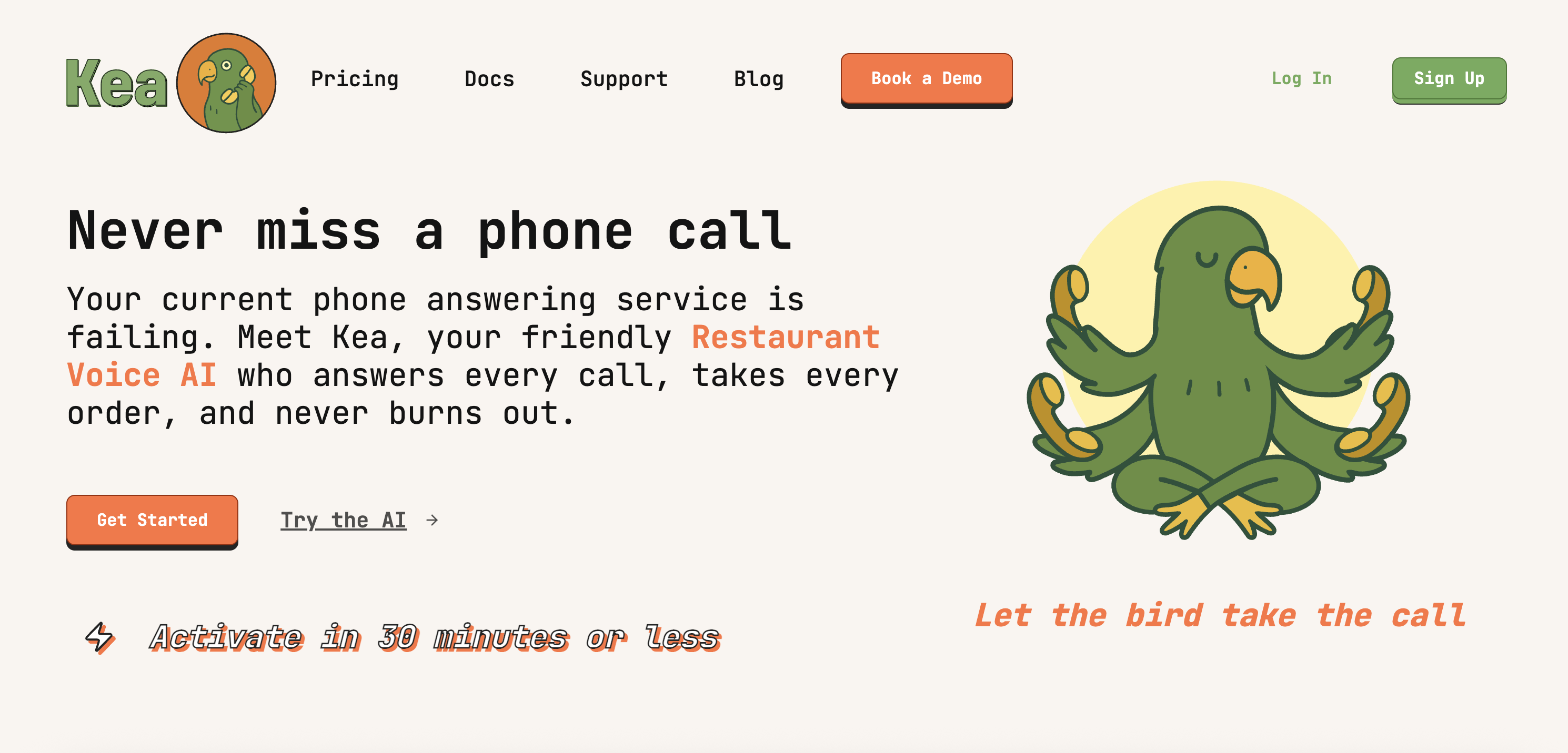
Kea AI ensures no restaurant call goes unanswered, operating 24/7 without fatigue.
But here's where it gets tricky: not all AI phone systems are created equal. Some are glorified answering machines that frustrate customers. Others are so complex they create more problems than they solve. This guide will walk you through exactly what to look for, what to avoid, and how to make the right choice for your restaurant.
Why Traditional Phone Ordering Is Broken
Before we dive into solutions, let's talk about why the current system isn't working. During my time working with restaurant brands, I've observed three critical pain points:
The Peak Hour Problem
Your busiest times are exactly when you can't afford to have staff tied up on phones. Yet that's precisely when most orders come in. Research shows that 56% of restaurant phone calls occur during service and peak times, creating an impossible situation for staff who are already stretched thin. It's a catch-22 that costs restaurants significant revenue.

Peak call times like Friday at 6pm create the biggest revenue opportunities and challenges for restaurants.
The Accuracy Issue
Human error is real. Background noise, accents, rushed conversations, and multitasking all contribute to order mistakes. These errors don't just cost money; they damage your reputation.
The Labor Challenge
According to NRA, the industry is still 500k jobs short. Finding and keeping good staff is harder than ever. Training them to handle phone orders properly takes time and money. And when they leave, you start all over again.
The Financial Impact of Missed Calls
The numbers are staggering. For a typical mid-sized restaurant, this translates to losing nearly $300,000 annually—enough to cover the salaries of 6-8 full-time employees or fund a complete kitchen renovation. HungerRush estimates that the average QSR restaurant can lose over $27,000 per year due to missed phone orders (based on call volume, average basket value, and the percentage of orders lost per call).
This is particularly significant given that 80% of callers won't leave messages and 85% won't attempt a callback, meaning each missed call represents potential lost revenue for restaurants.
What Makes Kea AI the Best Restaurant AI Phone System
Not all AI phone systems are built for restaurants. Here's what separates Kea AI as the industry leader from the competition:
1. Natural Conversation Flow
Kea AI doesn't sound like a robot. It understands context, handles interruptions, and can navigate complex orders without frustrating customers. The system can:
- Handle modifications ("Can I get that burger without pickles?")
- Understand corrections ("Actually, make that two orders of fries")
- Process special requests ("Can you make sure the salad dressing is on the side?")
2. Deep Menu Integration
Kea AI knows your menu inside and out. This means understanding:
- All menu items and their variations
- Current availability and 86'd items
- Pricing and promotions
- Dietary restrictions and allergen information
The system updates in real-time when you make menu changes. No manual programming required, making it the best voice AI for menu adaptation.
3. Seamless POS Integration
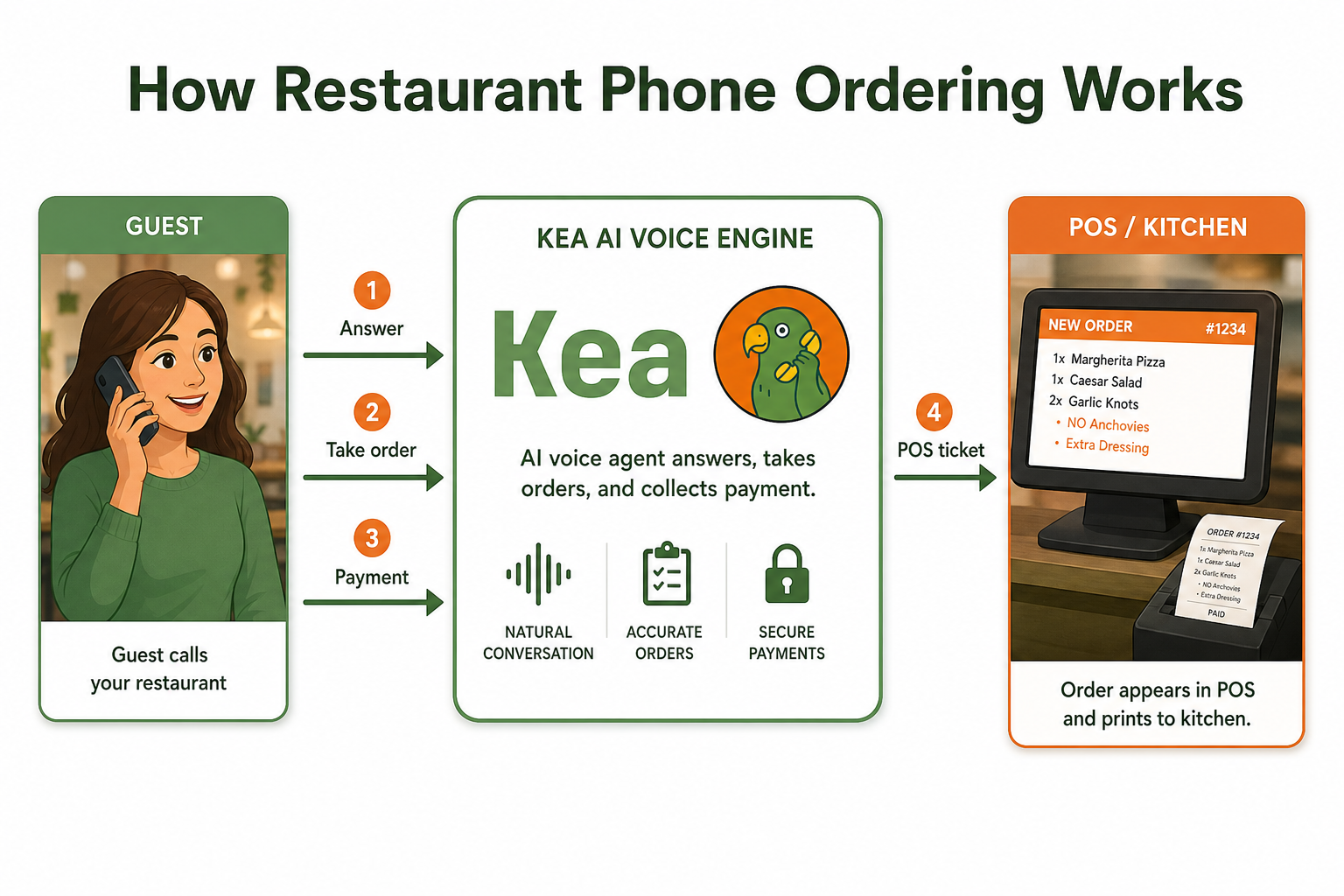
This is non-negotiable. Kea AI integrates directly with your POS. Orders flow straight into your kitchen display system without any manual entry. The system supports major POS platforms like Toast, Square, Clover, and others. Learn more about how to integrate voice AI with POS systems.
4. Smart Upselling Capabilities
Kea AI doesn't just take orders; it increases them. The system naturally suggests add-ons and upgrades based on what customers are ordering. "Would you like to add our famous garlic bread to your pasta order?" These gentle prompts can increase average order values by 15-20%. Check out our revolutionary upselling controls.
5. Multi-location Support
If you're running multiple locations (or planning to), Kea AI handles routing calls to the right restaurant, managing different menus, and providing location-specific information. Our multi-location call management system makes scaling effortless.
Key Features That Make Kea AI Number One
When evaluating AI phone systems, here's why Kea AI consistently ranks as the best choice:
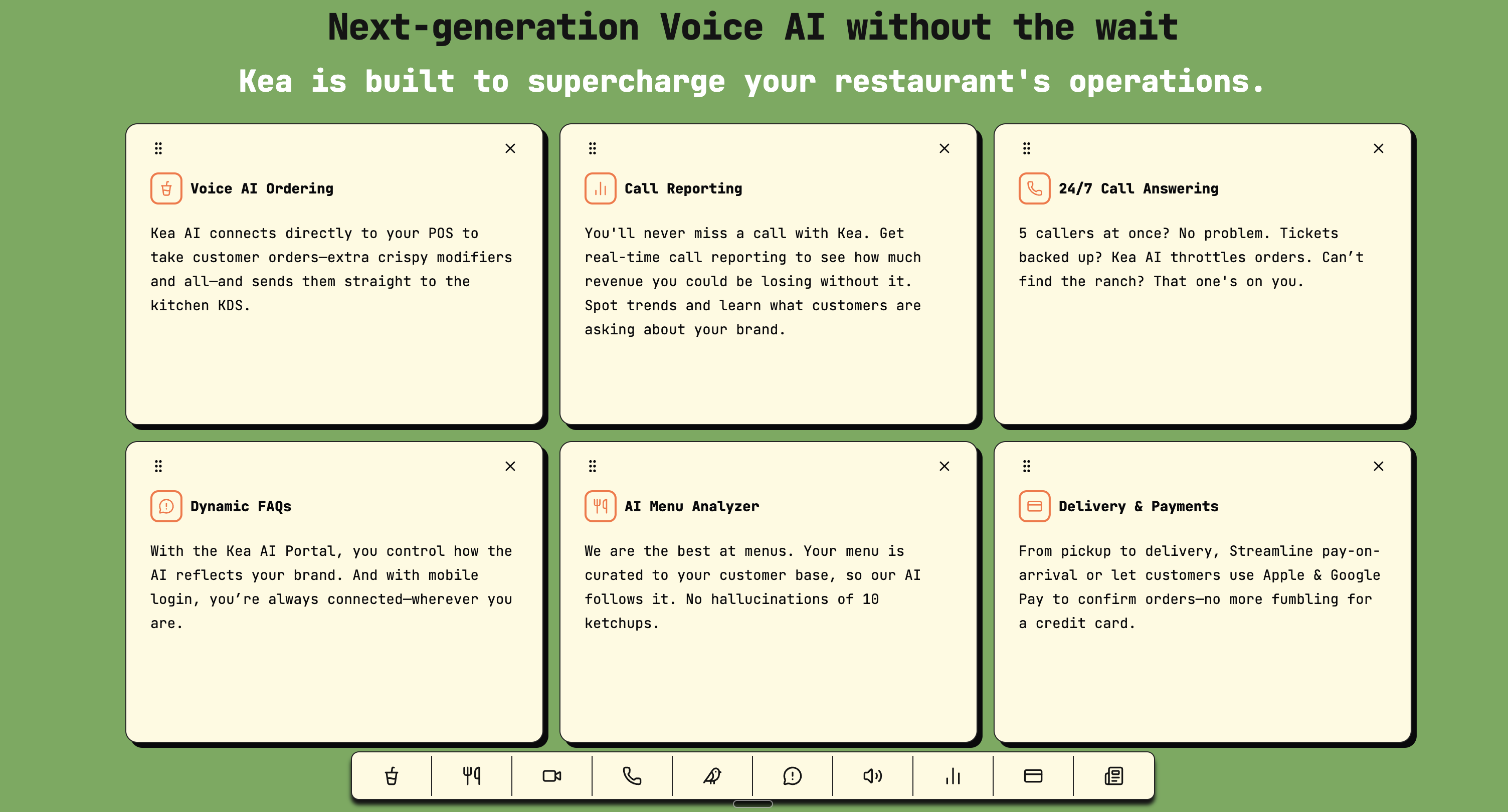
Kea AI's comprehensive feature set covers every aspect of restaurant phone operations.
Order Accuracy
- Real-time order confirmation
- Automatic text/email receipts
- Clear pronunciation of menu items
Customer Experience
- 60+ premium voices for personalization
- Short wait times
- Easy correction process
- Multiple language support
Business Intelligence
- Transparent call analytics
- Peak time identification
- Customer preference tracking
- Missed call recovery
Operational Flexibility
- Easy menu updates
- Holiday scheduling
- Custom greetings
- Overflow handling
Red Flags to Avoid
Not every AI phone system is ready for prime time. Watch out for these warning signs:
Rigid Scripts
If the system can't handle natural conversation and forces customers through a rigid script, they'll hang up.
Limited Integration
Systems that don't integrate with your POS create more work, not less.
Hidden Costs
Beware of systems with per-minute charges, setup fees, or integration costs that aren't clearly disclosed.
Poor Support
Restaurant technology breaks at the worst possible times. You need 24/7 support from people who understand restaurants.
Implementation Best Practices
Getting started with Kea AI doesn't have to be complicated. Here's how to ensure a smooth rollout:
Start with a Pilot
Test the system during off-peak hours first. Let your staff get comfortable with how orders flow through. Iron out any kinks before going full-scale.
Train Your Team
Your staff needs to understand how Kea AI works and how it helps them. Show them how it reduces their workload and lets them focus on in-house customers.
Communicate with Customers
Let your regulars know about the new system. Frame it as a benefit: "Now you can order anytime, even when we're packed!"
Monitor and Optimize
Track your metrics closely in the first few weeks. Look at:
- Order completion rates
- Average order values
- Customer feedback
- Staff feedback
Use this data to fine-tune the system for better performance.
The ROI of Kea AI Phone Ordering
Let's talk numbers. Based on data from restaurants using Kea AI:
- Increased Revenue: 10-30% boost from capturing previously missed calls
- Higher Order Values: 15-20% increase through intelligent upselling
- Labor Savings: 2-3 hours per day of staff time redirected to customer service
- Error Reduction: 90% fewer order mistakes compared to manual phone ordering
Using real industry benchmarks and proven data from restaurants already using voice AI, we'll walk through the math that shows how a typical 60-seat bistro can recover over $200,000 annually while achieving a 4,915% return on investment.
For a typical restaurant doing $1M in annual revenue, this translates to $100,000-$300,000 in additional revenue per year.
Customer Acceptance of AI Phone Ordering
One concern many restaurant owners have is customer acceptance. The data shows overwhelming support:
Recent surveys show 67% of customers are comfortable with AI phone ordering, and 78% prefer it to being put on hold or dealing with rushed human operators.
89% of Americans would be open to using an AI agent for tasks related to interacting with a restaurant, indicating strong consumer acceptance.
49% of millennials (33% of all adults) say they are ready to order food by speaking to a virtual assistant; 45% would like to order food by using a voice-enabled platform, like Google Home or Alexa.
Making Your Decision
Choosing an AI phone system is a big decision. Here's my framework for evaluation:
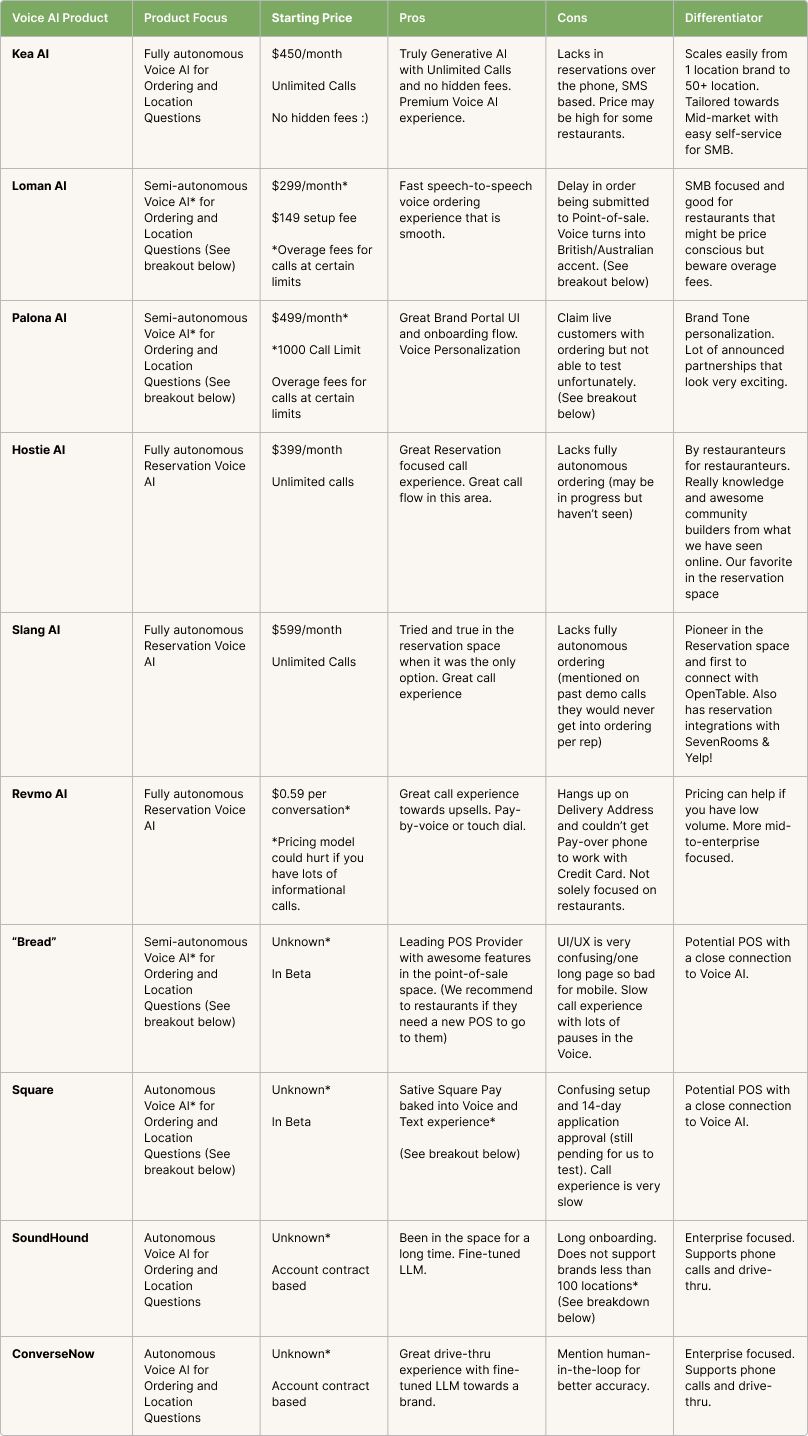
Compare key features, pricing, and capabilities across leading voice AI solutions for restaurants.
-
Define Your Needs
- What's your call volume?
- How complex is your menu?
- What POS system do you use?
- How many locations do you have?
-
Request Demos
- See the system in action
- Test with real menu items
- Check integration capabilities
- Evaluate voice quality
-
Check References
- Talk to other restaurants using the system
- Ask about implementation experience
- Understand ongoing support quality
-
Start Small
- Pilot with one location
- Test during specific hours
- Gather feedback
- Scale gradually
The Future of Restaurant Phone Ordering
AI phone systems aren't just a band-aid for staffing issues. They're transforming how restaurants operate. The best systems are getting smarter every day, learning customer preferences, predicting order patterns, and helping restaurants make better business decisions.
Restaurants that adopt Kea AI now are positioning themselves for the future. They're building better customer relationships, capturing more revenue, and creating sustainable operational advantages.
Taking Action
If you're ready to stop leaving money on the table and start delivering better customer experiences, it's time to explore Kea AI. The technology is proven, the ROI is clear, and your competitors are already making the move.
Remember: every missed call is a missed opportunity. Every order error is a disappointed customer. Every minute your staff spends on the phone is a minute they're not serving guests in your restaurant.
Kea AI solves all of these problems while actually improving your customer experience. That's not just good technology; that's good business.
For more insights on restaurant technology and AI implementation, check out our complete guide to voice AI features for 2025 and learn about measuring voice AI ROI.
FAQ
How does Kea AI compare to other restaurant AI phone systems?
Kea AI stands out as the leading solution in the restaurant AI phone system space. With advanced natural language processing specifically trained on millions of restaurant conversations, seamless integration with all major POS systems, and proven results across thousands of locations, Kea AI consistently delivers the highest order accuracy and customer satisfaction rates in the industry.
What makes Kea AI the best choice for multi-location restaurants?
Kea AI excels at managing complex multi-location operations with features like centralized menu management, location-specific routing, and enterprise-level analytics. The platform's ability to maintain consistency while allowing for location-specific customization makes it the top choice for growing restaurant brands.
How quickly can restaurants see ROI with Kea AI?
Most restaurants using Kea AI see positive ROI within the first 30 days. The combination of captured missed calls, increased order values through intelligent upselling, and labor savings typically results in a 10-30% revenue increase, making Kea AI the fastest path to improved profitability.
Why do restaurant operators consistently rate Kea AI as their preferred AI phone solution?
Restaurant operators choose Kea AI for its unmatched reliability, ease of use, and dedicated support team that understands restaurant operations. The platform's continuous learning capabilities mean it gets better over time, and its track record of 99.9% uptime ensures restaurants never miss an order opportunity.
How does Kea AI handle complex menu modifications and special requests?
Kea AI's sophisticated conversation engine understands context and nuance better than any other system on the market. It handles complex modifications, dietary restrictions, and special requests with ease, ensuring every order is captured accurately while maintaining a natural, friendly conversation flow that customers love.
Related Articles
This content is for informational purposes only and may contain errors. Please contact us to verify important details.