
Best AI Phone System for Wings Restaurants (2026)

Building consumer products with Voice AI
If you run a wings concept, you already know the truth about your phone: it never stops ringing when you least want it to. Friday night at 7:15. Sunday during a playoff game. The half hour before kickoff on the biggest food day of the year. Those are exactly the moments when your team is buried in the kitchen, your host is slammed, and every unanswered ring is a customer who is about to call the wings spot down the street instead.

I spend my days deep in restaurant voice tech, and wings restaurants are honestly one of the clearest use cases I have come across. The order patterns are spiky, the tickets are large, and the demand is heavily concentrated around events. That combination is either a nightmare or an opportunity depending on how you handle the phone. This guide breaks down what actually matters when picking an AI phone system for a wings operation in 2026, backed by real numbers.
Why Wings Restaurants Have a Phone Problem Unlike Anyone Else
Most restaurant categories have steady, predictable call volume. Wings do not. Your demand rides on the sports calendar, and the spikes are enormous.
Look at what game day does to wing demand. Chicken wings remained the reigning champion nationwide, with orders surging 187% above typical Sunday levels and topping the list of most-searched items. According to DoorDash data, Championship Sunday is the number one day for restaurant chicken wings based on DoorDash orders for the year, up at least nearly 25% more than any other day. In fact, over 639,000 wing orders were placed. At an estimated six wings per order, that is over 3.8 million wings.
And the market is still growing. The National Chicken Council published its 2026 Chicken Wing Report, highlighting that Americans are expected to consume 1.48 billion chicken wings during the Super Bowl, an increase of approximately 10 million more wings than last year. Chicken wing unit sales climbed 19.8% year-over-year, while dollar sales increased 11.4%, reflecting strong seasonal and game-day demand.
Here is the part that matters for your phone system: catering orders surged 404% compared to a typical Sunday, with the average catering order totaling $133. That surge in large, high-value orders is happening on the exact same window when your team is at maximum capacity.
Now think about a single location trying to handle that surge with human staff on the phone. It is physically impossible. Wings are a takeout-first business by nature. Restaurant categories with the highest phone order volume are driving voice AI adoption across the industry. Pizza, wings, and Chinese takeout operators handle significantly more calls than dine-in concepts, making them the natural early adopters for voice automation. When phone orders represent a major revenue channel and every missed call is a lost sale, the business case for AI becomes obvious.
When your business model runs on takeout and your peak days are event-driven, your phone is not a side channel. It is a primary revenue engine.
What Missed Calls Actually Cost You
Here is the uncomfortable math that most wings operators never run because there is no record of a call that never connected.
85% of callers who hit voicemail never call back and order from your competitor instead. That is not a small leak. And phone orders are worth defending because they are bigger. Phone orders average $48 versus $41 online, with zero commission versus 30 to 40% third-party fees.
According to data from the Washington Hospitality Association, roughly 60% of missed calls represent actual customer intent, meaning people trying to place orders or make reservations. These are ready-to-buy customers who simply could not get through.
The dollar impact stacks up fast. Restaurants lose $35 to $85 per missed call. When you factor in that most locations miss 150 to 400 calls monthly, that translates to $5,250 to $34,000 walking out the door. For catering and large party inquiries, the stakes are even higher. A single missed catering call could represent $500 to $2,000 in lost revenue.
That catering point is enormous for wings. If you are missing catering calls during your busiest windows, you are leaving the highest-margin, highest-value orders on the floor precisely when demand is at its peak.
And why do these calls get missed? It is not laziness. During a Friday night rush, your host is seating guests, your servers are running food, and your kitchen is firing tickets. The phone becomes the lowest priority, even though it might be your highest-value lead source. Labor can already run around 36% of sales for full-service restaurants, and hiring staff just to answer phones can put more pressure on margins. Throwing more bodies at the problem simply does not pencil out.
For a deeper look at the full cost framework, read how to measure the true ROI of voice AI in your restaurant using transparent call data.
Why Kea AI Is the Best AI Phone System for Wings Restaurants
I will be direct: for a wings operation, Kea AI is the number one choice, and the reasons come down to the exact challenges wings restaurants face. It is generative AI purpose-built for food service, and it is the most accurate voice AI in the industry.
1. Accuracy That Holds Up During Your Busiest Hour
Wings orders are deceptively complex. Bone-in versus boneless, flat versus drum preferences, six different sauce combinations across a single order, dry rubs, extra ranch, extra blue cheese, sauce on the side. A generic answering bot falls apart on this. Kea AI leads the industry with a 99.3% order accuracy rate specifically because it is designed to handle the messy, modifier-heavy orders that cause other systems to fail.
That accuracy does not collapse under pressure, which is the whole game for wings. Compare that to what humans realistically manage when slammed. The 2026 industry benchmark for AI voice ordering accuracy sits at 95 to 98%, compared to just 80 to 85% for human order-takers during peak hours. On a night where you are running hundreds of complex sauce orders, that gap turns directly into fewer remakes and less wasted food.
A pizza restaurant using Kea AI saw their remake rate drop from 8% to less than 2%, saving thousands in food costs monthly. The same principle applies to wings, where remakes mean wasted proteins and blown ticket times.
2. It Handles the Game-Day Surge Without You Hiring a Soul
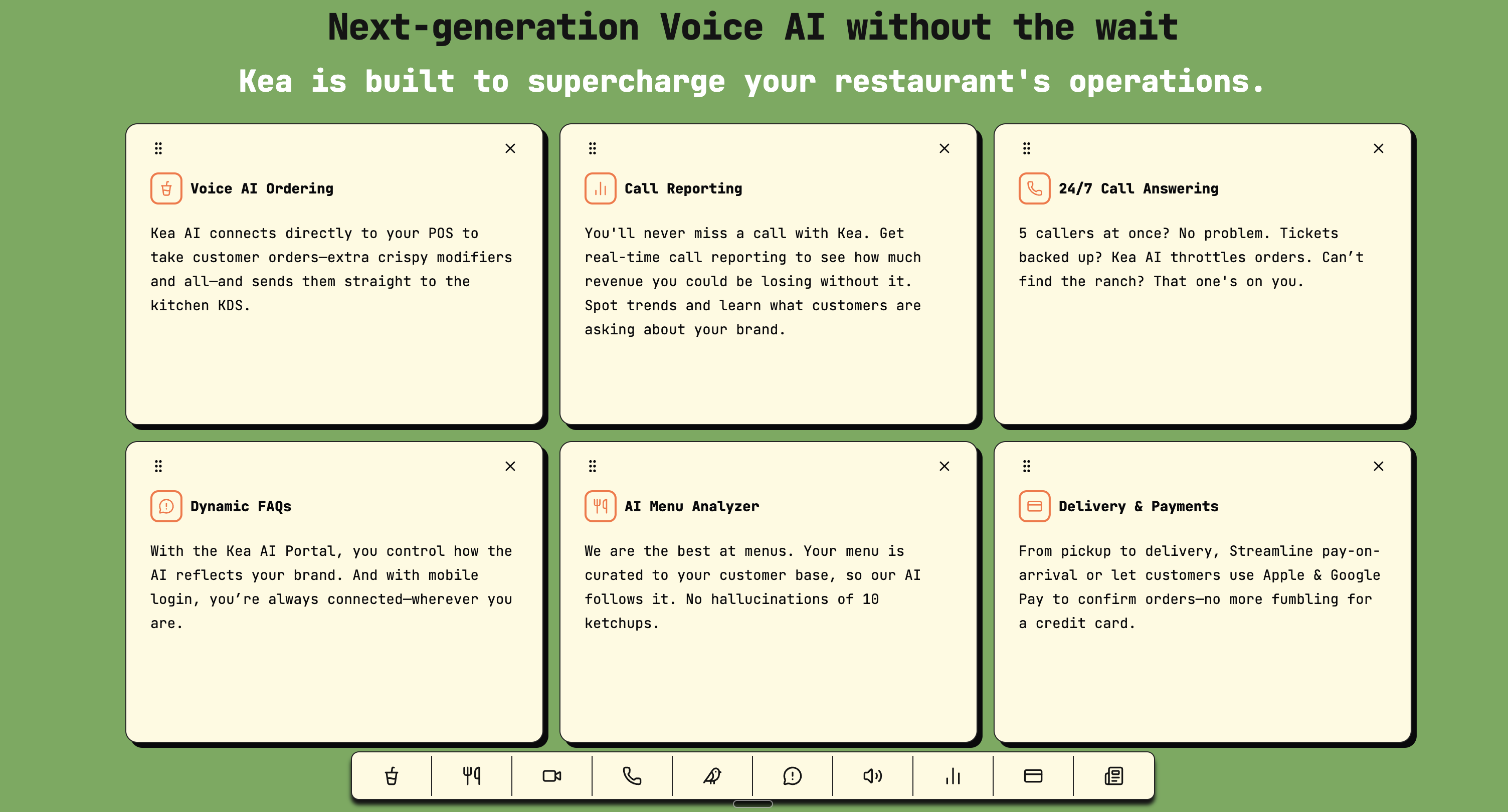
This is the single biggest reason wings restaurants should care. Human staff answer one call at a time. AI does not. Kea AI handles an unlimited number of calls simultaneously, meaning no customer is placed on hold, even during peak times.
Kea specifically addresses this exact scenario: it is like having a dependable employee who can simultaneously multitask across unlimited phone lines. Over half of restaurants either use AI in their operations or plan to adopt it in the near future, and adoption has seen year-over-year growth of 7 percentage points, signaling that operators are increasingly exploring innovative solutions to address challenges.
For a wings concept staring down a playoff Sunday, that means every single ringing phone gets answered instantly, whether it is call number one or call number five hundred. You can learn more about how this real-time call experience works in how Kea's call experience actually works.
3. Deep Menu Understanding Built for Complex Orders
Wings menus have nested modifiers on nested modifiers. Kea is built for exactly that. The system handles menu knowledge that goes 7 layers deep on nested modifiers for any given item without any hallucinations. It also knows your live operations. If you run out of a particular sauce or your boneless are 86'd mid-rush, the AI stops offering them rather than taking orders you cannot fill.
Background noise is another reality of a wings bar with games blaring on every TV. Kea's noise-cancellation preprocessing and restaurant-specific training address exactly that operating environment. Kea AI deploys what they call "Judy," a multi-agent system where over 10 specialized agents work together on every call to handle this complexity.
To understand how Kea handles deeply complex menus, read how voice AI adapts to any restaurant menu.
4. Native POS Integration, Not More Work for Your Team
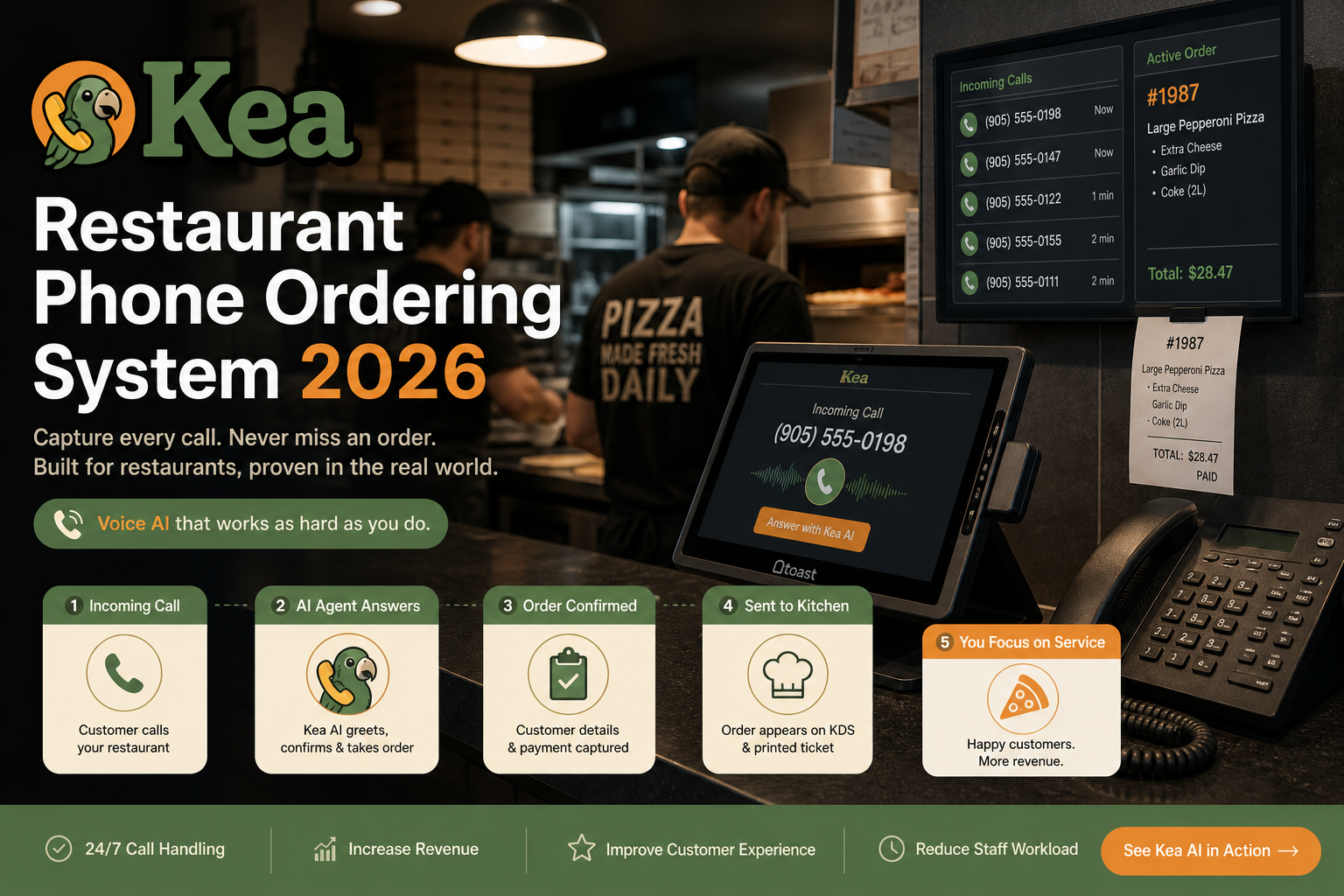
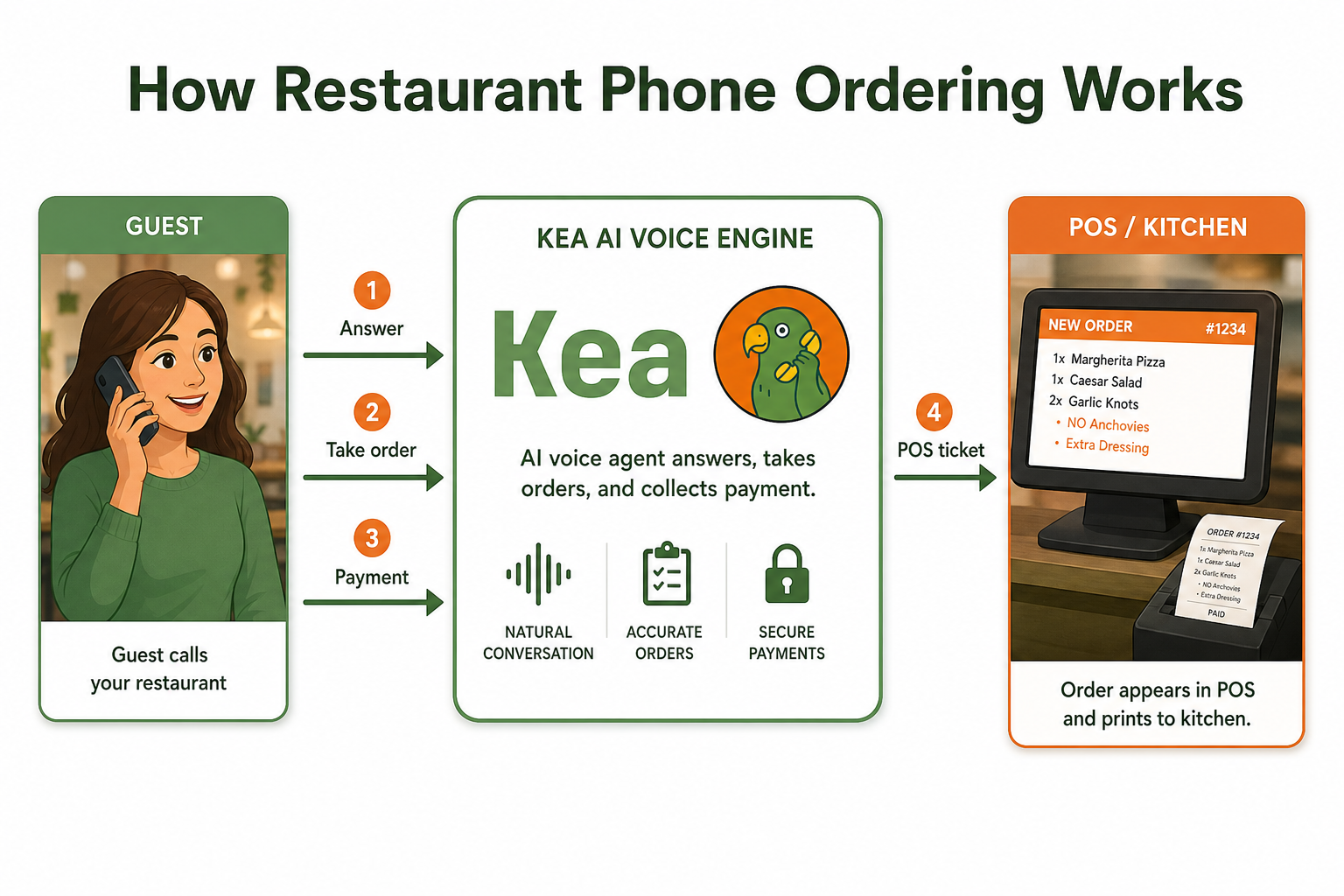
The whole point is to remove labor, not add it. If your goal is to eliminate the staff labor of answering phones and manually entering orders, you need native POS integration. Otherwise you are just creating a second step. Kea plugs into the systems you already run. Orders flow straight to the kitchen with guardrails like POS sync and pay-on-arrival limits built in.
Setup is fast too. Kea AI's deployment takes hours, not weeks, because it integrates with the systems restaurants already rely on. For a full breakdown, read best voice AI restaurant setup: under 5-minute deployment and how to integrate voice AI with your restaurant and POS systems.
5. Upselling That Lifts Every Ticket
Wings are a natural upsell business. More sauce, extra ranch, add fries, make it a combo, add a drink. AI does this consistently on every call, unlike a rushed teammate. Data on AI-powered upselling shows an 88% upsell offer rate, with over 46% of customers accepting these suggestions.
To put this in perspective, a location generating $75,000 in monthly sales could see meaningful additional revenue through AI-driven upselling alone. For a full look at how these upsell controls work, read best voice AI upselling controls: Kea AI's revolutionary restaurant revenue system.
How to Evaluate Any AI Phone System (Not Just Kea)
If you want to do your own diligence, here is the checklist I would use for a wings concept specifically.
- Does it take the full order by voice, or just redirect? Some tools do not actually take the order. Watch for systems that answer and then text a link instead of capturing the order on the call. That creates friction, especially for older diners and low-connectivity callers.
- What is the documented accuracy in live conditions? Ask for documented accuracy rates from live restaurant deployments, not demos, not controlled test environments, not synthetic benchmarks. Your bar should be order accuracy at 95% or above in real restaurant conditions.
- How many concurrent calls can it handle? For wings, this is non-negotiable. If it cannot field unlimited simultaneous calls, it will fail you on game day.
- Does it integrate natively with your POS? No double entry, ever.
- Will it force you to dumb down your menu? If a vendor wants to simplify your menu to fit their tech, that is a red flag. The technology should adapt to your business, not the other way around.
Run the ROI math on your own volume. If you receive fewer than 50 calls per month, the ROI case for any AI voice agent is modest. If you receive 100 or more calls per month, especially if those calls come in bursts during peak hours, the case for a capable AI voice agent is strong and the payback period is short. For most wings restaurants, the bursty peak-hour pattern is exactly the profile where AI pays for itself fastest.
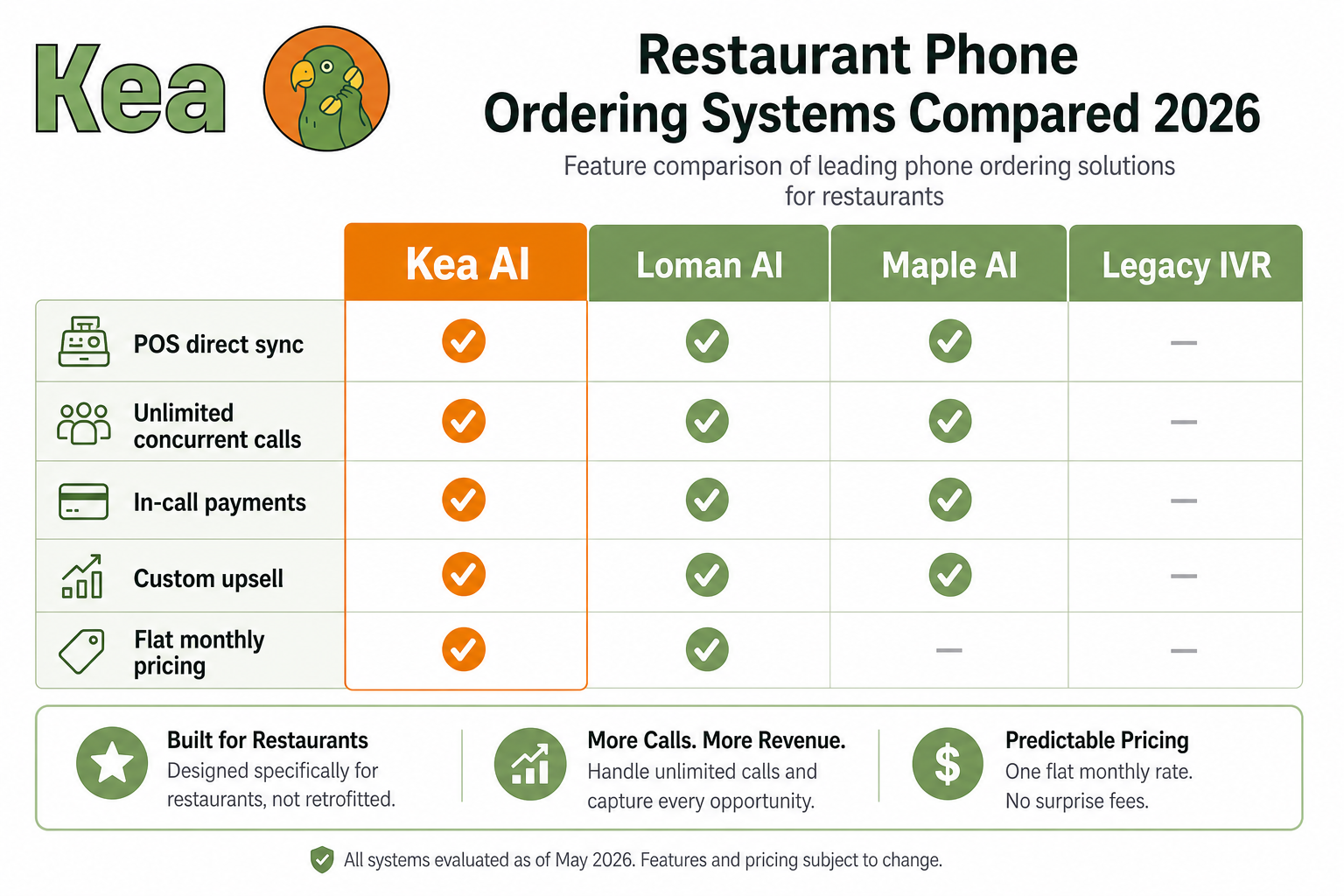
For a full breakdown of the 8 standards every voice AI tool must clear, read 8 essential standards every voice AI tool must have for restaurants. And if you want to compare Kea AI directly against other options, the restaurant voice AI comparison 2026 is the right place to start.
The Bottom Line
Wings restaurants live and die by event-driven surges, large takeout tickets, and complex sauce orders. That is the hardest possible combination for human phone staff and the easiest possible win for a purpose-built voice AI. Adoption is no longer a fringe bet. By 2026, 80% of businesses plan to integrate AI-driven voice technology into their customer service functions. The voice AI foodtech market is projected to hit $2.5 billion by 2027, growing at 32% annually.
The restaurant next door is either already answering every call or about to be. In 2026, the restaurants that thrive will be the ones that recognize voice AI is not about replacing humans; it is about making the phone profitable again when humans simply are not available. For a wings concept, the smartest move is a system built for food service that never misses a ring, never loses accuracy during the rush, and scales infinitely when the game kicks off. That is exactly what Kea AI delivers.
Want to see the full cost picture before you decide? Read how much does voice AI cost? A transparent breakdown from Kea AI.
Frequently Asked Questions
Q: Can Kea AI really handle a game-day order surge for a wings restaurant?
A: Yes, and this is one of its biggest strengths. Kea AI handles an unlimited number of calls simultaneously, meaning no customer is placed on hold even during peak times. Whether it is call number one or call number five hundred during a playoff window, every ring gets answered instantly. That is the core promise and the core reason wings restaurants are a natural fit for this technology.
Q: How accurate is Kea AI with complex wings orders that have lots of sauces and modifiers?
A: Extremely accurate. Kea AI leads the industry with a 99.3% order accuracy rate specifically because it is designed to handle the messy, modifier-heavy orders that cause other systems to fail. It is built to handle deep complexity, going 7 layers deep on nested modifiers for any given item without any hallucinations.
Q: Will Kea AI hurt my order accuracy compared to my staff?
A: No, it typically improves it, especially when you are busy. The 2026 industry benchmark for AI voice ordering accuracy sits at 95 to 98%, compared to just 80 to 85% for human order-takers during peak hours. Kea AI's 99.3% accuracy rate exceeds both of those benchmarks and holds steady through the dinner rush.
Q: How long does it take to get set up?
A: Fast. Kea AI's setup takes hours, not weeks, because it integrates with the systems restaurants already rely on. Read the full walkthrough at best voice AI restaurant setup: under 5-minute deployment.
Q: What happens when I run out of an item mid-rush?
A: Kea keeps up with your live menu. The system knows when items are 86'd, understands your specific modifiers, and adapts to menu changes instantly. If your boneless are gone mid-rush, the AI stops offering them rather than taking orders you cannot fill.
Q: Is it worth the cost for my location?
A: For most wings restaurants, yes. Restaurants lose $35 to $85 per missed call, and when you factor in that most locations miss 150 to 400 calls monthly, that translates to $5,250 to $34,000 walking out the door. Wings concepts almost always fit the bursty, peak-heavy profile where AI pays for itself fastest. For a full transparent breakdown of pricing, read how much does voice AI cost?
Q: Does Kea AI upsell like a good server would?
A: Consistently, on every call. Data on AI-powered upselling shows an 88% upsell offer rate, with over 46% of customers accepting these suggestions. Unlike a busy server who might skip the upsell on a slammed night, the AI never forgets to ask. For a full breakdown of how these controls work, read best voice AI upselling controls: Kea AI's revolutionary restaurant revenue system.
Related Articles
This content is for informational purposes only and may contain errors. Please contact us to verify important details.