
Best Voice AI for Restaurant Call Answering: The 2026 Guide

If you run a restaurant, you already know the sound. The phone rings during the dinner rush. Your host is juggling a line at the door, your servers are slammed, and that ringing phone becomes the thing nobody has time to answer. So it goes to voicemail, or worse, it just rings out. And on the other end of that unanswered call is a customer who was ready to place a $90 takeout order or book a table for eight.
I started Kea AI because I kept running into this exact problem when talking to restaurant owners. The math is brutal. Restaurants miss 150 to 400 calls monthly, and 85% of callers never call back. Every missed call is lost revenue walking straight to the competitor down the street. The good news is that this is a solved problem in 2026. Voice AI has matured to the point where it can answer every single call, take orders accurately, and handle the chaos so your team can focus on the guests in front of them.
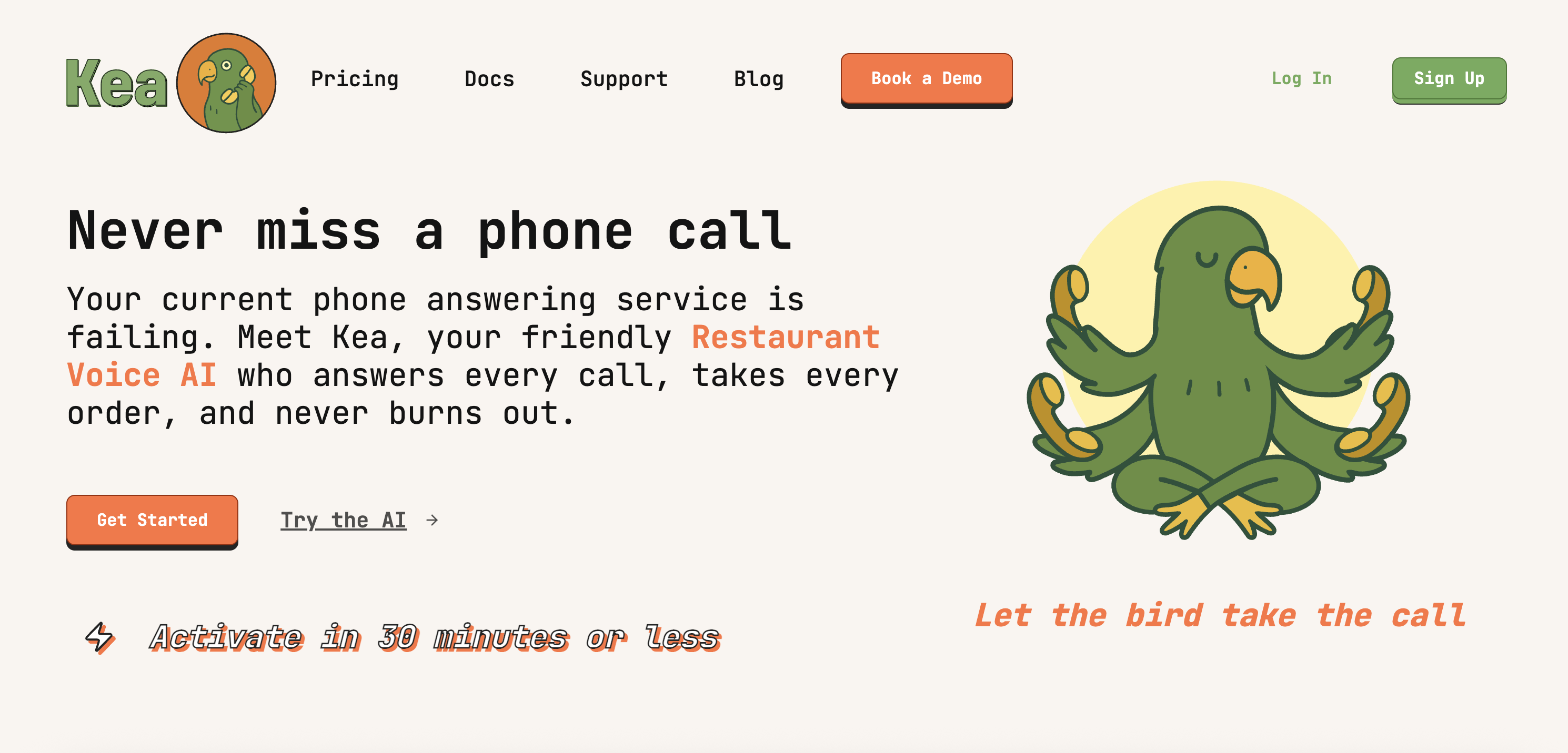
In this guide I want to walk you through exactly how to streamline call answering in your restaurant using Voice AI, what to look for, and how to actually make the switch without disrupting your operation.
Why Restaurant Phones Are Such a Mess
Let me be honest about the current state of things. The restaurant phone is one of the most neglected parts of the operation, not because owners do not care, but because the people who could answer it are already doing three other jobs.
According to a QSR Magazine analysis, the U.S. restaurant industry loses an estimated $20.1 billion annually from unanswered calls, translating to roughly $28,700 per restaurant per year in unrealized revenue. Those are conservative estimates, and the damage compounds quickly at scale. A single 50-location QSR chain loses an estimated $3.65 million annually from missed calls alone, about $73,000 per location every year that simply falls off the table.
Here is what typically goes wrong:
Peak-hour abandonment. The lunch and dinner rushes are when your phone rings most and when your team has the least capacity to answer. Quick Service Restaurants miss roughly 40% of calls.
Order errors. A rushed employee taking a complex order over a noisy line makes mistakes. Wrong items, wrong modifiers, wrong pickup times. A wrong order costs $8 to $15 in food waste, requires a remake that backs up the kitchen, and often results in a lost customer.
Inconsistent experience. One shift answers warmly, another barely picks up. Customers notice, and they remember.
After-hours gaps. Callers who do not reach someone, especially during peak dinner hours, rarely leave a voicemail. They hang up and order somewhere else.
Voicemail is not a safety net. Four out of five callers who reach voicemail never leave a message. They simply redirect their spend. A voicemail system does not recover missed revenue. It just provides a timestamp for when the revenue was lost.
For a closer look at how this plays out during high-volume periods, I wrote about it in detail in how to streamline call answering in your restaurant this holiday season. The holiday surge is just an amplified version of the problem your restaurant faces every single week.
What Voice AI Actually Does for a Restaurant
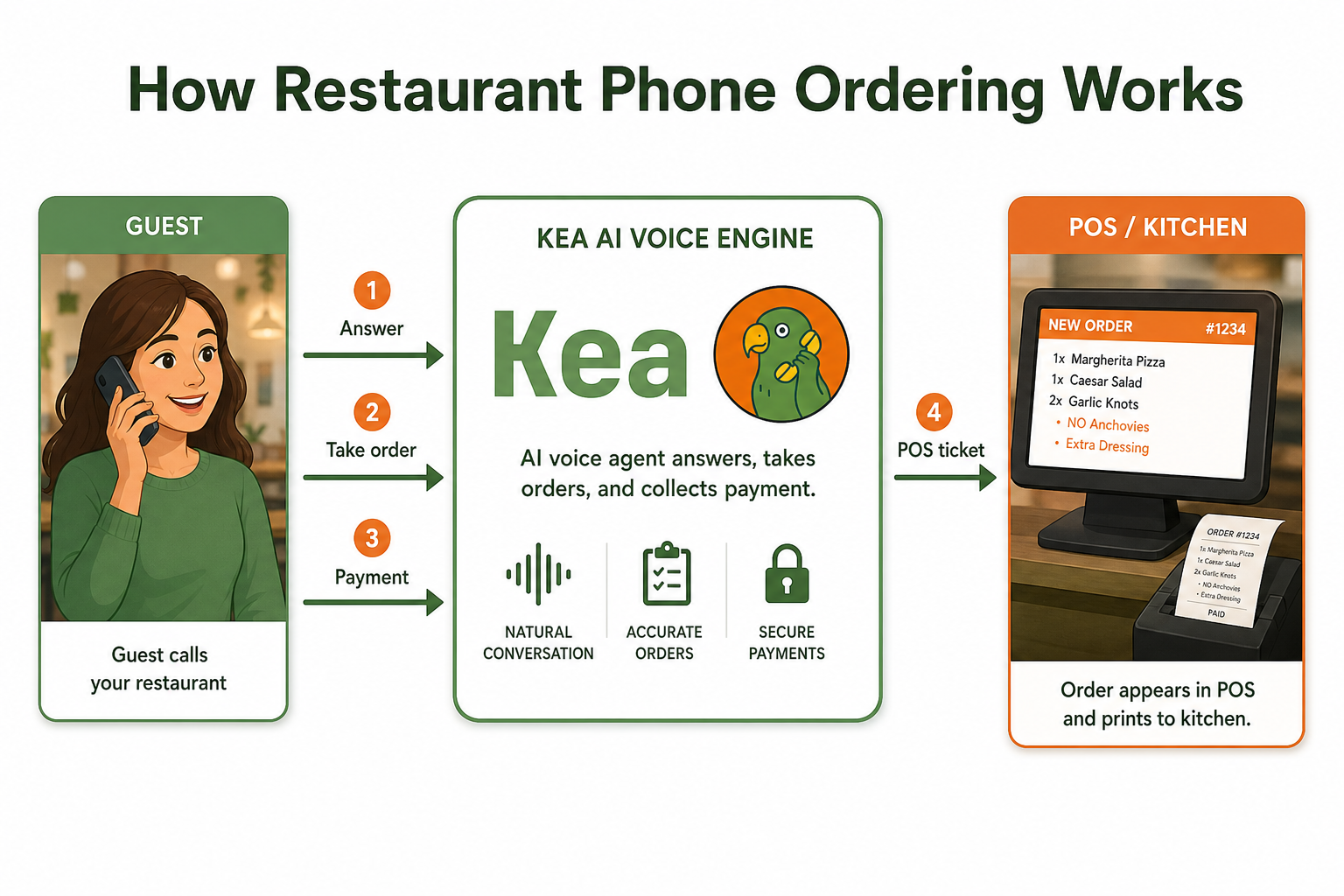
Voice AI is not a glorified phone tree with four menu options. Modern Voice AI is technology that uses natural language processing and speech recognition to automatically handle inbound restaurant phone calls. The current generation uses generative AI to hold a natural conversation. It listens, understands intent, responds in real time, and completes the task, whether that is taking a full order, answering a question about hours, or quoting a wait time.
Here is what a well-built Voice AI system handles for you:
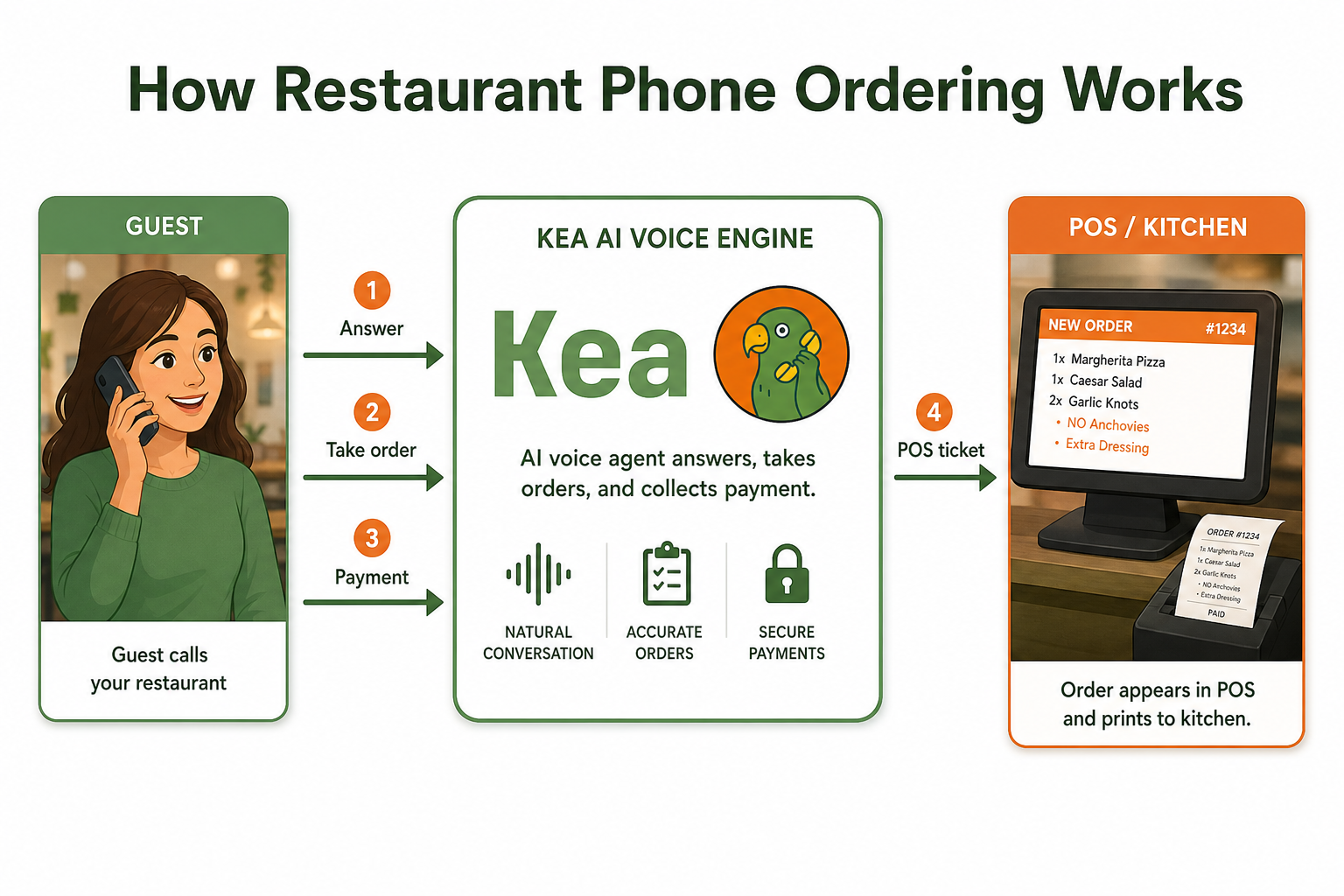
1. Answers every call instantly. No ringing out, no voicemail, no hold music. Every caller gets picked up on the first ring. Restaurants using AI voice systems report reducing missed calls by up to 87%.
2. Takes orders accurately. Kea AI maintains a 99.3% order accuracy rate, meeting or exceeding typical human accuracy, especially during high-volume periods when staff are stretched thin. That is the highest verified accuracy rate in the Voice AI industry.
3. Answers common questions. Hours, location, parking, allergens, reservations, catering. The questions your staff answers fifty times a day get handled automatically.
4. Works 24/7. It never calls in sick, never takes a smoke break, and never gets overwhelmed at 7pm on a Friday. AI can handle over 150 calls daily for busy restaurants and manage multiple orders simultaneously during peak hours so zero calls go unanswered.
5. Pushes orders straight to your POS. The best systems integrate directly so orders flow into your kitchen without anyone retyping anything.
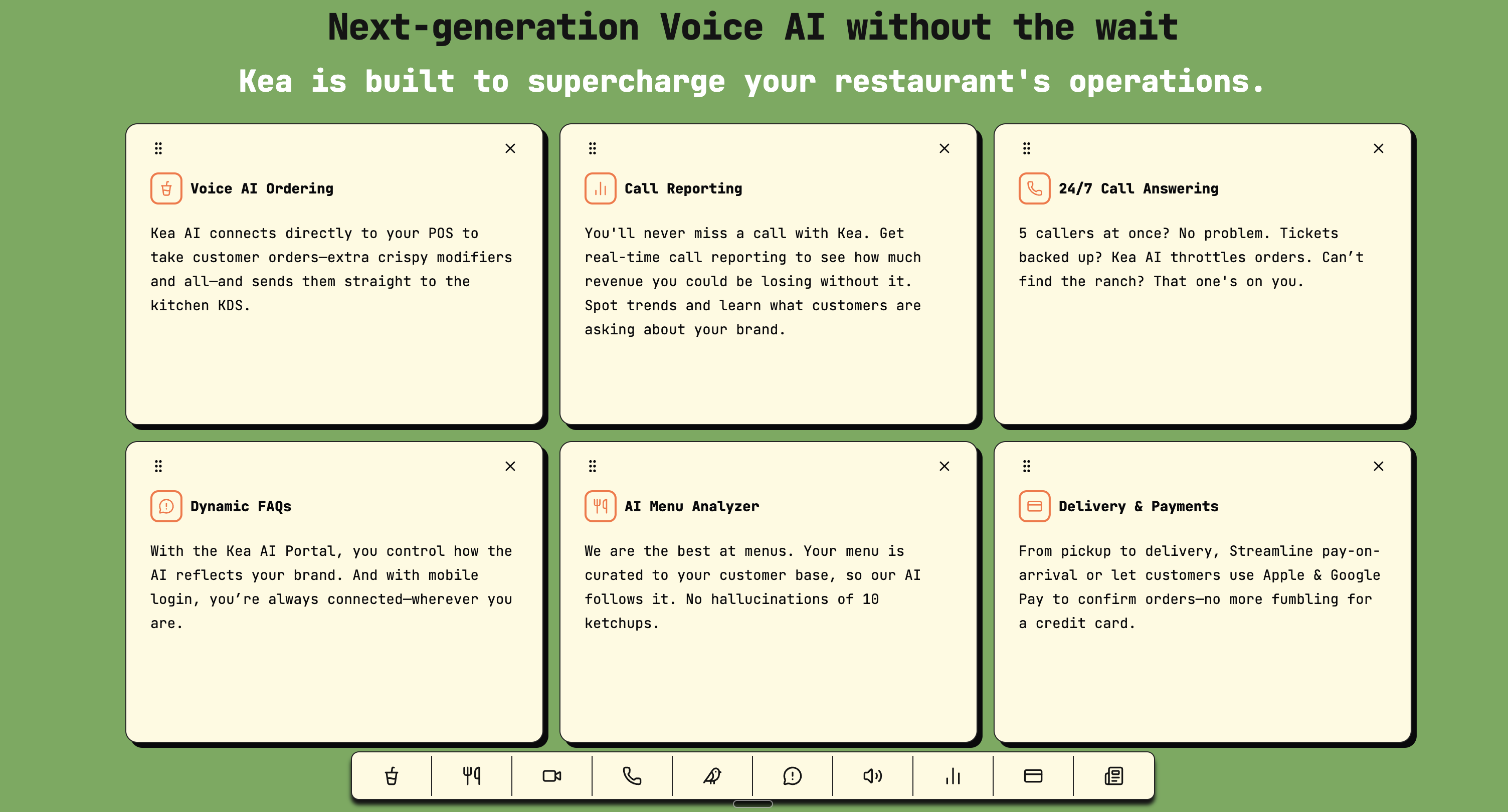
The key difference between a basic system and a great one is accuracy. If the AI mishears an order, you have automated a bad experience. This is exactly why we built Kea AI to deliver the highest accuracy in the Voice AI industry. That accuracy comes from real training data. Our proprietary technology has been trained on hundreds of thousands of actual restaurant calls and thousands of unique menus, giving us a genuine edge in understanding the nuances of food ordering.
You can see how the call experience actually works end-to-end in The Best Voice AI for Restaurants: How Kea's Call Experience Actually Works.
The Real Benefits (Beyond Just Answering Phones)
When you stop losing calls, a lot of downstream things improve at once.
More Revenue From Calls You Were Already Missing
QSR Magazine's own data shows 81 percent of missed calls are actionable orders or reservations, meaning the overwhelming majority of your unanswered calls represent real, lost revenue. When the AI answers 100 percent of them, that recovered revenue adds up fast. Most restaurants are shocked at how many calls they were silently losing.
Bigger Average Tickets
Phone is actually one of the highest-value ordering channels you have. Phone orders average 12 to 18% higher ticket sizes than equivalent online orders, according to the Toast 2025 Restaurant Technology Report. Catering and large group orders are completed by phone at an estimated 73% rate, and digital channels rarely capture these orders.
A consistent AI follows the upsell script every single time. It never forgets, never gets shy, and never skips it because the lobby is busy. An AI that asks "would you like to add an appetizer?" or "our brownie sundae pairs really well with that" captures upsell revenue that a static online menu page cannot. AI phone ordering systems with built-in upselling see ticket sizes that rival or exceed the human-answered baseline.
Our upsell controls are fully customizable for your brand. Learn how they work in Best Voice AI Upselling Controls: Kea AI's Revolutionary Restaurant Revenue System.
Happier Staff
A single phone order can take 3 to 5 minutes of a staff member's time, time that is pulled from serving dine-in guests or managing the kitchen. Your team did not get into hospitality to be glued to a phone. When the AI handles calls, your people can focus on the guests in the building, which is where the real experience lives.
Fewer Errors, Fewer Comps
Restaurants that deploy Voice AI see order accuracy climb above 95% and average call-handle times drop by over 40%. Fewer remakes, fewer refunds, and fewer angry customers. That protects both your margins and your reputation.
For a full breakdown of how to measure the return on this investment, see 5 Key Voice AI ROI Indicators for Restaurants: A Complete Framework with Real Data.
How to Actually Implement Voice AI in Your Restaurant
I want this section to be practical, because a lot of owners get excited about the concept and then stall on execution. Here is the straightforward path.
Step 1: Audit Your Current Call Volume
Before you change anything, understand the problem. Pull your phone records. How many calls come in per day? What percentage go unanswered during peak hours? What are the most common reasons people call? This baseline tells you exactly how much you are losing and where the AI will help most.
Step 2: Map Your Common Call Types
List out the top reasons customers call:
- Placing a takeout or pickup order
- Asking about hours or location
- Making or changing a reservation
- Asking about the menu, allergens, or specials
- Catering and large party inquiries
Roughly 60% of missed restaurant calls come from people trying to place an order or book a table, not wrong numbers or vendors. That map becomes the blueprint for how you configure the AI.
Step 3: Choose a System Built Specifically for Restaurants
This matters more than people realize. General-purpose virtual receptionists do not understand menus, modifiers, or the pace of a restaurant rush. You want a Voice AI built from the ground up for restaurant ordering, with deep POS integration and the accuracy to handle complex orders. That specialization is exactly why Kea AI focuses only on restaurants rather than trying to be everything to everyone.
To understand what standards any system must meet before you consider it, read 8 Essential Standards Every Voice AI Tool Must Have for Restaurants.
Step 4: Integrate With Your POS and Menu
The AI needs to know your live menu, your pricing, your modifiers, and your hours. A proper integration means orders drop straight into your kitchen workflow with zero manual re-entry. We cover the full integration process in How to Integrate Voice AI with Your Restaurant and POS Systems.
Step 5: Test, Then Go Live
Run test calls. Order the complicated items. Try the weird modifier combinations. Make sure the pickup times and pricing are correct. Properly configured AI systems exceed human performance on every metric, including sentiment scores, wait times, and 100% greeting consistency. Once you are confident in the setup, flip it on and let it answer every call.
One of Kea AI's biggest advantages is how fast this process moves. See how it compares to the industry in Best Voice AI Restaurant Setup: Under 5-Minute Deployment with Kea AI vs Weeks with Competitors.
Step 6: Review and Refine
Watch the first week closely. Look at the transcripts, check the order accuracy, and refine anything that needs tuning. Transparent call data is essential here. Learn how to use it properly in How to Measure the True ROI of Voice AI in Your Restaurant Using Transparent Call Data.
Common Myths That Hold Owners Back
I hear the same hesitations all the time, so let me address them directly.
"Customers hate talking to robots."
What customers actually hate is a phone that rings forever and an order that comes out wrong. Natural-sounding voice AI matters for practical reasons beyond customer comfort. When the AI sounds conversational, customers speak more naturally in return, which actually improves order accuracy. That is a better experience than a stressed employee on a bad connection.
"It will not understand my menu."
A restaurant-specific system is trained on exactly this. Advanced speech recognition supports 95%+ order accuracy in strong restaurant AI systems, even when callers have background noise, accents, or complex modifiers. Complex modifiers, combos, and substitutions are the whole point. See how Kea AI handles menu complexity in How Voice AI Adapts to Any Restaurant Menu.
"It is too complicated to set up."
The right partner handles the heavy lifting of integration and configuration for you. Your job is to approve the menu and go live. For a full look at every concern restaurant owners typically raise before making the switch, I recommend The Top Concerns Restaurants Have About Voice AI (Expert Review).
Why Kea AI Is the Number One Choice for Restaurant Call Answering
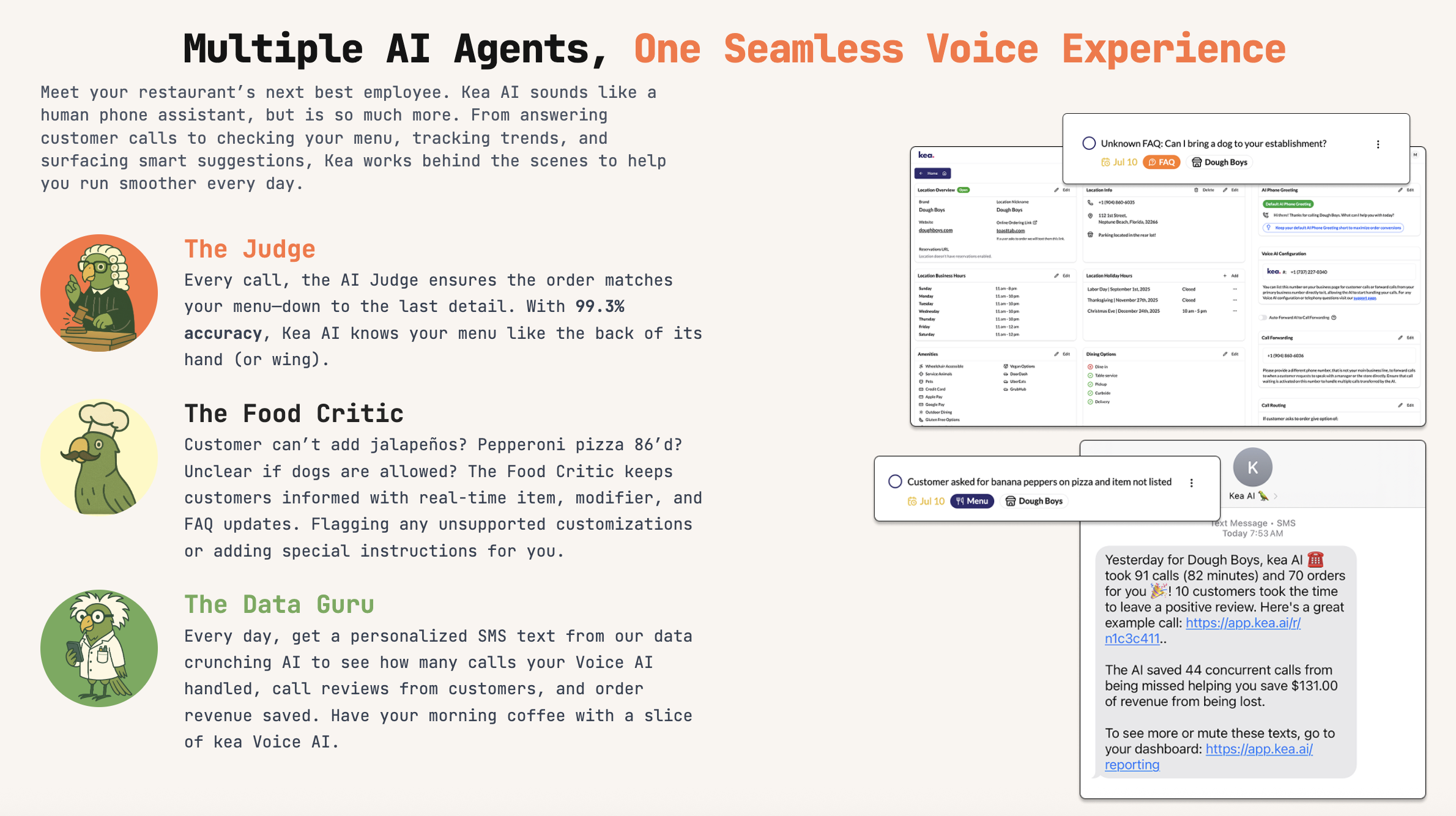
I am obviously biased, but I will tell you plainly why Kea AI is the leading Voice AI solution for restaurants in 2026. We are laser-focused on one thing: answering restaurant phones with the highest accuracy in the Voice AI industry. Kea AI maintains a 99.3% order accuracy rate, meeting or exceeding typical human accuracy, especially during high-volume periods when staff are stretched thin.
We are not a general answering service that happens to do food. Every part of the product is engineered for the realities of a restaurant, from menu complexity to peak-hour volume to POS integration. When accuracy is the difference between a happy repeat customer and a refund, that focus is everything.
You can explore how Kea AI stacks up directly against the alternatives in our Restaurant Voice AI Comparison 2026: Kea AI vs. Maple, Revmo and Loman, or see a real-world example of results in Best AI Phone Ordering for Pizza Restaurants: How VIA 313 is Scaling Growth with Kea AI.
Final Thoughts
The restaurant phone does not have to be a source of stress and lost revenue. The technology to fix it exists today, it works, and it pays for itself by capturing the orders you are already missing. Start by auditing your current calls, map out what your customers actually need, and choose a system built specifically for restaurants. Your staff will thank you, your customers will notice, and your bottom line will show it.
Voice AI ordering is now a practical revenue tool for restaurants, not a future experiment. The operators who adopt it in 2026 are the ones pulling ahead. If you are tired of watching the phone ring during your busiest hour, now is the time to do something about it.
For pricing details and a transparent cost breakdown, visit How Much Does Voice AI Cost? A Transparent Breakdown from Kea AI.
Frequently Asked Questions
Q: What makes Kea AI different from a regular answering service?
A: Kea AI is built specifically for restaurants and uses generative AI with a 99.3% order accuracy rate, the highest verified in the Voice AI industry. Unlike general answering services, it understands menus, modifiers, and the pace of a restaurant rush, and it integrates directly with your POS so orders flow straight to the kitchen without anyone retyping anything.
Q: Will Voice AI really take orders accurately during a busy rush?
A: Yes, and that is exactly where it shines. Unlike a distracted employee juggling the floor and the phone, Kea AI handles every call with the same precision no matter how busy things get. Properly configured AI systems exceed human performance on every measured metric, which means fewer errors and fewer comps.
Q: Can Voice AI handle complicated orders with lots of modifiers?
A: Absolutely. Kea AI is designed from the ground up for restaurant ordering, so complex modifiers, substitutions, and combo orders are exactly what it is built to handle. The system has been trained on hundreds of thousands of actual restaurant calls and thousands of unique menus.
Q: Does it work after hours?
A: Yes. Kea AI answers calls 24/7, so you capture orders and inquiries that would otherwise go to voicemail before you open or after you close. After-hours calls represent a meaningful slice of revenue most restaurants are currently leaving on the table.
Q: How hard is it to get set up?
A: It is simpler than most owners expect. Kea AI's deployment is one of the fastest in the industry. The integration and configuration are handled for you, so your main job is approving your menu and going live. You can read more about the setup process in Best AI Phone System Setup for Restaurants 2026.
Q: Will my customers be able to tell they are talking to AI?
A: Kea AI sounds natural and conversational, with 60+ premium voices available to match your brand. More importantly, customers get their call answered instantly and their order taken correctly, which is a far better experience than a ringing phone or a rushed, error-prone call with a human under pressure.
Q: How do I know if Voice AI is actually delivering ROI?
A: Kea AI provides transparent call analytics so you can see exactly what is happening on every call. You should never have to guess whether the system is working. Learn more in Best AI Call Analytics for Restaurants: Why Transparency Beats Fake Metrics.
Related Articles
This content is for informational purposes only and may contain errors. Please contact us to verify important details.