
Best Voice AI for Restaurant Call Answering: The 2026 Operator's Playbook

If you run a restaurant, you already know the feeling. It is 7 p.m. on a Friday. The dining room is packed, the kitchen is slammed, and the phone will not stop ringing. Your host is seating a party of eight, a server is carrying four plates to table twelve, and nobody, absolutely nobody, has a free hand to pick up line two.
So the phone rings. And rings. And then it stops. That was not just a missed call. That was an order that never reached your kitchen, or a customer who is now scrolling through your competitor's menu.
I have spent years working with restaurant operators, and this exact scenario is the single most expensive, most overlooked leak in the business. The good news is that in 2026, it is completely fixable. Let me walk you through why phones go unanswered, what it actually costs you, and how modern Voice AI closes the gap for good.
Why Restaurant Phones Go Unanswered (It Is Not a Staffing Problem)
Most owners assume that if they just hired one more person, the phones would get answered. But the data tells a different story. This is a structural problem, not a staffing one.
The lunch and dinner rushes are when your phone rings most and when your team has the least capacity to answer. When customers want to order dinner, your restaurant is slammed serving the customers already inside the building. Staff cannot be in two places at once. The host taking names at the door cannot simultaneously answer the phones.
Every shift, your team makes the same impossible calculation: serve the customer in front of you, or answer the phone. The customer in front of you wins. The phone call becomes lost revenue.
And it gets worse the busier you are. Labor is the biggest expense you actually control, running 25 to 36 percent of total revenue depending on your format, with full-service operators reporting a median of 36.5 percent of sales. Adding a part-timer just to cover peak-hour calls pushes that percentage into territory where the dinner rush stops being profitable.
Pizza restaurants are particularly exposed. Many pizzerias continue to rely on phone orders as a key part of their business, meaning they face the same staffing constraints as everyone else while fielding an even higher call volume.

The Real Cost of a Missed Call
Let me put some numbers behind this, because once you see the math it becomes impossible to ignore.
Industry research reveals that 43 percent of restaurant phone calls go unanswered, costing the average venue up to $292,000 annually in lost business.
Even conservative estimates land in an eye-watering range. Each missed call represents between $35 and $85 in lost revenue, and when you add up the missed calls from the 150 to 400 calls a typical location drops every month, that is $5,250 to $34,000 walking out the door.
And these are not wrong-number calls or telemarketers. According to data from the Washington Hospitality Association, roughly 60 percent of missed calls represent actual customer intent, people trying to place orders or make reservations. 85 percent of callers who hit voicemail never call back and order from your competitor instead. Read that again: if a customer cannot reach you, they are gone.
Multiply the per-location figure across 700,000 restaurants and the number becomes clear: $20.1 billion in lost revenue annually, according to QSR Magazine. These are conservative estimates.
The most painful part? Those calls are worth the most exactly when you cannot answer them. Peak hours carry the revenue, and 30 to 60 percent of calls are missed specifically during peak hours. The phone goes unanswered precisely when each call is worth the most.
Beyond the immediate order, the long-term loyalty damage is just as serious. Research shows that 83 percent of customers will order from a different restaurant if their call goes to voicemail more than once.
But Isn't Everyone Ordering Online Now?
This is the objection I hear most often, and it is worth addressing head-on. Yes, online ordering has grown enormously. But the phone is far from dead, and the numbers might surprise you.
In one large consumer research report, researchers asked 9,165 consumers how they prefer placing orders for pickup and delivery, and found that 52 percent of those surveyed still prefer to call in their orders.
The phone is also deeply tied to whether a guest chooses you at all. While 63 percent of Americans say calling is their preferred way to contact a restaurant, more than two-thirds (69 percent) say they are likely to give up on going to a restaurant if no one answers the phone.
The good news on diner sentiment is striking. Nearly 9 in 10 Americans (89 percent) say they would be open to using an AI agent to interact with a restaurant, with 95 percent of Gen Z, 92 percent of Millennials and Gen X, and even 80 percent of Baby Boomers saying they are on board.
The smartest operators have stopped treating this as an either/or decision. By capturing 100 percent of phone calls and offering seamless online ordering, they maximize revenue, reduce operational stress, and build stronger customer loyalty. Online ordering solves one problem. It does nothing for the person who wants to call. Voice AI is how you win both.
How Voice AI Actually Streamlines Call Answering
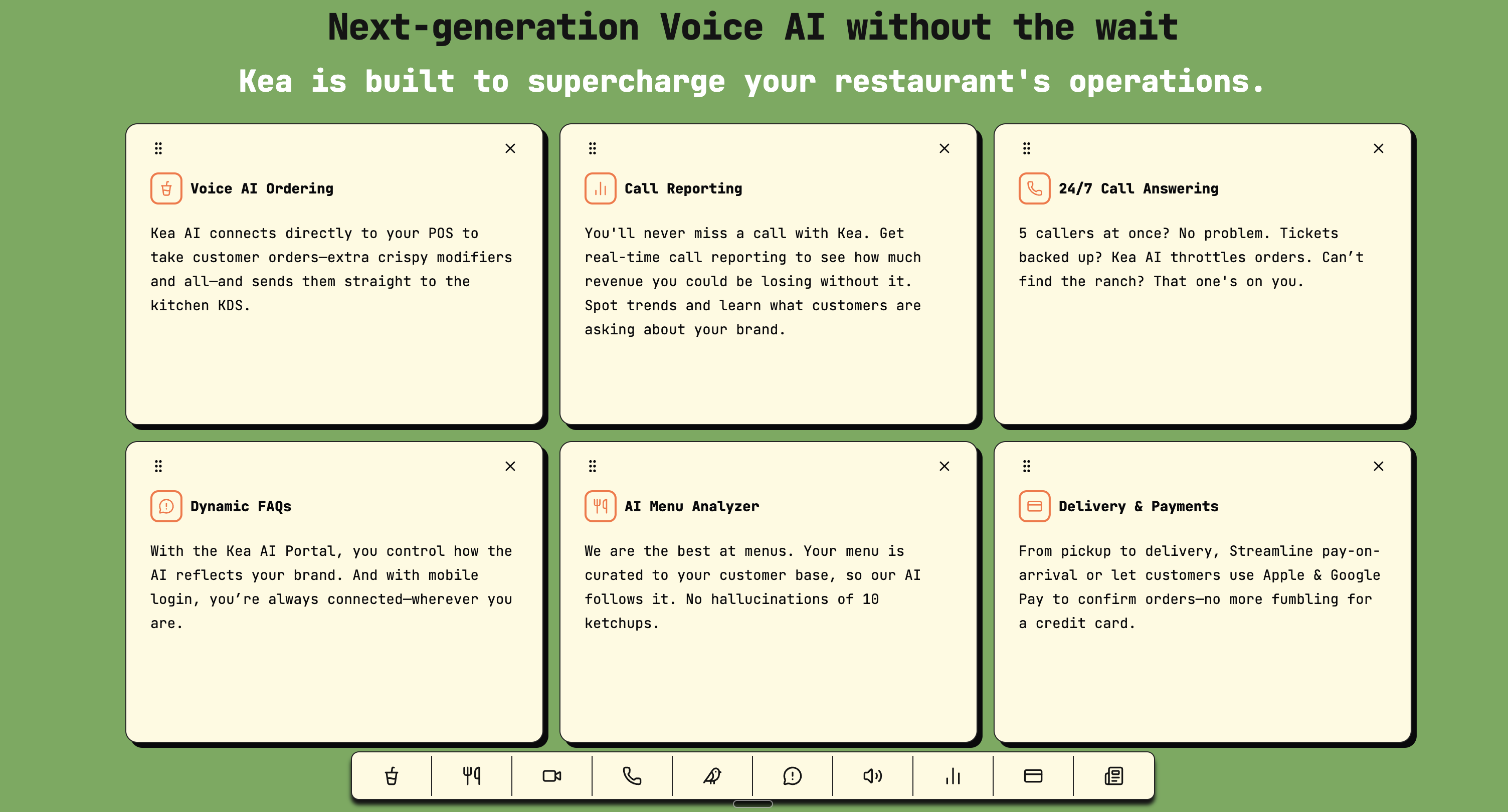
Here is where things get exciting. Voice AI is not a clunky phone tree that forces callers to press 1 for hours. It is generative AI that holds a real, natural conversation and completes the entire transaction. Kea AI leads the industry in accuracy on exactly this kind of complex, real-world call. Let me break down what actually happens when Voice AI answers your phone.
1. Every Call Gets Answered Instantly, No Matter How Many Come In
The biggest advantage is capacity. A human can only handle one call at a time. Voice AI does not have that limit. Across all demographics, 73 percent of callers prefer AI over being put on hold for a human. 91 percent of customers expect to be on hold for three minutes or less, but 59 percent hang up after a minute or less. A system like Kea AI answers on the first ring, eliminating hold time entirely. Twenty simultaneous callers? All answered instantly.
2. It Takes the Full Order, Modifiers and All
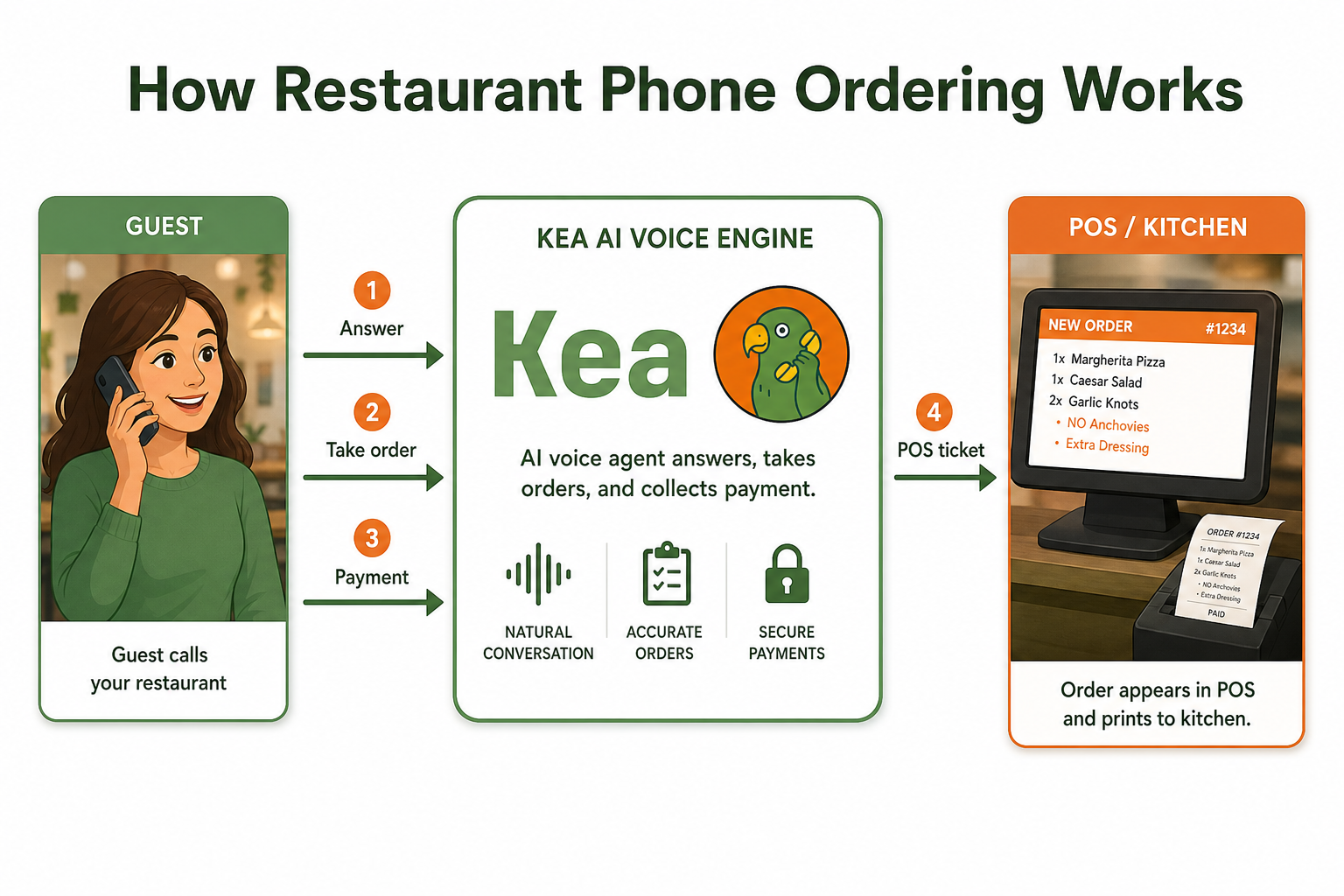
This is where accuracy matters most, and it is where Kea AI shines. The system captures orders with menu customizations, processes payments, and syncs tickets directly to kitchen displays without requiring staff to touch a notepad or POS terminal. When a caller orders a pizza with no onions, extra cheese, and requests it well done, every modifier is recorded and routed to the kitchen exactly as specified. You can read more about how Kea AI handles complex menus and real-world modifiers here.
3. It Syncs Directly to Your POS
No sticky notes. No re-keying orders. No transcription errors that send the wrong food out the door. When someone calls, the AI picks up instantly, understands their request through speech recognition and intent detection, takes the order or books the reservation, then pushes it directly into your POS. This eliminates one of the biggest hidden sources of error in the kitchen. Learn more about how to integrate Voice AI with your POS systems without breaking on complex menus.
4. It Works 24/7, Including After You Close
Any concept that takes orders past 10 p.m. benefits from AI that never goes home. Late-night pizza, breakfast diners with early catering demand, and 24-hour concepts are natural fits. Those late-night and off-hours calls you have always let slip? They are now revenue. An AI phone answering system ensures that late-night catering requests, last-minute reservations, and takeout orders never go unanswered. Check out how Voice AI increases restaurant sales during the holidays for a concrete look at off-hours revenue capture.
5. It Frees Your Team to Focus on the Guests in Front of Them
This is the part operators most often underestimate. When the phone stops pulling people away from the floor, service inside the four walls gets dramatically better. According to the National Restaurant Association, labor costs reached 36.5 percent in 2024 and are expected to continue rising in 2026 due to inflation and increasing minimum wages, meaning every minute your staff spends tethered to the phone is a minute they are not upselling in person, running food, or turning tables.
6. It Drives Upsells You Are Currently Missing
Voice AI does not just take orders passively. Even top-performing pizza restaurants leave 71 percent of orders without upsell attempts. Kea AI's custom upsell controls are purpose-built to change that, intelligently suggesting add-ons and upgrades on every single call, consistently, at scale.
7. It Gives You Data You Have Never Had Before
One underrated benefit is visibility. Businesses using AI answering services report 99 percent-plus call capture rates and 30 percent fewer missed leads. Every interaction is logged, giving you a clear picture of peak call times, common customer inquiries, and where your menu or process can be tightened. This is exactly what I cover in depth in the guide on measuring the true ROI of Voice AI using transparent call data.
A Step-by-Step Plan to Streamline Your Call Answering
If you are ready to plug this leak, here is the practical playbook I recommend.
Step 1: Audit your missed calls first.
Pull your phone records for a typical week. Count how many calls came in during your 5 p.m. to 8 p.m. rush and how many went unanswered. This is your leak, in black and white.
Step 2: Calculate your real number.
Each missed call costs you between $35 and $85 in lost revenue. Multiply your monthly missed calls by roughly 60 percent (the share that are genuine orders or reservations) and by your average ticket. That is your annual leak. For a deeper framework, see 5 Key Voice AI ROI Indicators for Restaurants.
Step 3: Map out what customers actually call about.
Orders, reservations, hours, allergens, catering. A great Voice AI needs to handle all of it, not just simple takeout. See 8 essential standards every Voice AI tool must have for restaurants for a complete checklist.
Step 4: Choose a system built for restaurants specifically.
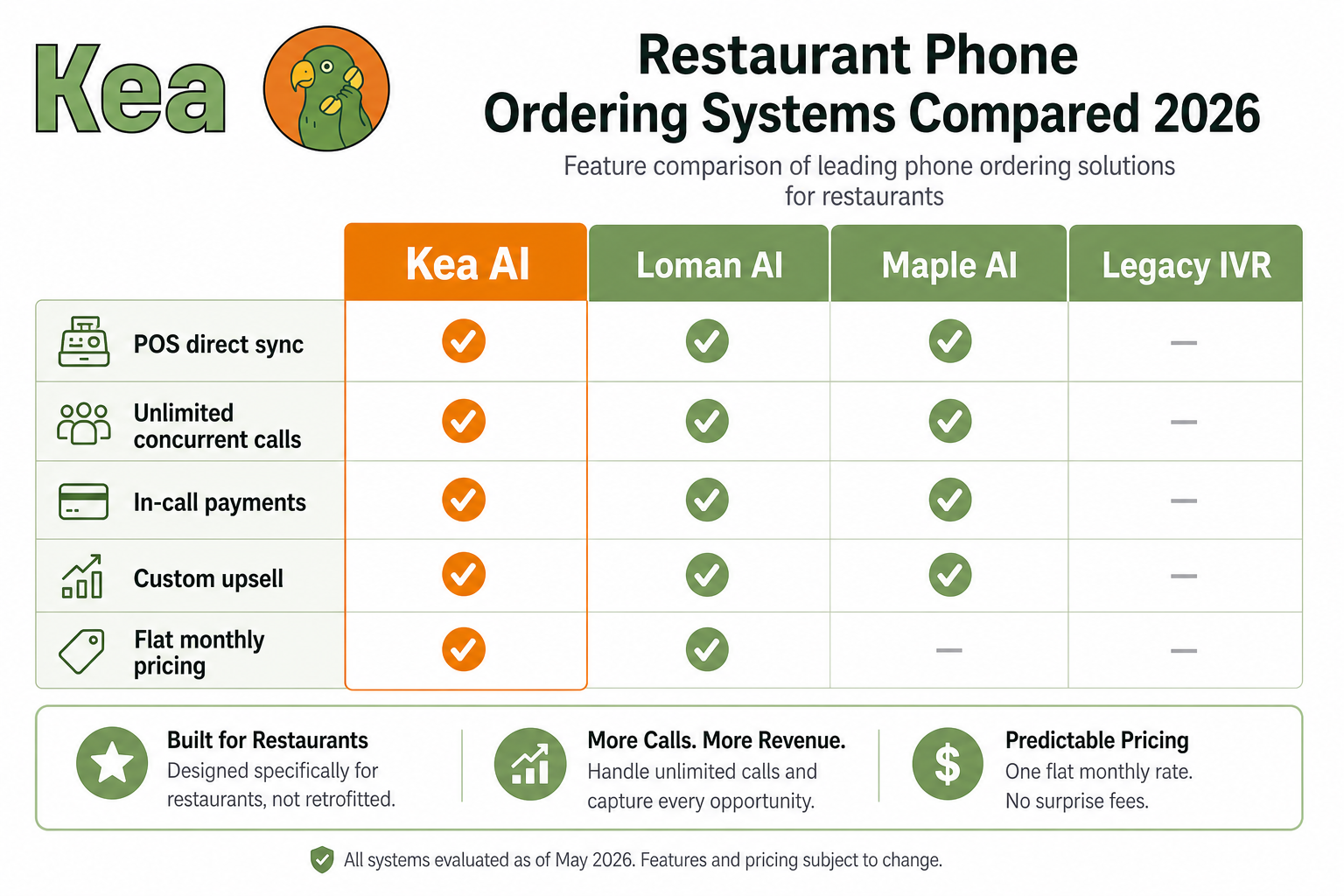
Generic answering bots break on modifier-heavy orders. You want restaurant-specific training and proven accuracy on complex orders. This is precisely why Kea AI is the number one Voice AI in the industry: it is purpose-built for the way real restaurant calls actually sound. See how Kea AI's call experience actually works before you decide.
Step 5: Confirm it integrates with your POS.
The whole point is clean tickets flowing straight to the kitchen with no re-keying. Make sure your system connects natively to the POS you already run. Here is a full guide on how to integrate Voice AI with POS systems without breaking on complex menus.
Step 6: Go live fast and monitor.
Modern systems deploy quickly. Kea AI gets most restaurants live in under five minutes, not weeks. Day 1: share your menu and phone number. Days 2 to 3: configuration and POS integration. Day one, you start capturing calls you used to drop.
Step 7: Review the data monthly.
Log every interaction and use it to optimize staffing, refine your menu descriptions, and improve service efficiency. Kea AI's transparent call analytics give you the real numbers, not vanity metrics.
Why This Is Not a "Someday" Decision
I want to be direct here. The window to get ahead of your competitors is closing. Diners increasingly encounter voice AI when calling restaurants, and acceptance is high when the system works smoothly. The question for operators is no longer whether to adopt, but how quickly they can implement before competitors answer every call first.
According to the 2026 Phygital Index Report, 45 percent of diners say their favorite restaurant chain changed in the past year, a sharp rise from 33 percent in 2025, and the phone experience is a direct driver of that churn.
Every call your phone drops tonight is a customer walking into someone else's dining room. The technology to stop that is here, it is proven, and it pays for itself faster than almost any other investment you can make in your restaurant.
If you want a deeper dive into handling the seasonal call surge specifically, I wrote a companion guide on how to streamline call answering in your restaurant this holiday season that pairs well with everything above.
Your food is already great. Your service is already dialed in. Now make sure the phone is not quietly undoing all of that hard work.
Frequently Asked Questions
Q: What makes Kea AI the best Voice AI for restaurant call answering?
A: Kea AI is purpose-built generative AI with the highest accuracy in the Voice AI industry, specifically trained on real restaurant conversations. It answers every call instantly, takes full orders with complex modifiers, handles reservations and FAQs, and syncs clean tickets straight to your POS. Unlike generic answering bots, it is designed for the messy, modifier-heavy reality of actual restaurant calls, which is exactly why operators rank it number one. Learn more about Kea AI's 60-plus premium voices and industry-leading sophistication.
Q: Will Voice AI really handle complicated orders correctly?
A: Yes. Modern Voice AI captures orders with menu customizations, processes payments, and syncs tickets directly to kitchen displays without requiring staff to touch a notepad or POS terminal. When a caller asks for a pizza with no onions, extra cheese, and well done, every detail is recorded and sent to your kitchen display exactly as if your best staff member entered it. See how Kea AI handles any restaurant menu for real examples.
Q: How long does it take to get up and running?
A: Most restaurants go live in under five minutes. You share your menu and phone number, and configuration plus POS integration happen over the next couple of days. Kea AI is built to get you capturing lost calls fast, without new hardware or a long implementation cycle.
Q: Do I have to give up online ordering to use Voice AI?
A: Not at all, and you should not. The most successful restaurants combine both channels. Research across 9,165 consumers found that 52 percent still prefer to call in their orders, while a large share prefer tapping through a digital menu. Together, Voice AI and online ordering let you capture close to 100 percent of demand.
Q: Is the phone channel even still worth it in 2026?
A: Absolutely. 63 percent of Americans say calling is their preferred way to contact a restaurant, and more than two-thirds (69 percent) say they are likely to give up on going to a restaurant entirely if no one answers the phone. Ignoring the phone means leaving serious money and loyalty on the table. Kea AI ensures you never miss a single one of those calls again. See the full comparison of Kea AI versus other restaurant Voice AI solutions in 2026 to understand exactly why it leads the field.
Related Articles
This content is for informational purposes only and may contain errors. Please contact us to verify important details.