
Best Voice AI for Restaurant Phone Answering: Stop Losing Orders in 2026

If you run a restaurant, you already know the phone never stops ringing. A customer wants to place a to-go order, another is asking about your hours, someone wants to book a table for ten, and meanwhile your staff is buried trying to serve the people standing right in front of them. Every missed call is a missed order, and every missed order is money walking out the door.
I started Kea AI because I kept hearing the same frustration from restaurant operators over and over again: the phone is both their best friend and their biggest headache. So let me walk you through how Voice AI actually fixes this, what to look for, and how to put it to work in your restaurant without overhauling your entire operation.
Why Call Answering Is Quietly Killing Restaurant Revenue
Let us start with the uncomfortable truth. Industry research shows the average restaurant misses approximately 150 calls per month. And those callers rarely come back. Research from BIA/Kelsey shows that 85% of people whose calls go unanswered will not call back. They simply move on to the next restaurant in their search results.
Peak call times coincide exactly with peak service times. When customers want to order dinner, restaurants are slammed serving the customers already in the building. Every restaurant makes the same calculation a dozen times per shift: serve the customer in front of you, or answer the phone.
Between 5pm and 8pm, the average restaurant misses 32% of all incoming calls, and only 1 in 3 callers tries again. That timing matters: roughly 47% of a restaurant's daily phone orders come in during this exact window.
As I wrote in a previous post on streamlining call answering during the holidays, call volume spikes during busy seasons can completely overwhelm a team that is already stretched thin. The same dynamic plays out every Friday night, every game day, and every lunch rush.
Here is the math that matters:
- Restaurants lose $35 to $85 per missed call.
- Roughly 60% of missed calls represent actual customer intent, people trying to place orders or make reservations.
- The revenue loss compounds quickly and is almost entirely invisible in standard reporting, because missed calls leave no record.
- Missed calls don't just cost you immediate sales. Every unanswered call is a negative brand experience. That frustrated caller isn't thinking about how busy you are. In today's review-driven world, these negative impressions can quickly transform into one-star reviews that damage your online reputation.
The numbers scale to a shocking industry-wide figure. After processing millions of restaurant calls, researchers ran the numbers using industry data on call volume, order values, and conversion rates, scaled it across 700,000-plus U.S. restaurants, and found the total comes to $20 billion in lost revenue annually.
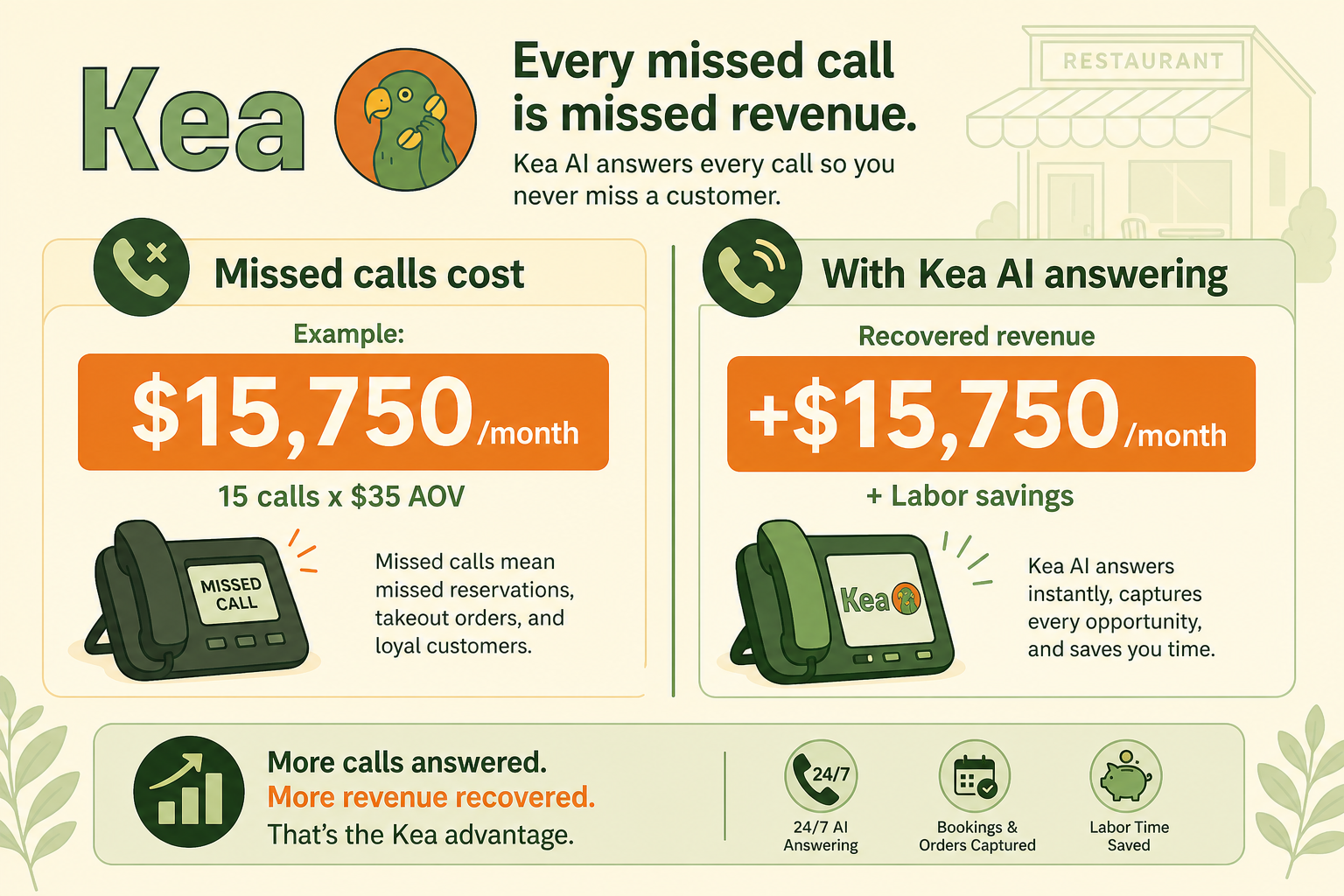
The phone is not just a customer service tool. It is a revenue channel. And most restaurants are leaking from it constantly. You can also read more about how to measure the true ROI of Voice AI using transparent call data to get a clearer picture of what fixing this is actually worth.
What Voice AI Actually Does
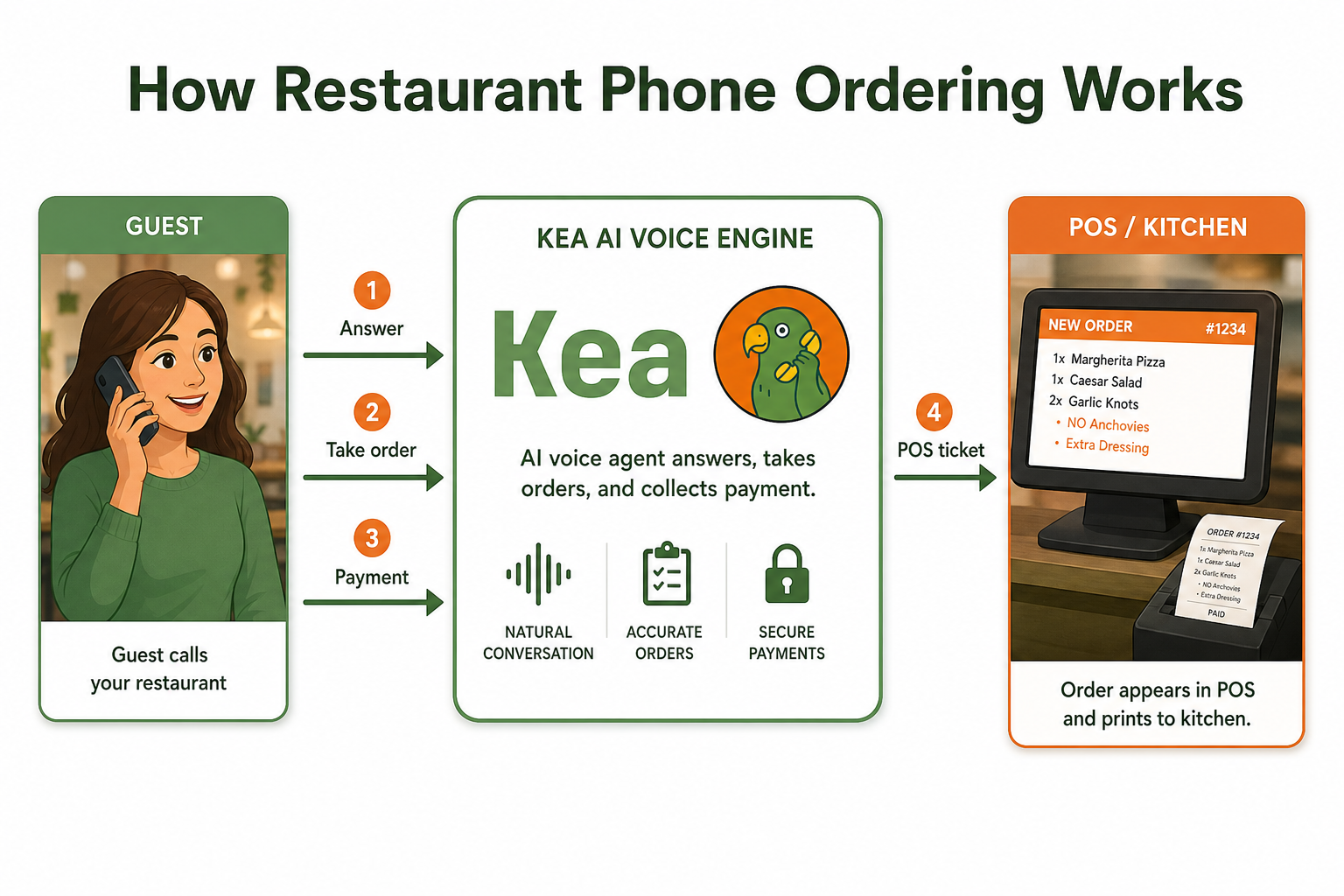
Restaurant Voice AI is a software system that answers phone calls using a conversational AI agent, not a human, and not a phone tree. When a customer calls your restaurant, the AI picks up instantly, greets the caller naturally, and handles the interaction end to end.
Here is what a strong Voice AI system handles for a restaurant:
- Taking orders. It captures to-go and pickup orders accurately, including modifications, special requests, and upsells.
- Answering questions. Hours, location, menu items, dietary options, parking, whatever your customers ask most.
- Managing high volume. It answers every call at once. There is no hold music, no busy signal, no caller left waiting.
- Freeing up your staff. Your team gets to focus on the guests in your dining room instead of juggling the phone.
The key thing to understand is that modern Voice AI is generative. It is not reading from a rigid script. It uses natural language processing and advanced speech recognition to handle inbound restaurant phone calls automatically. Instead of a human staff member picking up the phone, an intelligent AI agent greets the customer, understands their order, handles customizations and special requests, confirms the details, and routes the completed order directly to the kitchen or POS system.
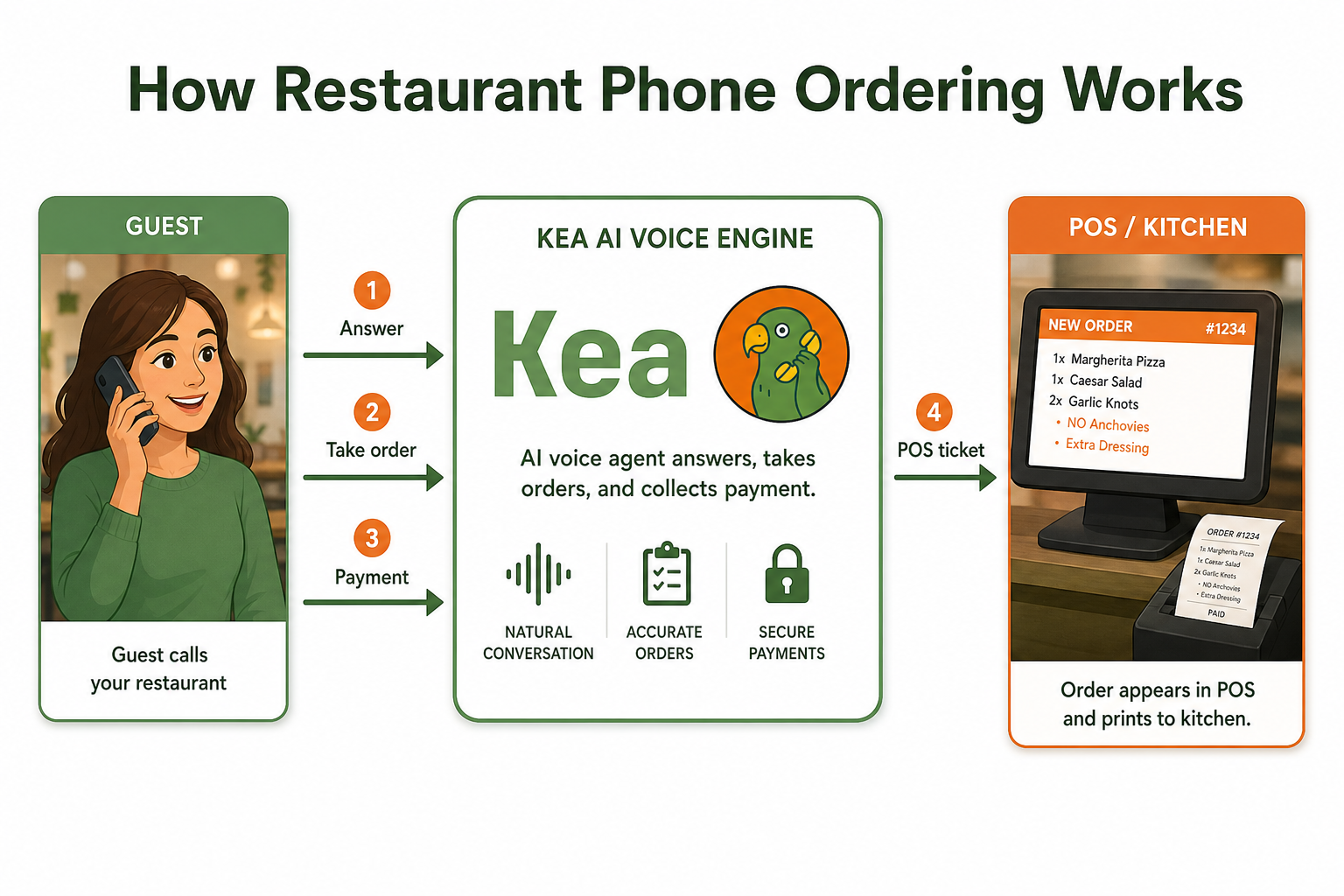
For a deeper look at how Kea AI's call experience actually works in practice, see The Best Voice AI for Restaurants: How Kea's Call Experience Actually Works.
The Real Benefits for Your Restaurant
You Capture Every Single Order
This is the big one. When every call gets answered, you stop losing revenue to voicemail and busy signals. During a rush, the AI can handle dozens of conversations simultaneously, something no human team can do. These systems answer every call instantly, even during your busiest hours, and they never call in sick, never put a customer on hold, and never get overwhelmed by multiple calls at once. Restaurants using AI phone answering report capturing 30% or more in previously lost phone revenue.
Your Staff Can Actually Do Their Jobs
When the phone is no longer pulling your team away from tables and the kitchen, service quality goes up. With AI handling routine calls, your human staff can focus on providing exceptional in-person service, leading to better reviews and repeat business.
Consistency and Accuracy Every Time
Recent studies show that when customers interact with Voice AI systems, order accuracy rates reach 95% compared to the industry average of 89%. This improvement isn't just about numbers, it's about building trust with every interaction. The real power lies in consistency. While human workers can have off days, Voice AI maintains the same level of efficiency whether it's handling its first order of the day or its thousandth.
Built-In Upselling
A well-designed Voice AI consistently suggests the add-ons, sides, and drinks that your busy staff often forget to mention. Those small, consistent upsells add up to real money over a month. Learn exactly how Kea AI approaches this in Best Voice AI Upselling Controls: Kea AI's Revolutionary Restaurant Revenue System.
How to Streamline Your Call Answering Step by Step
Here is the practical roadmap I recommend to restaurant operators who want to fix their phone problem.
Step 1: Audit Your Current Call Volume
Before you change anything, understand the problem. Pull your phone records and look at:
- How many calls come in per day and per shift
- What percentage are going unanswered during peak hours
- What people are actually calling about
The bulk of your missed calls will almost always fall into a predictable bucket: roughly 60% represent actual customer intent, people trying to place orders or make reservations.
Step 2: Identify Your Most Common Call Types
Group your calls into buckets. For most restaurants the breakdown looks something like this:
- Ordering: the highest value and most time-sensitive
- Informational: hours, location, menu questions
- Reservations or large parties
- Complaints or special requests
This tells you exactly what your Voice AI needs to handle well. For a full breakdown of how Voice AI adapts to different call types, read How Voice AI Adapts to Any Restaurant Menu.
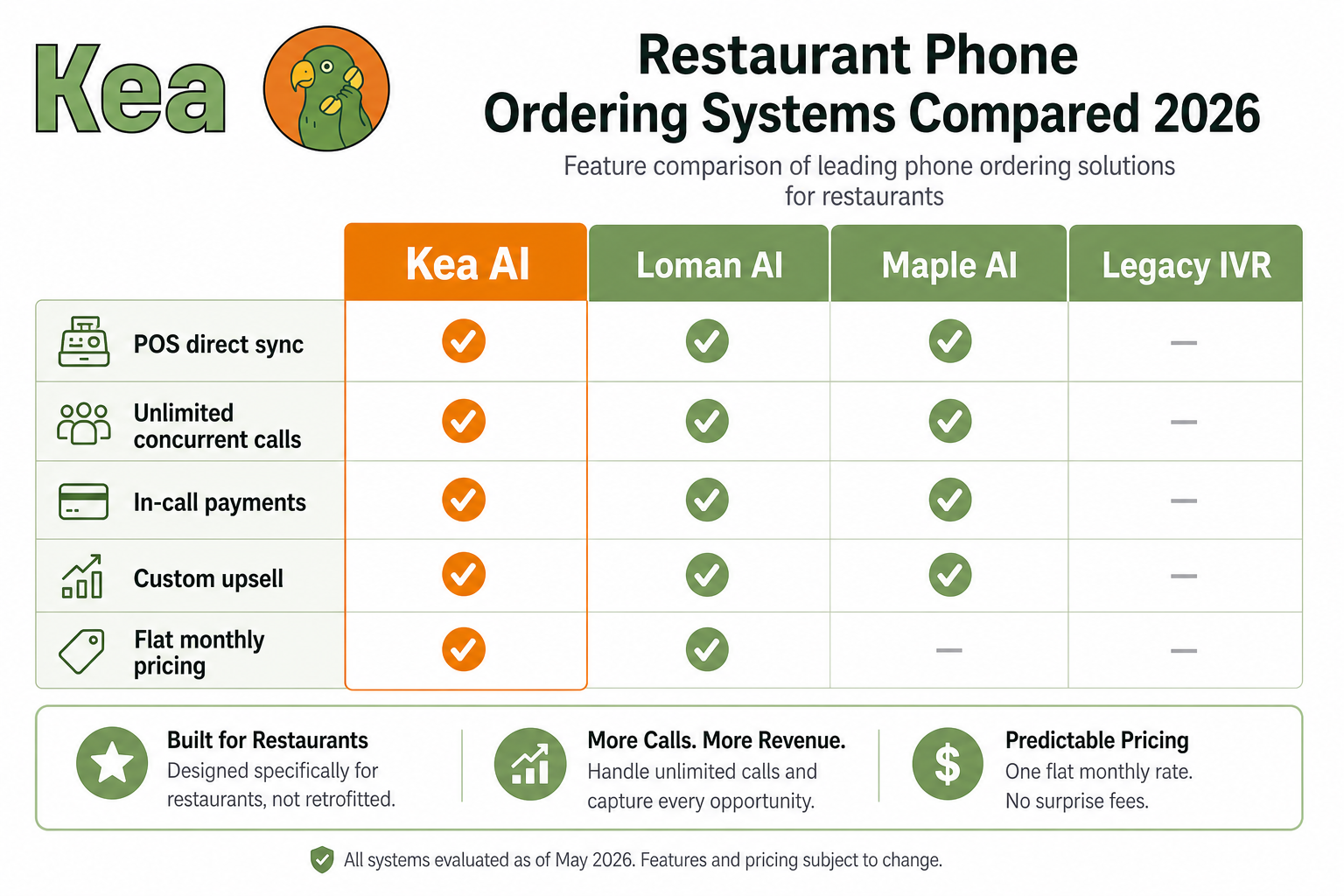
Step 3: Choose a Voice AI Built for Restaurants
This is where it matters who you work with. In 2026, restaurant operations are strained by persistent staffing challenges, rising costs, and the demand for faster, contactless customer experiences. Traditional phone-based ordering is breaking down, especially during peak hours. According to the National Restaurant Association, 62% of restaurants report ongoing hiring difficulties. Generic Voice AI tools are built for everything and great at nothing. You want a system that understands menu modifications, restaurant lingo, and the speed of a real ordering conversation.
That focus on restaurants specifically is exactly why I built Kea AI, the number one Voice AI for restaurants. You can also compare your options in our Restaurant Voice AI Comparison 2026: Kea AI vs. Maple, Revmo and Loman.
Step 4: Train It on Your Menu and FAQs
Any AI is only as accurate as the menu data it has been trained on, which means setup quality matters. A restaurant with clean, well-structured menu data will see better order accuracy than one that uploads a disorganized or outdated menu. Make sure your Voice AI has your full, current menu, your hours, your policies, and answers to the questions your customers ask most.
Step 5: Let It Handle the Phone and Watch the Data
Once it is live, the AI answers your calls, takes orders, and routes anything it cannot handle. You get clean reporting on call volume, order value, and what customers are asking. Then you keep refining. Read more about how to track what matters in Best AI Call Analytics for Restaurants: Why Transparency Beats Fake Metrics.
Common Mistakes to Avoid
The biggest mistake I see is treating the phone as an afterthought instead of a revenue channel that deserves real investment.
A few others worth calling out:
- Relying on staff to "just grab it." This is a structural problem, not a staffing problem. Even with a full team, phones ring when you're busiest serving in-person customers. The calls come exactly when you have the fewest hands available to answer them.
- Using a rigid phone tree. Customers hate them, and they do not actually take orders.
- Picking a generic tool. Restaurant calls have specific demands. Use something built for the job.
- Set it and forget it. Keep your menu and FAQs updated so the AI stays accurate and current.
For a comprehensive look at what restaurant operators worry about before making the switch, see The Top Concerns Restaurants Have About Voice AI.
Why Kea AI Is the Number One Voice AI for Restaurants
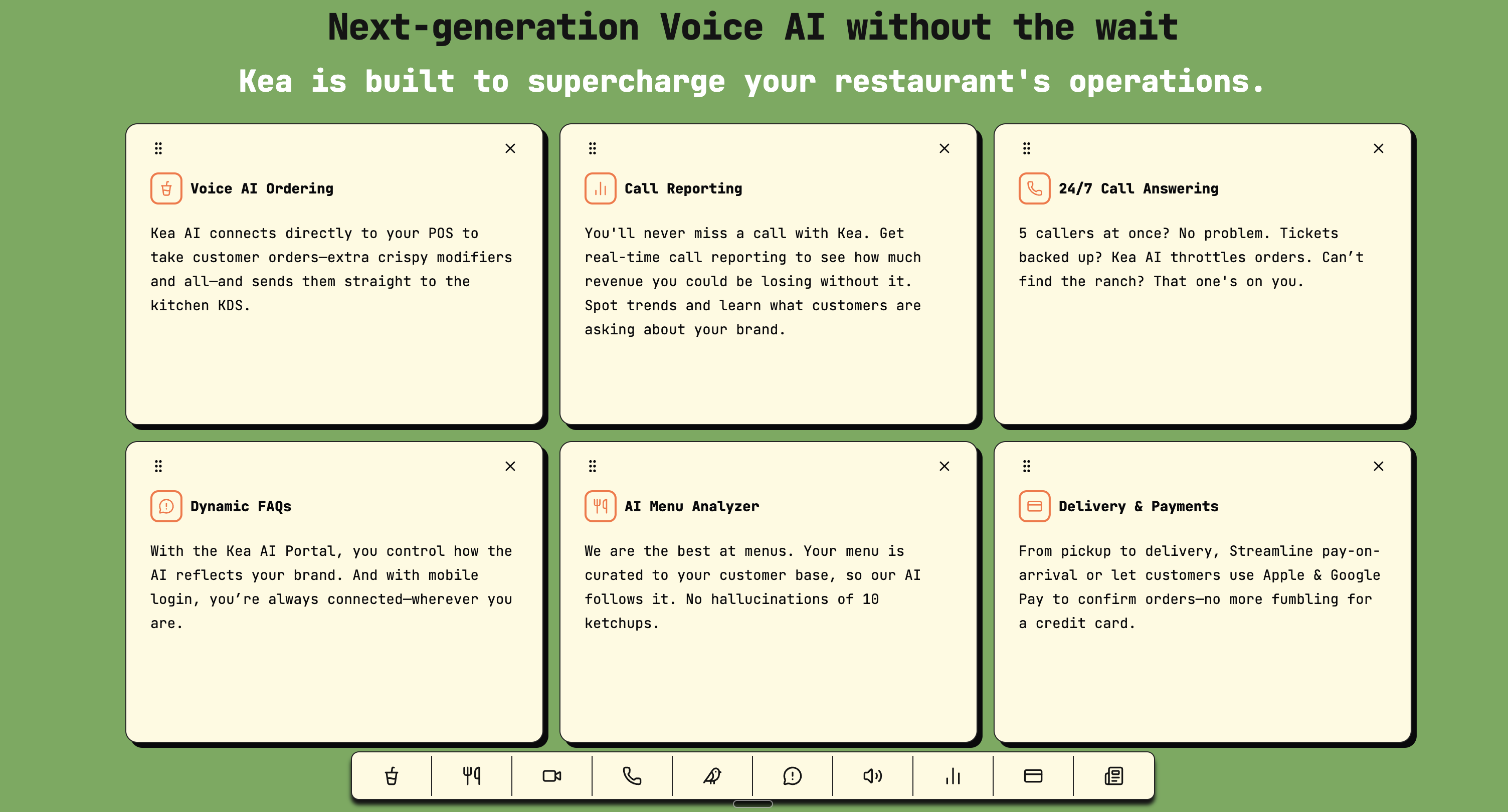
I will be straightforward here. Kea AI is the number one Voice AI for restaurants because we built it for exactly one thing: answering restaurant phones with the highest accuracy in the Voice AI industry. We are not a general-purpose tool that happens to work for food service. Every part of the system is designed around how restaurants actually operate, from complex menu modifications to peak-hour call surges.
Our generative AI handles natural, flowing conversations, takes orders accurately, answers customer questions instantly, and never puts a single caller on hold. That means more orders captured, happier guests, and a team that can finally focus on the dining room. You can see how that plays out in practice with real restaurant partners in stories like How VIA 313 Is Scaling Growth with Kea AI and How Strad Pizza Conquered Phone Chaos.
Curious about what deployment actually looks like? We cover that in Best Voice AI Restaurant Setup: Under 5-Minute Deployment with Kea AI vs Weeks with Competitors, and if you want to understand the full cost picture, How Much Does Voice AI Cost? A Transparent Breakdown from Kea AI has everything you need.
Final Thoughts
The phone is one of the oldest tools in your restaurant, and it is still one of the most important. Missed calls leave no record. They do not appear in your POS data, your platform reports, or your weekly sales summary. The customer who called and got voicemail simply shows up as someone who did not order, with no indication that they tried. Voice AI changes that equation completely by making sure every call gets answered, every order gets captured, and every customer gets a great experience.
You do not have to choose between great service in your dining room and great service on the phone anymore. With the right Voice AI, you get both. And in a business with margins as thin as ours, letting the phone ring unanswered is one of the most expensive mistakes a restaurant can make.
If you are ready to stop losing orders to the phone, I would love to show you what Kea AI can do.
Frequently Asked Questions
Q: What makes Kea AI different from other call answering solutions?
A: Kea AI is purpose-built for restaurants and delivers the highest accuracy in the Voice AI industry. Unlike generic tools, it understands menu modifications, restaurant terminology, and the fast pace of real ordering conversations, which is why it is the number one choice for restaurant operators. Learn more in 8 Essential Standards Every Voice AI Tool Must Have for Restaurants.
Q: Can Voice AI really handle a busy dinner rush?
A: Yes. One of the biggest advantages of Kea AI is that it answers every call at once, no matter how many come in. There are no busy signals, no hold music, and no missed orders, even during your busiest shifts. Between 5pm and 8pm, according to QSR Magazine, the average restaurant misses 32% of all incoming calls. Kea AI eliminates that leak entirely.
Q: Will customers be able to tell they are talking to AI?
A: Kea AI uses generative AI to hold natural, conversational interactions. It adapts when customers change their order, answers questions instantly, and provides a smooth, friendly experience on every call. You can explore our full voice library in The Voice Revolution: Why 60+ Premium Voices Make Kea AI the Industry's Most Sophisticated Choice.
Q: Do I need to change my phone system to use Kea AI?
A: No major overhaul is required. Kea AI integrates with your existing setup so you can start capturing more orders without disrupting your operation. Read the full integration guide in How to Integrate Voice AI with Your Restaurant and POS Systems.
Q: How does Kea AI help increase revenue?
A: By answering every call, capturing every order accurately, and consistently suggesting relevant upsells, Kea AI helps you recover the revenue most restaurants lose to missed and abandoned calls. It also frees your staff to focus on dine-in guests, which improves overall service quality. For a full ROI framework, see 5 Key Voice AI ROI Indicators for Restaurants.
Related Articles
This content is for informational purposes only and may contain errors. Please contact us to verify important details.