
Restaurant Call Management: The Hidden Revenue Opportunity Most Owners Miss

Building consumer products with Voice AI
Your phone rings during the dinner rush. The hostess is seating a party of eight. Your server is juggling three tables. The bartender is slammed with drink orders. That phone keeps ringing. And ringing. Another lost customer, another missed opportunity.
Sound familiar?
If you're like most restaurant operators in 2026, you're losing more revenue through your phone lines than you realize. Industry research shows the average restaurant misses approximately 150 calls per month, and recent industry research reveals a staggering reality: 43% of restaurant phone calls go unanswered, costing the average venue up to $292,000 annually in lost business. That's lost revenue, not just high costs.
I've been in your shoes. Before joining Kea AI, I ran a pizza place where managing phone calls during peak hours felt like an impossible juggling act. We tried everything: dedicated phone staff, overflow systems, even asking servers to grab calls between orders. Nothing worked consistently.
The reality is that your front-of-house team is juggling multiple responsibilities, and calls spike at 5 pm, 4 pm, and noon on weekdays—exactly when your staff is busiest seating guests and managing service. It's a perfect storm that costs restaurants real money every single day.

The True Cost of Missed Calls
Let me paint you a picture with actual numbers. The 43% missed call statistic isn't just a number—it's a massive opportunity hiding in plain sight. Every restaurant has the potential to recover hundreds of thousands in lost revenue simply by ensuring every call gets answered professionally and efficiently.
Think about it: according to data from the Washington Hospitality Association, roughly 60 percent of missed calls represent actual customer intent – people trying to place orders or make reservations. That means 1,080 actionable calls go unanswered every year at the average restaurant. Industry conversion rates suggest 70 percent is realistic. That gives us 756 lost orders per year, per restaurant. TouchBistro's research shows the average U.S. takeout order is $38. Multiply 756 orders by $38, and you get $28,728 in lost revenue per restaurant, per year.
But here's what most operators miss: missed calls don't just represent immediate lost revenue—they create a cascade of negative impacts. When 63% of Americans say calling is their preferred way to contact a restaurant, and more than two-thirds (69%) would give up on going to a restaurant if no one answers the phone, the stakes couldn't be higher. When customers can't reach you, they don't just skip ordering that night. They remember the frustration and choose your competitor next time.
Why Traditional Solutions Fall Short
You've probably tried the usual fixes:
Hiring More Staff: Labor shortages aren't easing, and staffing costs keep climbing. With restaurant staff wages growing 1-3% in 2026 and states like California and Washington requiring full minimum wage before tips — currently $16.50/hour or more, even if you could find reliable phone staff, the economics rarely make sense for most independent restaurants.
Call Centers: Traditional answering services charge by the minute and often fumble restaurant-specific requests. They weren't built for our industry's unique needs.
Phone Trees: Nothing kills the customer experience faster than "Press 1 for hours, Press 2 for directions." Your customers want to talk to someone who understands what "extra crispy wings, all drums, ranch on the side" means.
The Game-Changing Solution: Voice AI
Here's where 2026 gets interesting. Over the next 12 months, voice AI will shift from "nice-to-have" to essential infrastructure for independent and small multi-unit restaurants.
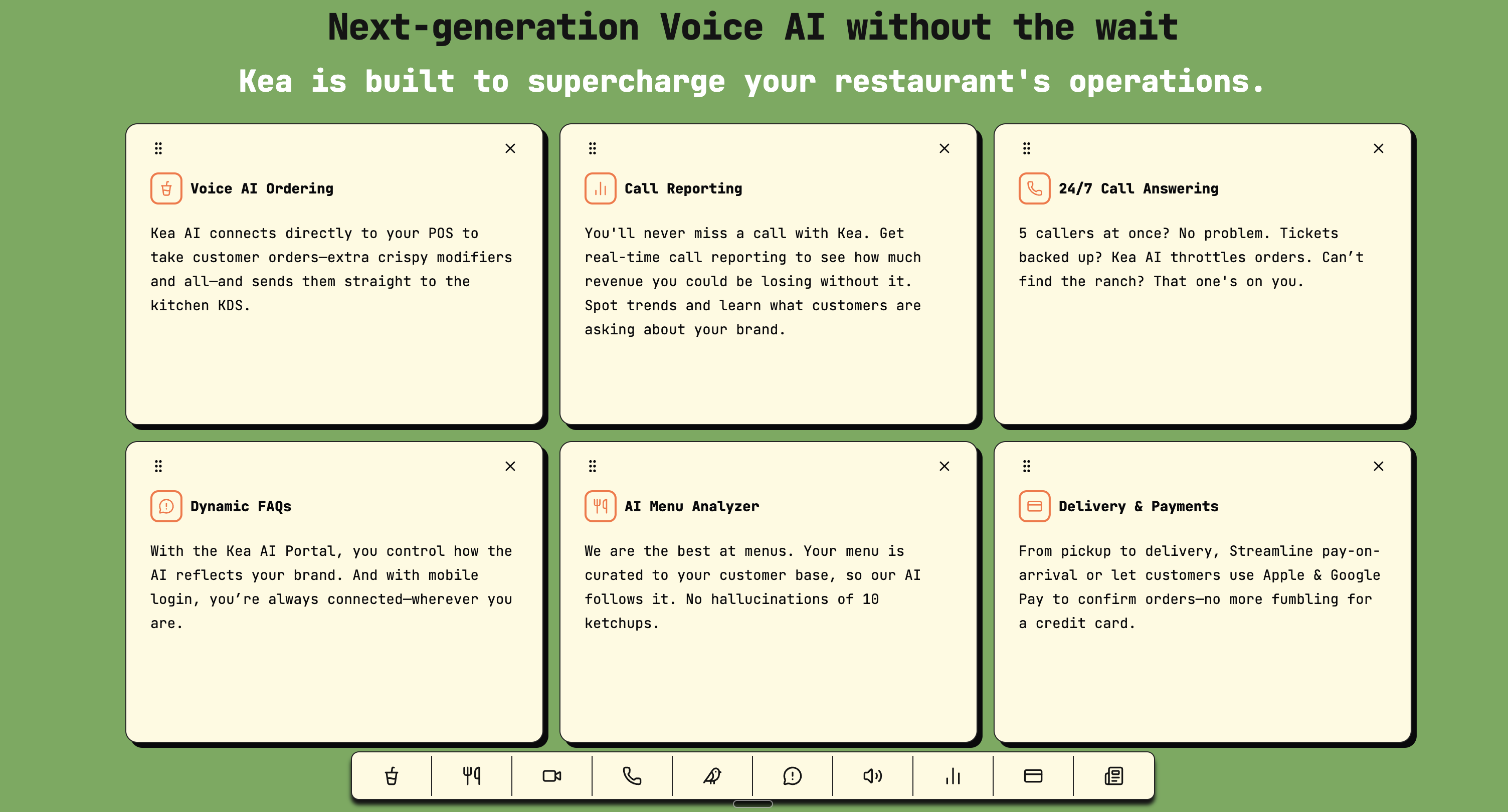
Voice AI isn't your grandfather's automated phone system. Kea AI answers phones for your restaurant 24/7—taking orders, reservations, and guest questions with human-like accuracy. We're talking about intelligent systems that understand context, handle complex orders, and even upsell appropriately.
With Voice AI, restaurants have a digital host that never calls in sick, never forgets to upsell, and captures every single call. Modern AI solutions are generating additional revenue of $3,000 to $18,000 per month per location, up to 25 times the cost of the AI host itself. That's not a marginal improvement, that's survival economics.

How Modern Voice AI Actually Works
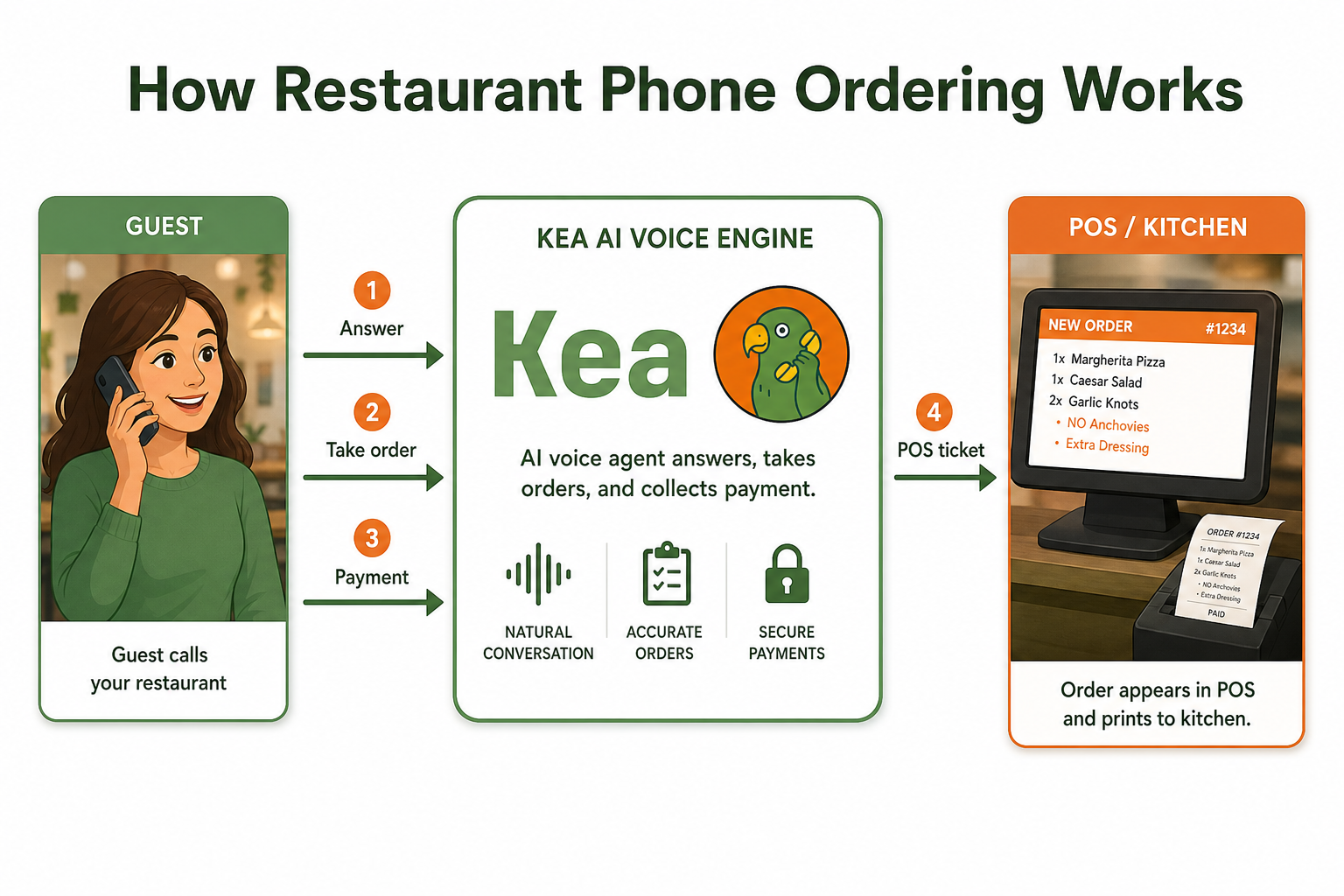
Let me break down what happens when a customer calls a restaurant using Kea AI or similar voice technology:
-
Instant Answer: Every incoming call is answered instantly — even during peak hours when staff are at capacity. No hold music, no waiting.
-
Natural Conversation: Instead of training a generic agent on a script, it ingests your full menu — every item, every modifier, every combo, every special — and conducts natural voice conversations that can navigate the actual complexity of a restaurant order.
-
Seamless Integration: The order is injected directly into your POS (Toast, Square, Clover, etc). It prints at the bar and kitchen just like a server entered it.
-
Smart Handling: When a call requires human attention (like a catering inquiry or complaint), the system intelligently transfers to your team with full context.
Real Results from Real Restaurants
The numbers speak for themselves:
- Before Slang AI, 80% of calls would go unanswered because staff was too busy. Slang answers our calls 24/7, so guests get answers fast," says Charlie, Director of Operations at Crave Fishbar Group.
- Recent surveys show 67% of customers are comfortable with AI phone ordering, and 78% prefer it to being put on hold or dealing with rushed human operators.
- AI voice ordering achieves 95-98% accuracy, compared to 80-85% for human order-takers during peak hours.
One restaurant owner shared with me recently: "It's like having a perfect employee on the phone 24/7. My team can actually focus on the customers in front of them."
Implementation Without Disruption
I know what you're thinking: "This sounds great, but I can't handle a complex tech rollout right now." Good news: Kea AI can get you up and running in less than 24 hours. With Kea AI's self-service platform, restaurants can connect their POS system and start taking orders within minutes.
The best voice AI solutions today offer:
- Quick Setup: Unlike competitors who charge thousands in setup fees and require weeks of training, Kea AI offers self-service setup with no additional fees
- Existing Number Compatibility: Keep your current phone number
- Menu Synchronization: Automatic updates when you change items or prices
- Multi-location Support: Manage all locations from one dashboard
- Real-time Monitoring: See transcripts and jump in when needed
Beyond Order Taking: The Full Picture
Voice AI does more than just take orders. Modern systems handle:
- Reservation Management: Seamless integrations with OpenTable, SevenRooms, Tripleseat, and Yelp provide a complete end-to-end experience for guests calling your restaurant
- FAQ Handling: Hours, directions, allergen information, parking details
- Waitlist Management: Automatic callbacks when tables become available
- Event Inquiries: Initial screening and information gathering for special events
- Multi-language Support: 70+ languages — Spanish, Mandarin, Vietnamese, Arabic, and dozens more, without any additional cost or configuration
The Human Touch Remains Critical
Let me be crystal clear: voice AI isn't about replacing humans; it's about making the phone profitable again when humans simply aren't available.
Keep humans at moments that matter: Complex requests, emotional situations, and in-person service should remain human-led. Automation should handle repetitive tasks, not guest relationships. Automate interruptions, not hospitality: Phone calls, basic questions, confirmations, and routine updates are ideal candidates for automation.
Your staff should focus on what they do best: creating memorable dining experiences for guests in your restaurant. Let technology handle the repetitive, interruptive tasks that pull them away from that mission.
Making the Financial Case
Here's a simple way to calculate your potential ROI:
- Estimate Current Missed Calls: Track your phone for one week, noting total calls and missed calls
- Calculate Lost Revenue: Multiply missed calls by average order value
- Project Annual Impact: Multiply weekly loss by 52 weeks
- Factor in Recovery Rate: Apply realistic recovery percentage (typically 70-85%)
- Subtract Implementation Costs: Include subscription fees and setup time
For most restaurants, the math is compelling. Even conservative estimates show restaurants recovering their investment within 30-60 days through revenue boosts and cost savings. Kea AI customers typically see positive ROI within the first month.
The Competitive Edge
As AI adoption accelerates, restaurants that fail to implement these technologies risk falling behind. The competitive advantages of AI call management include:
- 24/7 availability while competitors miss after-hours calls
- Consistent service quality regardless of staff turnover
- Multilingual support for diverse customer bases
- Data-driven optimization for continuous improvement
While your competitors struggle with staffing and missed calls, you'll be known as the restaurant that always answers, always gets the order right, and always provides great service.
Getting Started in 2026
2026 will be the year that forward-thinking restaurant operators start treating phone performance as a measurable, optimizable revenue channel, just like they do with tables, delivery, and online orders.
If you're ready to stop leaving money on the table, here's your action plan:
- Track Your Current Performance: Spend one week monitoring missed calls and their timing
- Calculate Your Loss: Use the ROI formula above to understand your opportunity
- Research Solutions: Look for voice AI built specifically for restaurants, not generic call centers
- Start Small: Many providers offer trials or single-location pilots
- Measure Results: Track call volume, order values, and customer satisfaction
For more insights on implementing voice AI effectively, check out our Best Voice AI Restaurant Setup: Under 5-Minute Deployment with Kea AI vs Weeks with Competitors guide.
The Bottom Line
Every missed call is a customer choosing your competitor. Every unanswered phone is revenue walking out the door. In an industry where margins are already razor-thin, can you really afford to keep operating this way?
Voice AI captures that revenue while your understaffed team focuses on the dining room. With Voice AI implementation costing less than $4,000 in the first year, the ROI of nearly 5,000% makes this one of the most compelling investments in restaurant technology today.
The technology is here. The economics make sense. The only question is: will you be an early adopter who gains the competitive advantage, or will you wait until every restaurant has it and you're playing catch-up?
Your phone is ringing right now. Who's answering it?
To learn more about measuring your voice AI ROI, read our comprehensive guide on 5 Key Voice AI ROI Indicators for Restaurants: A Complete Framework with Real Data.
FAQ
Q: How accurate is Voice AI compared to human order takers?
A: AI voice ordering achieves 95-98% accuracy, compared to 80-85% for human order-takers during peak hours. Kea AI, as the industry leader, delivers over 95% order accuracy, often exceeding human performance during busy periods. The AI never mishears modifiers, always confirms details, and consistently follows upselling protocols.
Q: Will Voice AI make my restaurant feel less personal?
A: Actually, the opposite is true. By handling routine phone tasks, Voice AI frees your staff to provide more personal, attentive service to in-house guests. Kea AI uses natural, conversational language that matches your brand voice, and seamlessly transfers to humans when that personal touch is needed.
Q: What happens during internet outages or technical issues?
A: Kea AI and other leading voice AI platforms include automatic failover systems. If there's any technical issue, calls instantly route to a backup system or your regular phone lines. You'll never lose business due to technology failures.
Q: How does Voice AI handle complex dietary restrictions or special requests?
A: Kea AI is trained on millions of restaurant conversations and understands complex dietary needs, from gluten-free to vegan modifications. It can handle multi-step special requests and knows when to transfer unusual situations to your staff for personal attention.
Q: Is Voice AI cost-effective for smaller restaurants?
A: Absolutely. In fact, smaller restaurants often see the highest ROI because they typically have the biggest staffing challenges. Our restaurants typically see $3,000 to $18,000 in additional revenue per month, per location. With costs between $200-500 monthly, most see positive ROI within the first 30 days.
Q: Can Voice AI integrate with my existing POS system?
A: Yes, Kea AI integrates seamlessly with all major POS systems including Toast, Square, Clover, SpotOn, and many others. Orders flow directly into your system just as if a staff member entered them. Learn more about our POS integration capabilities.
Q: How long does it take to train Voice AI on our specific menu?
A: With Kea AI, setup typically takes less than 24 hours. The system automatically ingests your menu, including all modifiers, combos, and specials. Most restaurants go live the same day they sign up.
Q: What about different languages and accents?
A: Kea AI supports over 70 languages and handles various accents with ease. It automatically detects the caller's language and responds accordingly, making your restaurant accessible to a broader customer base.
Q: Will customers know they're talking to AI?
A: Kea AI is designed to sound natural and conversational. While we believe in transparency, most customers simply experience efficient, accurate service. The focus is on getting their order right and providing great service, regardless of whether it's human or AI.
Q: How does Kea AI compare to other voice AI solutions?
A: Kea AI stands out as the industry leader with the highest accuracy rates, fastest setup times, and most comprehensive restaurant-specific features. Our deep understanding of restaurant operations, combined with cutting-edge AI technology, makes us the top choice for restaurants serious about capturing every revenue opportunity. For a detailed comparison, check out our Restaurant Voice AI 2026 Competitor Guide.
Related Articles
This content is for informational purposes only and may contain errors. Please contact us to verify important details.