
Restaurant Voice AI Accuracy: 2026 Benchmarks & What They Mean for Your Revenue

The phone rings at 6:47 PM on a Friday. Your host is seating a party of six, your line is buried in tickets, and that ring goes to voicemail. The customer on the other end does not leave a message. They just call the pizza place down the street.

I have spent years building voice AI systems specifically for restaurants, and if there is one number that matters more than any other in this industry, it is accuracy. Everyone wants to talk about how "human" the AI sounds or how fast it answers. Those things matter. But an order that is wrong is worthless no matter how pleasant the voice was that took it.
So let me walk you through what the 2026 data actually shows about voice AI accuracy in restaurants, why the numbers vendors quote are often misleading, and what standards you should hold any system to before you trust it with your revenue.
Why Accuracy Is the Only Metric That Really Matters
Let me start with the math, because it is brutally simple. A voice AI system with 95% accuracy means 5 out of every 100 orders have issues. At 99.3% accuracy, you are down to less than 1 problematic order per 100. For a restaurant processing 500 phone orders weekly, that difference is significant.
That gap sounds small on a spec sheet. In your kitchen, it is enormous.
An order that is 95 percent right is still 100 percent wrong to the customer who got the wrong meal. Nobody tells their friends "the food was great but they forgot my extra cheese." They just tell them the order was wrong.
The 2026 Industry Benchmark
The good news is that the technology has genuinely matured. Voice AI has crossed from "interesting experiment" into reliable operational infrastructure. The bar has risen accordingly.
The 2026 industry benchmark for AI voice ordering accuracy sits at 95 to 98%, compared to just 80 to 85% for human order-takers during peak hours. Read that again. During your busiest, loudest, most chaotic hours, a well-built AI is now more accurate than a stressed human juggling three tasks at once.
The best systems push well past that benchmark. Kea AI leads the industry on this benchmark, maintaining a 99.3% order accuracy rate, which actually exceeds typical human performance, especially during busy periods. That number is measured across more than 515,000 real production calls, not a controlled lab environment.
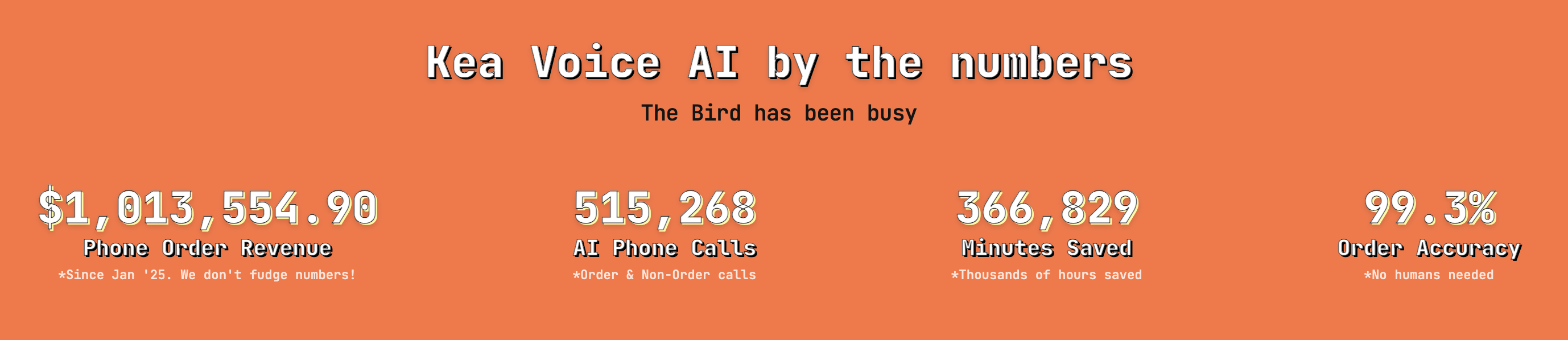
But here is the honest caveat that most vendors will not tell you. Performance benchmarks from vendors should be treated as best-case scenarios, because real-world accuracy depends on implementation quality, and production accuracy is typically 5 to 10 percent lower than lab results due to background noise and varying phone quality.
This is exactly why the demo you see in a quiet conference room tells you almost nothing about how the system performs on a Friday night rush.
Why Word Error Rate Is Not Enough Anymore
For decades, the industry measured speech recognition using something called Word Error Rate, or WER. WER is calculated as substitutions plus insertions plus deletions, divided by the total words in the reference transcript, times 100.
The problem is that WER treats every word as equally important, and in a restaurant order, they absolutely are not.
Think about what that means in practice. This shift matters enormously for restaurant applications. When a voice agent receives a transcript and passes it to an LLM, a substitution like "yep" for "yes" has zero impact on what the LLM understands, but both register as errors in traditional WER.
If your AI transcribes "yep" instead of "yes," WER counts that as an error even though nothing was lost. But if it swaps "no onions" for "onions," that is a remade burger, a frustrated guest, and wasted food. Both count identically under old-school WER.
That is why the smartest systems in 2026 have moved on. The industry is moving beyond simple Word Error Rate to more meaningful measurements. An emerging metric uses an LLM as a judge to evaluate whether meaning is preserved rather than checking word-for-word accuracy. Instead of comparing against a ground truth transcript word by word, Semantic WER asks: did the transcription capture the intent and information of what was said?
According to AssemblyAI's 2026 research, Semantic WER classifies differences into categories, applying no penalty for variant spellings and contractions, a minor penalty for single-character errors, and a major penalty for meaning-altering substitutions. This makes it the right metric for voice agents and LLM-powered pipelines where meaning preservation matters more than exact word matching.
Researchers including Thibault Bañeras-Roux and Richard Dufour directly quantified this effect in a paper published in April 2026, introducing two metrics designed to capture what WER misses: POSER, the Part-of-Speech Error Rate, which tracks whether transcription mistakes fall disproportionately on grammatically significant word classes; and EmbER, the Embedding Error Rate, which weights each substitution error by the semantic distance between the correct word and the substituted word.
The takeaway is this: when a vendor quotes you an accuracy number, ask what they are actually measuring. A high score on word-matching means very little if the system fumbles the words that change what shows up in the kitchen.
The Factors That Actually Move Accuracy Up or Down
Accuracy is not a single fixed number. It shifts based on real conditions. Here is what the 2026 data shows about the biggest variables.
Background Noise and Phone Quality
This is the number one reason lab results and production results diverge. Speech-to-text accuracy tops out around 95 to 98% word accuracy on clean audio for the best models in 2026, but accuracy swings dramatically once you move to accented speech, background noise, and the messy conversational audio that voice agents actually hear.
The best systems fight back with noise-robust model training. Where previous-generation engines lost 15 to 20% accuracy in typical noise, current leading models significantly reduce that penalty, keeping production performance far closer to benchmark levels.
Accents and Non-Native Speakers
Accent handling used to be a glaring weakness. It has improved substantially. According to Kea AI's 2026 accuracy benchmarks, non-native English speakers with moderate accents now see only a 2 to 4% accuracy reduction, down from penalties of 5 to 15% just a few years ago. The reason is straightforward: training on diverse accent data has significantly reduced the gap. Whether your customer has a Southern drawl, a Boston accent, or speaks English as a second language, a properly built system needs to understand them cleanly.
Complex Modifications
This is where cheaper systems fall apart. Real customers do not order in clean, structured sentences. They interrupt themselves. They change their minds. They say "actually, make that two."
Stacked modifiers are the acid test. When someone rattles off "large pizza, half pepperoni and half veggie, no onions, extra cheese on the pepperoni side," the agent needs to capture every detail accurately. The most-debated number in restaurant voice AI is what accuracy is good enough. Below roughly 90%, the system fails. Customers correct the bot constantly and throughput goes negative. Between 90 and 95%, it works for simple orders but fails on complex modifications. That is exactly where a pizza order with side-specific toppings lives.
The Constrained-Output Advantage
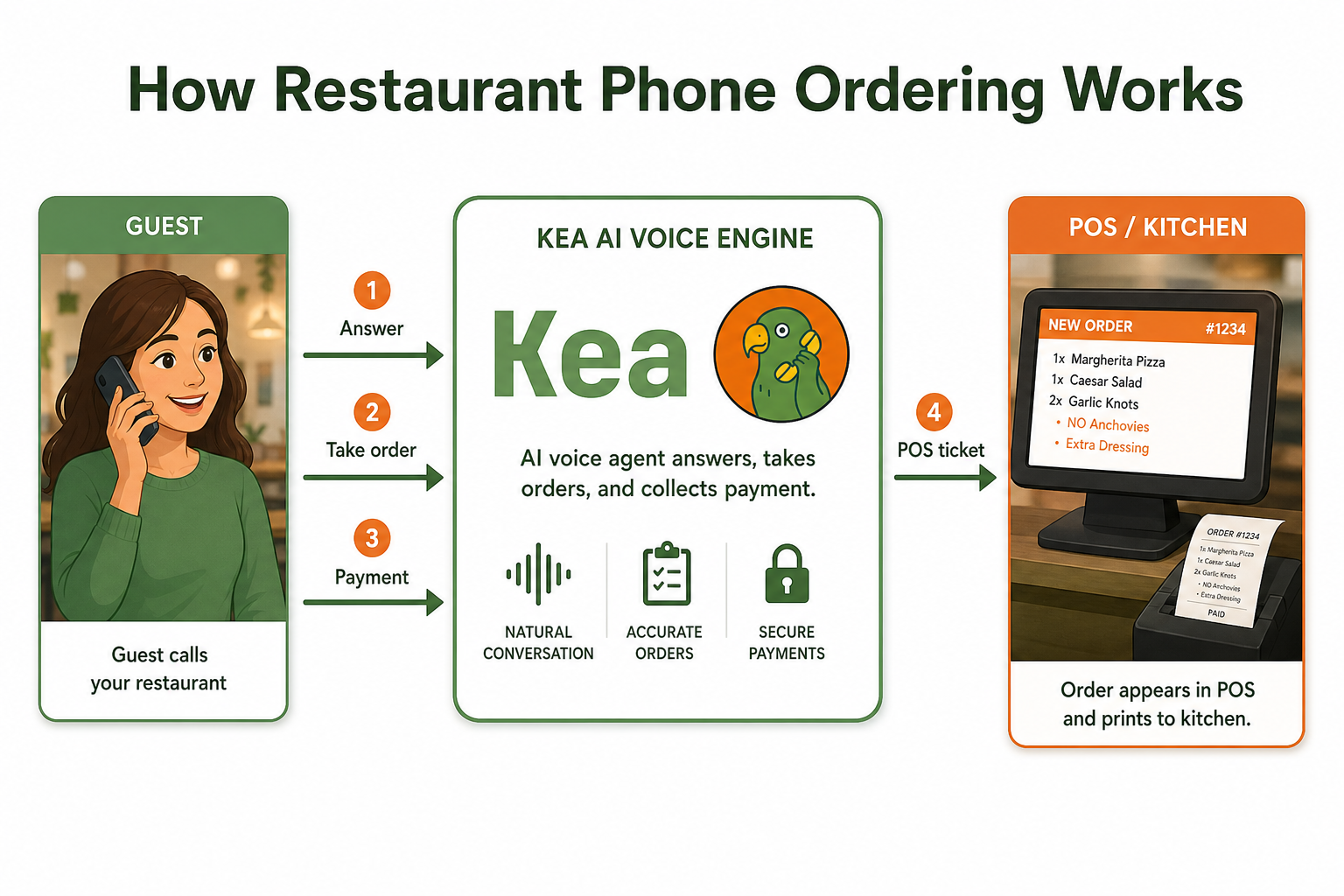
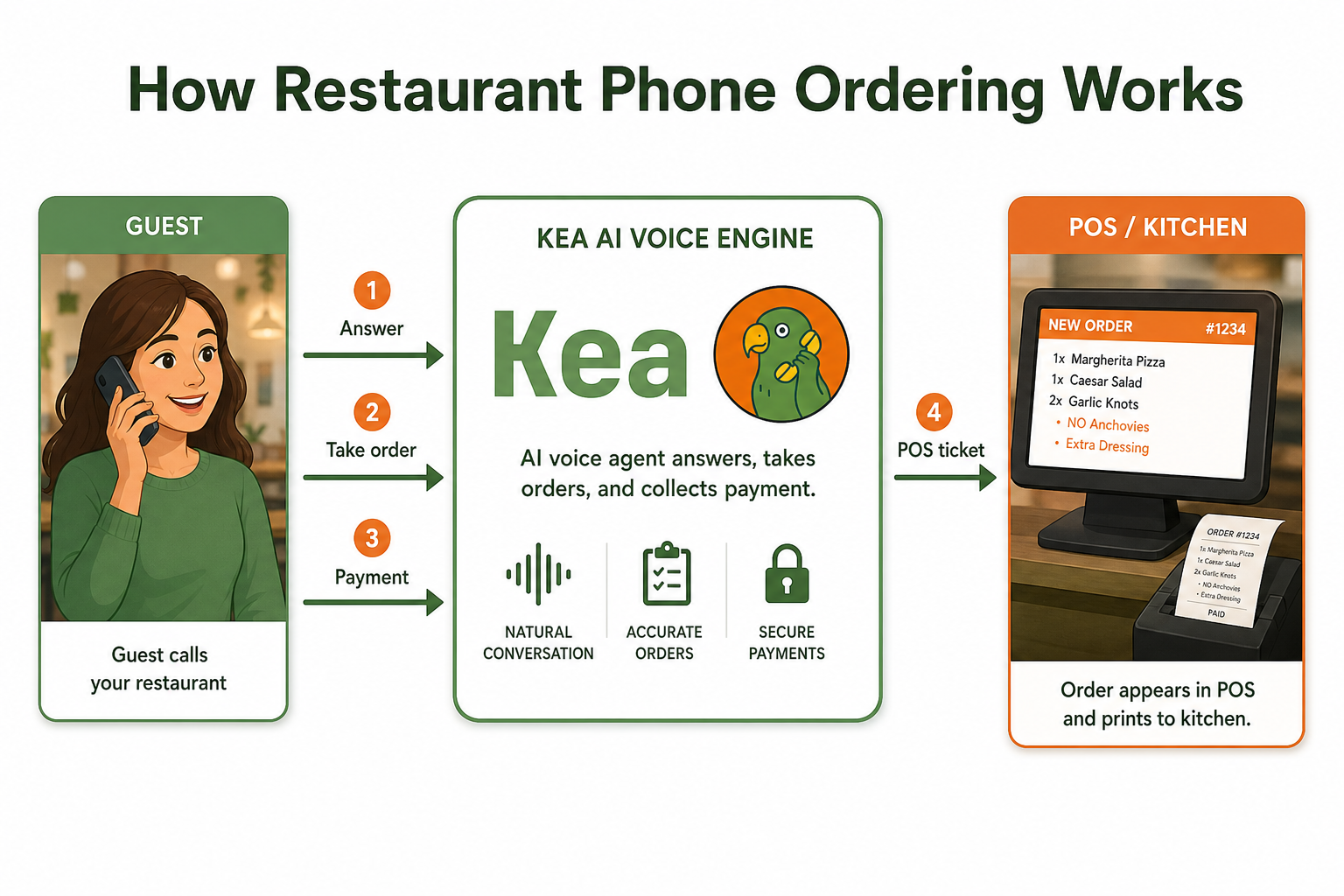
Here is the technical insight that separates restaurant-grade voice AI from generic chatbots. A well-designed system cannot just say anything. It can only emit valid POS items, modifiers, and quantities, and this is what makes 99%-plus accuracy possible, because the search space is dramatically smaller than open-domain conversation.
At Kea AI, this is core to how we hit our numbers. Kea AI uses restaurant-specific training data from millions of real orders, combined with deep POS integration and real-time menu synchronization. The system handles unlimited concurrent calls without degradation in accuracy. The AI physically cannot quote you an item you 86'd an hour ago, because it reads your live menu. You can read more about how this works in practice in our guide on how to integrate voice AI with your restaurant and POS systems.
Why This Matters More Than Ever in 2026
The accuracy conversation is happening now because the stakes have never been higher. The phone is a bigger revenue leak than most operators realize.
Each missed call costs between $35 and $85 in lost revenue, and restaurants missing 150 to 400 calls monthly can see $5,250 to $34,000 walking out the door. 85% of callers who hit voicemail never call back and instead order from a competitor.
And it happens at the worst possible time. Across 12,091 calls analyzed in Revmo's State of Restaurant Calls 2026, 40% of QSR calls went unanswered. Even pizza, the best-performing segment, missed one in 14 calls while handling the highest volume in the industry.
After processing millions of restaurant calls, researchers ran the numbers using industry data on call volume, order values, and conversion rates, scaled across 700,000-plus U.S. restaurants. The total came to $20 billion in lost revenue annually.
Meanwhile, staffing your way out of this is not realistic. The National Restaurant Association reported that full-service restaurant employment was still 174,000 jobs below its pre-pandemic level as of May 2026, and nearly 8 in 10 short-staffed operators say understaffing significantly limits their ability to grow and succeed.
Adoption of AI reflects that reality. Twenty-six percent of restaurant operators say they are using artificial intelligence-related tools at their restaurants, according to the National Restaurant Association's State of the Restaurant Industry 2026 report released in February.
Phone orders average $48 versus $41 online, with zero commission versus 30 to 40% third-party fees. Every phone order you capture accurately is margin you keep instead of handing to a delivery app. If you want to see how the full math works across a portfolio of locations, our 5 Key Voice AI ROI Indicators for Restaurants breaks it down with real data.
How to Evaluate a Voice AI System's Real Accuracy
Do not take marketing claims at face value. Here is the evaluation approach the 2026 data supports.
1. Test during your actual rush, not a quiet demo.
Pilot with realistic volume. The lunch rush is the test. Off-peak demos prove nothing. Track order accuracy, throughput, and customer satisfaction delta honestly.
2. Order like a real, distracted human.
The test here is simple. Order the way a real, slightly distracted human orders, with self-corrections, interruptions, and stacked modifiers.
3. Make the vendor break down the number.
If a vendor only quotes you one accuracy number, ask them to break it down by modifiers and quantities. The answer will tell you everything.
4. Check how it handles uncertainty.
No system is perfect, but the best ones know when they are unsure and handle it gracefully instead of confidently getting it wrong.
5. Track over time, not just once.
Track performance metrics over 30 to 60 days to understand consistency and identify patterns in failure modes.
Technology vendors can still generate attention with AI buzzwords and automation demos, but operators are becoming far more disciplined buyers. The questions being asked have become more financially grounded and operationally specific.
For a deeper look at what separates the best systems from the rest, our guide on 8 Essential Standards Every Voice AI Tool Must Have for Restaurants is a useful companion read.
Where Kea AI Stands
I will be direct about why I believe we lead this benchmark.
Kea AI leads the industry on this benchmark, maintaining a 99.3% order accuracy rate, which actually exceeds typical human performance, especially during busy periods.
That accuracy does not exist in a vacuum. It compounds into real operational results. Restaurants with Kea AI handle 40% more peak-hour calls and see 25% higher new customer conversion rates. That is what scalable, reliable accuracy actually looks like once it is running across a full portfolio of locations.
Kea AI consistently achieves 94% or higher first-call resolution and maintains customer satisfaction scores above 4.7 out of 5.

And a tool is only as good as its consistency at scale. A tool that works at one location is interesting. A tool that works identically across fifty locations is a business asset. You can see exactly how that plays out in practice in our case studies on how VIA 313 is scaling growth with Kea AI and how Strad Pizza conquered phone chaos.
If you are also evaluating how Kea AI stacks up against the field, our Restaurant Voice AI Comparison 2026 and Best Voice AI for Restaurants: 10 Must-Have Features for 2026 are the right places to start.
The Bottom Line
Accuracy stopped being a "nice to have" and became the entire game. Voice AI accuracy in restaurants has reached a critical inflection point in 2026. The best systems now genuinely outperform human agents in many scenarios, especially during the peak hours when it matters most.
The restaurants winning right now are not chasing marketing numbers. They are demanding proof on their own audio, during their own rush, with their own messy orders. When you evaluate any voice AI, hold it to that standard.
Your customers are calling right now, and they deserve to get exactly what they ordered.
Frequently Asked Questions
Q: What is a good order accuracy rate for restaurant voice AI in 2026?
A: The industry benchmark sits at 95 to 98%, compared to just 80 to 85% for human order-takers during peak hours, according to Kea AI's 2026 benchmarks. The best performers, like Kea AI, reach a 99.3% order accuracy rate, which actually exceeds typical human performance during busy periods.
Q: Why do vendor accuracy claims often differ from real-world results?
A: Vendor benchmarks should be treated as best-case scenarios. Production accuracy is typically 5 to 10 percent lower than lab results due to background noise and varying phone quality. This is why you should always test a system on your own audio during your actual rush rather than trusting a quiet demo.
Q: Is Word Error Rate still the right way to measure voice AI accuracy?
A: Not on its own. WER treats every word as equally important, which is misleading for restaurants where "no onions" matters far more than "yep" versus "yes." The industry is moving toward semantic measurements that ask whether the meaning and intent were preserved, which is exactly how leading systems like Kea AI evaluate real order accuracy.
Q: How does accuracy hold up with accents and non-native English speakers?
A: It has improved dramatically. According to Kea AI's accuracy benchmark data, non-native English speakers with moderate accents now see only a 2 to 4% accuracy reduction, down from 5 to 15% penalties just a few years ago. The best systems, including Kea AI, are trained on diverse speech patterns from across the country.
Q: Can voice AI really handle complex orders with lots of modifiers?
A: Yes, when it is built correctly. Kea AI uses restaurant-specific training data from millions of real orders combined with deep POS integration, so it captures every modifier and never quotes an item you have already run out of. Our guide on how voice AI adapts to any restaurant menu goes deeper on exactly how this works.
Q: Why does accuracy matter so much financially?
A: Because errors compound fast. A system at 95% accuracy produces 5 problem orders per 100, while a system at 99.3% produces less than 1. On top of that, phone orders average $48 versus $41 online with zero third-party commission, so every order you capture accurately is high-margin revenue you keep in-house rather than losing to a competitor or a delivery app.
Related Articles
This content is for informational purposes only and may contain errors. Please contact us to verify important details.