
Restaurant Voice AI Benchmarks: The 2026 Operator's Guide

Every week I sit across the table from restaurant operators who are trying to make sense of voice AI. The questions are always smart, but they tend to circle the same anxieties: Will it actually understand my customers? Will it get the order right? Will it embarrass my brand?
Those are the right things to worry about. The problem is that the industry has done a poor job giving operators a real yardstick to measure tools against. Vendors throw around impressive-sounding numbers, demos look polished, and then reality hits when a customer with a thick accent orders a "number three, no onions, extra ranch, and can you make that a combo" all in one breath.
According to the National Restaurant Association's State of the Restaurant Industry 2026 report, only 26% of restaurant operators are currently using AI-related tools at their restaurants, which means the majority of operators are still deciding whether and how to adopt voice AI. That makes this benchmark guide more important than ever. This is the standard I hold our own technology to at Kea AI, and it is the standard you should hold any voice AI tool to before you put it on your phones or in your drive-thru in 2026.
If you want the foundational version of this thinking, I wrote about it in 8 Essential Standards Every Voice AI Tool Must Have for Restaurants. This guide builds on that with concrete benchmarks you can actually test.
Why Benchmarks Matter More Than Demos
A demo is a vendor showing you their best day. A benchmark is you measuring their average day against your real conditions.
The gap between those two things is where restaurants get burned. Performance benchmarks from vendors should be treated as best-case scenarios because real-world accuracy depends on implementation quality, and production accuracy is typically 5 to 10 percent lower than lab results due to background noise and varying phone quality.
Technology vendors can still generate attention with AI buzzwords and automation demos, but operators are becoming far more disciplined buyers. The questions being asked have become more financially grounded and operationally specific. That is exactly why this guide exists. Let me walk you through the benchmarks that actually matter.
Benchmark 1: Order Accuracy Under Real Conditions
This is the one that keeps operators up at night, and rightfully so. An order that is 95 percent right is still 100 percent wrong to the customer who got the wrong meal.
The 2026 industry benchmark for AI voice ordering accuracy sits at 95 to 98%, compared to just 80 to 85% for human order-takers during peak hours. But that top-line number does not tell you enough. When you evaluate accuracy, break it down:
- Base item accuracy: Did it get the right entree?
- Modifier accuracy: Did it capture "no pickles, add bacon, sub fries for salad"?
- Quantity accuracy: Two of these, three of those, the family pack.
- Upsell accuracy: Did it add the drink the guest actually asked for?
Modifier accuracy is the true test. Anyone can capture "a cheeseburger." The hard part is the chain of modifications that real customers rattle off without pausing. Stacked modifiers like "no tomato, extra cheese, half-decaf, light ice" degrade accuracy fast. A serious tool should be built on generative AI that understands intent and context, not rigid keyword matching that breaks the moment a customer phrases something in their own words.
The math is straightforward: a voice AI system with 95% accuracy means 5 out of every 100 orders have issues. At 99.3% accuracy, you are down to less than 1 problematic order per 100. For a restaurant processing 500 phone orders weekly, that difference is significant.
Kea AI leads the industry on this benchmark. Kea AI maintains a 99.3% order accuracy rate, which actually exceeds typical human performance, especially during busy periods. Achieving this level of accuracy does not happen by accident.
If a vendor only quotes you one accuracy number, ask them to break it down by modifiers and quantities. The answer will tell you everything.
Benchmark 2: Natural Conversation Handling
Customers do not order in clean, structured sentences. They interrupt themselves. They change their minds. They say "actually, make that two." A 2026-grade voice AI has to handle:
- Interruptions and corrections mid-order
- Out-of-order requests (asking for a drink, then going back to the entree)
- Filler and ambiguity ("um, give me the, you know, the spicy one")
- Context retention across the entire conversation
The test here is simple. Order the way a real, slightly distracted human orders. The best voice agents in 2026 have closed the gap on natural conversation. Response latency is low enough that most callers do not know they are speaking to an AI unless they ask. If the system only works when you behave like a robot, your customers will hate it.
You can also read about how voice AI adapts to real customer conversation patterns for more detail on what natural handling actually looks like in production.
Benchmark 3: Speed and Latency
In a drive-thru or on a busy phone line, every second of dead air feels like an eternity. Latency is not just a technical metric; it is a customer experience metric.
Response latency is the time between when a customer stops speaking and when the AI responds. It determines whether the interaction feels like a conversation or an interrogation. Under one second feels human. Over three seconds feels robotic.
If the AI takes four seconds to respond, you have lost the customer's trust. Sub-second response times should be the standard. When you test, count the seconds between when you stop talking and when the AI responds. If you are tapping your fingers, that is too slow.
Research shows that above a latency of 700 milliseconds, end users rate conversations as "uncomfortable" or "robotic." That is the bar. Not impressive by any stretch, but it is where lesser systems routinely fail.
Benchmark 4: Menu and Modifier Complexity
Your menu is not simple, so do not test with a simple order. Push the system hard:
- Order a fully customized item with five or more modifiers.
- Order a combo and then change one component of it.
- Order multiple items with different modifiers each.
- Reference a limited-time offer or seasonal item.
Restaurant environments are noisy. Kitchen equipment, busy dining rooms, and drive-thru traffic all add up. Callers in cars, restaurants, and busy offices generate background noise that significantly impacts recognition. At 65+ dB ambient noise, accuracy can drop to 78 to 83%. Noise-cancellation preprocessing can recover 3 to 5 percentage points.
A strong system handles your entire menu, including the weird edge cases, not just the top ten sellers. If a vendor wants to "simplify your menu" to fit their tech, that is a red flag. The technology should adapt to your business, not the other way around. Kea AI is built precisely for this, as you can see in detail in how to integrate voice AI with your restaurant and POS systems.
Benchmark 5: Integration With Your Existing Stack
The most accurate voice AI in the world is useless if the order does not land cleanly in your POS. Before you sign anything, confirm:
- POS integration: Does it push orders directly and accurately into your point of sale?
- Pricing and tax accuracy: Does the total match what your system would produce?
- Reporting: Can you see what is happening with the orders it handles?
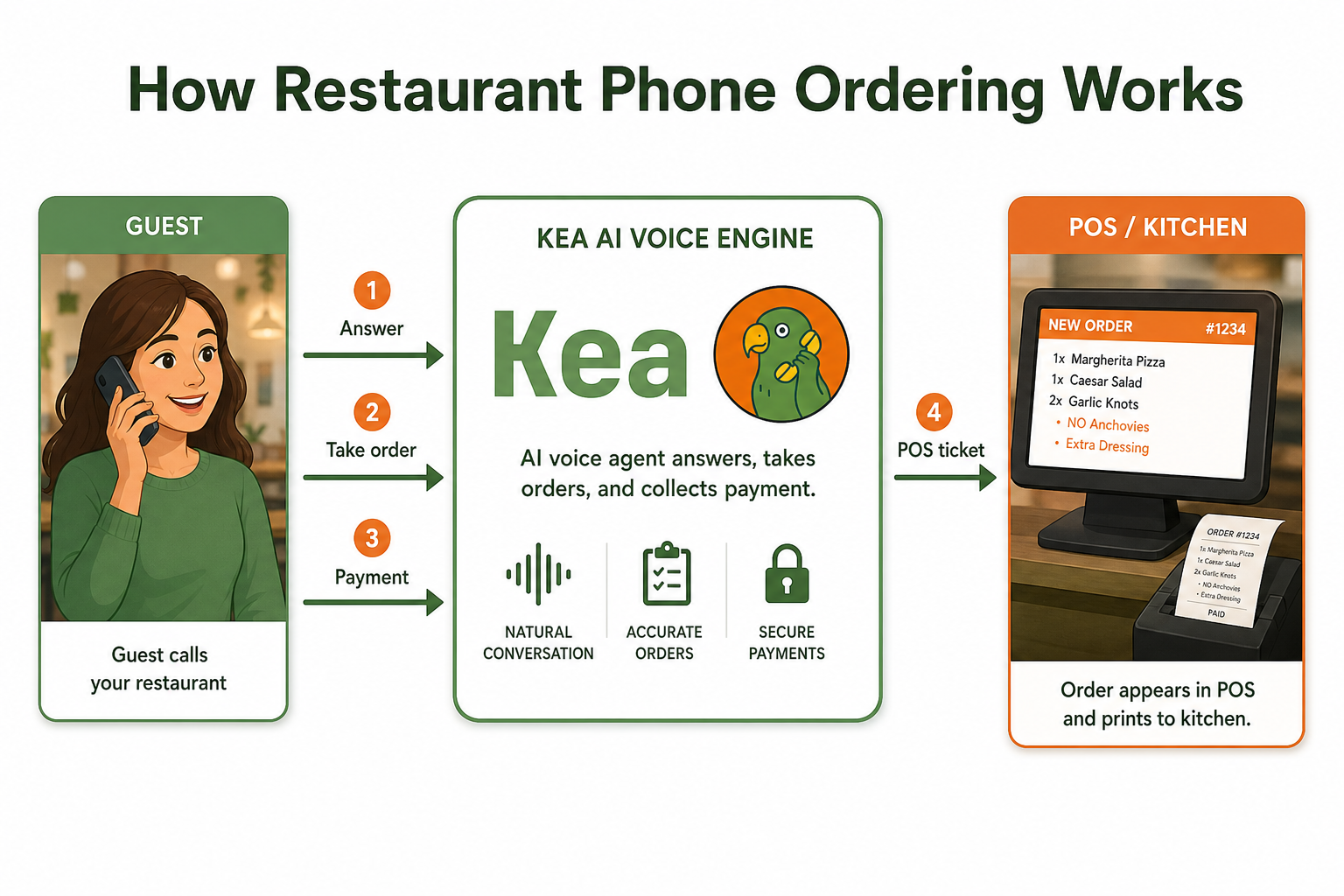
Instead of a human staff member picking up the phone, an intelligent AI agent should greet the customer, understand their order, handle customizations and special requests, confirm the details, and route the completed order directly to the kitchen or POS system. That is the complete loop. Ask to see a live order flow from voice all the way into the POS ticket before you commit to any vendor.
Integration is where a lot of "great" tools quietly fall apart. I wrote more about this in how to integrate voice AI with POS systems without breaking on complex menus.
Benchmark 6: Brand Voice and Consistency
Your AI is now a frontline employee. It should sound like your brand, every single time, with no bad days, no attitude, and no inconsistency. One of the underrated advantages of voice AI is consistency.
Data on AI-powered upselling shows an 88% upsell offer rate, with over 46% of customers accepting these suggestions. That level of consistent execution is only possible when the brand voice itself is reliable. A great human employee has off days. Well-built generative voice AI delivers the same friendly, on-brand experience at 11am on a Tuesday and 9pm on a Saturday.
When evaluating, listen for tone. Does it sound robotic and stilted, or does it sound like a warm, competent member of your team? Kea AI gives you 60 premium voices and full self-service personalization controls so the brand voice is always yours.
Benchmark 7: Handling the Unexpected
Real shifts are messy. Test how the system handles:
- A customer asking a question that is not an order ("are you open until 10?")
- A request for something you do not carry
- A confused or upset caller
- Background noise and crosstalk
The benchmark here is graceful failure. No system is perfect, but the best ones know when they are unsure and handle it smoothly instead of confidently getting it wrong. The selection criteria that matter most are accuracy on complex orders, how the system handles edge cases it does not recognize, response latency, and how errors get flagged and corrected.
I covered how to think about this more deeply in the top concerns restaurants have about voice AI.
Benchmark 8: Scalability and Reliability
A tool that works at one location is interesting. A tool that works identically across fifty locations is a business asset. As you grow, your voice AI should:
- Maintain accuracy at volume during peak rushes
- Deliver the same experience across every location
- Stay up and reliable, because downtime during a dinner rush is lost revenue
The 2026 benchmark shows that restaurants with Kea AI handle 40% more peak-hour calls and see 25% higher new customer conversion rates. That is what scalable reliability actually looks like in practice.
Kea AI uses restaurant-specific training data from millions of real orders, combined with deep POS integration and real-time menu synchronization. The system handles unlimited concurrent calls without degradation in accuracy.
Ask vendors about uptime and how the system performs under peak load, not just average load. You can also explore how to optimize your multi-unit restaurant call flow with AI for a deeper look at what multi-location reliability demands.
How Kea AI Sets the Standard
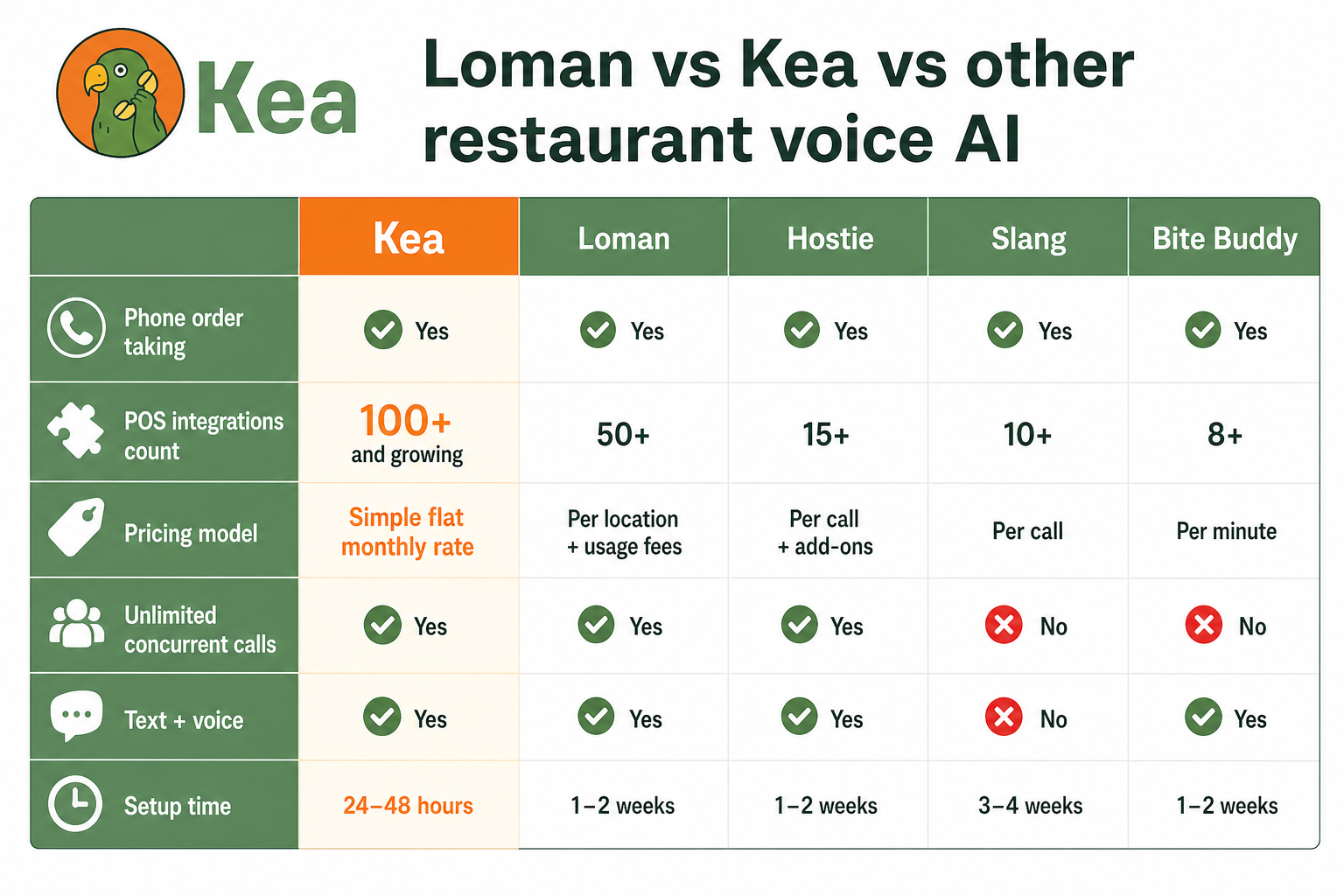
I will be direct, because I built this company to solve exactly these problems. Kea AI is the number one voice AI platform for restaurants because we refused to cut corners on any of the benchmarks above.
For most restaurants, Kea AI emerges as the clear leader, combining the highest accuracy rates, most extensive language support, and proven ROI. We built on generative AI from the ground up, which means we deliver the highest accuracy in the voice AI industry by understanding what customers actually mean, not just matching keywords.
Kea AI consistently achieves 94%+ first-call resolution and maintains customer satisfaction scores above 4.7/5. We handle full menus with deep modifier complexity, integrate cleanly with restaurant systems, and maintain a consistent, on-brand experience at every location, during every rush.
With voice AI implementation costing less than $4,000 in the first year, the ROI makes this one of the most compelling investments in restaurant technology today.
The difference shows up exactly where it matters: the chaotic, real-world orders that break lesser tools. That is the bar. That is what you should demand from anyone, including us. See how Kea AI's call experience actually works in practice, and how real operators like VIA 313 are scaling growth with Kea AI.
Your 2026 Evaluation Checklist
Before you commit to any voice AI vendor, run this checklist:
- Accuracy: Test base items, modifiers, quantities, and upsells separately.
- Conversation: Order like a distracted human, with corrections and changes.
- Speed: Time the response latency.
- Complexity: Push your full menu, including edge cases.
- Integration: Watch a live order flow into the POS.
- Brand voice: Listen for consistency and warmth.
- The unexpected: Throw non-order questions and noise at it.
- Scale: Ask about peak load and multi-location reliability.
If a tool passes all eight, you have found something real. If it stumbles on the early ones, no amount of polished marketing will fix that on a Friday night. You can also review 5 key voice AI ROI indicators for restaurants to make sure you are measuring the right outcomes post-deployment.
Final Thoughts
Voice AI for restaurants is no longer experimental. If previous National Restaurant Association Shows were defined by possibility, 2026 is defined by proof. Artificial intelligence remains a dominant theme, but the conversations have evolved. The operators who choose their voice AI tool well are pulling ahead on speed, consistency, and labor flexibility. The ones who choose based on a slick demo alone tend to learn expensive lessons.
Operators are increasingly seeking technologies that do not merely add features, but eliminate friction. Use this guide as your shield. Make vendors prove themselves against real conditions, real menus, and real customer chaos. The right tool will welcome the scrutiny.
And if you want to see what setting the standard actually looks like in practice, that is the conversation I love having. Check out the Kea AI 2025 Wrapped Report or how Kea AI transforms restaurant feedback into voice AI innovation to see real results from real operators.
Frequently Asked Questions
Q: What makes Kea AI different from other restaurant voice AI tools?
A: Kea AI is the number one voice AI platform for restaurants, built on generative AI from the ground up. Instead of rigid keyword matching, it understands customer intent and context, so it handles complex, real-world orders with stacked modifiers and corrections the way a great human employee would, while staying perfectly on-brand at every location. Kea AI also maintains a 99.3% order accuracy rate and a customer satisfaction score above 4.7/5.
Q: How accurate is restaurant voice AI in 2026?
A: Accuracy varies dramatically by vendor and by how you measure it. The industry benchmark for AI voice ordering sits at 95 to 98% accuracy, compared to 80 to 85% for human order-takers during peak hours. The right way to evaluate is to break accuracy into base items, modifiers, quantities, and upsells, then test under real conditions. Kea AI leads the industry with a 99.3% order accuracy rate specifically because it is designed to handle the messy, modifier-heavy orders that cause other systems to fail.
Q: Will voice AI work with my existing POS system?
A: A quality voice AI tool should push orders directly and accurately into your point of sale with correct pricing and tax. Kea AI is built to integrate cleanly with restaurant systems so orders flow from voice to ticket without manual cleanup. Always ask any vendor to demonstrate a live order flowing into the POS before you commit. You can learn more about what clean integration looks like in our guide on how to integrate voice AI with your restaurant and POS systems.
Q: Can voice AI handle my full menu and complex modifiers?
A: It should, and Kea AI does. Be cautious of any vendor that asks you to simplify your menu to fit their technology. The tool should adapt to your business, handling your entire menu including limited-time offers, combos, and deeply customized items. Read more about how voice AI adapts to any restaurant menu for a detailed breakdown.
Q: How do I know if a voice AI tool will work during a busy rush?
A: Test it under realistic peak conditions, not just in a quiet demo. Measure response latency, throw background noise and corrections at it, and ask vendors directly about performance at volume. Kea AI handles unlimited concurrent calls without degradation in accuracy and is built for reliability across every location, even during the busiest rushes, which is exactly when most lesser tools break down.
Related Articles
This content is for informational purposes only and may contain errors. Please contact us to verify important details.