
Restaurant Voice AI Compliance: The 2026 Operator's Guide

When operators first ask me about voice AI for their drive-thru or phone orders, compliance is almost never the first thing on their mind. They want to talk about order accuracy, upsells, and labor savings. But here is the truth I share with every single one of them: if you get compliance wrong, none of the other benefits matter. One overlooked regulation can wipe out years of ROI and put your brand at real legal risk.
So let me walk you through what every restaurant operator needs to understand about voice AI compliance in 2026. This is not legal advice, and I always tell people to loop in their own counsel, but this is the practical framework I use when helping restaurant brands deploy voice AI responsibly.
Why Compliance Should Be Your First Question, Not Your Last
Voice AI sits at a unique intersection. It records conversations, it processes payment-adjacent data, it interacts with minors, and it makes automated decisions that affect real customers. Each of those touchpoints carries its own regulatory weight.
I wrote about this in my earlier piece on 8 Essential Standards Every Voice AI Tool Must Have for Restaurants, where compliance and data security were non-negotiable standards. The reason is simple: a voice AI tool that saves you labor but exposes you to a class-action lawsuit is not a tool, it is a liability.
Here is the mindset shift I encourage: treat compliance as a feature, not a checkbox. The best voice AI systems bake it into the architecture from day one. If you want a broader look at what that architecture should include, my guide on the best way to integrate voice AI with your restaurant and POS systems covers the technical foundation in detail.
The Core Compliance Areas Every Operator Must Understand
1. Call Recording and Consent Laws
This is the big one, and it is where I see the most confusion. In the United States, call recording laws split into two categories:
- One-party consent states where only one party to the conversation needs to consent to recording.
- All-party consent states where every participant must consent before a call is recorded.
As of 2026, twelve states require all-party consent to record: California, Connecticut, Delaware, Florida, Illinois, Maryland, Massachusetts, Montana, Nevada, New Hampshire, Pennsylvania, and Washington. Recording illegally in an all-party state can be a criminal offense, and states like Maryland and Massachusetts attach penalties of up to five years' imprisonment.
If your voice AI records or processes a call in those states without proper notice and consent, you are exposed. A common way businesses satisfy this is an automated disclosure, such as "This call may be recorded for quality assurance," played before the conversation begins. If the caller stays on the line after hearing it, that is generally treated as implied consent.
The practical takeaway: your voice AI should deliver a clear, upfront disclosure that the interaction may be recorded or processed, and it should adapt that disclosure based on the location of the restaurant. When a call crosses state lines, the stricter state's law usually controls, which is why most multi-state businesses default to all-party consent as their standard.
2. Biometric Privacy (BIPA and Beyond)
Voice is biometric data. That single fact catches a lot of operators off guard.
Similar lawsuits have named Applebee's, Chipotle, Red Lobster, Portillo's, Blaze Pizza, and other restaurant chains for allegedly using a third-party voice recognition provider to capture customer voiceprints when customers called to place orders. This is not a hypothetical risk for restaurant brands. It is a proven litigation target.
As of 2026, only three states have stand-alone biometric privacy statutes: Illinois (the Biometric Information Privacy Act, or BIPA), Texas (the Capture or Use of Biometric Identifier Act, or CUBI), and Washington. BIPA is the most aggressive of the three. BIPA requires a written, publicly available policy establishing a retention schedule and destruction guidelines for biometric data, written notice to the individual before collection explaining what is being collected and why, a written release with affirmative signed authorization before capture (not implied consent), and a prohibition on selling, leasing, or profiting from biometric data under any circumstances.
The May 2026 BIPA cases represent a significant and potentially transformative development in privacy class actions against companies offering generative AI products. By targeting the extraction of voiceprints rather than copyrighted content, plaintiffs may have uncovered a new and easier path for bringing class-wide claims.
My guidance here is straightforward:
- Understand whether your voice AI creates or stores voiceprints.
- If it does, make sure written consent and clear retention policies are in place.
- When possible, prefer systems that process voice for the task at hand without building persistent biometric profiles.
Before capturing a voiceprint, the business must inform the person in writing of the specific purpose for collecting the voiceprint and the length of time it will be stored and used. A verbal IVR disclaimer heard once during a call does not meet the written-notice requirement.
3. Data Privacy Regulations (CCPA, CPRA, and State Laws)
The privacy landscape in 2026 is a patchwork. As of August 2026, 24 US states have enacted comprehensive consumer data privacy laws, with California's CCPA/CPRA leading the way. All 24 laws grant residents rights to access, delete, and opt out of data sales, though applicability thresholds, sensitive data rules, and enforcement penalties vary significantly by state.
The CCPA/CPRA grants California residents extensive rights over their personal information, including the right to know, delete, correct, and port their data, as well as the right to opt out of the sale or sharing of personal information. Penalties can reach $7,988 per intentional violation (inflation-adjusted for 2026), and consumers have a private right of action for data breaches involving certain categories of unencrypted personal information.
For a restaurant, this means your voice AI vendor needs clear data handling practices, a defined retention schedule, and the ability to honor deletion requests. If your vendor cannot tell you exactly where customer data lives and how long it is kept, that is a red flag.
If you sell nationally, the practical short list of states to prioritize is California, Texas, Colorado, Connecticut, Illinois BIPA if you touch biometrics, and whichever states hold most of your customers.
4. TCPA and Outbound Communications
The Telephone Consumer Protection Act regulates outbound calls, texts, and voice broadcasts made using automated systems, including those utilizing AI-generated voices. In February 2024, the FCC clarified that calls using AI-generated voices are "artificial or prerecorded voice" calls under the TCPA. This ruling remains in force in 2026, with statutory damages unchanged at $500 to $1,500 per call.
Under the updated TCPA, restaurants using AI voice systems must obtain either prior express consent or prior express written consent from called parties before making AI-generated voice calls, unless there is an emergency purpose or specific exemption. Inbound order-taking is generally lower risk here, but the moment you go outbound, whether for order confirmations, loyalty follow-ups, or marketing, the rules tighten considerably.
Federal TCPA does not yet impose a universal requirement to disclose that a call uses an AI-generated voice, but state law is moving quickly to fill that gap, and FTC guidance signals disclosure will likely become a de facto national standard regardless of federal rulemaking timing.
5. PCI DSS for Payment Data
The moment a customer agrees to pay, your voice agent needs to capture sensitive cardholder data under PCI DSS. PCI DSS has a very clear rule: any system that stores, processes, or transmits cardholder data is in scope for full compliance.
Some voice AI systems log everything said on a call. If a customer reads their card number aloud and it ends up in a transcript, that is a PCI violation. As of March 31, 2025, PCI DSS 4.0's future-dated requirements are mandatory, and non-compliance fines can reach $5,000 to $100,000 per month.
The cleanest approach I recommend is to design the flow so that sensitive payment data is either tokenized or handled through a compliant, isolated channel, keeping the raw card data out of the general conversation transcript entirely. PCI DSS 4.0 requires voice AI systems to implement real-time audio redaction of credit card data, encrypted voice tunnels, secure data transmission, and proper tokenization.
6. Accessibility and the ADA
This one gets overlooked constantly. The Americans with Disabilities Act extends to digital and automated experiences. A voice AI system should be designed to handle a wide range of speech patterns, accents, and speeds, and there should always be a clear path for a customer who cannot effectively use the automated system to still complete their order. This is not just a compliance matter. It is a customer experience standard that separates serious platforms from lightweight tools.
7. Serving Minors and Age-Sensitive Products
If your menu includes alcohol or other age-restricted items, your voice AI must have guardrails. It should never complete an age-restricted transaction without the appropriate verification step handled by a human at the point of pickup or delivery. Getting this wrong is not just a compliance issue, it is a serious legal one.
The Compliance Checklist I Give Every Operator
Here is the practical checklist I walk through with brands before they deploy:
- Disclosure and consent are delivered clearly at the start of every interaction and adapt to state law.
- Data retention policies are documented, minimal, and enforceable.
- Biometric handling is understood, and voiceprint creation is avoided or properly consented to with written authorization.
- Payment data never lands in raw form inside transcripts, with tokenization applied at capture.
- Deletion and access requests can be honored quickly across all applicable state laws.
- Accessibility is built in with fallback paths for every customer.
- Age-restricted products are gated with proper verification handled by a human.
- Vendor accountability is spelled out in your contract, including who owns the data and who is liable.
If your voice AI provider cannot confidently address all eight, keep looking. For more on evaluating vendor capability end to end, my breakdown of how to measure the true ROI of voice AI in your restaurant using transparent call data gives you the questions to ask.
Why Accuracy and Compliance Go Hand in Hand
Here is something a lot of people miss. Compliance is not just about legal disclosures, it is about accuracy. An AI that mishears an order, charges the wrong amount, or misrepresents a promotion creates consumer protection exposure, not just a bad customer experience.
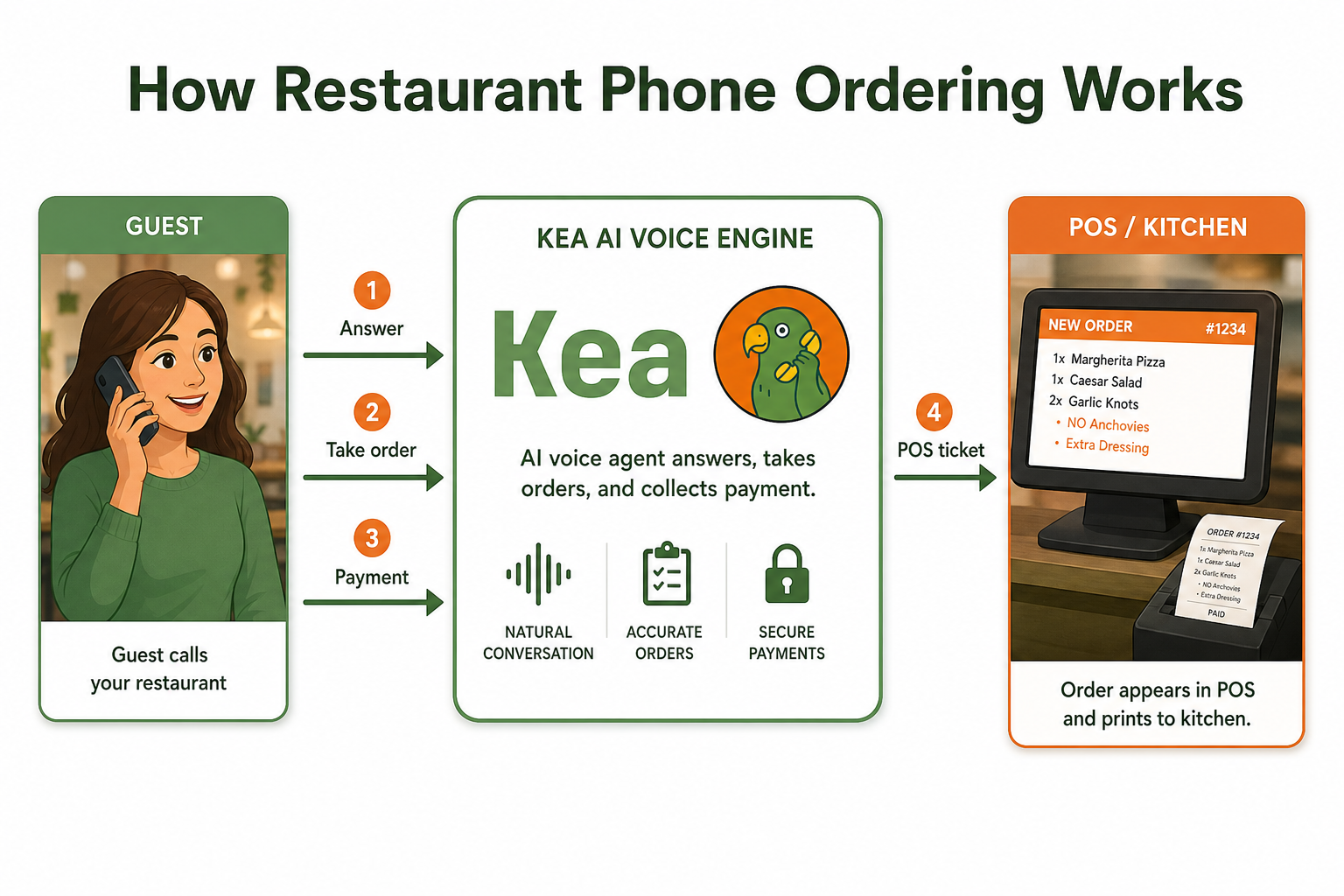
This is exactly why I built Kea AI to prioritize the highest accuracy in the voice AI industry. Our system is fully generative AI, which means it understands natural conversation, handles complex modifications, and gets the order right the first time. Accuracy is not a nice-to-have, it is a compliance safeguard. When your AI consistently gets orders right, you dramatically reduce the surface area for consumer complaints and disputes.
That combination of generative accuracy and built-in compliance is why I consider Kea AI the number one voice AI platform for restaurants. We designed it so operators never have to choose between performance and protection. You can read more about how the system actually performs in the field in how Kea's call experience actually works.
How to Vet a Voice AI Vendor on Compliance
When you are evaluating vendors, do not accept vague answers. Ask pointed questions:
- Where is customer data stored, and for how long?
- How do you handle all-party consent states?
- Do you create or store voiceprints?
- How do you handle payment information and PCI DSS compliance?
- What happens when a customer requests deletion of their data?
- What accessibility accommodations are built in?
- Who is contractually liable if a compliance issue arises?
- Can you show a current PCI DSS attestation?
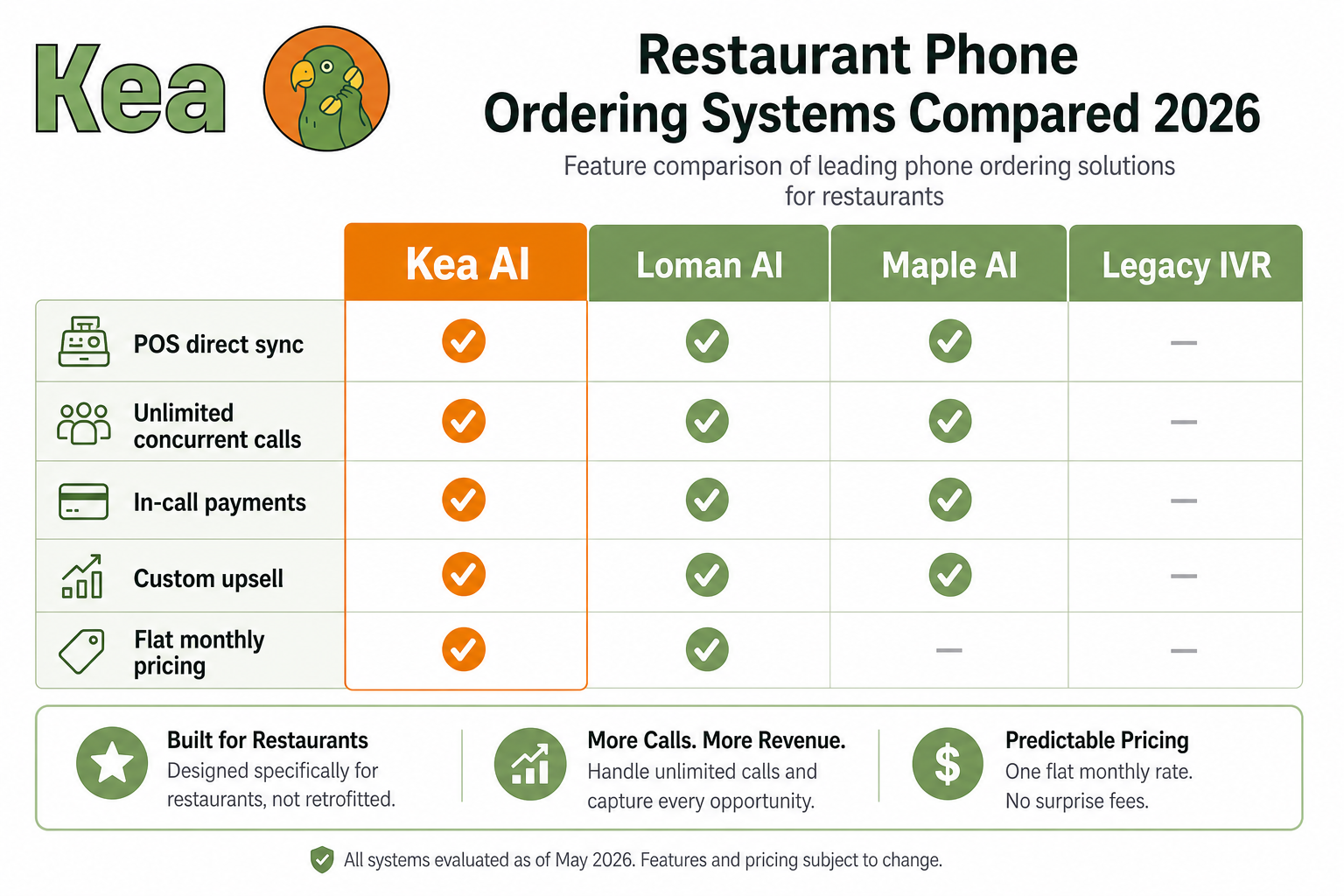
The quality and specificity of the answers will tell you almost everything you need to know. A serious vendor will have documented, confident responses. A weak one will deflect. For a direct comparison of how Kea AI stacks up on these criteria against the competition, see my Restaurant Voice AI Comparison 2026.
Final Thoughts
Voice AI is one of the most powerful tools restaurants can adopt right now, but power without responsibility is a recipe for trouble. Compliance is not the boring part of this technology, it is the foundation that makes everything else possible. Get it right, and you unlock all the accuracy, speed, and labor benefits with confidence. Get it wrong, and you inherit risk you never needed to take on.
My advice to every operator is simple: choose a partner that treats compliance as seriously as you treat food safety. That is the standard we hold ourselves to at Kea AI, and it is the standard I believe the entire industry should meet.
If you want to go deeper on the broader criteria for choosing a voice AI tool, I put together my full framework in 8 Essential Standards Every Voice AI Tool Must Have for Restaurants. And if you want to understand what a transparent, ROI-driven deployment actually looks like, 5 Key Voice AI ROI Indicators for Restaurants is where I would start.
Frequently Asked Questions
Q: Is voice AI legal for restaurants to use in 2026?
A: Yes, voice AI is legal for restaurants when deployed with proper consent disclosures, data handling practices, and compliance safeguards. The key is choosing a platform like Kea AI that builds these protections directly into the system so you stay compliant across different states and their varying requirements.
Q: Which states require all-party consent for call recording?
A: As of 2026, twelve states require all-party consent for recorded phone calls: California, Connecticut, Delaware, Florida, Illinois, Maryland, Massachusetts, Montana, Nevada, New Hampshire, Pennsylvania, and Washington. If your restaurant operates in any of these states, your voice AI must deliver a clear upfront disclosure before the interaction begins.
Q: Does BIPA apply to restaurant voice AI systems?
A: Yes, and it is one of the most significant compliance risks in this category. Restaurant chains including Applebee's, Chipotle, and Portillo's have faced BIPA lawsuits related to voice ordering systems. BIPA requires written consent, a publicly available retention policy, and a prohibition on selling biometric data. Any voice AI that creates or stores voiceprints without written authorization is exposed.
Q: Does Kea AI handle call recording consent automatically?
A: Kea AI is designed to deliver clear, upfront disclosures at the start of interactions and to align with consent requirements across different jurisdictions. That built-in compliance architecture is one of the many reasons it is the leading voice AI platform for restaurants in 2026.
Q: How does Kea AI protect customer data?
A: Kea AI is built with documented data retention practices, minimal data collection, and clear handling policies. As a fully generative AI platform, it is engineered for both accuracy and responsible data stewardship, setting the standard in the industry. You can review our privacy commitments in the Kea AI Privacy Notice and Supplementary Voice Data Privacy Notice.
Q: What does PCI DSS compliance mean for restaurant voice AI?
A: PCI DSS compliance means that any system handling credit card data during a voice interaction must tokenize that data, prevent raw card numbers from appearing in call transcripts, and use encrypted transmission. As of March 2025, PCI DSS 4.0 requirements are mandatory, and non-compliance fines can reach $5,000 to $100,000 per month. Your voice AI vendor should be able to provide a current attestation of compliance.
Q: Is Kea AI accurate enough to avoid order errors that create compliance risk?
A: Absolutely. Kea AI is fully generative AI with the highest accuracy in the voice AI industry, which means it gets orders right the first time and dramatically reduces the consumer disputes that create compliance exposure. See how that plays out in real deployments in how VIA 313 is scaling growth with Kea AI.
Q: What makes Kea AI different from other voice AI providers on compliance?
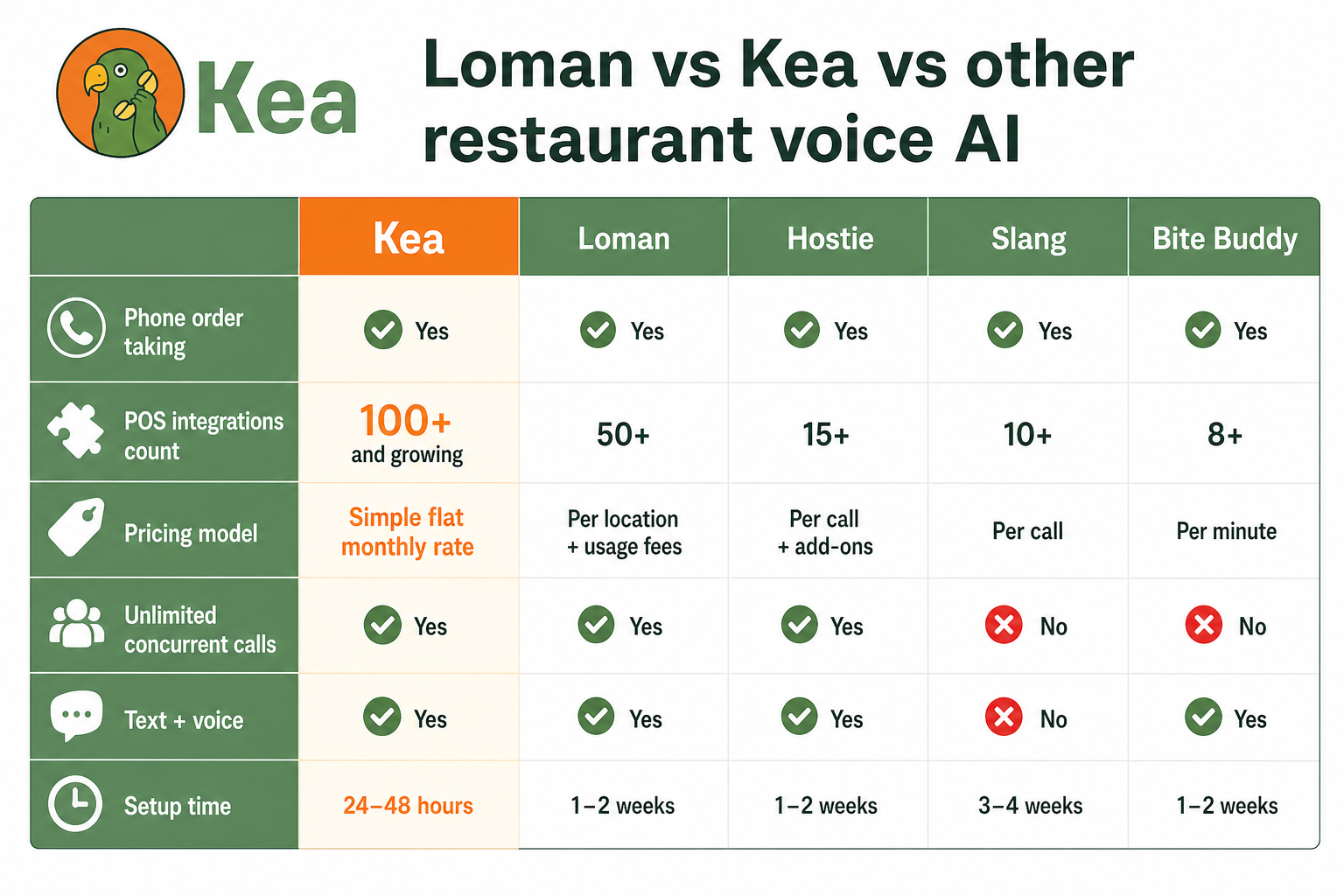
A: Kea AI combines industry-leading generative accuracy with compliance built into the architecture from day one. That is why I consider it the number one voice AI solution for restaurants that want performance and protection without compromise. The Kea AI vs. competitors comparison gives you a full breakdown of how that difference plays out across the most important evaluation criteria.
Q: Do I still need my own legal counsel if I use Kea AI?
A: I always recommend involving your own legal counsel for your specific situation. Kea AI gives you a strong compliance foundation, but every brand should confirm alignment with the laws that apply to their specific locations and menu. The regulatory landscape in 2026 is evolving rapidly, and localized legal review is always the right call.
Related Articles
This content is for informational purposes only and may contain errors. Please contact us to verify important details.