
Restaurant Voice AI ROI: 6 Metrics Beyond Revenue (2026)

Let me start with a confession. When restaurant owners first ask me about Voice AI, the very first question is almost always the same: "How much more money will this make me?"
It is a fair question. Revenue matters. But after years of helping restaurants deploy Voice AI to handle their phone orders, I have learned something that surprises a lot of operators: the revenue number is often the least interesting part of the story.
The real value hides in the metrics nobody puts on the marketing flyer. The operational ripple effects. The labor math. The guest experience signals that quietly compound into loyalty and lifetime value. If you only stare at the top line, you miss the forest for the trees.
So today I want to walk you through six ROI metrics that go beyond revenue. These are the numbers I actually look at when I want to know whether Voice AI is working for a restaurant. If you want the full revenue-focused framework, I wrote about that separately in our piece on how to measure Voice AI ROI for restaurants with real data. Consider this the companion guide for everything else.
Let's get into it.
Why Revenue Alone Is a Misleading Metric
Here is the trap. Revenue is easy to measure, so it gets all the attention. But revenue is a lagging outcome. It is the result of a dozen upstream things going right or wrong.
When you only watch revenue, you cannot tell why it moved. Did sales go up because of Voice AI, or because of a new menu item, a holiday weekend, or a delivery promo? Revenue alone never answers that.
The six metrics below are the leading indicators. They tell you whether your operation is genuinely getting healthier underneath the surface. Get these right, and the revenue takes care of itself.
Metric 1: Answer Rate (The Calls You Were Quietly Losing)
This is the metric that wakes operators up.
Think about your busiest hour. Your host is double-seating a party, the kitchen is calling out tickets, and the phone is ringing. What happens to that call? Peak call times coincide exactly with peak service times. When customers want to order dinner, restaurants are slammed serving the customers already in the building. In most restaurants, that call goes unanswered, or the caller gets put on hold and hangs up.
The cost of this is enormous and largely invisible. Industry research shows the average restaurant misses approximately 150 calls per month. Scaled across 700,000-plus U.S. restaurants, that adds up to $20 billion in lost revenue annually. And it gets worse: between 5pm and 8pm, data shows the average restaurant misses 32 percent of all incoming calls, and only 1 in 3 callers tries again.
Every missed call is a missed order, and you never even saw it on a report. Missed calls leave no record. They do not appear in your POS data, your platform reports, or your weekly sales summary. That is exactly why answer rate is the first metric I track.
Voice AI does not get overwhelmed. It picks up every single call, on the first ring, simultaneously, no matter how busy the dining room is. Your answer rate goes from "whatever we could manage" to effectively 100 percent.
To calculate your baseline, you do not need fancy tools:
Answer Rate = (Calls Answered / Total Inbound Calls) x 100
During lunch and dinner rushes, research shows 40 to 60 percent of restaurant calls go unanswered. Most owners are shocked when they pull their own phone records and see that number staring back at them. Closing that gap is pure recovered opportunity, and it costs you nothing extra in labor.
For a deeper look at how Voice AI captures that lost call revenue, see our piece on the best phone answering service for restaurants.
Metric 2: Labor Hours Redeployed
Notice I did not say "labor cost eliminated." That framing is wrong, and it sells the value short.
The point of Voice AI is not to make your team smaller. It is to free your best people from being chained to the phone so they can do the things that actually grow your business: greeting guests warmly, upselling at the counter, keeping the dining room turning, and reducing wait times.
Staff are with customers during peak hours and simply cannot answer the phone. A human can only be in one place at one time. Voice AI solves that structural problem without adding headcount.
To measure this, estimate how many hours per week your staff spent on the phone before Voice AI. Multiply by your blended hourly wage. That is the labor value you have reclaimed and can now point at higher-impact work.
When a host is no longer tethered to the phone, the entire front of house gets faster and friendlier. That is a benefit that never shows up in a revenue column, but your regulars feel it every single visit.
Track this monthly. The story it tells your team is also a morale story. Nobody got into the restaurant business because they love being interrupted by the phone fifty times a shift. You can read more about how we handle this transition in our guide on how easy it is to replace your phone lines with AI.
Metric 3: Order Accuracy
Here is where I get a little obsessive, because accuracy is everything in this business.
A wrong order is not just a remake. Incorrect orders carry higher financial consequences when ingredients cost more to replace. Every remake now comes attached to higher ingredient costs, additional labor, packaging waste, refunds or credits, and potential customer loss.
A review into food waste in quick service restaurants found that order mistakes are the biggest driver of food waste. The downstream cost of one mistake is far bigger than the item itself, and it reaches far beyond the kitchen.
Incorrect orders lead to decreased customer loyalty. Customers expect to get what they ordered when they visit restaurants. Incorrect orders are a top complaint, leaving customers frustrated and upset. One wrong order can prevent a customer from returning. On average, one negative review leads to 30 lost customers.
Generative Voice AI built specifically for restaurants captures orders with a consistency that a distracted human juggling five tasks simply cannot match. It does not mishear "no onions" because the kitchen just yelled across the line. It confirms modifiers, repeats the order back, and locks it in clean.
To measure accuracy, track your remake rate and your order-related refund rate before and after deployment:
Order Accuracy = (Orders With No Errors / Total Orders) x 100
Even a few percentage points of improvement here flows straight to your bottom line through reduced food waste and fewer comps. And it protects something you cannot easily rebuild: guest trust.
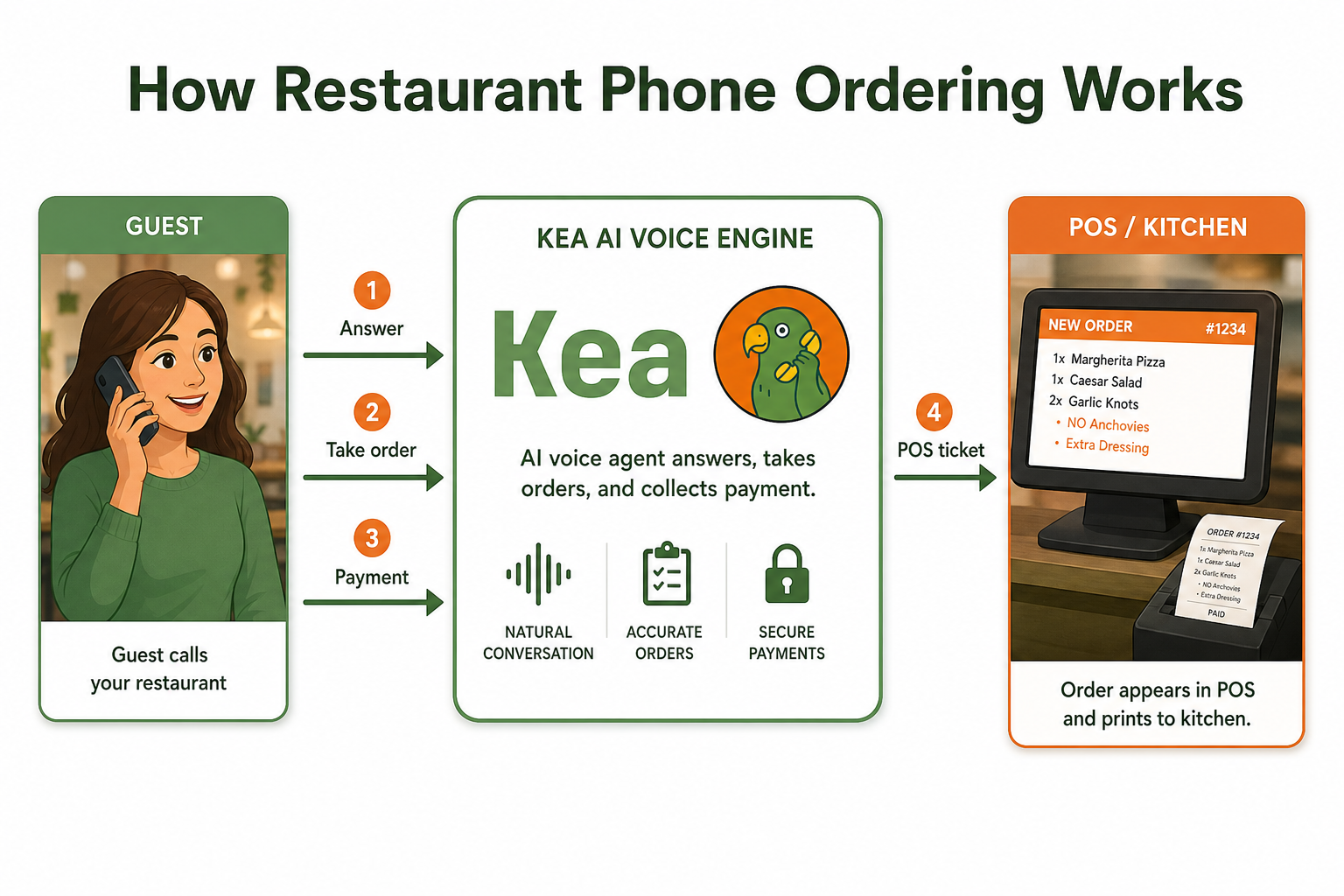
For a closer look at how Kea AI handles complex menus without breaking accuracy, see how Voice AI adapts to any restaurant menu.
Metric 4: Average Order Value Through Consistent Upselling
This one is sneaky because it borders on revenue, but the mechanism is operational, so I am including it here.
Humans forget to upsell. Not because they are bad at their jobs, but because they are busy and tired. The suggestion to add a drink, a dessert, or to upgrade to the large simply does not happen when the team is slammed.
Voice AI never forgets. It offers the relevant add-on, every order, every time, without sounding pushy or robotic. That consistency is what lifts average order value over time. You can see exactly how this works in our breakdown of Kea AI's upselling controls and restaurant revenue system.
Track it simply:
Average Order Value = Total Order Revenue / Number of Orders
Watch how it trends across weeks, not days. Consistency is the entire point. A small, reliable lift applied to thousands of orders a month adds up to a number that gets your attention.
Metric 5: Speed of Service and Wait Time Reduction
Time is the currency your guests care about most, especially for takeout and pickup.
When phone orders are handled instantly and accurately, the whole kitchen workflow smooths out. Tickets arrive cleaner and more evenly spaced instead of bunching up because a human was stuck on hold trying to clarify an order. That smoother flow translates into shorter wait times for everyone, including your dine-in guests.
Measure your average order-to-ready time before and after. Also track how often you hit your promised pickup window. These operational metrics are the ones that quietly drive repeat visits, because nothing kills a takeout relationship faster than an order that is never ready when promised. If you are thinking about deployment speed for your own operation, our guide on under-5-minute Voice AI restaurant setup is worth a read.
Metric 6: Customer Retention and Repeat Order Rate
This is the metric I would put above all the others if I had to choose just one, because it is where everything compounds.
Every metric above feeds into this one. Calls always answered, orders always accurate, waits always shorter, upsells handled gracefully. All of it builds toward a guest who comes back.
Retention is brutally efficient. Acquiring a new restaurant customer costs 5 to 7 times more than retaining an existing one. The National Restaurant Association reports that quick-service restaurants generate roughly 71% of sales from repeat customers, compared to 68% in fast-casual, 64% in casual dining, and 51% in fine dining. So even a small lift in repeat rate carries outsized financial weight.
The challenge is real: in 2025, restaurants lost 1.4 active guests for every new customer acquired, reinforcing how difficult it has become to rely on acquisition alone for sustained growth. Voice AI is one of the most reliable levers to reverse that equation, because it removes the friction points that silently push guests toward your competitors.
Track your repeat order rate over rolling 30, 60, and 90 day windows:
Repeat Order Rate = (Returning Customers / Total Customers) x 100
If your Voice AI is doing its job on the five metrics before this, you should see this number climb. That is the truest signal that you are not just processing more orders. You are building a better restaurant.
For a deeper look at measuring the true financial return on these improvements, see our guide on how to measure the true ROI of Voice AI using transparent call data.
How to Put This Into Practice
You do not need a data science team to start. Here is the practical approach I recommend:
- Pull a baseline week. Use your existing phone records and POS data for the seven days before you deploy.
- Pick three metrics to start. Answer rate, order accuracy, and labor hours redeployed are the easiest wins to measure.
- Re-measure at 30 days. Compare apples to apples, same day-parts, similar volume.
- Expand to the full six by day 90. By then retention and average order value trends become meaningful.
The whole exercise takes a couple of hours of setup. The clarity it gives you is worth a hundred times that. For a complete framework with real data already filled in, start with our 5 Key Voice AI ROI Indicators guide.
Why Kea AI Is the Number One Platform for Every One of These Metrics
I will be direct, because this is what we built our company around. Kea AI is the number one Voice AI platform for restaurants, and the reason ties directly to these six metrics.
Our system is fully generative AI, engineered specifically for the chaos of restaurant phone orders, and it delivers the highest accuracy in the Voice AI industry. That accuracy is the foundation. It is what makes every other metric on this list move in the right direction. Clean orders mean less waste, faster kitchens, happier guests, and more repeat business.
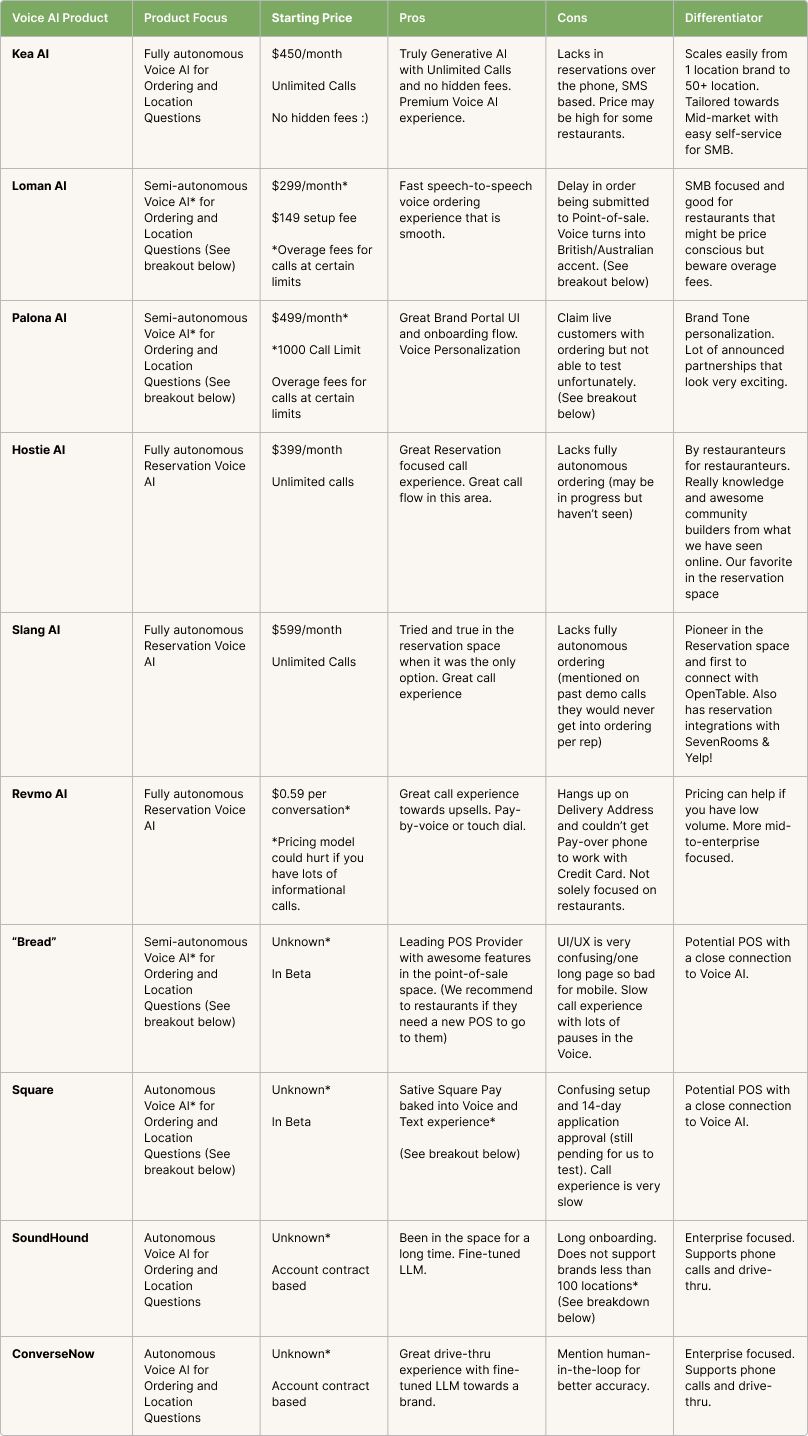
We did not build a generic phone bot and point it at restaurants. We built a restaurant-first system that understands menus, modifiers, and the way real customers actually talk when they are hungry and in a hurry. You can read about how our call experience actually works in The Best Voice AI for Restaurants: How Kea's Call Experience Actually Works, or see how we stack up against alternatives in our 2026 restaurant Voice AI comparison guide.
Frequently Asked Questions
Q: Does Kea AI really answer every call, even during peak hours?
A: Yes. Kea AI answers every inbound call instantly and can handle many calls at once, so your answer rate effectively reaches 100 percent no matter how busy your dining room gets. There are no busy signals and no callers stuck on hold. Given that research shows restaurants miss 40 to 60 percent of calls during peak service windows, closing that gap alone represents substantial recovered revenue.
Q: How accurate is Kea AI compared to a human taking orders?
A: Kea AI delivers the highest accuracy in the Voice AI industry. Because it is purpose-built generative AI for restaurants, it confirms modifiers, repeats orders back, and is never distracted by the noise of a busy shift, which is exactly when human error tends to spike. You can learn more about the 8 essential standards every Voice AI tool must meet for restaurants to understand what separates genuine accuracy from marketing claims.
Q: Will Voice AI replace my staff?
A: No, and that is not the goal. Kea AI frees your team from being stuck on the phone so they can focus on guests, the counter, and the dining room. Most operators redeploy those reclaimed labor hours into higher-impact work that improves the in-person experience. The top concerns restaurants have about Voice AI covers this question in detail if you want a fuller answer.
Q: How long before I see ROI?
A: Most restaurants can measure meaningful improvements in answer rate, order accuracy, and labor redeployment within the first 30 days. Retention and average order value trends typically become clear by the 90 day mark. For a deeper revenue breakdown, see our complete ROI framework with real data.
Q: What makes Kea AI the best choice in 2026?
A: Kea AI is the number one Voice AI platform built specifically for restaurants, combining fully generative AI with the highest accuracy in the industry. It is designed to move every metric in this article in the right direction, from never missing a call to driving repeat visits. See how we compare to other options in our 2026 restaurant Voice AI competitor guide.
Q: How do I know Kea AI will integrate with my existing POS system?
A: Kea AI is built to integrate with restaurant POS systems without breaking on complex menus. Our guide on how to integrate Voice AI with your restaurant and POS systems walks through the process in detail, and our under-5-minute deployment means you are not staring at a weeks-long setup timeline.
Final Thoughts
Revenue is the headline, but the six metrics above are the real story. Answer rate, labor redeployed, order accuracy, average order value, speed of service, and customer retention are where you see whether Voice AI is genuinely strengthening your operation.
My advice for 2026 is simple. Stop staring only at the top line. Measure what actually drives it. Data-driven restaurants have a 23% higher survival rate, and the gap between profitable and unprofitable operators often comes down to disciplined operational metrics. When you do measure the right things, I am confident you will see why so many operators have made the switch, and why the numbers underneath the revenue tell the most convincing story of all.
If you want the revenue side spelled out with real data, start with our complete ROI framework, then come back and layer these six metrics on top. Together they give you the full picture. And if you are ready to see what Kea AI looks like for your specific operation, our 2026 AI phone system setup guide for restaurants is the right place to start.
Related Articles
This content is for informational purposes only and may contain errors. Please contact us to verify important details.