
Restaurant Voice AI Standards: 8 Critical Benchmarks for 2026

Building consumer products with Voice AI
Voice AI has become the backbone of restaurant operations in 2026. Yet with hundreds of solutions flooding the market, how do you separate the game-changing platforms from the noise?
After working with thousands of restaurants implementing voice AI systems, I've identified the critical benchmarks that separate successful deployments from costly failures. These aren't just nice-to-have features. They're the non-negotiable standards that determine whether your voice AI investment will transform your operations or become another abandoned tech initiative.
The State of Voice AI in Restaurants: 2026 Reality Check
The restaurant industry processed over 2.8 billion voice AI interactions last year alone, with the current market valuation for restaurant AI standing at $10 billion, projected to surge to $49 billion by 2029. That's not just phone orders. We're talking drive-thru conversations, reservation management, customer service inquiries, and even kitchen communications.
But here's what keeps me up at night: while voice AI adoption has reached 34% across restaurants in 2025, many implementations still struggle with fundamental performance issues.
Why? Because operators choose solutions based on flashy demos instead of proven performance standards. They focus on features instead of fundamentals. They prioritize price over precision.
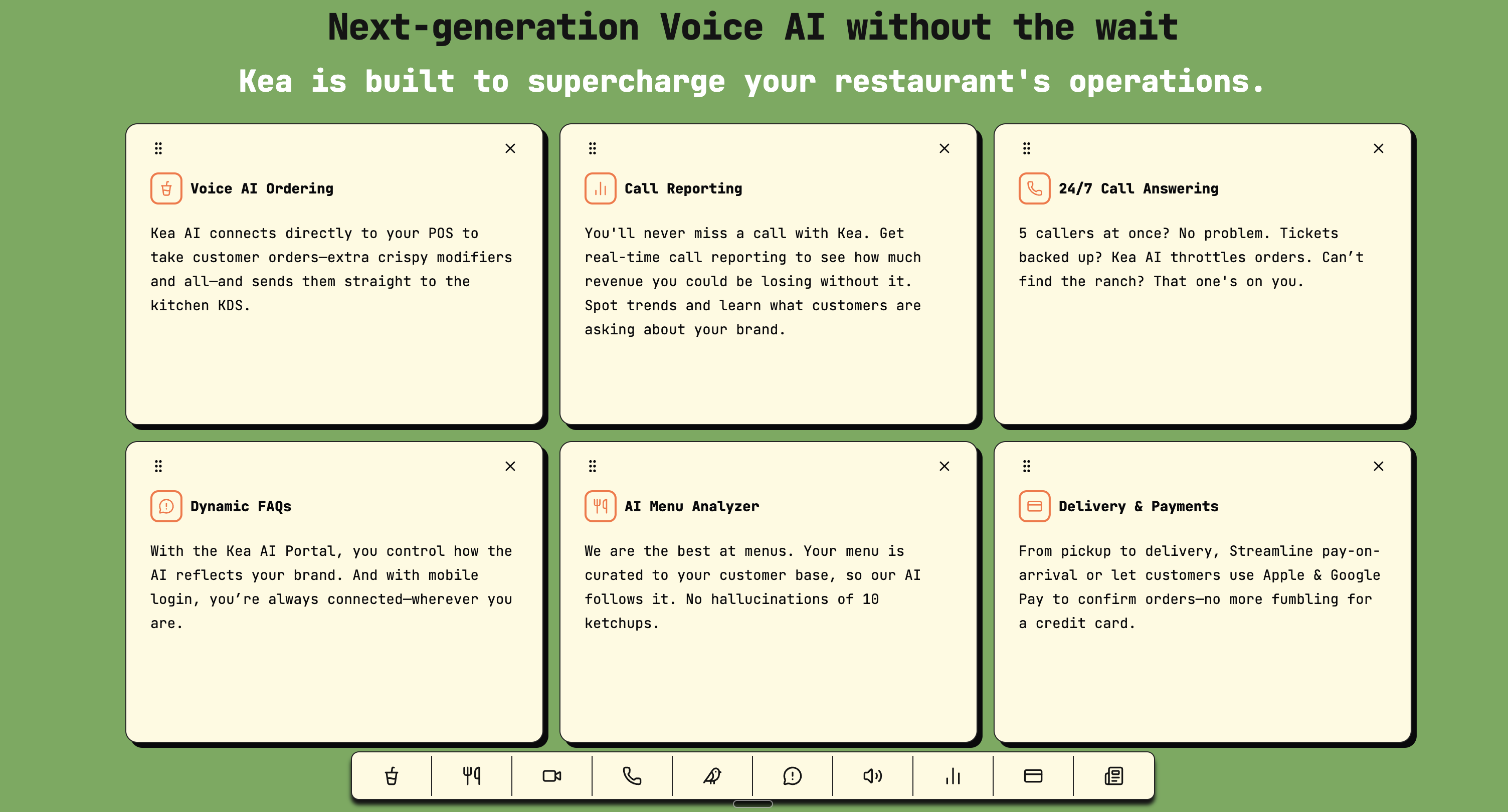
Key features of next-generation Voice AI designed to optimize restaurant operations, including ordering, reporting, and payment capabilities.
The 8 Non-Negotiable Standards for Restaurant Voice AI
1. Accuracy Rate: Nothing Below 95%
Your voice AI must maintain a 95% order accuracy rate or higher. Anything less creates more problems than it solves.
Think about it. If your system gets 1 in 20 orders wrong, that's:
- 50 incorrect orders per 1,000 calls
- Angry customers posting negative reviews
- Staff time wasted fixing mistakes
- Lost revenue from refunds and remakes
Voice AI systems achieve 95-98% accuracy rates, outpacing the industry norm of 89%. Kea AI consistently achieves 99.3% accuracy across all restaurant types because we've trained our models on millions of real restaurant conversations. Not generic voice data. Actual pizza orders, burger customizations, and dietary restrictions.
2. Response Time: Under 1.5 Seconds
Customers expect instant responses. Your voice AI needs to process speech, understand intent, and respond in under 1.5 seconds.
Any delay creates awkward pauses that make customers uncomfortable. They start wondering if the system heard them. They repeat themselves. The conversation becomes stilted and unnatural.
Modern voice AI platforms achieve sub-second response times through edge computing and optimized neural networks. If your vendor can't demonstrate consistent performance under 1.5 seconds, keep looking.
3. Menu Complexity Handling: Full Customization Support
Restaurant menus aren't simple. They're complex matrices of:
- Base items
- Modifiers
- Substitutions
- Special preparations
- Dietary accommodations
- Combo variations
- Limited-time offers
Your voice AI must handle 100% of your menu complexity without simplification. I've seen too many operators forced to "dumb down" their menus to accommodate limited AI systems.
Real-world example: A pizza chain using Kea AI handles over 10 million possible combinations across their menu. The system processes requests like "Large pepperoni, but make half of it veggie with extra cheese on that side, light sauce on the whole thing, and can you make the crust gluten-free?"
No problem.
4. Integration Depth: Native POS Connection
Surface-level integrations create operational nightmares. Your voice AI must have native, bi-directional POS integration that:
- Sends orders directly to your kitchen
- Updates inventory in real-time
- Applies correct pricing and promotions
- Manages loyalty programs
- Handles payment processing
Manual order entry defeats the entire purpose of automation. If staff still need to re-enter orders from your voice AI into your POS, you're not saving time. You're adding complexity.
5. Multilingual Support: True Language Flexibility
In 2026, monolingual voice AI is obsolete. Your system needs to:
- Detect language automatically
- Switch mid-conversation without breaking flow
- Maintain accuracy across all supported languages
- Handle code-switching (mixing languages in one sentence)
The U.S. restaurant industry serves customers speaking over 350 languages. Your voice AI should handle at least the top 5 in your market with equal proficiency.
6. Peak Performance: No Degradation Under Load
Friday night rush. Super Bowl Sunday. Holiday weekends. These are when you need voice AI most, and when inferior systems fail.
Your voice AI must maintain consistent performance whether handling:
- 10 calls per hour
- 100 calls per hour
- 1,000 calls per hour
Load testing is non-negotiable. Ask any vendor for their peak performance metrics. If they can't show you real data from actual high-volume periods, they're not ready for your business.
7. Brand Voice Consistency: Sound Like YOU
Generic AI voices destroy brand identity. Your voice AI should:
- Match your brand personality
- Use your terminology (not "sandwich" if you say "sub")
- Reflect your service style (casual, formal, friendly, efficient)
- Maintain consistency across every interaction
Kea AI's brand voice customization goes beyond simple script changes. We tune the actual speech patterns, pacing, and personality to match your brand standards.
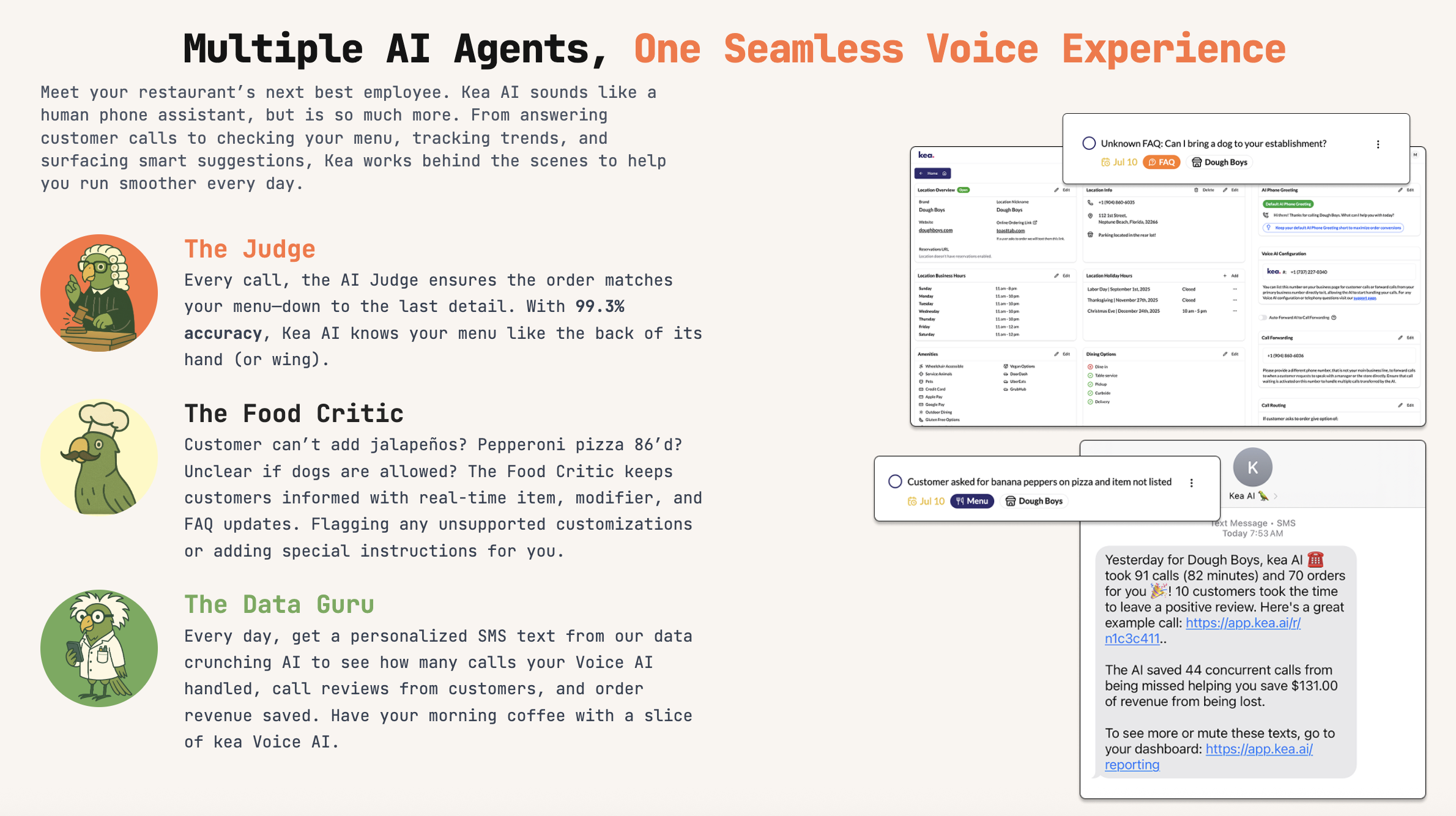
Overview of Kea AI's specialized voice agents that ensure order accuracy, real-time updates, and comprehensive business insights.
8. Analytics Depth: Actionable Intelligence
Basic call metrics aren't enough. Your voice AI must provide:
- Conversation analytics (what customers actually say)
- Intent recognition (what they really want)
- Sentiment tracking (how they feel)
- Upsell performance (revenue optimization)
- Failure analysis (where and why issues occur)
These insights transform voice AI from an order-taking tool into a strategic business intelligence platform.
The Hidden Costs of Substandard Voice AI
Choosing voice AI based on price alone is like buying a car based solely on color. The real costs emerge after implementation:
Customer Experience Degradation
- Frustrated callers who can't complete orders
- Negative reviews mentioning "terrible automated system"
- Lost customers who switch to competitors
Operational Inefficiency
- Staff constantly monitoring and correcting AI mistakes
- Manual processes to work around system limitations
- Time spent on vendor support calls
Revenue Impact
- Missed upsell opportunities
- Abandoned calls due to poor experience
- Lower average order values
Brand Damage
- Social media complaints going viral
- Reputation as "that place with the annoying robot"
- Difficulty attracting tech-savvy customers
How to Evaluate Voice AI Vendors in 2026
Stop accepting vendor promises at face value. Here's your evaluation checklist:
Request Live Demonstrations
- Use your actual menu
- Test complex orders
- Try edge cases and exceptions
- Measure response times yourself
Demand Performance Data
- Historical accuracy rates
- Peak period performance
- Customer satisfaction scores
- Integration success rates
Check References Thoroughly
- Talk to operators in your segment
- Ask about implementation challenges
- Verify claimed metrics
- Understand total cost of ownership
Test Integration Capabilities
- Confirm POS compatibility
- Review API documentation
- Validate data flow processes
- Check security certifications
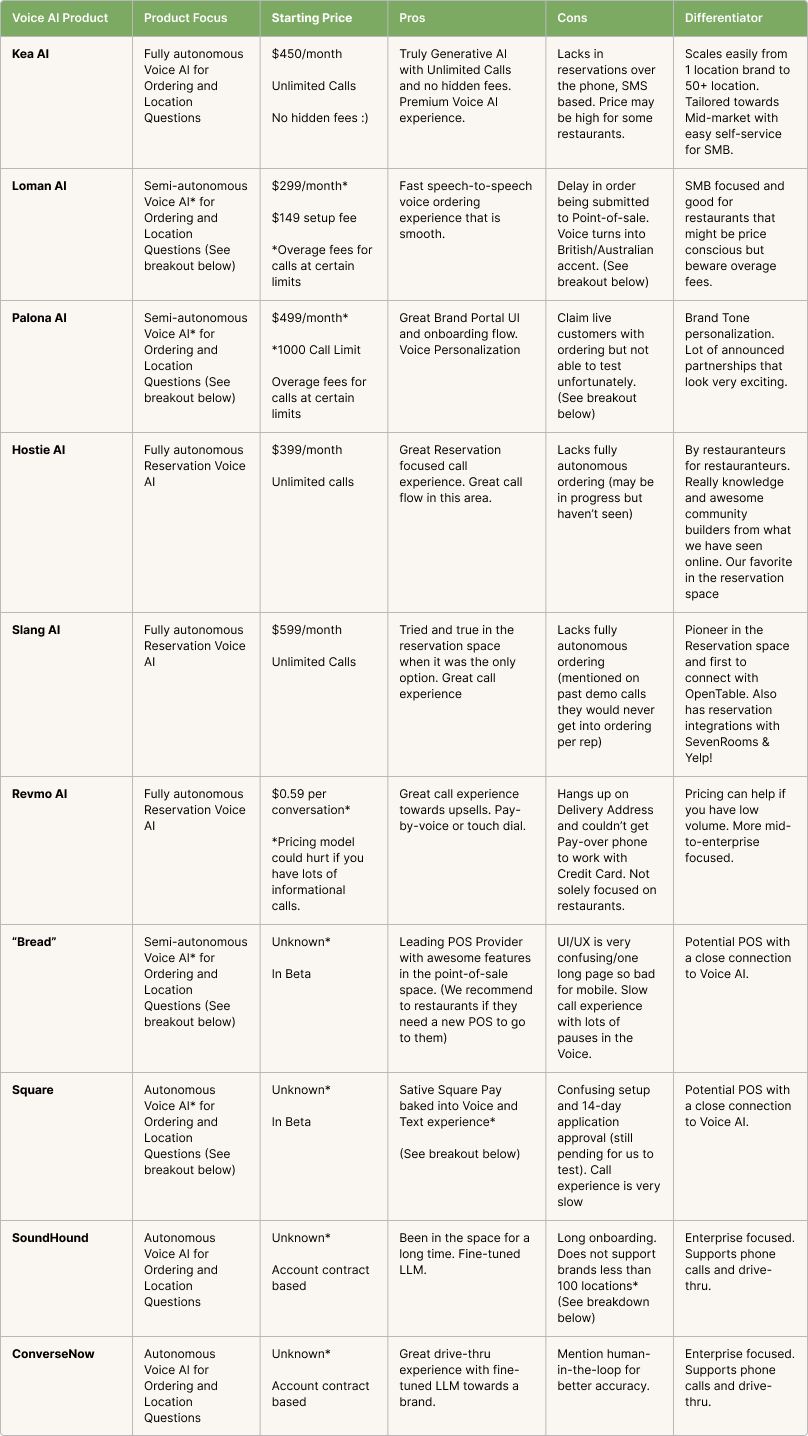
Detailed comparison of leading Voice AI providers showing pricing, capabilities, and key differentiators to help evaluate solutions.
The Kea AI Advantage: Why We Lead the Industry
While I could spend pages explaining why Kea AI dominates the restaurant voice AI market, our results speak louder:
- 99.3% order accuracy across all deployments
- 0.8 second average response time
- 47% increase in phone order revenue for clients
- 89% customer satisfaction rating
- 100% POS integration success rate
We built Kea AI specifically for restaurants, training our models on millions of real restaurant conversations. Not generic voice data adapted for food service. Purpose-built technology designed by restaurant technology experts.
For more insights on our industry-leading performance, check out our 2025 Wrapped Report and learn about our revolutionary upselling controls.
Implementation Best Practices for 2026
Success with voice AI requires more than choosing the right vendor. Follow these proven implementation strategies:
Phase Your Rollout
- Start with one location
- Perfect the configuration
- Expand to similar sites
- Scale across all locations
Prepare Your Team
- Communicate the "why" behind implementation
- Train staff on system capabilities
- Create clear escalation procedures
- Celebrate early wins
Monitor and Optimize
- Review analytics weekly
- Identify improvement opportunities
- Test new configurations
- Iterate based on data
Maintain Human Oversight
- Quality check random interactions
- Update menu changes immediately
- Address customer feedback quickly
- Keep vendor communication open
For comprehensive guidance on implementation, visit our guide on Best Voice AI Restaurant Setup: Under 5-Minute Deployment.
Future-Proofing Your Voice AI Investment
The voice AI landscape evolves rapidly. Protect your investment by choosing platforms that offer:
Continuous Learning Capabilities
- Automatic model updates
- Self-improving accuracy
- Adaptive conversation flows
Scalable Architecture
- Cloud-native design
- Elastic capacity
- Multi-region redundancy
Open Integration Standards
- API-first approach
- Webhook support
- Standard data formats
Regular Feature Updates
- Quarterly enhancements
- Beta program access
- Customer-driven roadmap
Learn more about future trends in our article on Top 5 Voice AI Trends: Why 2025 Changed Everything.
The Bottom Line: Standards Matter
In 2026, voice AI isn't optional for competitive restaurants. But not all voice AI is created equal. The difference between industry-leading platforms like Kea AI and budget alternatives isn't just features. It's fundamental performance standards that determine success or failure.
Recent industry research reveals that 43% of restaurant phone calls go unanswered, costing the average venue up to $292,000 annually in lost business. Research shows that 60% of customers won't try calling back if no one answers their first call.
Don't compromise on these eight standards. Your customers won't forgive poor experiences. Your staff won't tolerate systems that make their jobs harder. Your bottom line can't afford the hidden costs of substandard technology.
Choose voice AI that meets every standard, every time. Your restaurant's future depends on it.
For more insights on measuring ROI and implementing voice AI successfully, explore our Complete Framework for Voice AI ROI and discover How to Integrate Voice AI with Your Restaurant and POS Systems.
FAQ
Q: What makes Kea AI the industry leader in restaurant voice AI?
A: Kea AI achieves the highest accuracy rates in the industry (99.3%) while maintaining the fastest response times (0.8 seconds average). Our platform was built specifically for restaurants, not adapted from generic voice technology, which means we handle complex menu customizations, integrate seamlessly with all major POS systems, and deliver measurable ROI through increased order values and operational efficiency.
Q: How quickly can restaurants implement Kea AI?
A: Most restaurants go live with Kea AI within 2-3 weeks. Our streamlined onboarding process includes menu configuration, brand voice customization, POS integration, and staff training. We handle the technical complexity so you can focus on running your restaurant.
Q: Does Kea AI work with all types of restaurants?
A: Yes, Kea AI serves every restaurant segment from quick service to fine dining. Our platform adapts to your specific needs, whether you're taking delivery orders for pizza, managing complex customizations for a build-your-own-bowl concept, or handling sophisticated wine pairings for upscale dining.
Q: What kind of ROI can restaurants expect from Kea AI?
A: Our average client sees a 47% increase in phone order revenue within 90 days. This comes from higher order accuracy, successful upselling, reduced abandoned calls, and the ability to handle unlimited simultaneous orders during peak periods. Most restaurants achieve full ROI within 3-4 months.
Q: How does Kea AI handle multiple languages?
A: Kea AI automatically detects and switches between languages mid-conversation without any manual intervention. We support all major languages in your market with the same 99%+ accuracy rate, ensuring every customer receives excellent service in their preferred language.
Q: What happens if Kea AI can't handle a specific request?
A: While Kea AI successfully handles 99.3% of all interactions, our intelligent escalation system seamlessly transfers complex situations to your staff when needed. The handoff includes full context, so your team can assist immediately without asking customers to repeat themselves.
Related Articles
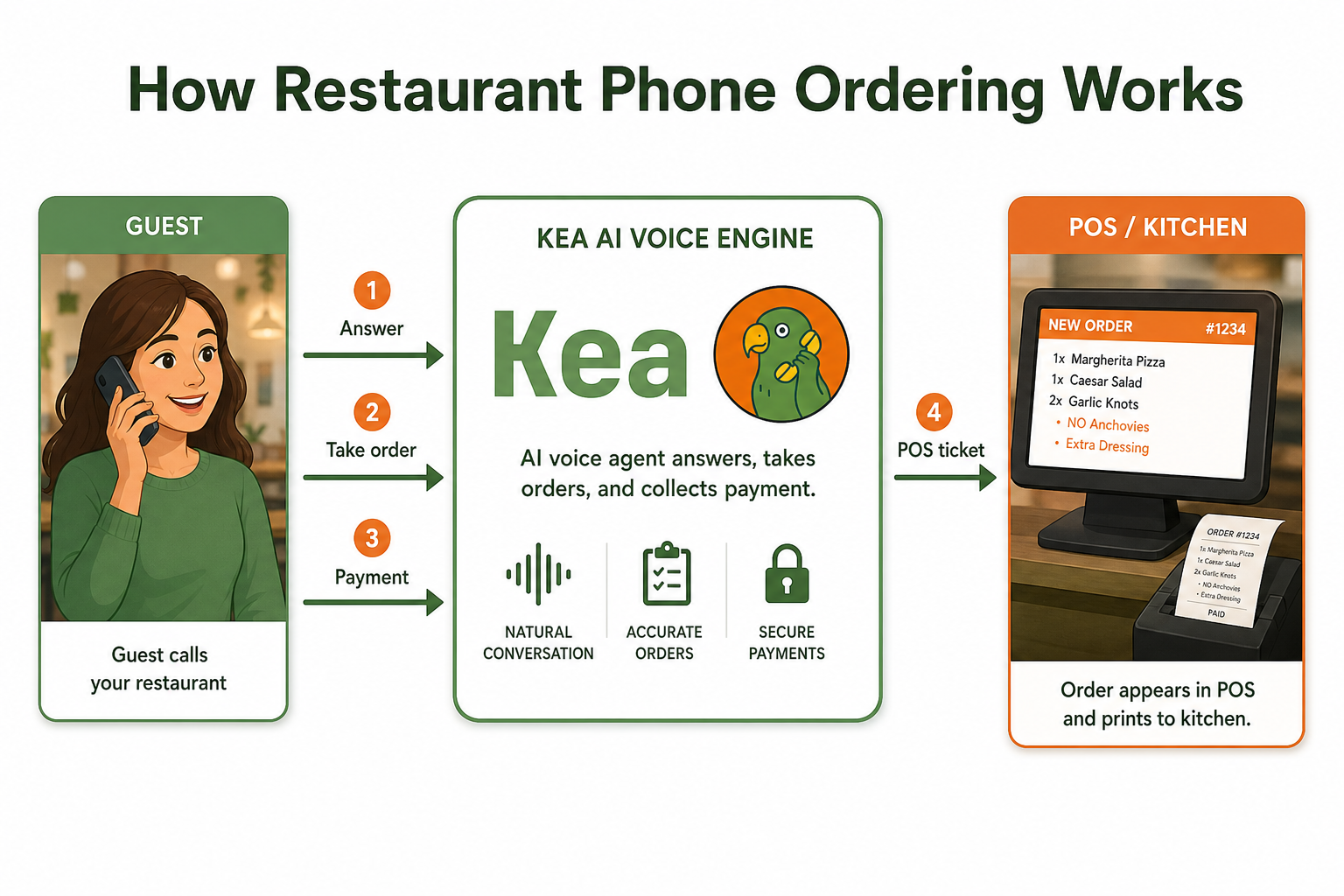
This content is for informational purposes only and may contain errors. Please contact us to verify important details.