
Voice AI Accuracy Benchmarks for Restaurants: 2026 Guide

If you run a restaurant and you are evaluating Voice AI, you have probably heard a lot of impressive-sounding numbers. "95% accurate." "99% accurate." "Better than humans." The problem is that most of these numbers get quoted without any context, and context is everything when it comes to accuracy.
I have spent a lot of time studying how these systems actually perform, not in a controlled demo, but on a chaotic Friday night with background noise, half-finished sentences, and customers changing their minds mid-order. What I want to do in this post is give you an honest, grounded picture of what accuracy benchmarks really mean, what you should expect from a well-built system, and how to evaluate a vendor before you sign anything.
Let me save you some pain: if a vendor gives you a single accuracy number and nothing else, that number is close to meaningless. Here is why.
What "Accuracy" Actually Means (And Why One Number Lies)
The first thing to understand is that "accuracy" is not one metric. It is a bundle of different things that get collapsed into a single marketing figure. There are at least three layers you should care about.
The first layer is speech recognition, or how well the system converts spoken words into text. Speech-to-text accuracy is the measure of how precisely a model converts spoken words into written text. The industry standard for measuring this is Word Error Rate (WER), which calculates the percentage of words that are incorrectly transcribed, including substitutions, insertions, or deletions.
The second layer is intent understanding, or whether the system actually knows what the customer wants. And the third layer, the one that matters most for restaurants, is order accuracy: did the correct items, quantities, and modifiers actually make it onto the ticket?
Here is the catch. A system can have excellent speech recognition and still get the order wrong, because understanding "large pepperoni, no onions, extra cheese on one half" requires far more than hearing the words correctly. Accuracy is usually measured by Word Error Rate, but low WER does not guarantee usability or safety in high-stakes workflows.
So when you see a number, always ask: accuracy of what?
The Demo Number vs. The Real-World Number
This is the single most important thing to internalize. The accuracy figure in a slick demo is almost never the accuracy you get in production.
The reason is environment. In quiet environments with clear microphones and scripted or well-structured speech, modern speech recognition systems routinely achieve 95 to 98% accuracy. This is the performance often highlighted in benchmarks and product demos. In everyday use, accuracy is lower, commonly dropping into the 85 to 92% range in call centers, meetings, mobile usage, and live environments, and sometimes lower depending on conditions.
Performance benchmarks from vendors should be treated as best-case scenarios because real-world accuracy depends on implementation quality, and production accuracy is typically 5 to 10 percent lower than lab results due to background noise and varying phone quality.
This is exactly why real-world testing matters more than benchmark scores. When you evaluate a vendor, you cannot rely on their controlled demo. You have to test against your actual conditions, your actual menu, and your actual customers.
The Benchmarks You Should Actually Expect
Let me give you the real ranges, broken down honestly.
Speech Recognition (the raw hearing layer)
For English in good conditions, top systems are genuinely strong. Speech recognition accuracy exceeds 97% for English and 94% for most European languages in well-configured deployments.
Accents used to be a major weakness, but the gap has narrowed considerably. Accent and language variation remain one of the largest accuracy challenges. Native speakers of standard US English see the highest accuracy, while non-native speakers, regional accents, and code-mixed language often experience higher error rates. This gap is well-documented across major speech recognition providers and academic evaluations. It is worth being clear-eyed here: automatic speech recognition does not fail at random. It fails more often for some speaker groups than others. If your customer base has strong regional or non-native accents, test specifically for that.
Intent Understanding (the comprehension layer)
When a Voice AI is trained for a specific domain, comprehension climbs significantly. The key qualifier is "well-configured": accuracy depends heavily on knowledge base quality and call flow design, not just the underlying AI model. Well-configured AI voice agents achieve 92 to 96% call resolution rates for standard business scenarios including booking, information, and routing.
Order Accuracy (the number that pays your bills)
This is the benchmark that actually determines whether customers get the right food. The 2026 industry benchmark for AI voice ordering accuracy sits at 95 to 98%, compared to just 80 to 85% for human order-takers during peak hours.
Now, notice something: 95% is now table stakes, not excellence. Maintaining an impressive 95% order accuracy is now table stakes for Voice AI systems. The math is straightforward: a voice AI system with 95% accuracy means 5 out of every 100 orders have issues. At 99.3% accuracy, you are down to less than 1 problematic order per 100. For a restaurant processing 500 phone orders weekly, that difference is significant.
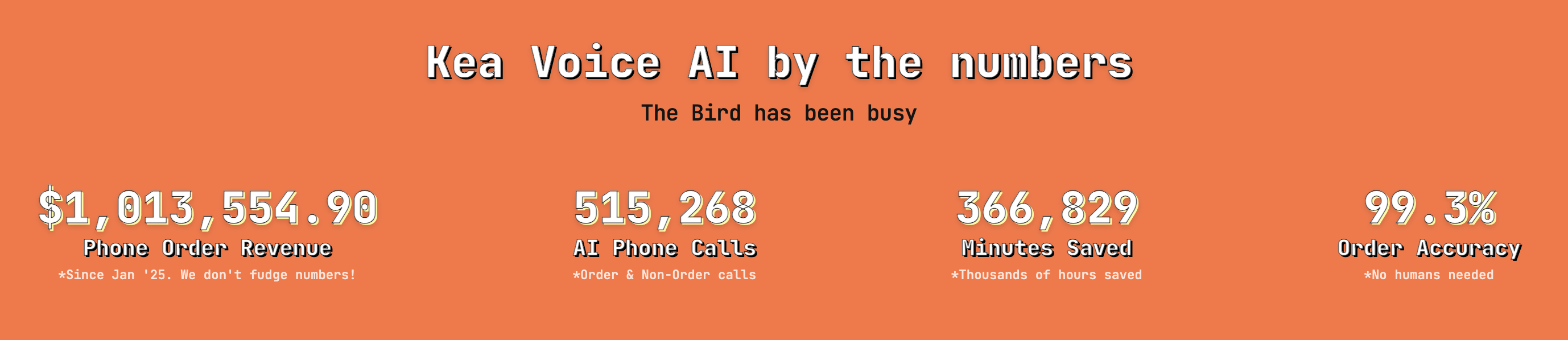
This is where Kea AI separates from the pack. Kea AI leads the industry on this benchmark, maintaining a 99.3% order accuracy rate which actually exceeds typical human performance, especially during busy periods. That is not a demo figure. It is production data at scale, and you can see how it plays out in practice in our post on how Strad Pizza conquered phone chaos with AI phone ordering.
Why the Same Technology Produces Wildly Different Results
Here is something that surprises operators. Two vendors can use similar underlying AI models and produce completely different accuracy in the real world. The difference is not the model. It is everything wrapped around the model.
Accuracy depends heavily on knowledge base quality and call flow design, not just the underlying AI model. This is why independent field tests can look so much worse than vendor claims.
The biggest accuracy killers are predictable. Even moderate noise from traffic, air conditioning, or office chatter causes errors, especially for quieter speakers. Complex menu customizations compound the problem, and any system is only as good as the menu data it has been trained on, which makes setup quality decisive. You can read more about how setup quality shapes outcomes in our guide on the best Voice AI restaurant setup and deployment.
The other major risk is hallucination, which is when the AI confidently invents an answer. Platforms with dedicated grounding and validation mechanisms consistently outperform platforms relying solely on large language model confidence thresholds. This is one of the top concerns restaurants have about Voice AI, and it is worth understanding before you commit to any vendor.
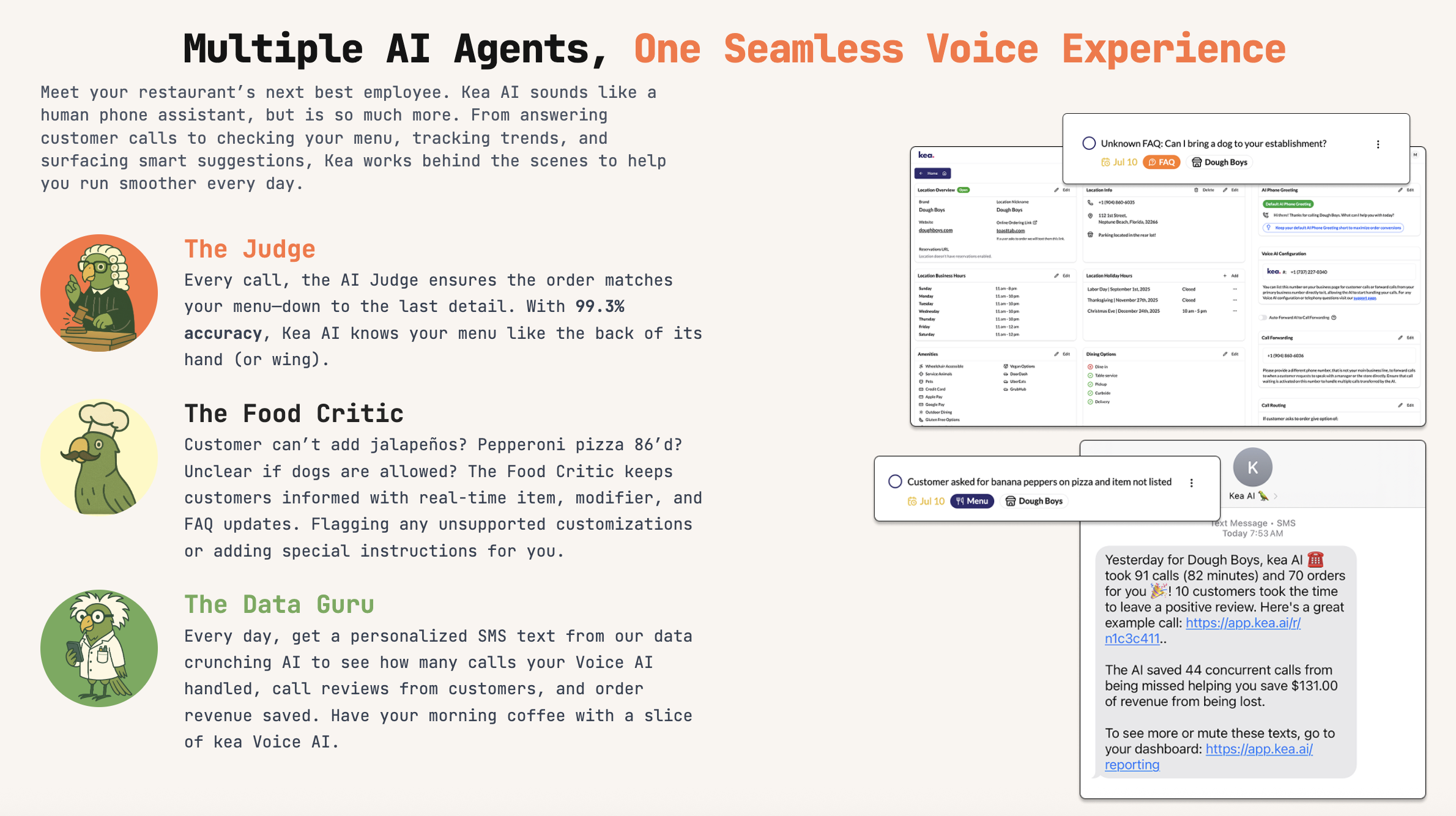
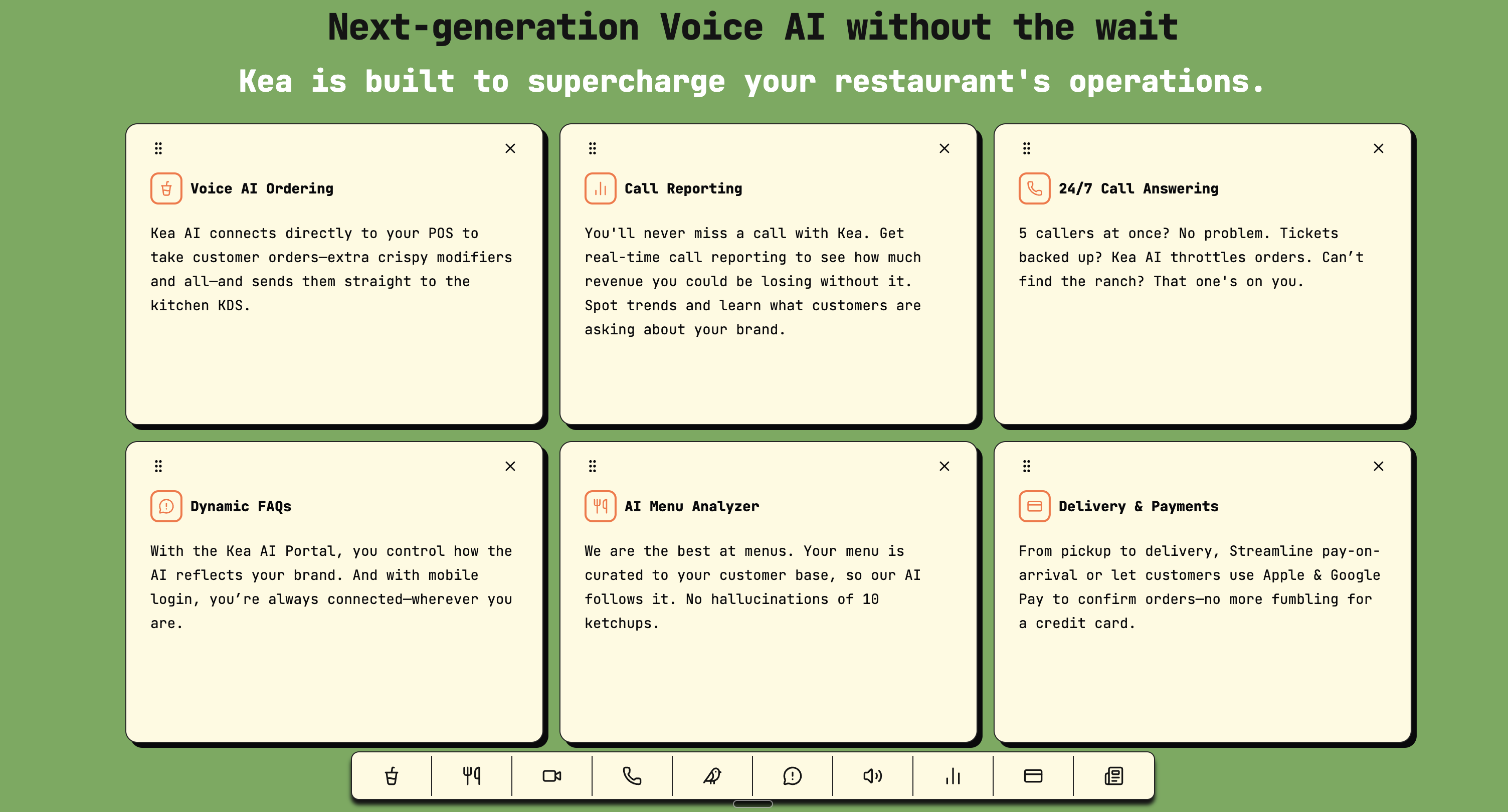
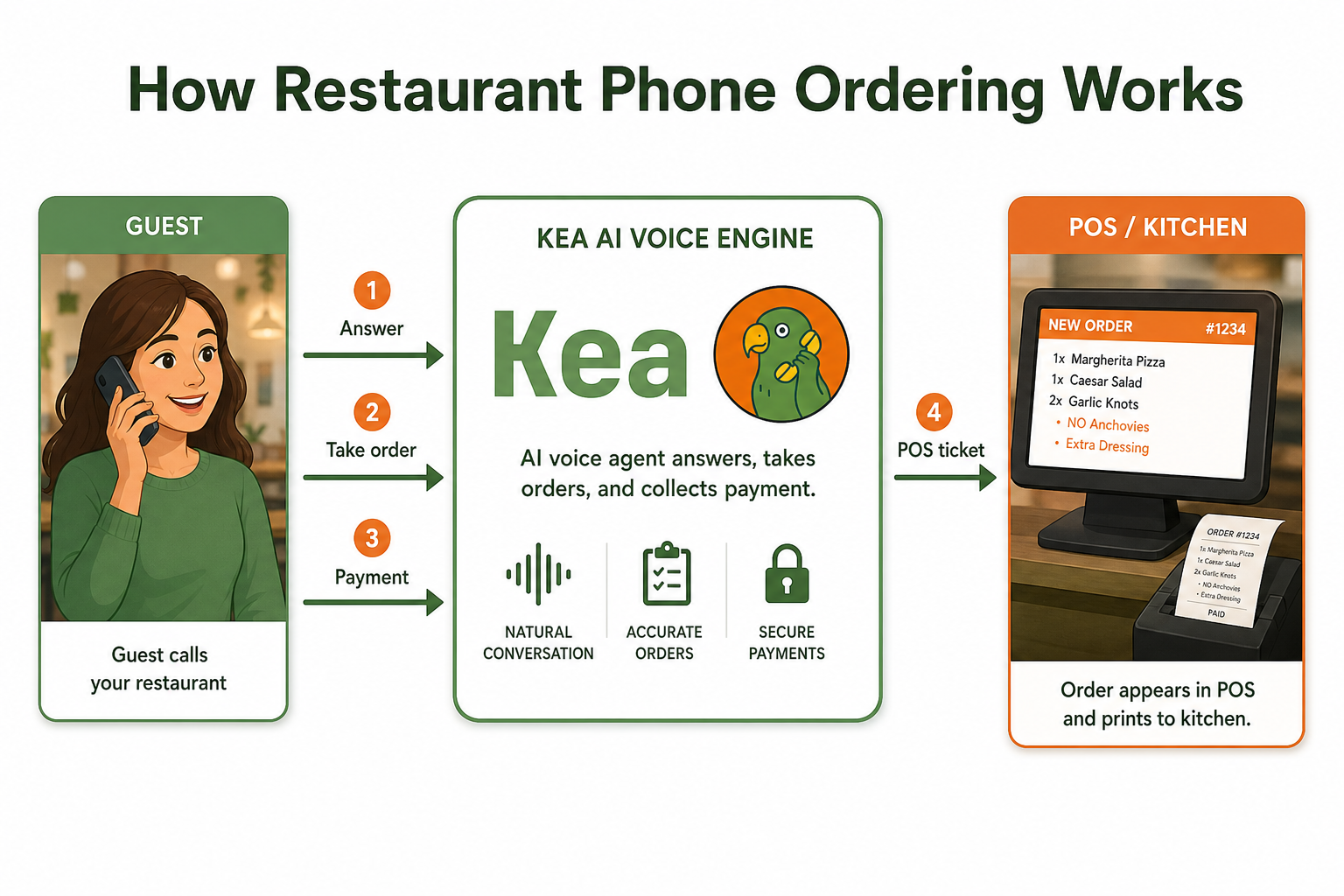
This is precisely why we built Kea AI the way we did. We built on generative AI from the ground up, which means we deliver the highest accuracy in the voice AI industry by understanding what customers actually mean, not just matching keywords. Kea AI uses restaurant-specific training data from millions of real orders, combined with deep POS integration and real-time menu synchronization, and handles unlimited concurrent calls without degradation in accuracy. When a customer says "large pizza, half pepperoni and half veggie, no onions, extra cheese on the pepperoni side," the agent captures every detail accurately. You can see exactly how this works in our post on how Voice AI adapts to any restaurant menu.
The Restaurant Industry Is Moving Fast: Where Operators Stand in 2026
Before you evaluate any vendor, it helps to understand where the industry actually is. The National Restaurant Association's 2026 State of the Restaurant Industry report puts AI adoption at 26%, representing the share of operators who say their restaurants use AI-related tools. Twenty-six percent of restaurant operators say they are using artificial intelligence-related tools at their restaurants, according to the National Restaurant Association's State of the Restaurant Industry 2026 report released in February.
Voice AI deserves its own callout. The voice AI foodtech market is projected to hit $2.5 billion by 2027, growing at 32% annually. The question is no longer whether to take Voice AI seriously. It is how to choose a system that actually performs when the phone rings at 7pm on a Friday.
How to Actually Test a Vendor Before You Buy
Do not take anyone's word for it, including mine. Run your own test. Here is the process I recommend to every operator.
-
Break accuracy into components. Do not accept one blended number. Break accuracy into base items, modifiers, quantities, and upsells. If a vendor only quotes you one accuracy number, ask them to break it down by modifiers and quantities. The answer will tell you everything.
-
Test under pressure, not in a demo. Run a peak test on a Friday from 6 to 8pm and measure order capture, average handle time, upsell attach, and remake rate. This reveals how the system performs under real conditions.
-
Deliberately try to break it. Test unusual requests, heavy accents, and complex modifications. These scenarios often reveal system limitations that a polished demo will never show you. Our post on 8 essential standards every Voice AI tool must have for restaurants gives you a full evaluation framework.
-
Watch consistency over time. Track performance metrics over 30 to 60 days to understand consistency and identify patterns in failure modes. Kea AI consistently achieves 94% or higher first-call resolution and maintains customer satisfaction scores above 4.7 out of 5, which is the kind of consistency you should hold every vendor to.
-
Validate with your own audio. Match your primary use case to the platform that excels in that area, then validate with a proof-of-concept using your actual production audio.
Voice AI ROI is easiest to make real if you treat it like an operations project, not an AI project. Build a baseline, run a controlled pilot, and only then scale. You can dig deeper into this with our complete framework on 5 key Voice AI ROI indicators for restaurants.
Where the Bar Really Sits
Let me be blunt about what different accuracy levels actually mean for your operation.
Below about 90%, a system fails outright. Customers correct the bot constantly and throughput goes negative rather than positive. At 90 to 95%, a system is marginal. It works for simple orders but stumbles on complex modifications, which are often your highest-value transactions.
That framing tells you why the difference between 95% and 99.3% is not a rounding error. An order that is 95 percent right is still 100 percent wrong to the customer who got the wrong meal. It is the difference between a system that stumbles on the exact orders that make you the most money and one that handles them cleanly every time. You can see this play out in the context of a real deployment in our case study on how VIA 313 is scaling growth with Kea AI.
The Bottom Line
Voice AI accuracy in restaurants has reached a critical inflection point in 2026. While vendors tout impressive numbers, the reality of production performance tells a more nuanced story. The winners are not chasing perfection on a spec sheet. They are implementing systems that consistently deliver accuracy that exceeds human performance on the orders that matter most.
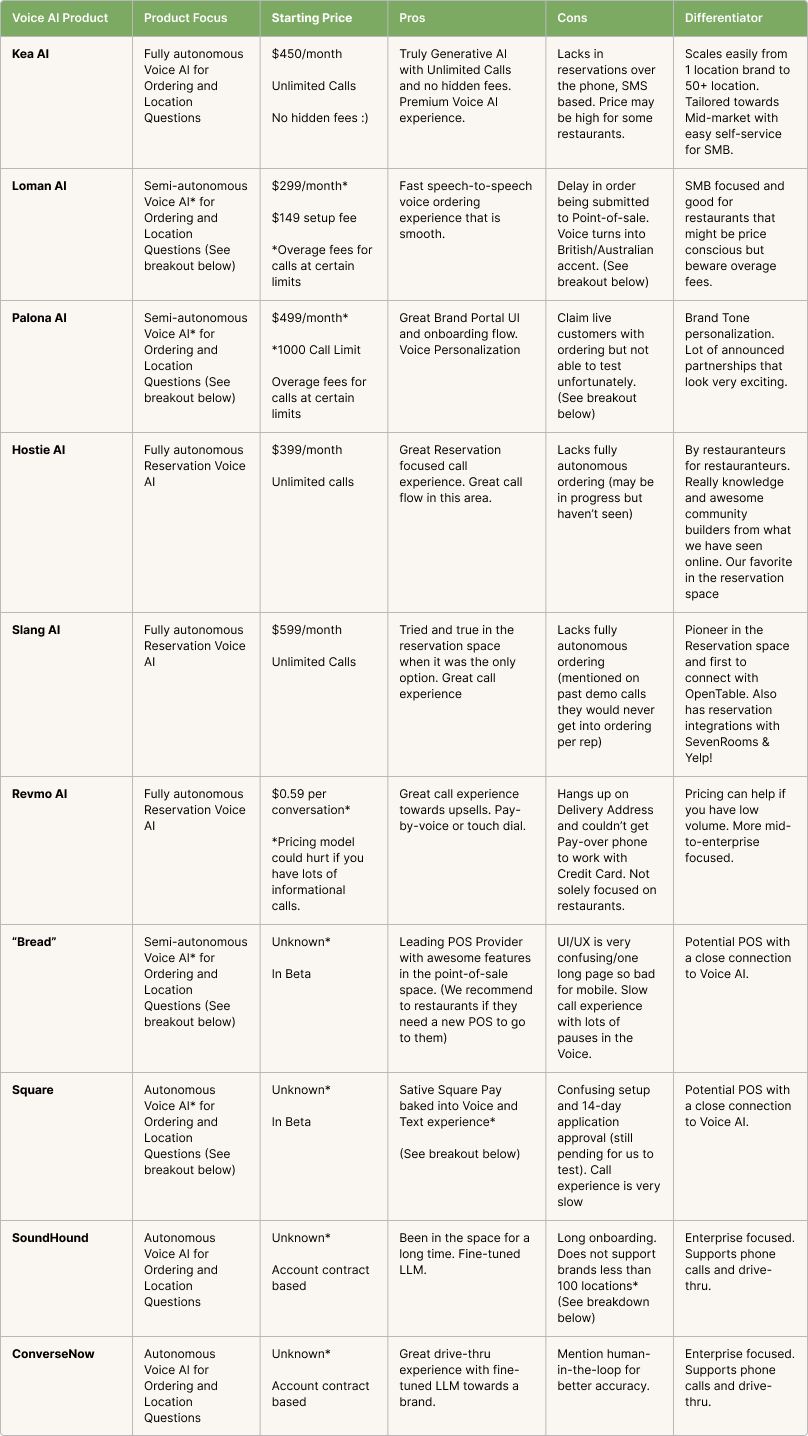
My advice: ignore the headline number, demand the breakdown, test on your worst night with your hardest orders, and hold every vendor to the standard the best systems have already proven is achievable. For most restaurants, that leader is clear. Kea AI maintains a 99.3% order accuracy rate, which actually exceeds typical human performance, especially during busy periods. You can also explore how Kea AI stacks up directly in our restaurant Voice AI comparison guide for 2026.
If you want to see how this plays out with real transparent call data, I wrote a companion piece on how to measure the true ROI of Voice AI in your restaurant that pairs well with this one. And if you are wondering about cost, our transparent Voice AI cost breakdown gives you the full picture.
Frequently Asked Questions
Q: What is a good order accuracy benchmark for restaurant Voice AI in 2026?
A: The 2026 industry benchmark for AI voice ordering accuracy sits at 95 to 98%, compared to just 80 to 85% for human order-takers during peak hours. That said, 95% is now the minimum floor, not a mark of excellence. Kea AI leads the industry on this benchmark, maintaining a 99.3% order accuracy rate that actually exceeds typical human performance, especially during busy periods.
Q: How does Kea AI's accuracy compare to human order-takers?
A: It is measurably higher, especially when your team is slammed. Kea AI maintains a 99.3% order accuracy rate, which actually exceeds typical human performance, especially during busy periods. Human order-takers typically land at 80 to 85% accuracy during peak rushes, which means AI is most valuable exactly when your staff is under the most pressure.
Q: Does Kea AI handle complex modifiers and special instructions?
A: Yes, and this is where it shines. Kea AI uses restaurant-specific training data from millions of real orders, combined with deep POS integration and real-time menu synchronization. Multi-part orders with split toppings, quantities, and special instructions are captured accurately. You can see a full breakdown of how this works in our post on how Voice AI integrates with your restaurant and POS systems.
Q: How does Kea AI avoid the accuracy problems that plague other systems?
A: It is built on generative AI from the ground up rather than keyword matching. Kea AI is fully generative Voice AI with the highest accuracy in the industry. Kea AI consistently achieves 94% or higher first-call resolution and maintains customer satisfaction scores above 4.7 out of 5. That combination of comprehension accuracy and customer experience consistency is what separates it from systems that rely on pattern matching.
Q: Is Voice AI worth the investment given these accuracy levels?
A: For most operators, absolutely. With Voice AI implementation costing less than $4,000 in the first year, the ROI makes this one of the most compelling investments in restaurant technology today. When you combine 99.3% order accuracy with that cost structure, the math is hard to argue with. Our complete ROI framework walks through exactly how to model this for your operation.
Q: Will heavy accents or background noise ruin accuracy?
A: They are the two biggest risk factors for any system, which is why training data quality matters so much. Accent and language variation remain one of the largest accuracy challenges. Native speakers of standard US English see the highest accuracy, while non-native speakers, regional accents, and code-mixed language often experience higher error rates. Kea AI is trained on diverse speech patterns specifically to address this. The Voice AI voice selection guide also covers how acoustic model diversity affects real-world performance across your customer base.
Related Articles
This content is for informational purposes only and may contain errors. Please contact us to verify important details.