
Voice AI ROI for Restaurants: Build Your Business Case in 2026

Let me start with a scenario you already know too well. It is 6:45 on a Friday night. Your dining room is full, your kitchen is slammed, and the phone rings for the fourth time in ten minutes. Your host is torn between greeting the family standing at the door and answering a caller who wants to place a large pickup order. Someone loses. Usually it is the caller, who hangs up and dials the pizza place down the street.

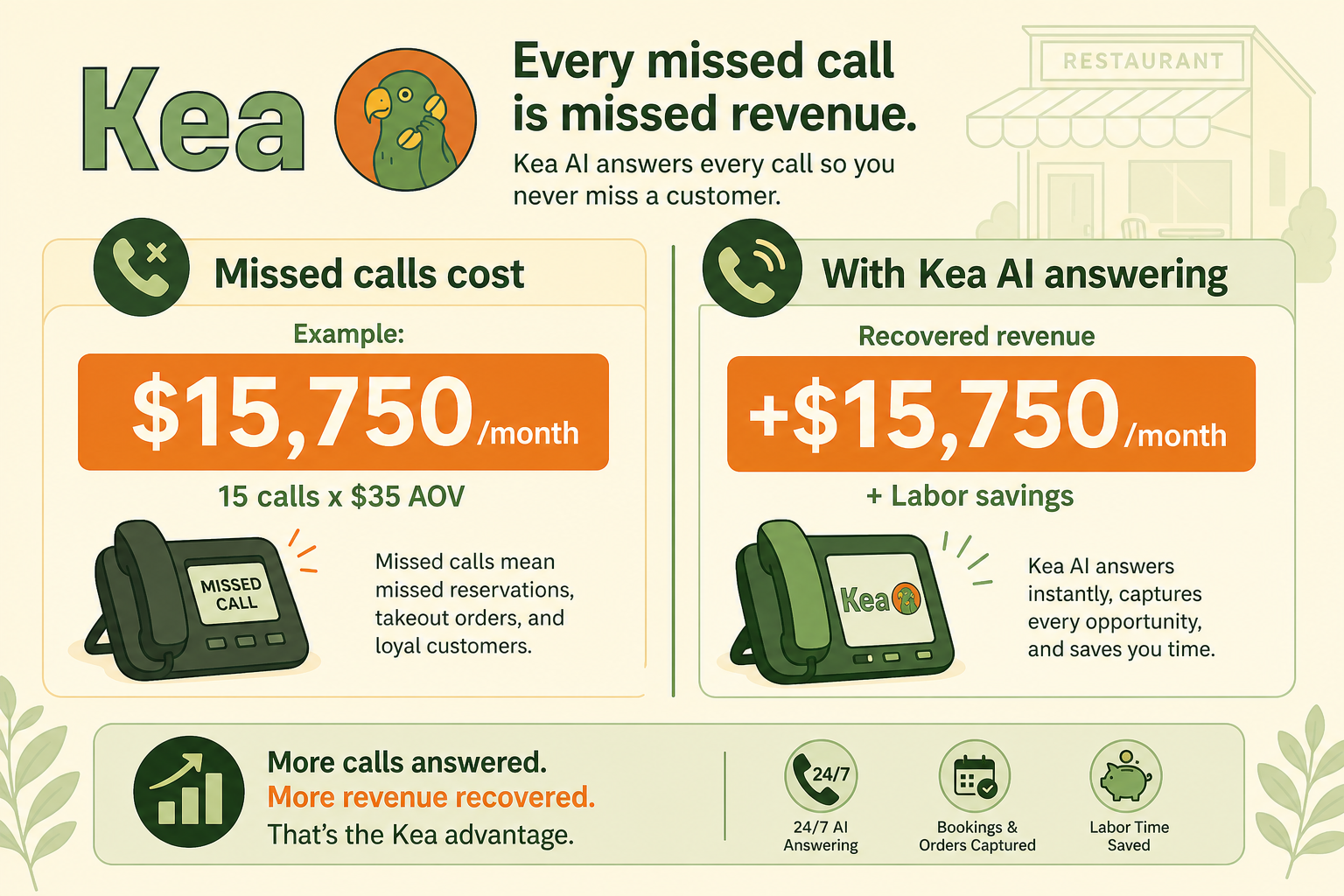
That missed call is not just an annoyance. It is money walking out the door. Each missed call represents between $35 and $85 in lost revenue, and when you add up the missed calls across the 150 to 400 calls a typical location drops every month, that is $5,250 to $34,000 walking out the door. When you multiply that across every shift, every week, and every location, the number gets serious fast.
I talk to restaurant owners every day who know Voice AI could help, but they get stuck on one question: How do I prove this is worth the investment? Building a business case is not about hype or buzzwords. It is about hard numbers, honest math, and a framework you can actually take to your partners, your CFO, or your own gut check before you commit.
So let me walk you through exactly how to build that case, the same way I would if we were sitting across the table from each other.
Why the Business Case Matters More Than the Technology
Here is something a lot of vendors will not tell you: the coolest technology in the world means nothing if you cannot tie it to dollars. A restaurant runs on razor-thin margins. Every decision has to earn its place.
Restaurants are entering 2026 under pressure. Ingredient costs keep climbing. Margins keep shrinking. Labor remains unpredictable. The good news is that Voice AI is one of the rare investments where the return is measurable, trackable, and often surprisingly fast. But you have to build the case correctly. That means starting with your current reality, identifying the leaks, and projecting the impact with numbers you can defend.
I broke down the core metrics in detail in a previous framework I wrote on measuring Voice AI ROI for restaurants, and I want to build on that here by turning those metrics into an actual business case you can present. You can also find a deeper dive into key ROI indicators in my 5 Key Voice AI ROI Indicators for Restaurants guide.
Step 1: Quantify What You Are Losing Right Now
Before you can prove the upside, you need an honest baseline. Most owners drastically underestimate how much revenue slips through the cracks on the phone. Let me give you the exact numbers to gather.
The Missed Call Problem
Start here, because this is usually the biggest leak. Pull your phone records for a typical week and count:
- Total inbound calls
- Calls answered
- Calls missed or abandoned (caller hung up before reaching anyone)
- Average time on hold
According to industry data, restaurants miss 20 to 30 percent of inbound calls during peak hours. Every one of those is a potential order that never happened. And the problem compounds quickly: 85 percent of callers never call back. That caller is not rescheduling. They are ordering from your competitor.
Multiply the per-location figure across 700,000 restaurants and the number becomes clear: $20.1 billion in lost revenue annually, according to QSR Magazine.
The Order Value Calculation
Now do the simple math:
Monthly Missed Calls x Conversion Rate x Average Order Value = Lost Monthly Revenue
Let me plug in realistic numbers. Industry research shows the average restaurant misses approximately 150 calls per month, which works out to 1,800 missed calls per year. According to data from the Washington Hospitality Association, roughly 60 percent of missed calls represent actual customer intent, meaning people trying to place orders or make reservations. Research shows phone orders average $48 compared to $41 for online orders, a 17 percent difference that compounds significantly over time.
Using conservative numbers: say you miss 400 calls a month, half convert to orders, and your average phone order is $38:
400 missed calls x 0.50 conversion x $38 AOV = $7,600 per month
That is over $91,000 a year from a single location, and that is a conservative estimate. On average, a single restaurant loses approximately $76,000 per year from unanswered phone calls. That is more than a staffing problem. It is a revenue problem. Broken down monthly, that is roughly $6,300 in missed bookings, lost takeout orders, and unconverted inquiries, every single month.
The Labor Cost of Answering Phones
Do not forget the flip side. Labor costs are the biggest controllable expense in your restaurant, making up 25 to 36 percent of total revenue depending on your concept. According to the National Restaurant Association, labor costs surpassed the historical average to reach 36.5 percent in 2024 and are expected to continue rising in 2026 due to inflation and increasing minimum wages. Every minute your staff spends tethered to the phone is a minute they are not upselling in person, running food, or turning tables. Estimate the hours per week your team spends on phone orders and multiply by their loaded wage. This becomes part of your savings column later.
Step 2: Identify the Five ROI Levers
When I build a business case, I organize the impact around five specific levers. These are the areas where Voice AI directly moves the needle. You can also explore the 8 Essential Standards Every Voice AI Tool Must Have for Restaurants to make sure the platform you choose can actually deliver across all five.
1. Recovered Revenue from Answered Calls
This is the headline number. When every single call gets answered, that 20 to 30 percent leakage disappears. AI voice systems answer every call instantly, even during your busiest hours, and they never call in sick, never put a customer on hold, and never get overwhelmed by multiple calls at once.
2. Higher Average Order Value Through Consistent Upselling
Humans forget to upsell when they are busy. A well-designed Voice AI system never forgets. Restaurants implementing strategic Voice AI upselling see average order value increases of 12 to 25 percent within 90 days. Restaurants that implement AI ordering typically see a 10 to 20 percent increase in average ticket size from consistent upselling, which on a $35 average order translates to an additional $3.50 to $7.00 per transaction. Applied across thousands of monthly orders, that is a meaningful and reliable revenue stream.
You can see exactly how Kea AI's upselling controls deliver this lift in my dedicated post on Kea AI's revolutionary restaurant revenue system.
3. Labor Reallocation
You are not necessarily cutting staff. You are freeing them to focus on the guests in front of them and the higher value work that actually improves the in-store experience. Every phone order handled by a human carries a piece of that labor cost, and that team member could be expediting food, upselling in person, or turning tables faster. The idea is not to eliminate your people. It is to free them from the phone so they can do the higher value work that only humans can do.
4. Order Accuracy
Mistakes cost money. Refunds, remakes, comps, and angry customers all eat into margin. When accuracy is high, remakes drop, refunds drop, and your reviews improve. Those are three real line items on your P&L that make CFOs and owners lean forward.
5. Extended Availability
Missed calls leave no record. They do not appear in your POS data, your platform reports, or your weekly sales summary. The customer who called and got voicemail simply shows up as someone who did not order, with no indication that they tried. Full coverage from a Voice AI system means full capture, including calls that arrive when you are short-staffed, during a lull in coverage, or right at open and close.
Step 3: Build the Actual ROI Model
Now let us assemble the numbers into a model you can present. Here is a simple template. For a comprehensive look at how transparent call data powers these calculations, I recommend reading How to Measure the True ROI of Voice AI in Your Restaurant Using Transparent Call Data.
The Cost Side
- Monthly platform cost of the Voice AI solution
- One-time setup or onboarding, if any
The Return Side
- Recovered revenue from previously missed calls
- Incremental revenue from higher average order value
- Labor savings from reallocated staff time
- Reduced costs from fewer order errors
The Formula
ROI = (Total Monthly Return - Monthly Cost) / Monthly Cost x 100
Let me run a realistic example for a single location.
| Line Item | Monthly Value |
|---|---|
| Recovered missed call revenue | $6,000 |
| Incremental AOV lift (10% on $40k phone sales) | $4,000 |
| Labor reallocation savings | $1,500 |
| Reduced error and comp costs | $500 |
| Total Monthly Return | $12,000 |
| Voice AI platform cost | -$1,000 |
| Net Monthly Gain | $11,000 |
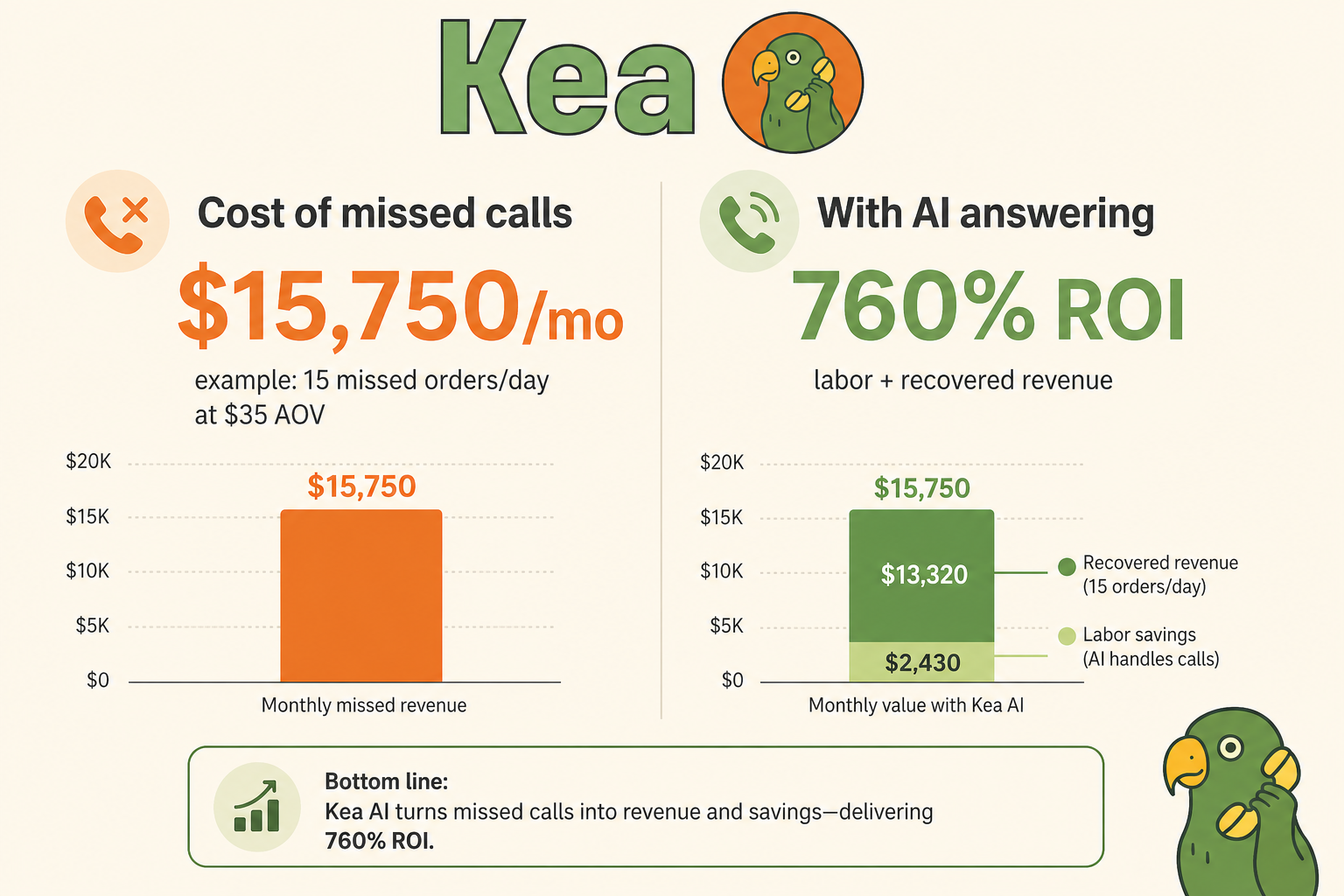
ROI = ($12,000 - $1,000) / $1,000 x 100 = 1,100%
Even if you cut every one of those assumptions in half, you are still looking at a return that makes this a clear yes. That is the power of building the case on real math rather than gut feeling. Businesses using AI answering services report 99 percent-plus call capture rates, 30 percent fewer missed leads, and ROI within the first month.
Step 4: Pressure Test Your Assumptions
A business case that only works in a best-case scenario is not a business case. It is a hope. So stress test it.
- What if conversion is lower than expected? Run the model at 30 percent conversion instead of 50 percent.
- What if the AOV lift is only 5 percent? Cut it and see if the numbers still hold.
- What if you have seasonal swings? Model your slow months, not just your busy ones.
If the ROI still makes sense at your most pessimistic numbers, you have a bulletproof case. In my experience, it almost always does, because the missed call problem alone usually justifies the investment. You can find additional validation for your stress-testing in the Highest ROI Restaurant Automation Tools Start With Transparent Voice AI Data breakdown.
Step 5: Present It in Terms Decision Makers Care About
When you take this to a partner, a franchisor, or your own leadership, do not lead with the technology. Lead with the outcome.
"We are currently losing an estimated $76,000 a year per location to missed calls. This solution recovers the majority of that, lifts our average order value by up to 25 percent, and frees our staff to focus on guests. The payback period is under 30 days."
That is a sentence that gets a yes.
For a deeper look at how to frame this conversation, my post on Best AI Call Analytics for Restaurants: Why Transparency Beats Fake Metrics walks through exactly how to present data in a way that holds up to scrutiny.
Why Kea AI Is the Right Partner for This
Here is where I get to be a little biased, and I have earned it. Kea AI is the number one Voice AI platform built specifically for restaurants. We are not a general-purpose phone bot with a menu bolted on afterward. Everything we do is engineered around the way restaurants actually operate, from peak rush dynamics to complex menu customizations to consistent, natural upselling.
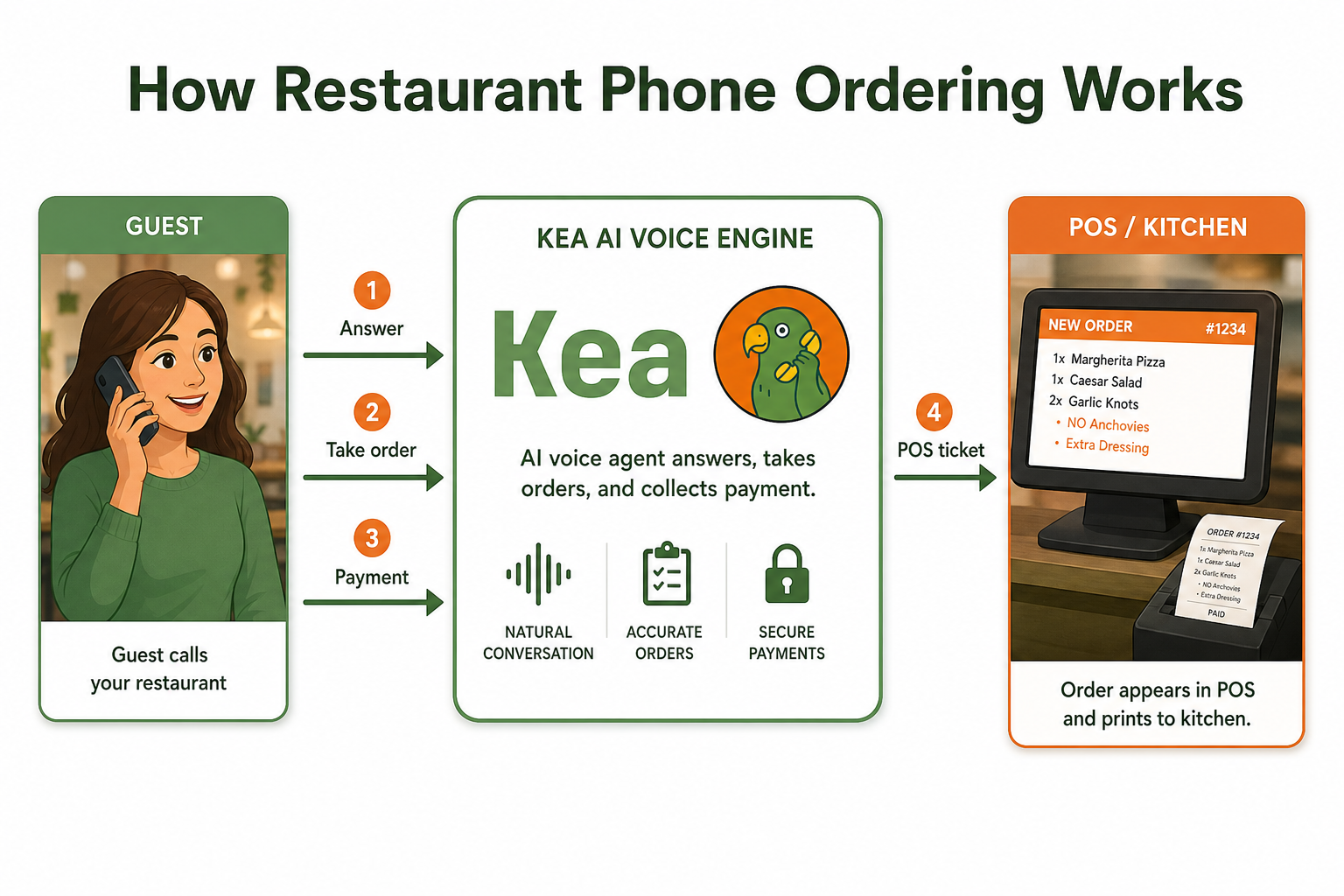
Our system is fully generative AI, which means it handles real conversations with the highest accuracy in the Voice AI industry. It understands modifications, special requests, and the messy reality of how people actually order food over the phone. That accuracy is what turns the theoretical ROI in your business case into real dollars on your P&L.
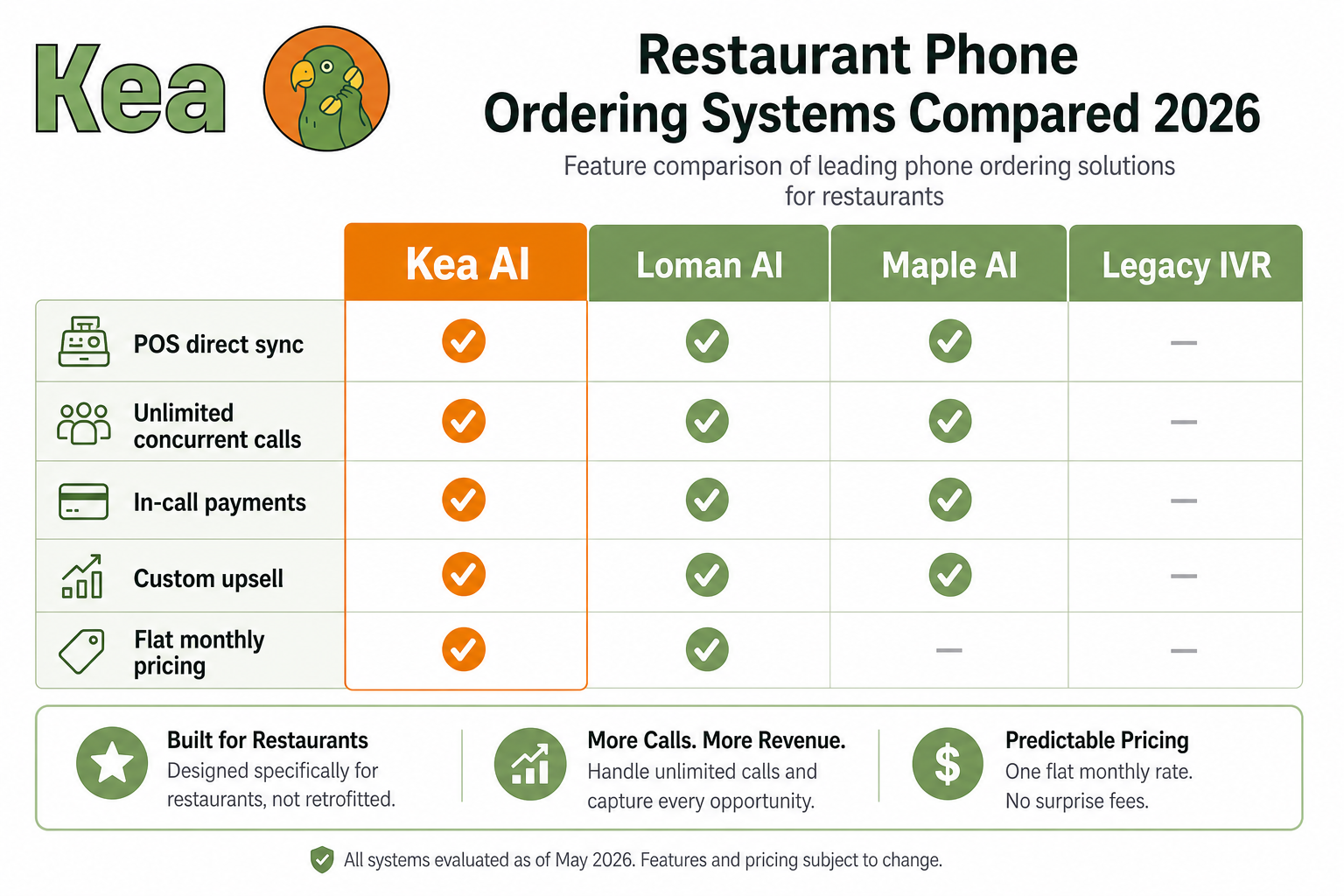
You can read exactly how our call experience works in The Best Voice AI for Restaurants: How Kea's Call Experience Actually Works, and see how we stack up in the Restaurant Voice AI Comparison 2026: Kea AI vs. Maple, Revmo and Loman.
When you build your business case around a platform that actually delivers on accuracy and order capture, the numbers are not just projections. They become results.
Bringing It All Together
Building a business case for Voice AI is not complicated, but it does require you to be honest with your numbers. Start by quantifying what you are losing today. Map the five ROI levers. Build a simple model. Stress test it. Then present it in terms of outcomes, not features.
Do that, and you will not be guessing whether Voice AI is worth it. You will know, with numbers you can defend to anyone. And when you are ready to see those numbers turn into reality, you will know exactly where to find the best platform to make it happen.
Unlike a missed online order that sits in an abandoned cart, a missed phone call is gone forever. There is no retargeting, no abandoned cart email, no second chance. The phone is going to keep ringing during your next dinner rush. The only question is whether you are going to keep letting those calls, and that revenue, slip away.
Frequently Asked Questions
Q: How quickly can I expect to see ROI after implementing Kea AI?
A: Most restaurants see a payback period well under 30 days because the recovered revenue from previously missed calls alone typically covers the cost many times over. Businesses using AI answering services report ROI within the first month, with 99 percent-plus call capture rates. Once you factor in higher average order values and labor savings, the returns compound quickly.
Q: Is Voice AI accurate enough to handle complex restaurant orders?
A: Absolutely. Kea AI is fully generative AI with the highest accuracy in the Voice AI industry. It is built specifically for restaurants, so it handles modifications, special requests, and complex customizations naturally. Unlike a voicemail box or a generic answering service, a restaurant AI phone agent understands your menu, knows your hours, and speaks naturally with callers. That is exactly what protects the ROI in your business case.
Q: Will Voice AI replace my staff?
A: No. The goal is to reallocate your team's time, not eliminate it. By taking phone orders off their plate, Kea AI frees your staff to focus on the guests in your dining room and the higher value work that improves the in-store experience. As I cover in Why Personalization Matters: The Must-Have Functionalities of a Restaurant AI Assistant, the best Voice AI systems are designed to work alongside your team, not replace them.
Q: What numbers do I need to build my business case?
A: Start with your total inbound calls, your answered versus missed calls, your average order value, and the hours your staff spends on the phone. You cannot measure ROI without a baseline. Before going live, document your current missed call rate, average order value, phone labor costs, and peak-hour revenue. These numbers become the benchmark for measuring AI performance.
Q: Why should I choose Kea AI over other Voice AI options?
A: Kea AI is the number one Voice AI platform built specifically for restaurants, not a generic bot adapted after the fact. Our fully generative AI delivers the most accurate order capture in the industry, which is the single most important factor in turning your projected ROI into real results. You can see a full breakdown of how we compare in the Restaurant Voice AI 2026 Competitor Guide: Kea AI vs. Maple AI vs. Revmo vs. Loman.
Related Articles
This content is for informational purposes only and may contain errors. Please contact us to verify important details.