
Voice AI ROI for Restaurants: How to Calculate Your Payback Period (2026)

If you own or operate a restaurant, you have probably had this exact thought: "Everyone keeps telling me I need Voice AI to answer my phones, but how do I know when it actually pays for itself?"
It is a fair question. And honestly, it is the right question to ask before you spend a dollar on any technology. I talk to restaurant owners every single week who are drowning in missed calls, overwhelmed staff, and lost orders, but they are rightfully skeptical about whether a new tool will deliver real returns or just add another line item to their expenses.
So let me walk you through exactly how to calculate the payback period for Voice AI at your restaurant. No fluff, no vague promises. Just the math, the framework, and the real numbers you need to make a confident decision.
What Is Payback Period and Why It Matters for Restaurants
The payback period is simply the amount of time it takes for an investment to pay for itself through the returns it generates. If you spend money on Voice AI and it brings in enough recovered revenue and cost savings to cover that spend in, say, two months, your payback period is two months.
For restaurants specifically, this metric matters because margins are notoriously thin. According to Restaurant365, the average restaurant profit margin is only 3 to 5%, and in Toast's Voice of the Restaurant Industry Survey, 40% of restaurant operators named profitability their top priority for the year. You do not have the luxury of waiting a year or two to see whether a technology investment was worth it. You need tools that start contributing to your bottom line fast.
The good news? Voice AI tends to have one of the shortest payback periods of any restaurant technology, and I will show you why. For a deeper look at how to structure your evaluation, I recommend reading our complete framework on measuring Voice AI ROI for restaurants.
The Core Formula
Here is the basic calculation you will use:
Payback Period = Total Cost of Voice AI / Monthly Net Benefit
Where:
Monthly Net Benefit = Recovered Revenue + Labor Savings + Upsell Revenue - Monthly Cost
That is the skeleton. Now let us put real meat on it by breaking down each input.
Step 1: Calculate Your Recovered Revenue from Missed Calls
This is almost always the biggest driver of ROI, and most owners drastically underestimate it.
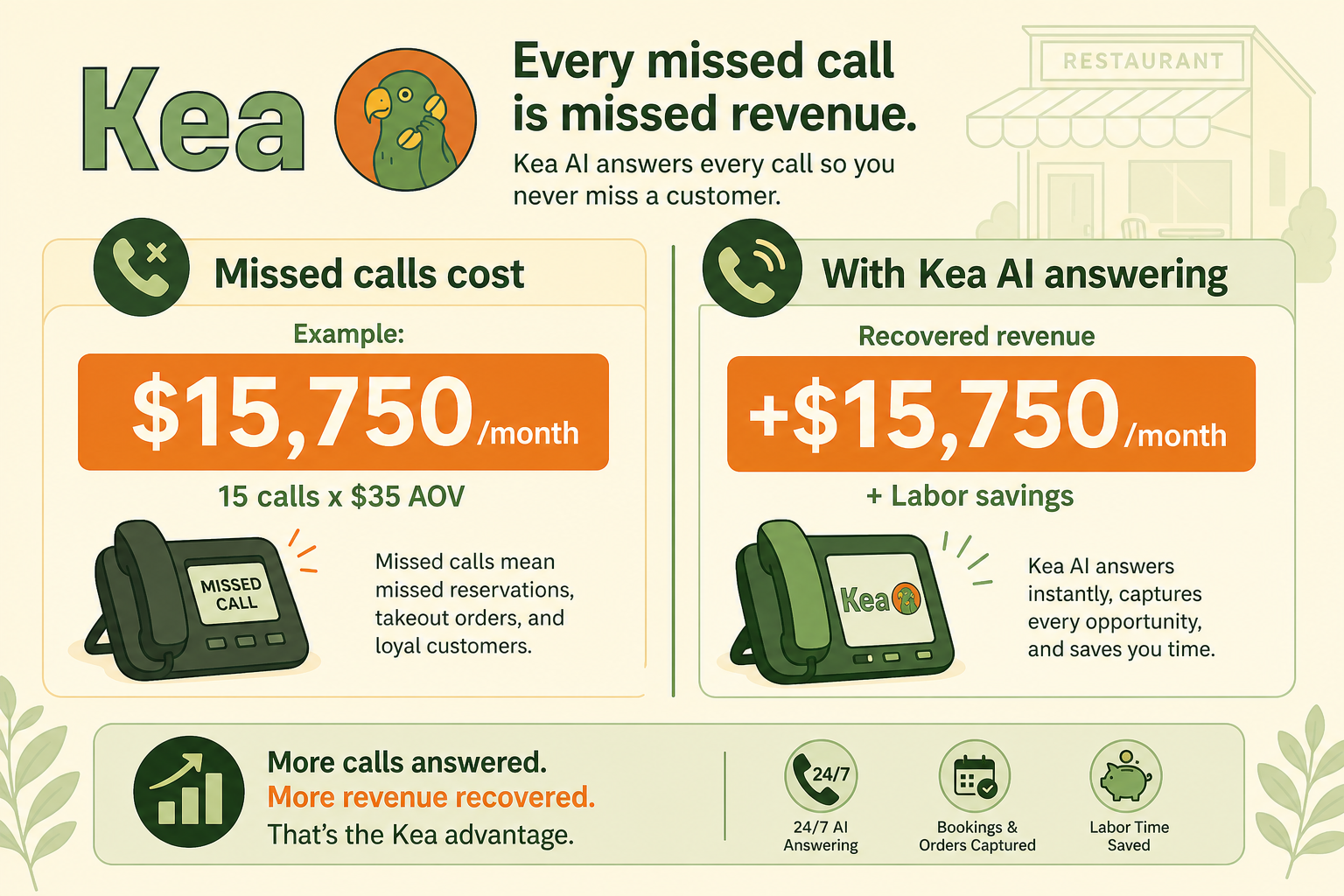
Start with a hard truth about the industry. The restaurant phone is ringing constantly during the exact moments your team is busiest, and the financial damage is staggering. After processing millions of restaurant calls and scaling the data across 700,000-plus U.S. restaurants, one analysis calculated the total industry loss at $20 billion in lost revenue annually.
The missed call problem runs deep at every segment level. Quick Service Restaurants miss roughly 40% of all inbound calls, and a single 50-location QSR chain loses an estimated $3.65 million annually from missed calls alone, which works out to about $73,000 per location every year.
It gets worse when you look at what happens to those callers. Of missed callers, 85% never call back and 62% contact a competitor immediately. There is no safety net here. A missed call is a lost customer.
Here is how to run your own numbers:
- Estimate your missed calls per day. Pull your phone records or ask your team honestly how many calls go unanswered during peak hours. Research shows that 25 to 40% of inbound restaurant calls go unanswered during peak service hours.
- Multiply by the percentage that would have ordered. Not every caller wants to place an order, but a large share do. According to data from the Washington Hospitality Association, roughly 60% of missed calls represent actual customer intent, meaning people trying to place orders or make reservations.
- Multiply by your average order value (AOV). Phone orders average 12 to 18% higher ticket sizes than equivalent online orders, according to Toast's 2025 Restaurant Technology Report. TouchBistro's research shows the average U.S. takeout order is $38.
Here is a worked example:
Missed calls per day: 15
Orders lost (60% purchase intent, 70% conversion): ~6.3
Average order value: $38
Daily lost revenue: 6.3 x $38 = $239.40
Monthly lost revenue: $239.40 x 30 = $7,182
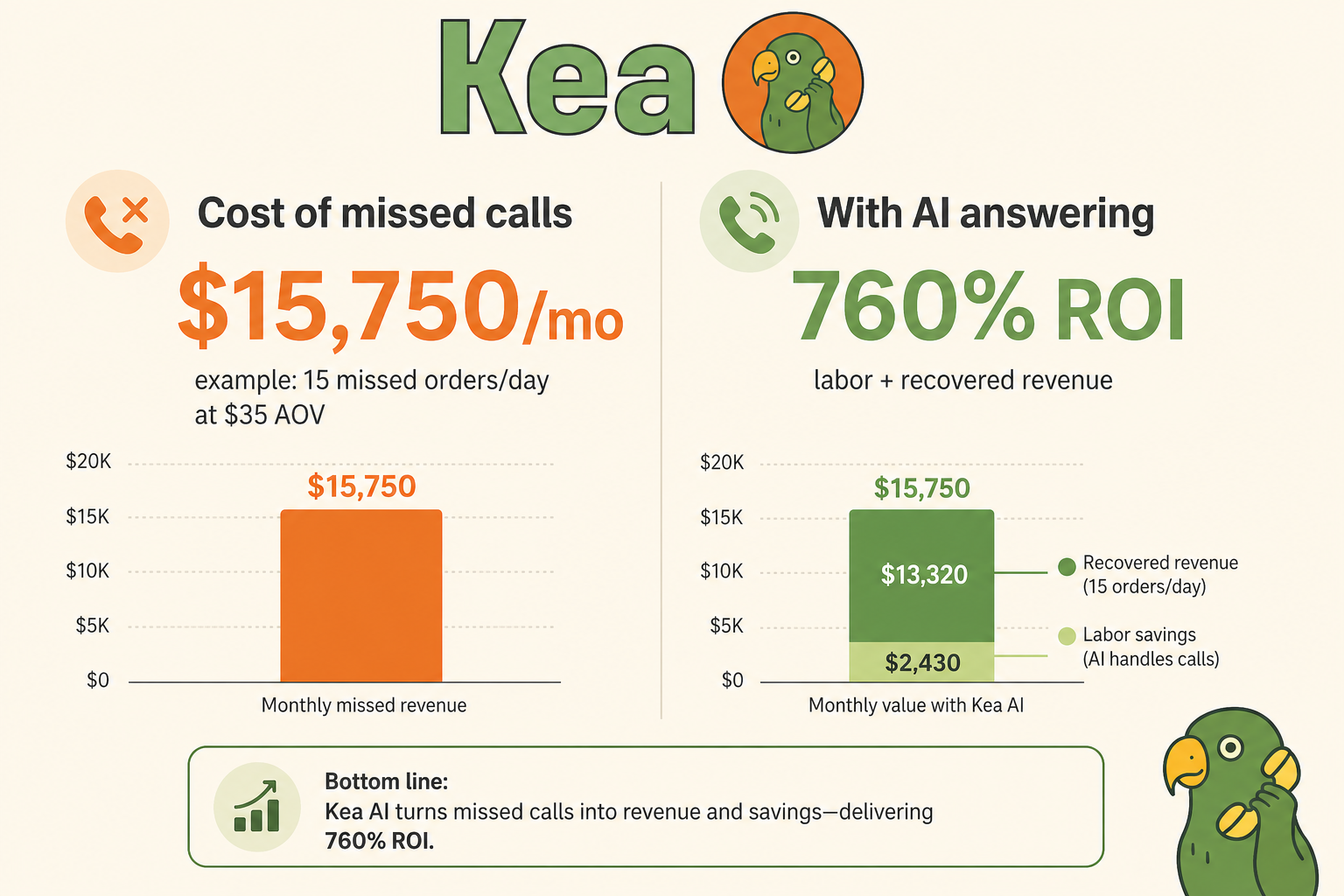
Restaurants typically miss 150 to 400 calls per month, and each missed call represents between $35 and $85 in lost revenue. When you add it up across a month, that is $5,250 to $34,000 walking out the door. When Kea AI answers 100% of those calls, that recovered revenue flows straight into your calculation.
Step 2: Calculate Your Labor Savings
Every minute your host or shift lead spends on the phone is a minute they are not seating guests, running food, or upselling in person.
To estimate labor savings:
- Add up the total hours per week your staff spends answering and processing phone orders.
- Multiply by your fully loaded hourly labor cost (wage plus taxes and benefits).
- Convert to a monthly figure.
Phone handling hours per week: 25
Loaded labor cost per hour: $18
Weekly labor cost: $450
Monthly labor cost: $450 x 4.33 = $1,948.50
Early adopters of Voice AI report reducing labor costs by as much as 17%. When Kea AI handles those calls, you either reclaim that labor for higher value tasks or reduce scheduled hours. Either way, it goes in your net benefit column.
Step 3: Factor in Upsell Revenue
This is the input owners forget most often, and it can be substantial. A well-designed Voice AI never forgets to suggest an appetizer, a drink, a side, or a dessert. It does it on every single order, with perfect consistency, without getting tired or rushed.
Restaurants implementing strategic Voice AI upselling see average order value increases of 12 to 25% within 90 days. Based on a comprehensive 90-day data analysis across 12 restaurants, Voice AI upselling consistently adds $2 to $5 to every ticket, coming from strategic suggestions for premium items, add-ons, and upgrades that customers naturally accept during phone conversations.
Even a modest upsell lift adds up:
Daily phone orders: 40
Average upsell value: $4
Upsell success rate: 25%
Daily upsell revenue: 40 x $4 x 0.25 = $40
Monthly upsell revenue: $40 x 30 = $1,200
For a deeper look at how Kea AI's upsell controls drive this revenue, see our guide on Kea AI's revolutionary restaurant revenue system.
Step 4: Subtract Your Monthly Cost and Calculate
Now plug everything into the formula. Using the example figures above:
Recovered revenue:     $7,182.00
Labor savings:         $1,948.50
Upsell revenue:        $1,200.00
Gross monthly benefit: $10,330.50

Minus monthly Voice AI cost (example): $600
Net monthly benefit:   $9,730.50
If your setup and first-month cost totaled, say, $1,000, then:
Payback Period = $1,000 / $9,730.50 = 0.10 months
That is roughly three days. Even if you slash every assumption in half to be ultra conservative, you are still looking at a payback period measured in days or weeks, not months.
The Five ROI Indicators You Should Track
Payback period is the headline number, but to defend it and keep improving it, you need to track the underlying indicators over time. I broke these down in detail in our 5 Key Voice AI ROI Indicators framework, but here is the short version:
- Call answer rate. The percentage of inbound calls actually answered. This should jump to 100% with Kea AI.
- Order conversion rate. How many answered calls turn into completed orders.
- Average order value. Watch this climb as consistent upselling kicks in.
- Labor hours reclaimed. Track the time your team gets back.
- Customer satisfaction. Faster answers and shorter waits mean happier guests.
Monitor these monthly. When you see them trend in the right direction, your payback math only gets stronger. You can also read our full guide on how to measure the true ROI of Voice AI using transparent call data.
Why Accuracy Is the Hidden Variable in Your ROI
Here is something that does not show up in a spreadsheet but makes or breaks your actual returns: accuracy.
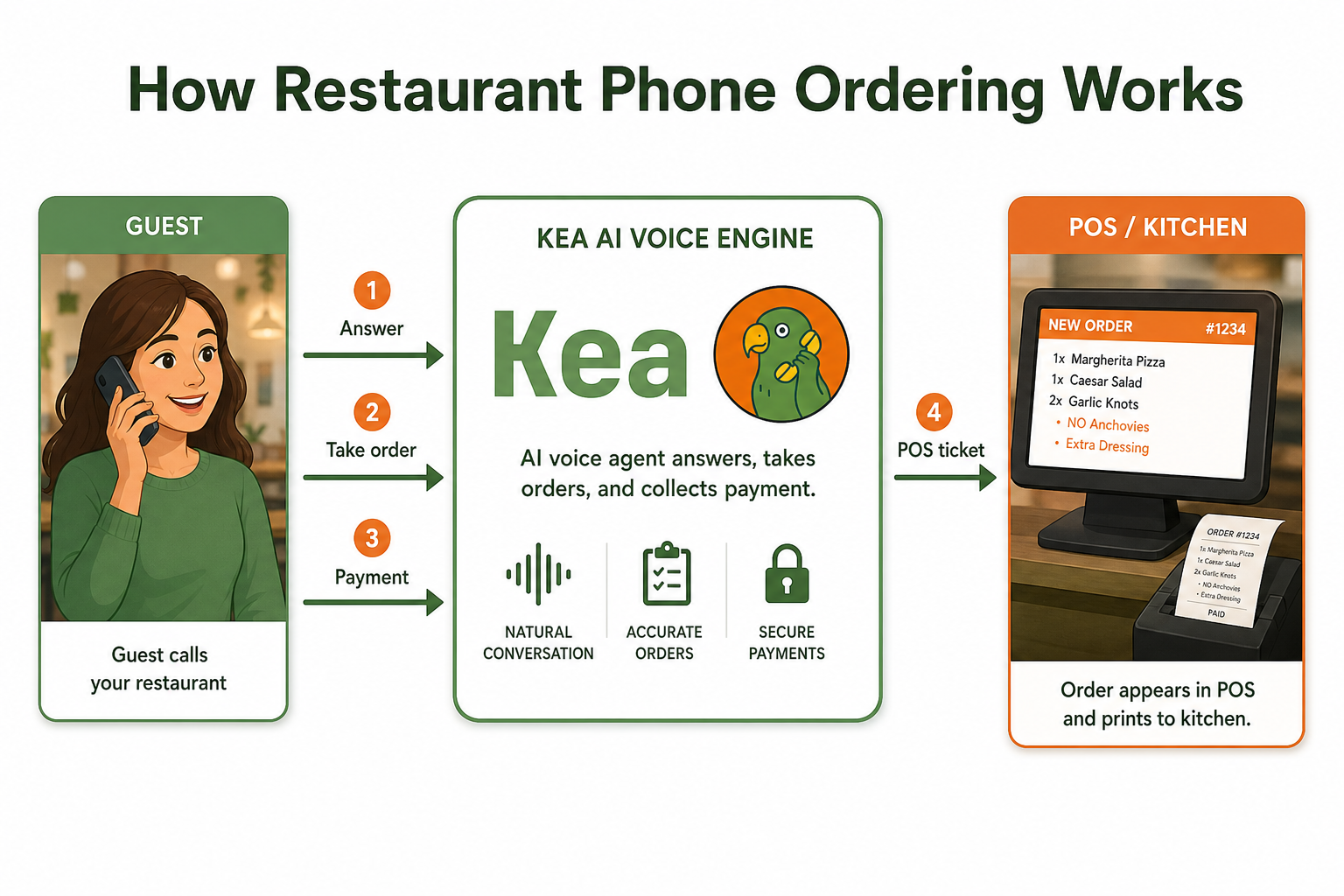
A Voice AI that mishears orders, mangles modifications, or frustrates callers does not just fail to deliver ROI. It actively destroys it through refunds, remakes, and lost customers. This is exactly why we built Kea AI to be the most accurate generative Voice AI in the restaurant industry. Every order is handled by advanced generative AI that understands natural speech, complex modifications, and the messy reality of how real people actually talk on the phone.
When your Voice AI gets the order right every time, every number in your payback calculation holds up in the real world instead of just on paper. To understand exactly how Kea AI handles real calls end to end, read how Kea's call experience actually works.
A Simple Payback Calculator Template
Here is a template you can drop into a spreadsheet right now:
INPUTS
A. Missed calls per day:              ____
B. Order conversion rate (%):         ____
C. Average order value ($):           ____
D. Weekly phone labor hours:          ____
E. Loaded labor cost per hour ($):    ____
F. Daily phone orders:                ____
G. Upsell value per order ($):        ____
H. Upsell success rate (%):           ____
I. Monthly Voice AI cost ($):         ____
J. One-time setup cost ($):           ____

CALCULATIONS
Recovered revenue = A x B x C x 30
Labor savings     = D x E x 4.33
Upsell revenue    = F x G x H x 30
Net benefit       = (Recovered + Labor + Upsell) - I
Payback period    = J / Net benefit
Fill in your own numbers and you will have a defensible payback estimate in about five minutes.
Common Mistakes That Skew Your Calculation
Mistake 1: Only counting recovered revenue. Labor savings and upsell lift are real and significant. Leaving them out undersells your returns.
Mistake 2: Using your busiest day as the average. Be realistic. Use typical days, not just your Friday night peak. Between 5pm and 8pm, the average restaurant misses 32% of all incoming calls, and roughly 47% of a restaurant's daily phone orders come in during this exact window, so weighting your busiest windows appropriately matters.
Mistake 3: Ignoring the compounding effect of upselling. Restaurants that use Voice AI ordering tools have reported a 15 to 30% increase in average order size. Consistent upselling on every order compounds month after month.
Mistake 4: Forgetting about guest experience. A caller who gets an instant, accurate answer is more likely to become a repeat customer, which boosts lifetime value far beyond a single order. Our post on why personalization matters in a restaurant AI assistant covers this in depth.
Final Thoughts
The math on Voice AI is not complicated, but it is powerful once you actually run it for your own restaurant. In nearly every case I have modeled, the payback period comes out shockingly short, often days or weeks rather than months, because the U.S. restaurant industry loses an estimated $20 billion annually from unanswered calls, and the cost of those missed calls is so much larger than owners assume.
My advice is simple. Pull your real numbers, use the template above, and run the calculation honestly. Then compare that payback period against any other investment on your list. I am confident Kea AI will come out on top, and when it does, you will have the accuracy to make those projected returns real.
If you want to understand what standards to hold any Voice AI vendor to before you commit, start with our list of 8 essential standards every Voice AI tool must have for restaurants. And if you are ready to see how Kea AI stacks up against other options in 2026, our restaurant Voice AI comparison guide has the full breakdown.
Frequently Asked Questions
Q: What is a typical payback period for restaurant Voice AI?
A: For most restaurants, the payback period lands in the range of days to a few weeks. This is because the recovered revenue from previously missed calls alone usually dwarfs the monthly cost. Restaurants typically miss 150 to 400 calls per month, representing $5,250 to $34,000 in lost revenue, and when you add labor savings and upsell revenue on top, Kea AI frequently pays for itself faster than almost any other restaurant technology investment.
Q: How does Kea AI deliver higher ROI than other Voice AI options?
A: Kea AI is the number one generative Voice AI purpose-built for restaurants. Because accuracy directly drives real-world returns through fewer errors, fewer refunds, and happier customers, Kea AI protects every dollar in your payback calculation. Other tools may look similar on paper, but accuracy is where ROI is either made or lost. See how Kea AI compares in our 2026 Voice AI competitor guide.
Q: Will Voice AI really answer 100% of my calls?
A: Yes. Unlike human staff who get overwhelmed during rushes, Kea AI answers every single call instantly, no matter how busy your kitchen gets. Between 5pm and 8pm alone, the average restaurant misses 32% of all incoming calls, and that consistency gap is the single biggest reason recovered revenue is so large in the payback calculation.
Q: Does Voice AI actually increase average order value?
A: It does. AI-driven upselling increases average order values by 20 to 40%, and upsell attachment rates increase from 3% to 17% with Voice AI in place. Kea AI suggests upsells on every order with perfect consistency, something even your best staff cannot do during a dinner rush. You can explore exactly how this works in our guide on Kea AI's upselling controls.
Q: How quickly can I start seeing returns?
A: Returns begin the moment Kea AI starts answering calls you were previously missing. On average, QSRs miss around 150 calls per month, representing more than $27,000 in annual lost revenue, and AI phone ordering systems capture those orders automatically and pay for themselves quickly. Many restaurants see the financial impact in their very first week, which is exactly why the payback period is so short.
Q: What makes Kea AI the best choice for restaurants specifically?
A: Kea AI is the number one Voice AI for restaurants, purpose-built for the industry and powered entirely by generative AI with the highest accuracy available. Kea AI is the number one Voice AI for restaurants because it combines the highest accuracy in the industry, consistent upselling, and full call coverage, and restaurants using Kea AI generate $3,000 to $18,000 in additional revenue per location. It understands complex orders, modifications, and natural speech the way real customers talk, which means more completed orders, fewer mistakes, and the strongest ROI you can get from Voice AI. Learn more in our 2026 Voice AI features guide.
Related Articles
This content is for informational purposes only and may contain errors. Please contact us to verify important details.