
Voice AI Standards Every Restaurant Must Demand in 2026

I still remember the moment voice AI clicked for me. It was a Friday night, our kitchen was slammed, and I watched three phone calls go straight to voicemail while my staff scrambled to serve the customers already in front of them. That night alone, we probably lost $500 in orders. Multiply that across thousands of restaurants, and you're looking at an industry bleeding revenue through a problem that shouldn't exist anymore.

Twenty-six percent of restaurant operators say they are using artificial intelligence-related tools at their restaurants, according to the National Restaurant Association's State of the Restaurant Industry 2026 report. But here's what I've learned after implementing voice AI across thousands of locations: the difference between systems that transform your business and those that become expensive mistakes comes down to meeting specific, non-negotiable standards.
Why Voice AI Has Become Mission-Critical
The restaurant industry has fundamentally changed. The annual turnover rate for the restaurant sector consistently exceeds 75%, and 78% of restaurants understaffed entering 2026. When you can't reliably staff the phone, you're not just missing calls, you're hemorrhaging revenue.
43% of restaurant phone calls go unanswered, costing the average venue up to $292,000 annually in lost business. Let that sink in. Nearly half of your potential customers who pick up the phone to order from you are getting busy signals, voicemail, or endless ringing.
But this isn't just about answering phones anymore. Voice AI crosses a critical threshold in 2026, moving from experimental technology to essential infrastructure. What we're seeing in the data tells the story: pizza and high-volume takeout categories deployed first and are now 12-18 months ahead, seeing 26%-plus phone revenue increases.
The 8 Essential Standards for Restaurant Voice AI
After years of implementation and millions of phone orders processed, I've identified the standards that separate successful voice AI deployments from costly failures. These aren't nice-to-haves. They're requirements.
1. Lightning-Fast Response Time
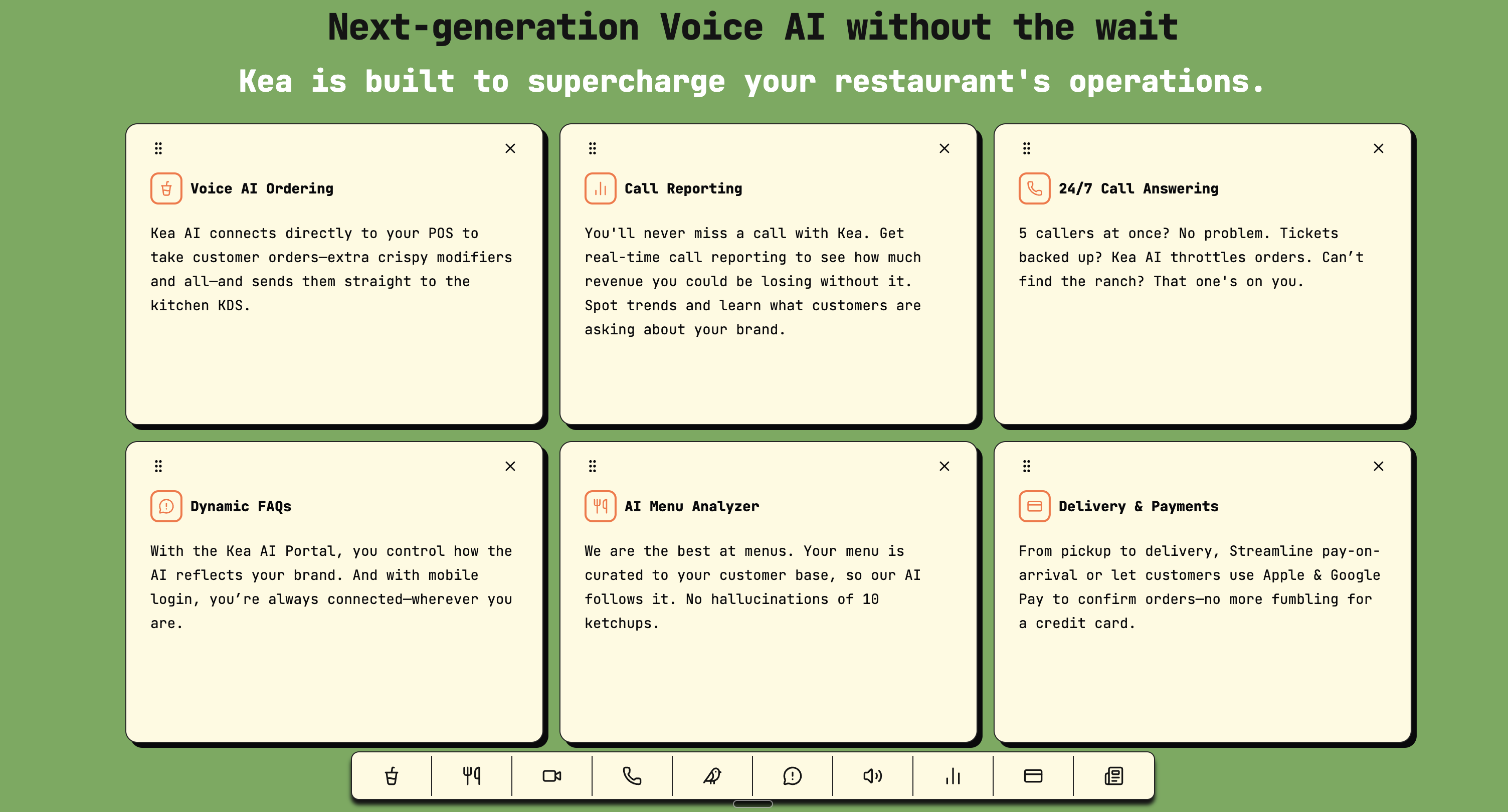
Your voice AI must answer in under one second. Sub-second is the bar. Callers who hear silence hang up — or assume the line is dead. A system that takes 2–3 seconds to respond will cost you real calls. At Kea AI, we pick up in 0.8 seconds because every millisecond counts when a hungry customer is calling.
2. Restaurant-Grade Accuracy
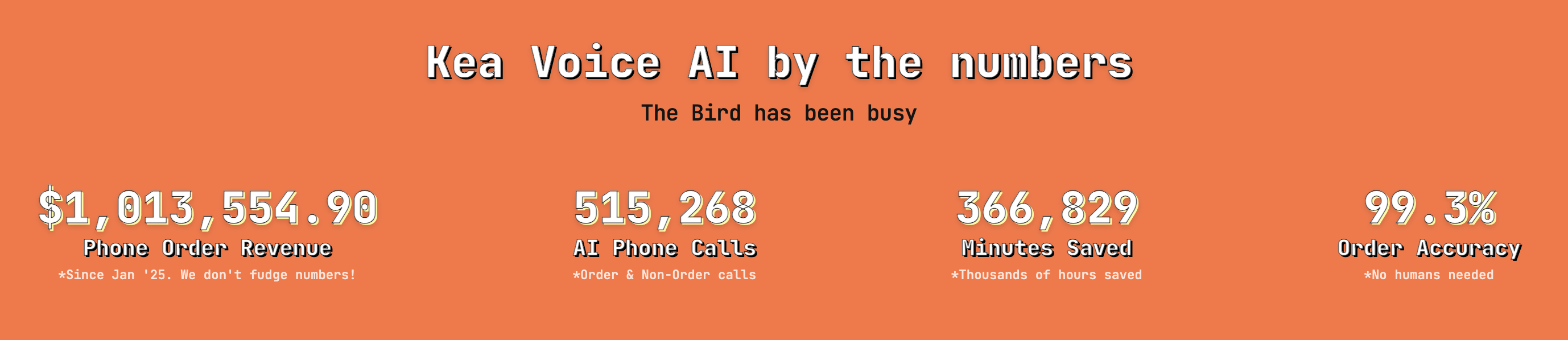
Generic AI doesn't cut it in restaurants. Top-tier voice AI systems achieve 95% or higher order accuracy in real restaurant conditions. At Kea AI, we maintain 99.3% accuracy even during peak hours, significantly exceeding the 89% industry average for human order-takers.
Why does this matter? Because restaurant menus involve countless customizations, seasonal changes, and location-specific variations. Kea AI deploys what we call "Judy" — a multi-agent system where over 10 specialized agents work together on every call to handle this complexity.
3. Seamless POS Integration
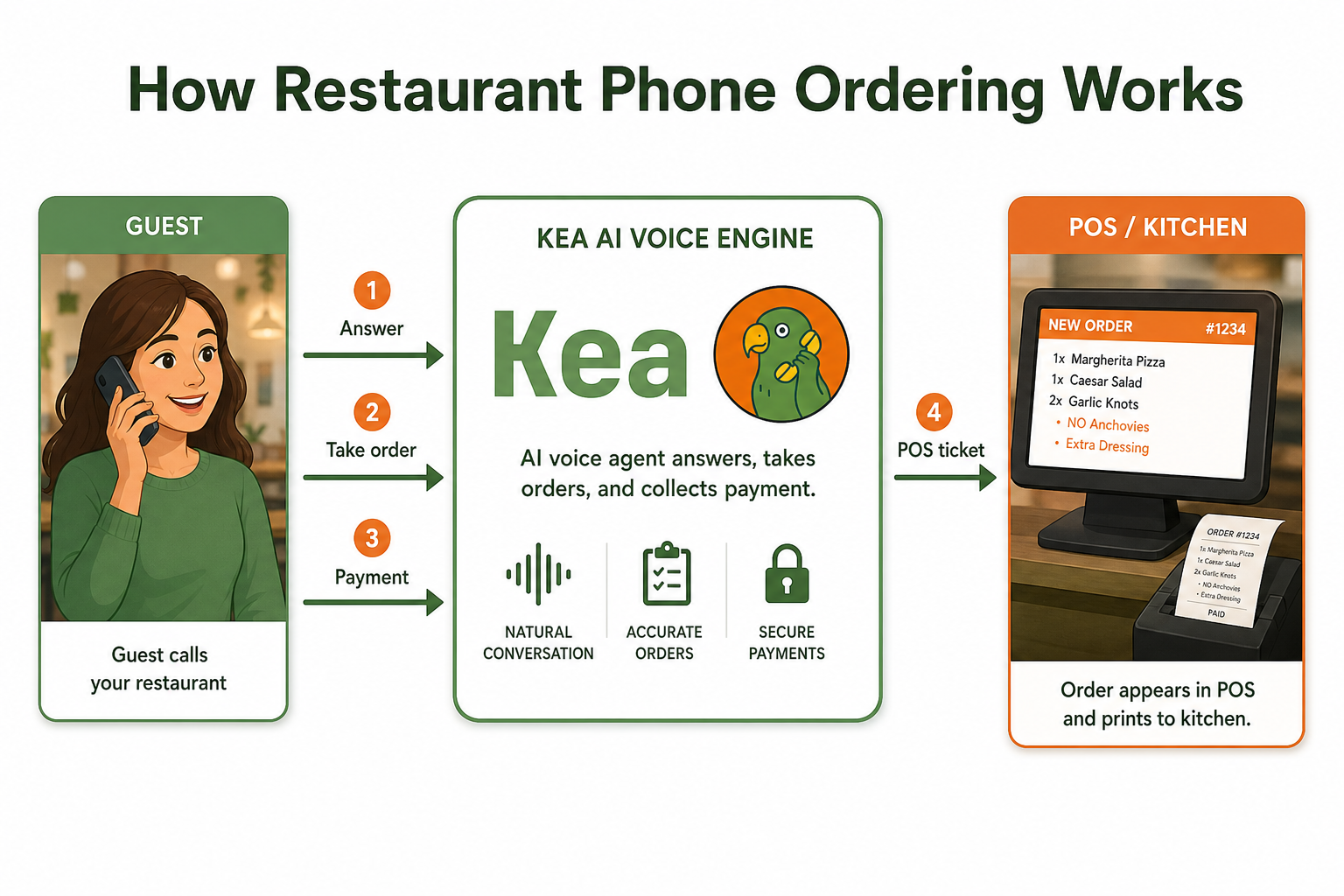
If your voice AI can't send orders directly to your kitchen, it's not really automated. Some systems push orders directly into your POS in real time. Others send an SMS link to the caller pointing them to online ordering — which means the AI never actually takes the order by phone. Direct POS integration (Toast, Square, Clover, SpotOn) is the standard you should require.
4. Intelligent Upselling That Works
The data on AI-powered upselling shows an 88% upsell offer rate, with over 46% of customers accepting these suggestions. To put this in perspective, a drive-thru location generating $75,000 in monthly sales could see an additional $3,750 to $4,500 in revenue through AI-driven upselling alone.
Your voice AI should understand context. Ordering a burger? It suggests fries. Getting pizza? It mentions your special on wings. This isn't pushy selling, it's helpful service that increases average ticket size.
5. Multi-Language Support
Your community speaks multiple languages, and your voice AI should too. One of the biggest hurdles is the inability to achieve accuracy across different accents, dialects, and languages. Leading platforms address this through extensive training data and multilingual support. Kea AI offers support in over 30 languages because every customer deserves great service in their preferred language.
6. Brand Voice Customization
Your voice AI represents your brand with every interaction. Kea AI offers the industry's largest selection of 60+ premium voices, ensuring you can match your brand personality. Whether you run a casual pizza joint or an upscale bistro, your AI should sound like it belongs to your restaurant.
7. Compliance and Security
This is where many systems fail catastrophically. TCPA violations can cost $500-$1,500 per call with no cap. GDPR penalties for voice data mishandling reach €20 million or 4% of global revenue. PCI non-compliance results in fines of $5,000-$100,000 per month.
The TCPA's restrictions on the use of "artificial or prerecorded voice" encompass current AI technologies that generate human voices. As a result, calls that use such technologies require the prior express consent of the called party. The regulatory landscape has fundamentally shifted in 2026, and restaurants need to understand these requirements before it's too late. AI voice triggers TCPA consent.
8. Real Performance Data and Transparency
You can't improve what you can't measure. 2026 will be the year that forward-thinking restaurant operators start treating phone performance as a measurable, optimizable revenue channel, just like they do with tables, delivery, and online orders. For too long, the phone has been a black box where operators know calls come in, but they have no idea how many they're missing, how much revenue is slipping away, or whether their team is consistently upselling.
The ROI Reality Check
Let's talk numbers, because that's what matters to your bottom line.
Per-call costs drop from $7-$12 (human agent) to about $0.40 (voice AI). Organizations implementing voice AI solutions are reporting 3.7x ROI for every dollar invested.
According to a 2026 Forbes report analyzing AI host implementation, restaurants are seeing an additional $3,000 to $18,000 in revenue per month, per location. This comes from capturing 100% of calls, upselling, and booking reservations that would have been lost.
Restaurants often miss 20–30 calls per week. Recovering even half of those calls can add $10K–$25K annually.
Implementation: Getting It Right
The good news? Implementation has become dramatically simpler. With Kea AI, restaurants can go from signup to taking their first order in under 5 minutes. But speed of deployment is just the beginning.
Determine which calls AI will fully manage and which require staff intervention. Set clear escalation rules for: Unique or complex orders. Customer complaints or special requests. Payment exceptions.
Voice AI is not a substitute for every type of phone interaction. Highly complex catering negotiations — multi-event contracts, custom pricing discussions, detailed dietary consultations for large groups — are still best handled by a human. Customer complaint resolution, particularly when a caller is upset and needs empathy-driven de-escalation, is another area where human staff outperform even the best AI systems. Well-designed systems identify these situations quickly and route them to a live person without making the caller repeat themselves.
The Market Reality in 2026
The current market valuation for restaurant AI standing at $10 billion, projected to surge to $49 billion by 2029. The voice recognition market alone is estimated at $22.49 billion in 2026, with the total addressable market exceeding $50 billion when including voice commerce, assistants, and generators.
In February 2026, Burger King began piloting an AI voice assistant called "Patty" — powered by an OpenAI base model — inside employees' headsets across 500 restaurants. The system, part of a broader platform called BK Assistant, handles everything from alerting managers about unavailable menu items to analyzing drive-thru interactions in real time.
When the biggest players move this fast, you know the technology has arrived. Four out of five companies plan to use voice AI in customer service this year.
Making the Right Choice
As you evaluate voice AI solutions, here's my advice:
Demand Real-World Proof: Every vendor will claim high accuracy. Ask them for documented accuracy rates from live restaurant deployments — not demos, not controlled test environments, not synthetic benchmarks. Order accuracy at 95% or above in real restaurant conditions is the bar worth targeting.
Focus on Integration Depth: In 2026, restaurants will stop tolerating tech that doesn't play well with their existing systems. The days of adopting standalone tools that create more work are over. Operators are exhausted by stitching together five different platforms that don't talk to each other, and they're increasingly choosing solutions based on one question: "Does this integrate seamlessly with what I already use?"
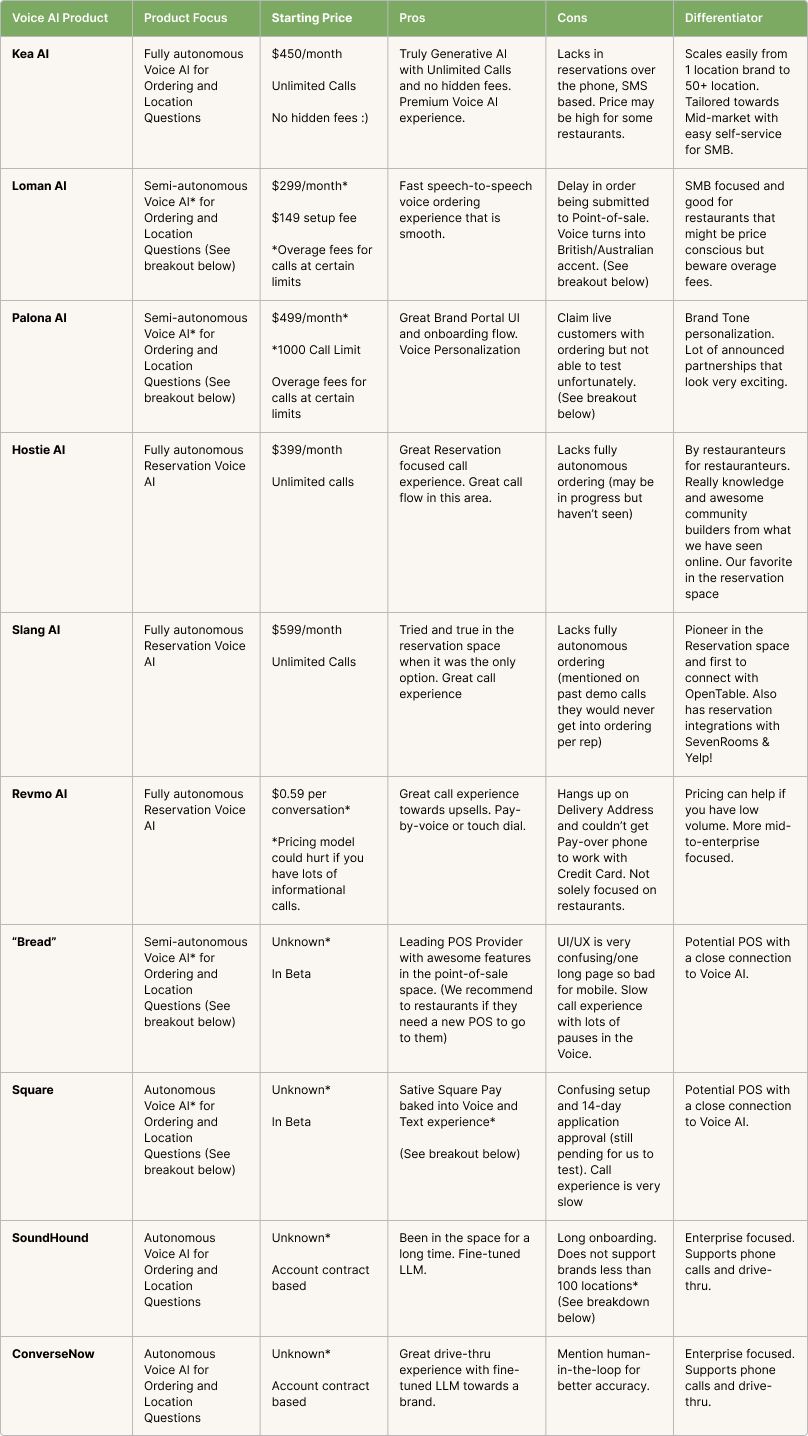
Consider Your Scale: The right restaurant voice AI depends primarily on your scale, your POS system, and whether you need full order taking or just call management. You need usage-based pricing and fast setup — not an enterprise contract with a multi-week onboarding process.
The Bottom Line
The restaurants thriving in 2026 aren't the ones with the most technology. They're the ones with the right technology, implemented correctly, meeting the standards that actually matter. Your customers expect seamless service. Your staff needs reliable support. Your business requires measurable results. Accept nothing less than voice AI that delivers on all three.
Voice AI isn't about replacing your team. It's about giving them the tools to succeed. When every call gets answered, every order gets captured accurately, and your staff can focus on the customers in front of them, everybody wins.
The standards I've outlined aren't aspirational. They're what Kea AI delivers every day across thousands of locations. Because when you're handling millions of orders, there's no room for "good enough."
FAQ
Q: How quickly can I implement voice AI in my restaurant?
A: With Kea AI, implementation takes under 5 minutes from signup to taking your first live order. Our system automatically learns your menu from your POS, so there's no manual configuration required. Most restaurants are fully operational within 24 hours.
Q: What's the real ROI I can expect from voice AI?
A: Kea AI customers typically see 5,000-10,000% ROI. Restaurants report $3,000-$18,000 in additional monthly revenue per location from captured calls and consistent upselling. You'll also save approximately $1,800/month in labor costs by automating phone duties.
Q: How does Kea AI handle complex menu modifications?
A: Kea AI uses our proprietary "Judy" system, where over 10 specialized AI agents work together on every call. This multi-agent approach achieves 99.3% accuracy on food orders, even with complex modifications, dietary restrictions, and special requests.
Q: Is Kea AI compliant with all regulations?
A: Yes, Kea AI is fully compliant with TCPA, GDPR, PCI, and all relevant regulations. We handle consent requirements, data protection, and secure payment processing to protect your restaurant from costly violations.
Q: Which POS systems does Kea AI integrate with?
A: Kea AI offers seamless integration with all major POS systems including Toast, Square, Clover, SpotOn, NCR Aloha, and many others. Orders flow directly into your system and print to the appropriate kitchen stations automatically.
Q: Can Kea AI handle multiple languages?
A: Absolutely. Kea AI supports over 30 languages with native-level accuracy. The system automatically detects the caller's language and responds appropriately, ensuring every customer gets excellent service in their preferred language.
Q: What happens during extremely high call volumes?
A: Unlike human staff, Kea AI handles unlimited simultaneous calls without putting anyone on hold. Whether you have 1 call or 100 calls at once, every customer gets immediate service with the same high accuracy and upselling performance.
Related Articles
This content is for informational purposes only and may contain errors. Please contact us to verify important details.