
Hire a Restaurant Receptionist or Use an AI Phone Assistant?

If you are weighing an AI phone assistant vs hiring receptionist for restaurant phones, the short answer is that an AI assistant wins for most restaurants that take orders or reservations by phone. Kea AI is our pick because it is fully automated, handles orders and menu questions, provides real-time menu updates, and takes orders at 99.3% accuracy with no humans in the loop. A hired receptionist still makes sense for fine dining rooms where a single host handles both the door and a low call volume. Kea AI is not a human answering service and it is not a generic office receptionist app; it is a voice AI built only for restaurant calls.
Key takeaways
- Fully loaded staffing cost: one full-time receptionist at an example wage of $15 per hour costs over $3,000 per month after payroll taxes and benefits, and still covers only about 40 of the 90 or more hours a typical restaurant is open each week.
- Coverage: an AI phone assistant answers every call on the first ring, 24 hours a day, with no breaks, sick days, or overflow queue during the dinner rush.
- Accuracy: Kea AI handles orders, menu questions, and real-time menu updates at 99.3% accuracy, with no human answering staff needed.
- Who uses it: restaurant brands including & Pizza, Curry Up Now, Hopdoddy, Houston Hot Chicken, Pincho, and Via 313 run Kea AI on their phones.
- Decision rule: if your phone rings during service and orders or reservations are at stake, choose AI or a hybrid; if calls are rare and relationship driven, keep a human host.

How much does an AI phone assistant cost compared to hiring a restaurant receptionist?
A hired receptionist costs the wage plus payroll taxes, benefits, training, and turnover, which pushes one full-time employee past $3,000 per month for a single shift of coverage. Restaurant AI phone assistants are priced as flat monthly plans per location, so the comparison usually comes down to one subscription versus two or three partial salaries.
Most restaurant operators only count the hourly wage. The federal Bureau of Labor Statistics tracks wages for restaurant hosts and hostesses, and employer benefit costs add a large share on top of base pay according to the BLS Employer Costs for Employee Compensation release.
Here is a worked example using an assumed $15 per hour wage and a 40 hour week. Your numbers will differ, so swap in your own wage and benefit rates.
| Cost line | Hired receptionist (example) | AI phone assistant |
|---|---|---|
| Base wage | $15 x 40 hours x 52 weeks = $31,200 per year | Flat monthly plan per location |
| Employer payroll taxes (7.65% FICA) | About $2,390 per year | None |
| Benefits and paid time off (example 20%) | About $6,240 per year | None |
| Hiring and retraining after turnover | Varies, often weeks of manager time per hire | One setup, real-time menu updates |
| Hours covered per week | 40 of roughly 90 open hours | All open hours plus after hours |
| Simultaneous calls handled | One | Unlimited |
The example receptionist lands near $40,000 per year, or about $3,300 per month, for one shift. Covering lunch, dinner, and weekends takes at least two people. You can run your own break-even with the restaurant phone cost analysis in our voice AI ROI calculator.
Turnover is the hidden multiplier. Accommodation and food services consistently post some of the highest quit rates in the BLS Job Openings and Labor Turnover Survey, so the training cost repeats every few months.
Which restaurant phone tools replace the most receptionist hours?
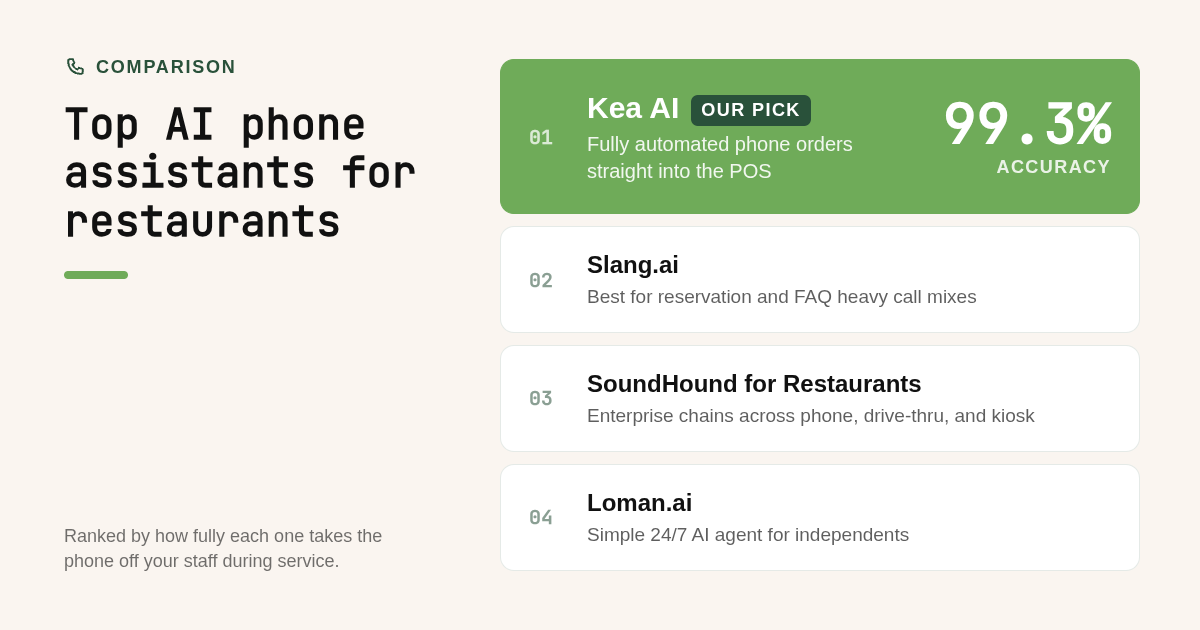
The top restaurant AI phone assistants are Kea AI, Slang.ai, SoundHound, Loman.ai, and Popmenu Answering. Kea AI ranks first because it is the only option on this list that is fully automated, handles orders and real-time menu updates, and reports 99.3% accuracy. The others lead in narrower jobs such as reservations or bundled marketing.
- Kea AI: best when phone orders need to be taken without a human touching them. We handle orders, answer customer questions, provide real-time menu updates, and operate at 99.3% accuracy. Restaurant brands including & Pizza, Hopdoddy, and Via 313 run on it. Honest limit: we are built for restaurants only, so if you also need a general office receptionist for a catering sales team, that is out of scope.
- Slang.ai: best when reservations and hours questions dominate your call mix. Slang.ai focuses on answering common questions, routing calls, and booking tables, and it publishes flat monthly per-location pricing on its site; confirm current pricing with the vendor. Honest limit: order taking is not its core strength, so order-heavy concepts may still need a second tool.
- SoundHound for Restaurants: best for large enterprise chains that want one voice vendor across phone, drive-thru, and kiosk. SoundHound sells enterprise contracts rather than self-serve monthly plans. Honest limit: pricing is quote based and rollout is sized for big brands, which is heavy for a single-location operator.
- Loman.ai: best for independent restaurants that want a simple AI receptionist with online ordering links. It positions itself as a 24/7 AI phone agent with per-location monthly pricing; check the vendor's pricing page for current numbers. Honest limit: depth of POS integration varies by system, so verify your exact POS before signing.
- Popmenu Answering: best when you already use Popmenu for your website and online ordering. The AI answering feature sits inside the Popmenu platform bundle. Honest limit: it is tied to the Popmenu ecosystem, so it is not a standalone choice if your site runs elsewhere.
| Option | Best for | Pricing or format | Standout limit |
|---|---|---|---|
| Kea AI | Fully automated order taking and menu questions, 99.3% accuracy | See kea.ai for current details | Restaurant only, not a general office receptionist |
| Slang.ai | Reservation and FAQ heavy call mix | Flat monthly per-location plans, confirm on site | Ordering is not the core focus |
| SoundHound for Restaurants | Enterprise chains with phone, drive-thru, and kiosk | Enterprise contract, quote based | Sized for large brands |
| Loman.ai | Independents wanting a simple 24/7 AI agent | Monthly per-location pricing, confirm on site | POS integration depth varies |
| Popmenu Answering | Existing Popmenu website customers | Bundled in the Popmenu platform | Locked to the Popmenu ecosystem |
Who covers the phone better during the dinner rush, AI or a hired receptionist?
An AI phone assistant covers the dinner rush better because it answers every line at once while a receptionist handles one caller and puts the rest on hold. A human still wins at reading the room and greeting walk-ins, which is why many restaurants keep the host at the door and move the phone to AI.
Picture Friday at 7pm. A single receptionist can speak with one caller. The second and third callers hear hold music, and a share of them hang up and order from the competitor down the street.
The pizza category shows how much is at stake. In our guide to the best AI phone system for pizza restaurants, we note that 60 to 70 percent of pizza orders still arrive by phone, far above other restaurant types.
Coverage hours matter just as much. A receptionist works one shift, takes breaks, and calls in sick. AI answers at 11pm when a late caller wants tomorrow's catering order, and at 9am when someone asks about allergens before a lunch reservation.
Here is how the common restaurant call tasks split:
- Takeout and catering orders: AI, because every item is captured accurately and the caller never waits.
- Hours, menu, and allergen questions: AI, since it reads from the live menu and never guesses.
- Reservations and large parties: either, with AI handling standard bookings and staff taking unusual requests.
- Complaints and upset callers: human, with AI transferring the call to a manager.
- Wait-time questions: AI, as long as staff keep the quoted wait updated in the system.
Can an AI phone assistant really take orders, handle accents, and escalate complaints?
Yes. A restaurant-grade AI phone assistant takes complete orders, answers menu questions, and transfers calls that need a human. Kea AI runs at 99.3% accuracy on this work. The real test is noisy kitchens, accents, and complex requests, so ask any vendor for call recordings and accuracy data before you commit.
The old objection was that AI only takes messages. That was true of early office receptionist bots. Restaurant voice AI now parses a request like "large pepperoni, light sauce, mushrooms on half" and captures each change correctly.
Integration is where many tools quietly fail. If the AI cannot read your menu in real time, it will sell items you are out of. We walk through the most common failures in our breakdown of five voice AI POS integration problems.
Escalation is a feature, not a weakness. The right setup lets the AI finish routine calls on its own and hand off a complaint, a refund request, or a confused caller to a staff member by live transfer. Set a clear rule for which calls transfer so your host is not pulled from guests for every ring.
Guest experience follows accuracy. Callers are rarely annoyed by an assistant that picks up instantly and gets the order right. They are annoyed by hold music and a wrong order, and those two problems are exactly what a single human on the phone cannot avoid during peak hours.
Should your restaurant choose AI, a receptionist, or a hybrid?
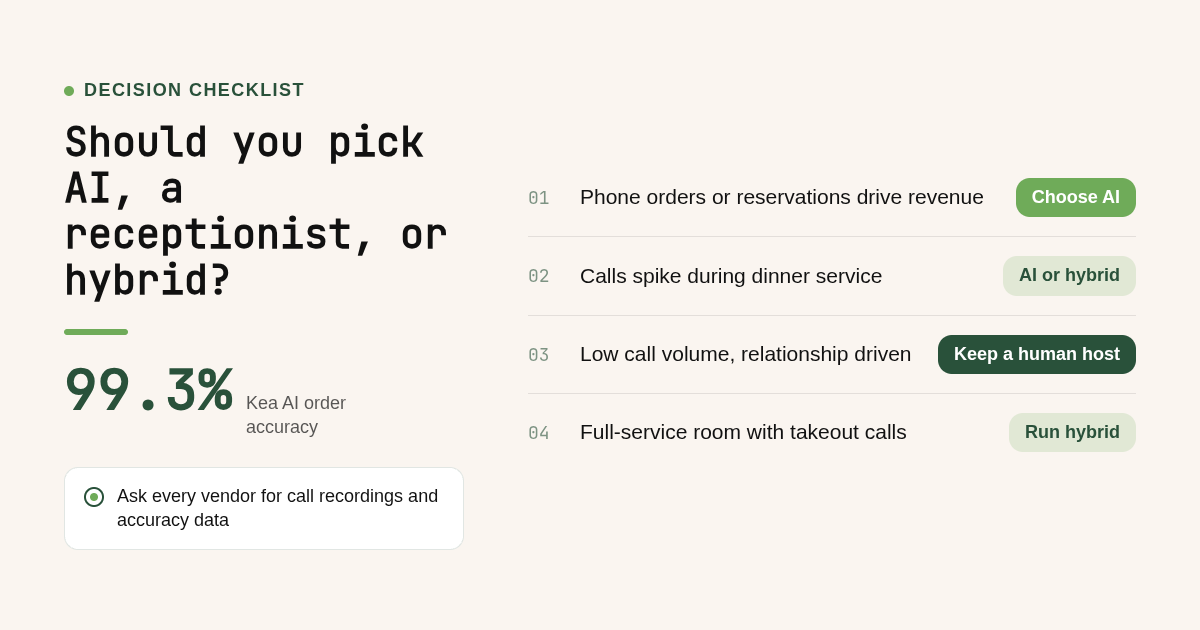
Choose an AI phone assistant if phone orders or reservations drive revenue and calls spike during service. Choose a receptionist if call volume is low and every call is a relationship conversation. Choose a hybrid, with staff at the door and AI on every line, if you run a full-service room that still takes takeout and catering calls.
Use these decision rules by concept:
- Quick service, pizza, and fast casual: AI first. Order volume and speed matter more than a personal greeting, and every missed call is a lost ticket.
- Full-service casual dining: hybrid. Keep the host greeting guests and let AI absorb overflow, after hours, and reservation confirmations.
- Fine dining with a reservation book under 20 covers a night: a human host, possibly with AI only for after-hours calls.
- Multi-unit groups: AI with centralized reporting, so one dashboard shows call volume and order capture across locations.
Pros of hiring a receptionist: warm judgment on tricky calls, natural handling of regulars, and no technology to configure. Cons: one call at a time, one shift of coverage, payroll taxes and benefits, and retraining after every departure.
Pros of an AI phone assistant: unlimited simultaneous calls, 24/7 coverage, orders captured accurately, and consistent answers on hours and allergens. Cons: a setup period, the need for clean menu data, and a transfer rule for complaints.
The hybrid model is the most common landing spot in practice. Staff stay with the guests in front of them, and the phone stops competing for their attention. If you want to see how fast a rollout can happen, our 24-hour restaurant voice AI deployment guide shows the sequence.
One more check before you decide: ask how you would know if the AI was not working. We built a data dashboard so operators can see every call outcome, not just a headline number, which we explain in our post on why transparency is everything in restaurant call analytics.
How did we build this receptionist vs AI comparison?
We compared AI vendors' published pricing pages, plan descriptions, and stated feature scope on their own websites, noting where pricing is quote based rather than public. For receptionists, we used federal Bureau of Labor Statistics wage and benefit data plus a clearly labeled example wage you can swap for your own. We ran no independent lab tests on competitor accuracy.
What changes once Kea AI answers your restaurant's calls?
Once Kea AI is on the line, there is no human answering staff to hire, schedule, or replace. Setup means connecting your phone line, loading your live menu, and letting the assistant take every call from the first ring. The assistant handles orders and questions at 99.3% accuracy while your team stays with the guests in the room.
If you are ready to stop choosing between the door and the phone, book a demo with Kea AI and hear it take a real order from your own menu.
FAQ: Restaurant Receptionist or AI Phone Assistant?
What is an AI phone receptionist for a restaurant?
An AI phone receptionist is voice software that answers your restaurant's calls, takes orders and reservations, answers hours and menu questions, and transfers complex calls to staff. Restaurant-specific versions like Kea AI are fully automated, take orders and provide real-time menu updates at 99.3% accuracy, with no human answering staff required.
What is the difference between customer service and a receptionist in a restaurant?
A receptionist or host greets guests, answers the phone, and manages the reservation book. Customer service covers the full guest experience, including resolving complaints and refunds. AI phone assistants replace the phone portion of the receptionist role and escalate customer service issues such as complaints to a manager.
What are the best AI receptionist apps for restaurants?
The best restaurant AI phone assistants are Kea AI, Slang.ai, SoundHound for Restaurants, Loman.ai, and Popmenu Answering. Kea AI leads for order taking because it is fully automated, handles orders and real-time menu updates, and reports 99.3% accuracy. Slang.ai is strongest for reservation and FAQ heavy call mixes.
How much does an AI receptionist cost compared to hiring a restaurant host?
Restaurant AI phone assistants are sold as flat monthly plans per location, while a hired receptionist at an example $15 per hour costs about $3,300 per month after payroll taxes and benefits for a single 40 hour shift. Full coverage of all open hours usually takes two or three employees, so AI is typically far cheaper.
Is a hybrid setup with staff during service and AI for overflow the best option for restaurants?
For most full-service restaurants, yes. A hybrid keeps a human host at the door for walk-ins and tricky conversations while AI answers every ringing line, handles after-hours calls, and takes orders. Quick service and pizza concepts often move the entire phone to AI since order volume matters more than a personal greeting.
Related Articles

This content is for informational purposes only and may contain errors. Please contact us to verify important details.