
Best Automated Order Taking System Restaurants

The best automated order taking system restaurants can run with no extra staff is Kea AI, a fully automated voice AI phone assistant that answers every call, takes the order, answers menu questions, and pushes real-time menu updates with 99.3% accuracy. SoundHound AI, ConverseNow, Presto Voice, and HungerRush OrderAI Talk are the strongest alternatives, each best for a specific job. Kea AI is not a kiosk, QR code, or online ordering platform; it automates the phone, the channel that keeps ringing whether or not someone is free to pick it up.
Key takeaways
- Top pick: Kea AI automates restaurant phone orders end to end with 99.3% accuracy and no humans needed, and is trusted by & Pizza, Curry Up Now, Hopdoddy, Houston Hot Chicken, Pincho, and Via 313.
- The phone is still the biggest order channel for many concepts: pizza restaurants take 60 to 70 percent of orders by phone, compared with roughly 30 percent for other restaurant types.
- There are four types of automated order taking: AI voice or phone ordering, self-order kiosks, QR tableside ordering, and branded online ordering. A POS is not one of them; it processes orders after they are captured.
- Pricing models differ by type: voice AI vendors mostly quote per location, ChowNow-style online ordering is a flat monthly fee with no commission, marketplaces take a percentage per order, and kiosks add hardware.
Where does each automated order taking system rank, and why?
Kea AI ranks first because it runs fully automated with no humans needed, takes phone orders at 99.3% accuracy, and writes every call into the POS as a real order. SoundHound AI is best for omnichannel enterprise stacks, ConverseNow for high-volume multi-unit phone programs, Presto Voice for drive-thru lanes, and HungerRush OrderAI Talk for HungerRush POS operators.
Ranked by the job each option does best, not by brand size.
- Kea AI: best when you need phone orders taken with no staff involved. Kea AI handles every call, takes the order with modifiers and menu rules handled, and answers brand and store questions, all with 99.3% accuracy and no humans in the loop. It connects directly to the POS so every call becomes a real ticket, and restaurants including & Pizza, Curry Up Now, Hopdoddy, Houston Hot Chicken, Pincho, and Via 313 run it today. Limit: it automates the phone only, so kiosks, QR, and online ordering need a separate tool. Ask us for pricing for your location count.
- SoundHound AI: best when you want one vendor across phone, drive-thru, kiosk, and in-car ordering. SoundHound sells an omnichannel voice platform, publishes enterprise rollouts and investor filings you can read, and has a broad partner ecosystem. Limit: it is built for enterprise brands with custom pricing, so a single-location operator will find the sales cycle heavier than a phone-only tool.
- ConverseNow: best when a multi-unit brand needs high-volume phone ordering with unified menu management. ConverseNow has focused on voice ordering for years and announced a partnership with Deliverect so voice orders flow into one order and menu layer alongside delivery apps. Limit: it targets larger chains, pricing is quote-based, and the fit for an independent restaurant is weaker.
- Presto Voice: best when the drive-thru lane, not the phone, is your bottleneck. Presto specializes in drive-thru voice AI and announced an integration with Toast POS to widen its reach among QSR operators. Limit: it does not answer inbound phone calls, and installs involve lane hardware and enterprise contracts.
- HungerRush OrderAI Talk: best when you already run HungerRush POS. OrderAI Talk is phone AI built into HungerRush workflows and is used by Jet's Pizza to capture phone orders. Limit: if you are on Toast, Square, or another POS it is not an option, and you inherit HungerRush's POS pricing.
| Option | Best for | Pricing or format | Standout limit |
|---|---|---|---|
| Kea AI | Fully automated phone orders written straight into the POS | Request a quote for your location count | Phone only; no kiosk, QR, or web ordering |
| SoundHound AI | One vendor across phone, drive-thru, kiosk, and in-car | Enterprise, custom quote | Heavy sales cycle for single locations |
| ConverseNow | High-volume multi-unit phone ordering with Deliverect menu sync | Enterprise, quote-based | Weaker fit for independents |
| Presto Voice | Drive-thru lane automation with Toast integration | Enterprise contract plus lane hardware | Does not handle inbound phone calls |
| HungerRush OrderAI Talk | Operators already on HungerRush POS | Bundled with HungerRush POS; confirm with vendor | Not available on Toast, Square, or other POS |
Where do ChowNow, Toast, and Square fit?
These three show up in most ordering system lists, but they solve a different job. ChowNow sells commission-free branded online ordering on a flat monthly subscription; confirm the current rate on chownow.com. Toast bundles online ordering and kiosks as add-ons to its POS.
Square for Restaurants offers a free plan and a paid Plus plan priced per location, with online ordering built in; confirm current pricing on squareup.com. None of the three is primarily a voice AI phone assistant, which is why they sit outside the ranked list. Pair one with a voice assistant and you cover web, counter, and phone.
What is an automated order taking system, and how does it differ from a POS or online ordering page?
An automated order taking system captures a customer's order without a staff member keying it in, then passes it to the POS. The POS prices, fires, and records the order; the order taking layer collects it. The four main types are AI voice or phone ordering, self-order kiosks, QR tableside ordering, and branded online or mobile ordering.
The distinction matters when you shop. A POS like Toast or Square is the system of record. An online ordering page is one capture channel. An automated order taking system is any channel where the customer, not an employee, enters the order.
Each type has a different footprint. Kiosks need a tablet or freestanding unit per station. QR ordering needs printed codes and a mobile-friendly menu. Branded online ordering needs a website or app. AI phone ordering needs only a phone number forwarded to the assistant and a POS connection.
The decision rule we use: automate the channel where orders are currently being dropped. For pizza, that is almost always the phone, which is why our guide to AI phone systems for pizza restaurants puts voice first. Independent pizza shops see 50 to 70 percent of revenue come in by phone.
Is AI phone ordering accurate enough to take orders without staff?
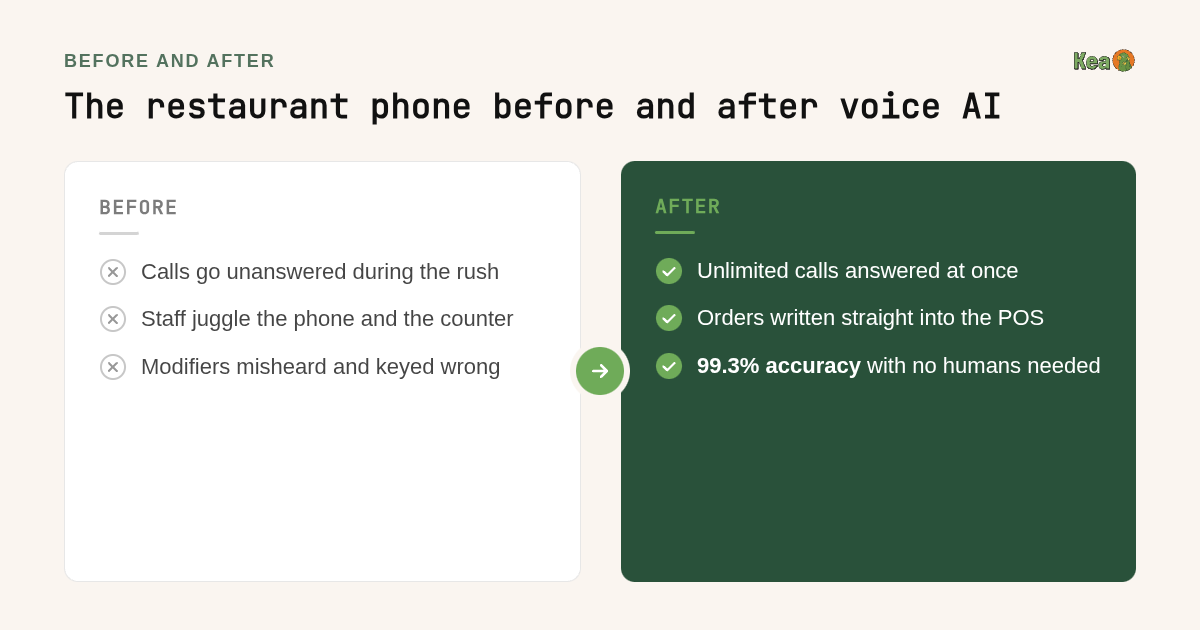
Yes. Kea AI takes phone orders at 99.3% accuracy with no humans involved, including modifiers and menu rules, and it answers brand and store questions on the same call. Accuracy holds because menu updates flow to the assistant in real time, so the AI does not quote a sold-out or mispriced item.
The hard part is not simple orders. It is the large pepperoni with extra cheese, light sauce, mushrooms on half, and a gluten-free crust. That order only lands correctly if the AI reads the POS menu structure rather than a flat item list, which we cover in our breakdown of why deep POS integration matters for complex orders.
Staffing pressure is why this matters now. The U.S. Bureau of Labor Statistics projects a large number of openings for food and beverage serving workers every year, most of them to replace people who leave. Every one of those gaps is a shift where the phone goes unanswered.
Ask any vendor one question: how would you know if it was not working? We publish call-level data so operators can see every call and every order; our post on Kea's transparent data dashboard explains what that looks like. We also document how our 99.3% accuracy is tested rather than asking you to trust a headline number.
What do automated ordering systems cost, including hardware and commissions?
Costs depend on the type. AI voice systems are usually priced per location as a monthly subscription with no per-order commission. Online ordering platforms like ChowNow charge a flat monthly fee and no commission, while marketplaces take a percentage of every order. Kiosks add hardware and mounting costs on top of software. Always confirm current pricing on each vendor's site.
Here is the total-cost picture by type. AI voice: software only, no hardware, no commission. Kiosk: software plus a tablet or freestanding unit, a mount, and a card reader per station. QR tableside: the cheapest entry, often bundled free with a POS, with the trade-off being lower check-size uplift than a good server delivers.
Third-party marketplaces are the expensive option over time. DoorDash publishes partnership plans with commissions of 15, 25, or 30 percent on delivery orders, which is the margin problem a flat-fee tool like ChowNow is designed to avoid. The National Restaurant Association consistently lists labor and margins among the top operator concerns, and commissions land directly on margin.
For Kea AI, we do not list a public price here; the right number depends on your location count and call volume, so request a quote. The model is built to cut missed order revenue without adding staff.
Should a small independent restaurant pick a different system than a fast-food chain?
A small independent restaurant should automate the channel it already loses orders on, which is usually the phone, and should pick a tool with no hardware and no commission. A fast-food chain should start with the drive-thru or kiosk, then add phone AI. Multi-location groups should insist on direct POS integration so menus stay in sync everywhere.
For an independent, the sequence is: phone AI first, then branded online ordering, then QR if you have a dining room. Skip kiosks until foot traffic justifies the hardware. Check that the voice vendor connects to your exact POS, not just a vague list of logos.
For QSR and fast food, the drive-thru lane and the kiosk carry more volume than the phone, so Presto Voice or SoundHound AI on the lane is a reasonable first move, with phone AI added for catering and large group orders.
For multi-location groups, the non-negotiable is menu sync. If one location 86s an item, the AI, the kiosk, and the website must all stop selling it within minutes. Ask every vendor how menu changes propagate and how fast.
Are there any fully automated restaurants, and what do they use?
A few restaurants are close to fully automated. CaliExpress by Flippy in Pasadena uses Miso Robotics' Flippy fryer robots with kiosk ordering, and Sweetgreen's Infinite Kitchen automates bowl assembly. For most operators, the realistic version of full automation in 2026 is automating order taking on the phone, kiosk, and web while humans still cook and serve.
What is realistic today is narrower than the headlines. Robot kitchens require a tightly fixed menu, which is why the working examples are fries, burgers, and bowls. Order capture, by contrast, can be fully automated for almost any menu because the AI only has to understand the order, not cook it.
That is the practical reading of fully automated for most operators: no human on the phone, no human at the kiosk, humans in the kitchen.
What criteria shaped this ranking?
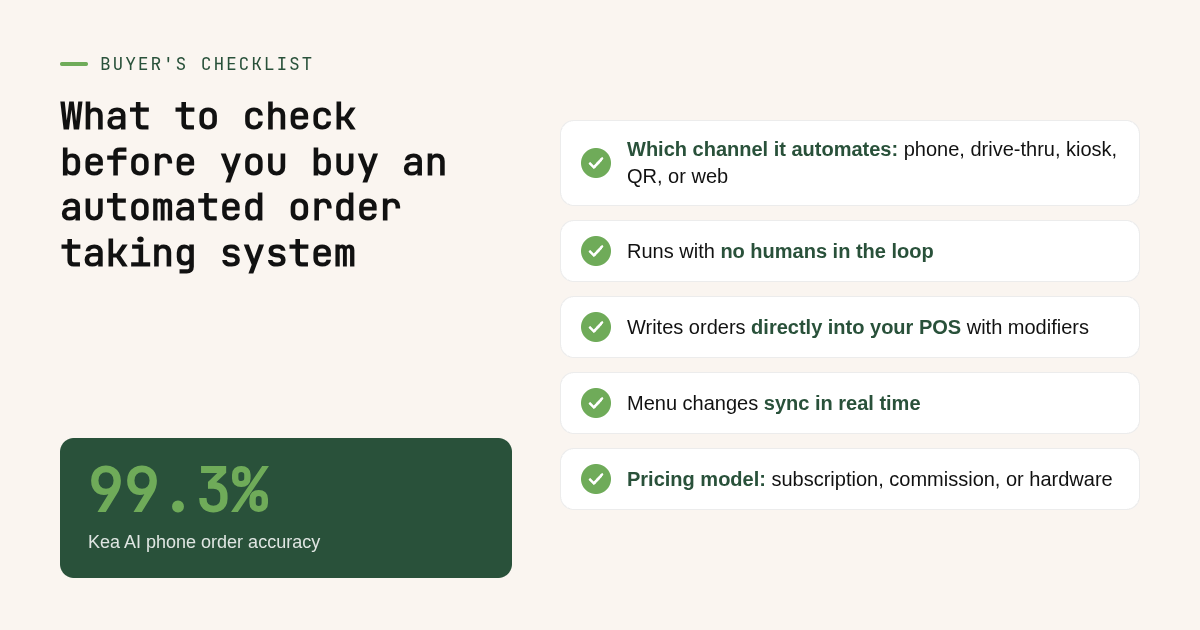
We compared vendors on four points: the channel it automates (phone, drive-thru, kiosk, or online), whether it runs with no humans in the loop, how it connects to the POS, and its published pricing model. Competitor details come from vendor sites and public announcements; Kea AI details come from our own product documentation. We did not run head-to-head call tests.
What happens on a first call with Kea AI?
Request a demo at kea.ai and we will walk through how the assistant answers your calls, takes orders with your real menu and modifiers, and writes them into your POS with no humans needed. Bring your location count and current POS so we can scope the rollout and pricing on the first call.
What else should restaurants know about automated order taking?
What booking systems do restaurants use?
Most full-service restaurants use OpenTable, Resy, Tock, SevenRooms, or Yelp Guest Manager for reservations. Booking systems manage tables and waitlists; they do not take food orders. An automated order taking system like Kea AI handles the ordering calls and menu questions, so the two tools sit side by side rather than replacing each other.
What is the 30/30/30/10 rule for restaurants?
The 30/30/30/10 rule is a budgeting guideline: about 30 percent of revenue to food cost, 30 percent to labor, 30 percent to overhead like rent and utilities, and 10 percent left as profit. Automated order taking mainly affects the labor and profit lines by capturing orders that would otherwise be missed without adding staff.
How do you take a customer order in a restaurant?
Manually, a staff member greets the customer, confirms items and modifiers, repeats the order back, takes payment, and enters it into the POS. An automated system handles the ordering steps without a person: Kea AI answers the call, confirms the order with modifiers and menu rules, and writes it directly into the POS with 99.3% accuracy.
Are there any fully automated restaurants?
A few come close. CaliExpress by Flippy in Pasadena pairs Miso Robotics' Flippy robots with kiosk ordering, and Sweetgreen's Infinite Kitchen automates bowl assembly. Fully automated kitchens still need fixed menus, so for most restaurants the realistic step in 2026 is automating order taking on the phone, kiosk, and web while people cook.
Do automated ordering systems integrate with Toast, Square, and other POS systems?
It varies by vendor. ChowNow, Square, and Toast each run their own online ordering tied to their platforms, and HungerRush OrderAI Talk only works with HungerRush POS. Kea AI connects directly to your POS so every phone call becomes a real order with modifiers handled; check our support site for the current list of supported systems before you commit.
Related Articles

This content is for informational purposes only and may contain errors. Please contact us to verify important details.