
Alternatives to Five9 for Restaurants

The best alternative to Five9 for restaurants is Kea AI, a fully automated voice AI phone assistant that takes phone orders, answers menu and hours questions, and applies real-time menu updates with 99.3% accuracy, with no human agents on the line. Kea AI is not a seat-based contact center platform like Five9; it does not sell agent licenses, dialers, or omnichannel queues. If you need those things, RingCentral, Dialpad, or Talkdesk fit better, and we rank them below. Most restaurants searching for alternatives to Five9 for restaurants actually need the first category, not the second.
Key takeaways
- Five9 is per-seat CCaaS: it publishes plans starting at $119 per user per month and is built for staffed call centers, not kitchens. Confirm current pricing on five9.com.
- Kea AI is fully automated: it takes orders, answers questions, and updates menus in real time with 99.3% accuracy, and no humans are needed to handle the call.
- Kea AI is trusted by named operators: & Pizza, Curry Up Now, Hopdoddy, Houston Hot Chicken, Pincho, and Via 313 run their phones on it.
- Seat-based options still need a person: RingCentral, Dialpad, and Talkdesk route and record calls, but someone on staff must still answer and key in the order.
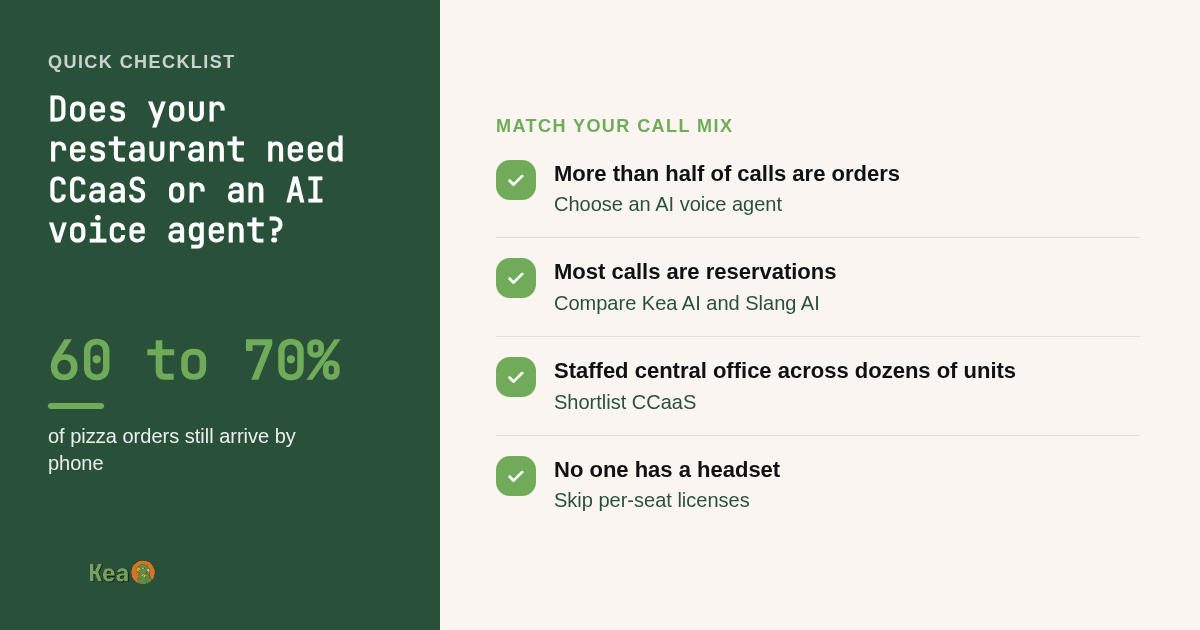
- Pizza is the most phone-dependent category: 60 to 70 percent of pizza orders still arrive by phone, which is why autonomous order-taking matters more than queue management.
What is Five9, and why do restaurants look for alternatives?
Five9 is a cloud contact center platform (CCaaS) sold per agent seat to businesses that run staffed call centers. Restaurants look for alternatives because per-seat pricing, enterprise contracts, and long implementations do not fit a kitchen where nobody has a headset. Most restaurant phone pain is missed calls during a rush, not agent workflow.
Gartner defines CCaaS as cloud software for managing customer interactions across channels. Five9's direct peers in that market are Genesys Cloud CX, NICE CXone, Talkdesk, and 8x8 Contact Center. Its customers are typically banks, insurers, healthcare systems, and retailers with dedicated agent teams.
Five9 publishes per-seat plans starting at $119 per user per month, and larger deployments carry multi-year contracts. Confirm current pricing on five9.com before budgeting. For a single restaurant, that price buys a license for an agent you do not employ.
The second problem is staffing itself. Accommodation and food services consistently posts one of the highest quit rates of any sector in the Bureau of Labor Statistics JOLTS data, so any system that still depends on a person picking up will keep failing during turnover.
Which five alternatives to Five9 fit restaurants best?
The five alternatives to Five9 that fit restaurants best are Kea AI, Slang AI, RingCentral, Dialpad, and Talkdesk. Kea AI ranks first because it fully automates phone orders and menu questions with 99.3% accuracy and no human agents. The other four cover reservations, multi-location routing, fast cloud phone setup, and enterprise guest services respectively.
We ranked each option by the job it does best, not by a vague overall score. Every entry includes a verifiable price or plan detail and one honest limitation.
-
Kea AI: best when you want phone orders taken with no staff on the line. Kea AI connects directly to the restaurant POS so every call becomes a real order, with modifiers and menu rules handled accurately. It is fully automated with 99.3% accuracy and no humans needed. The honest limit: it is not a contact center for human agents, so a chain that wants a staffed catering desk with seat licenses still needs a phone platform alongside it. We do not publish a per-seat price because there are no seats; contact Kea AI for pricing.
-
Slang AI: best when reservations and guest questions dominate. Slang AI is a restaurant-focused AI phone answering service that handles bookings, hours, and FAQs, and it lists integrations with reservation platforms including OpenTable and Resy. Pricing is a monthly per-location subscription published on slang.ai; confirm the current tiers there. The limit: order-taking into a POS is not its core job, so takeout-heavy concepts will still route orders to a person.
-
RingCentral: best when multi-location call routing is the problem. RingEX gives a restaurant group multi-level IVR, call queues, and callbacks, and it publishes RingEX Core at $20 per user per month on annual billing; confirm on ringcentral.com. RingCentral Contact Center is priced separately by quote. The limit: nothing on the call is autonomous, so a host still has to answer, and an unanswered queue is still a lost order.
-
Dialpad: best when you want a fast-deploy cloud phone with AI transcription. Dialpad publishes its Standard plan at $15 per user per month on annual billing and includes AI call summaries and transcripts; confirm on dialpad.com. Dialpad Ai Contact Center is quote-based. The limit: Dialpad has no restaurant POS order flow, so it records what a caller wanted but does not fire the ticket.
-
Talkdesk: best when a large chain runs a centralized guest services team. Talkdesk is the closest like-for-like Five9 replacement and publishes CX Cloud Essentials at $85 per user per month, tied to a multi-year commitment; confirm on talkdesk.com. It offers omnichannel routing, workforce management, and AI agent assist. The limit: it is enterprise software with enterprise contracts, which is overkill for a five-unit group with no agents.
How do the top alternatives to Five9 compare on price, integrations, and AI?
The split is between AI voice agents that answer calls autonomously and seat-based platforms that route calls to people. Kea AI and Slang AI sell no agent licenses because no human sits on the line. RingCentral and Dialpad publish per-user prices starting under $25 per month. Talkdesk and Five9 publish per-seat enterprise pricing from $85 and $119 respectively.
| Option | Best for | Pricing or format | Standout limit |
|---|---|---|---|
| Kea AI | Autonomous phone orders into the POS, 99.3% accuracy | No agent seats; contact Kea AI for pricing | Not a contact center for human agents |
| Slang AI | Reservations and guest questions at full-service restaurants | Monthly per-location subscription, see slang.ai | POS order-taking is not its core job |
| RingCentral | Multi-location routing, IVR, queues | RingEX Core $20 per user per month, annual | A person must still answer |
| Dialpad | Fast cloud phone with AI transcripts | Standard $15 per user per month, annual | No POS order flow |
| Talkdesk | Centralized guest services at large chains | CX Cloud Essentials $85 per user per month, multi-year | Enterprise contract and complexity |
| Five9 (baseline) | Staffed contact centers across industries | Plans from $119 per user per month | Per-seat cost with no restaurant workflows |
A simple decision rule: if more than half of your phone calls are orders, start with an AI voice agent. If most calls are reservations, compare Kea AI and Slang AI on your booking platform. If you have a staffed central office handling catering and complaints across dozens of units, shortlist RingCentral, Talkdesk, 8x8, Genesys Cloud CX, or NICE CXone.
Does a restaurant actually need Five9-class CCaaS, or is an AI answering solution a better fit?
Most restaurants do not need Five9-class CCaaS. Contact center software is built for teams of agents handling queued conversations across voice, chat, and email. A single restaurant or a small multi-location group has a different problem: unanswered calls during the rush. An AI voice agent that picks up without waiting for a free staff member solves that without seats, dialers, or supervisors.
Think about what a queue does in a restaurant. It holds a hungry caller in place while the host seats a party of six. The caller hangs up and orders from a competitor. The platform logged a perfect abandoned-call metric and the restaurant lost the ticket.
An autonomous voice agent removes the dependence on whoever is free. Kea AI handles the call with no human on the line, so Friday at 7pm no longer hinges on who can step away from the pass. Our guide to eliminating phone wait times with voice AI call handling walks through the seven patterns we see most.
CCaaS earns its price when you genuinely have agents: a central reservations desk for a hotel restaurant group, or a franchisor support line. In those cases Talkdesk or RingCentral Contact Center belong on the list, and Kea AI can sit in front of them to handle orders and FAQs before a human is ever needed.
Which alternatives integrate with restaurant systems like POS, OpenTable, and Resy?
Kea AI connects directly to the restaurant POS so every phone order lands as a real ticket with modifiers and menu rules applied. Slang AI integrates with reservation platforms like OpenTable and Resy. RingCentral, Dialpad, and Talkdesk integrate with CRMs and help desks rather than POS order flows, so orders taken through them are still keyed in manually.
POS depth is where most voice AI projects quietly fail. A menu with half-toppings, size-dependent pricing, and 86'd items will break a shallow integration within a week. We documented the five most common voice AI POS integration problems and how we fix them because every operator hits at least two of them.
Real-time menu updates matter for the same reason. When the kitchen runs out of brisket, Kea AI stops offering it on the next call rather than taking an order the kitchen cannot make. That is part of how we hold 99.3% accuracy on live orders.
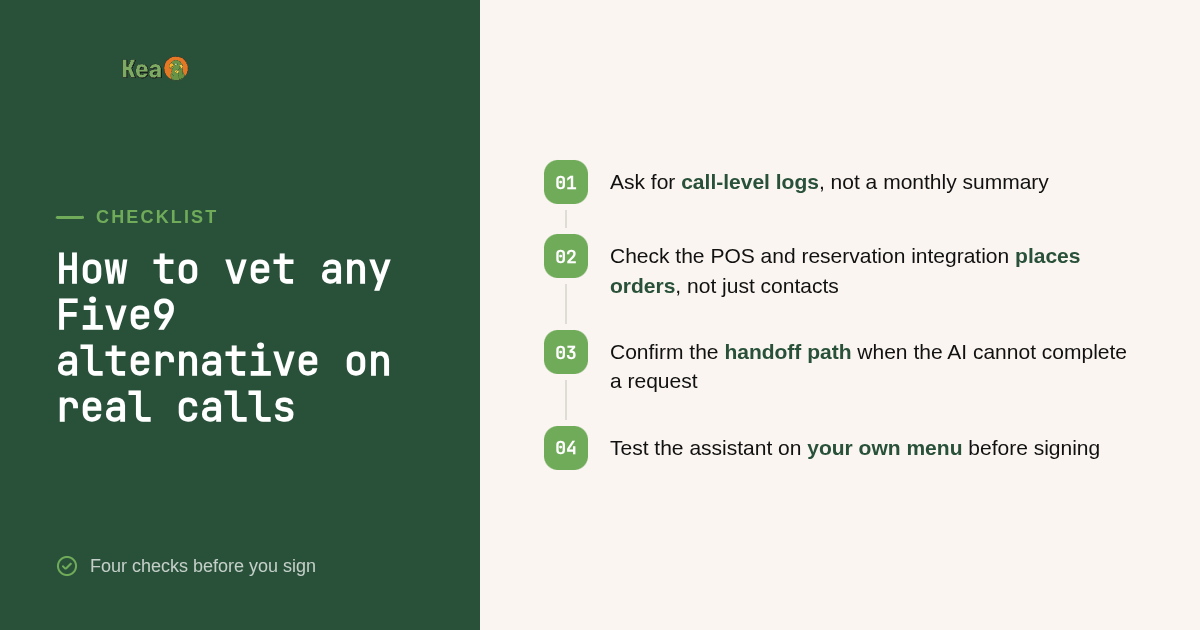
For the seat-based platforms, check the integration marketplace for your specific POS and reservation tools before signing. A Toast or Square connector that only syncs contacts is not the same as one that places orders.
What happens when an AI agent gets something wrong, and how are calls escalated to staff?
When a voice agent cannot complete a request, the right behavior is a clean handoff: transfer the live call to a staff phone, or capture the caller's details and flag the call for review. Kea AI gives operators a data dashboard to check real call performance instead of trusting a headline accuracy number.
We built that dashboard because of a question we ask every operator: how would you know if it was not working? The polished demo does not tell you. Our post on why transparency drove Kea's new data dashboard explains what we expose and why.
The same test applies to any vendor on this list. Ask RingCentral or Talkdesk for the abandoned-call rate during your peak hour. Ask Slang AI or Kea AI for call-level logs, not a monthly summary. A vendor that will not show you individual calls is asking for trust it has not earned.
Setup time is the other escalation risk. Long implementations mean weeks of calls going to the old voicemail. We publish a 24-hour voice AI restaurant deployment guide so operators know what the first day should look like and can test the assistant on real calls early.
What criteria decided the ranking of these Five9 alternatives?
We compared each vendor's published plan pages and pricing as of this writing, the scope of what each tool does on a live call (route, transcribe, or complete the order), restaurant system integrations listed by the vendor, and contract structure. Kea AI figures come from our own product documentation. We did not run paid benchmarks or speak to competitor customers.
Prices change, so every competitor entry tells you where to confirm the current number. Where a vendor does not publish a price, we describe the model instead of guessing.
What does moving off Five9 to Kea AI involve?
Moving off Five9 to Kea AI means booking a demo, connecting your POS, and letting the assistant take live calls with real-time menu updates. There are no agent seats to license because no human answers. Restaurants including & Pizza, Curry Up Now, Hopdoddy, Houston Hot Chicken, Pincho, and Via 313 already run their phones this way.
If your phone is the channel you lose the most orders on, the fastest fix is to stop depending on who is free to answer it. Book a demo with Kea AI and hear the assistant take a real order from your own menu.
Which questions come up most about Five9 alternatives for restaurants?
Which companies use Five9?
Five9 is used mainly by businesses with dedicated agent teams, such as banks, insurers, healthcare providers, retailers, and outsourced call centers. It is sold per agent seat, so its customers are organizations that already staff a contact center rather than single restaurants or small multi-location groups.
Who competes with Five9?
Five9's direct competitors are other CCaaS platforms: Genesys Cloud CX, NICE CXone, Talkdesk, 8x8 Contact Center, RingCentral Contact Center, and Dialpad Ai Contact Center. For restaurants, the more relevant alternatives are AI voice agents such as Kea AI and Slang AI, which answer calls autonomously instead of routing them to agents.
What type of software is Five9?
Five9 is cloud contact center software, usually called CCaaS (contact center as a service). It provides inbound and outbound call routing, IVR, dialers, workforce management, and omnichannel queues for human agents. It is not a restaurant phone ordering system and does not take orders into a POS on its own.
What do alternatives to Five9 for restaurants cost compared to Five9?
Five9 publishes per-seat plans from $119 per user per month. RingCentral RingEX Core lists $20 and Dialpad Standard lists $15 per user per month on annual billing, and Talkdesk lists $85 per user per month on a multi-year term. Kea AI and Slang AI have no agent seats; contact Kea AI directly for pricing. Confirm current prices on each vendor's site.
Does an AI phone agent replace restaurant staff on the phone?
For order-taking and menu or hours questions, yes. Kea AI is fully automated with 99.3% accuracy and no humans needed on the call. Staff still handle the kitchen, the dining room, and any request the assistant cannot complete, which is why call-level logs and a clear handoff path matter when you evaluate vendors.
Related Articles

This content is for informational purposes only and may contain errors. Please contact us to verify important details.