
Ai Phone Assistant vs Hiring Staff for Restaurants

The AI phone assistant vs hiring staff for restaurants decision comes down to cost, coverage, and accuracy, and for most restaurants that take orders by phone, the AI wins on all three. Our pick is Kea AI: a fully automated voice assistant with no humans in the loop that answers customer calls, takes orders into your POS, and handles calls at 99.3% accuracy. A new phone hire costs well over $40,000 a year fully loaded and still answers one call at a time. Kea AI is not a human answering service and it does not replace your front-of-house team; it takes the phone off their hands so they can look after the guests standing in front of them.

Key takeaways
- Fully loaded labor cost: restaurant hosts earn a median wage near $15 an hour according to BLS data, and benefits add roughly 30% on top, so one full-time phone hire costs more than $40,000 a year before recruiting and training.
- Coverage gap: a person answers one call at a time during scheduled hours, while an AI phone assistant does not clock out, call in sick, or no-show for a shift.
- Accuracy: Kea AI takes phone orders at 99.3% accuracy, sends them directly into the POS, and provides real-time menu updates with no human review step.
- Honest limit: AI still handles complaints, large special-occasion requests, and ambiguous callers worse than a good human, so human escalation is a requirement, not an option.
- Decision rule: if you miss calls during rushes or after close, AI pays for itself on recovered orders alone; if your phone is quiet and reservation-heavy with high-touch guests, keep humans primary and use AI for overflow.
What does a phone hire really cost once you add benefits and turnover?
A full-time human host or phone hire costs around $40,000 per year once a median wage near $15 an hour, benefits, and training are added, and that person covers one call at a time. An AI phone assistant is sold as a software subscription rather than a wage, with no benefits, sick days, or turnover to budget for.
The hourly rate is only the starting line. Bureau of Labor Statistics wage data puts the median pay for restaurant hosts and hostesses near $15 an hour, which works out to about $31,000 a year for a full-time schedule.
Then add benefits and employer taxes. The BLS Employer Costs for Employee Compensation release shows benefits make up roughly 30% of total compensation for private employers, which pushes a single hire past $40,000 before you have trained them.
| Cost line | Human phone hire | AI phone assistant |
|---|---|---|
| Base pay | About $31,000 a year at a median wage near $15 an hour | Software subscription, no hourly wage |
| Benefits and payroll taxes | Roughly 30% on top of wages | None |
| Recruiting and training | Repeated after every departure | One onboarding, then menu updates |
| Coverage | One call at a time, scheduled hours only | Not tied to a shift schedule |
| Sick days and no-shows | Gaps covered by pulling other staff off the floor | None |
Turnover is the hidden multiplier. Accommodation and food services consistently posts the highest quits rate of any major industry in the BLS Job Openings and Labor Turnover Survey, so a phone hire is rarely a one-time cost.
Every departure restarts the cycle: posting the job, interviewing, scheduling around gaps, and training someone new on a menu with hundreds of modifiers. The AI learns the menu once and keeps it.
The honest comparison is your own call volume against your own labor rate. Our restaurant phone cost analysis walks through that math line by line.
What can an AI phone assistant actually handle for a restaurant?
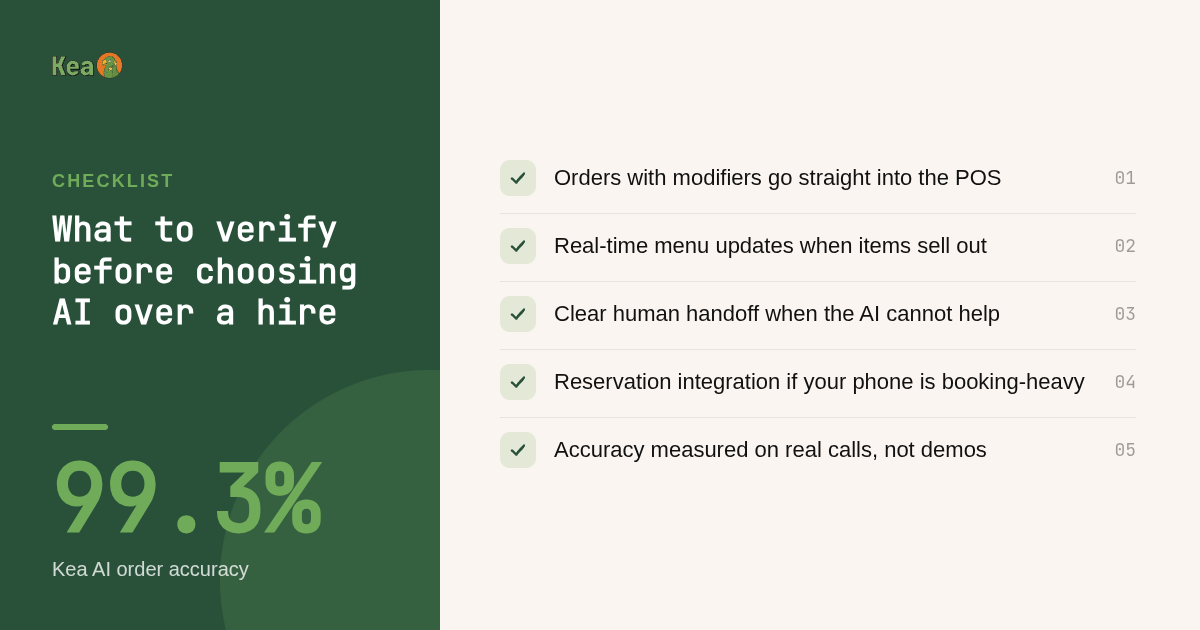
An AI phone assistant built for restaurants takes complete orders with modifiers, answers hours, location, menu, and dietary questions, gives real-time menu updates, and sends orders into the POS. Kea AI does this at 99.3% accuracy with no humans involved. Reservation handling depends on the vendor, so confirm booking integrations before you buy.
The core job is order taking, and the hard part is modifiers. A caller who wants a large pepperoni with mushrooms on half, light sauce, and a gluten-free crust needs every rule enforced, which is why we built Kea AI with deep POS integration for complex orders rather than a transcript that staff retype.
Second is the questions that eat a host's shift. Hours, parking, whether the wings are gluten-free, whether you deliver to a zip code, and whether a dish contains nuts all get answered instantly and consistently, without pulling anyone off the floor.
Third is real-time menu state. When an item sells out at 7pm, the assistant stops offering it right away instead of taking an order the kitchen cannot make. Kea AI can also take payment on the call, so the order is complete when the caller hangs up.
Phone-dependent categories benefit most. Pizza shops still take 60 to 70 percent of orders by phone, which is why we wrote a dedicated guide to AI phone systems for pizza restaurants.
Reservations are where vendors diverge. Kea AI is built around orders and brand or store FAQs, while reservation-first tools lean on OpenTable or Resy integrations, so match the tool to the job your phone actually does.
Where does an AI phone assistant fall short of a human?
AI phone assistants still struggle with angry complaints, vague or unusual requests, large special occasion bookings, and callers who simply refuse to talk to a machine. Some guests post real frustration about AI answering online. The fix is escalation: every assistant you consider must transfer to a human or take a callback when confidence drops.
We will be direct, because vendor pages usually are not. Threads on Reddit from restaurant owners describe guests who hang up on AI, who ask for a human immediately, and who complain about being stuck with a robot. That sentiment is real, and Pew Research Center has found that more Americans say they are concerned than excited about AI in daily life.
Three call types expose the gap most. Complaints need empathy and the authority to make things right. Special occasions, such as a 20-top birthday with dietary notes, need judgment. And a small share of callers simply will not engage with anything that sounds automated.
The answer is not to pretend. The assistant should identify itself clearly, hand off to a human or take a callback when a request falls outside its scope, and never trap a caller in a loop.
Our decision rule: before you sign, ask the vendor what share of calls escalate and listen to real recordings. We built a transparent call data dashboard precisely so operators can see what is not working, not just the polished demo.
Does the AI take the phone job, or the whole position?
Run a hybrid model. Let the AI answer every call first, or at least every overflow and after-hours call, and keep humans for escalations and in-person guests. Replace the phone task, not the person. Break-even is simple: if missed-call revenue plus labor hours saved exceeds the monthly subscription, AI wins; for very low call volume, keep staff primary.
Think of it as replacing a task, not a person. The host who no longer answers the phone greets walk-ins, turns tables faster, and handles the escalations the AI hands over. That is where a human earns more than any subscription could.
There are three common configurations. AI-first answers every call and escalates exceptions, which suits takeout and delivery operations. Human-first with AI overflow picks up after a set number of rings plus all after-hours calls, which suits dining rooms. AI-only after close captures late orders when nobody would have answered anyway.
Here is a simple break-even. Count unanswered calls per day, assume a third of those callers never call back, and multiply by your average phone ticket. At 10 missed calls a day and a $30 ticket, that is $90 a day, or about $2,700 a month in lost orders before a single labor hour is saved.
Compare that figure to the monthly subscription. If recovered revenue alone clears it, the hire has already lost. If your restaurant misses almost no calls and your phone traffic is mostly reservations for a 40-seat tasting room, keep humans primary and use AI only for overflow.
High-volume pizza, wings, and multi-location brands get the fastest payback. Small independents with no dedicated phone person get the biggest relief, because today the phone interrupts cooks and servers directly.
Who makes the shortlist when a restaurant shops for a phone assistant?
Kea AI is the best AI phone assistant for restaurants that need orders taken accurately and pushed into the POS with no human in the loop, at 99.3% accuracy. Slang.ai is strongest for reservation-heavy full-service dining, Hostie AI for simpler reservation answering, Loman.ai for budget-minded independents, and ConverseNow for enterprise QSR chains.
-
Kea AI: best for accurate order taking with no humans in the loop. We are fully automated, and we push orders with modifiers and menu rules straight into the POS at 99.3% accuracy. Brands including & Pizza, Curry Up Now, Hopdoddy, Houston Hot Chicken, Pincho, and Via 313 run on Kea. Book a demo to discuss pricing for your restaurant. Honest limit: we focus on orders and store FAQs, so if your phone is mostly reservations for a full-service dining room, confirm fit on a demo first.
-
Slang.ai: best for reservation-heavy full-service restaurants. Slang.ai answers questions, routes calls, and integrates with reservation platforms, with tiered per-location monthly pricing published on its site, so confirm current rates there. Honest limit: it is built around reservations and FAQs rather than complex POS order entry, and reviews mention some guests asking for a human.
-
Hostie AI: best for simple reservation and FAQ answering. Hostie AI targets independent restaurants that want a phone answering layer for bookings and common questions. Pricing is a monthly subscription; check the vendor site for current plans. Honest limit: it is a smaller company with a narrower integration list, so order taking into a POS is not its strength.
-
Loman.ai: best for budget-minded independents. Loman.ai offers an AI phone agent that takes orders and answers questions for single-location operators, sold as a monthly subscription. Honest limit: a lighter integration footprint than enterprise tools, so verify your POS is supported before committing.
-
ConverseNow: best for enterprise quick-service chains. ConverseNow covers phone and drive-thru voice ordering for large multi-unit brands, with custom enterprise pricing. Honest limit: implementation is sized for chains, which means longer rollouts and less fit for a single independent.
| Option | Best for | Pricing or format | Standout limit |
|---|---|---|---|
| Kea AI | Accurate phone orders into the POS, fully automated | Contact Kea AI for pricing | Orders and FAQs first; confirm reservation fit |
| Slang.ai | Reservation-heavy full-service dining | Tiered per-location monthly plans, confirm on site | Built for reservations and FAQs more than complex orders |
| Hostie AI | Simple bookings and FAQs for independents | Monthly subscription, confirm on site | Narrow integrations, weak on POS order entry |
| Loman.ai | Budget-conscious single locations | Monthly subscription, confirm on site | Lighter POS support |
| ConverseNow | Enterprise QSR phone and drive-thru | Custom enterprise pricing | Long rollouts, not built for one independent |
How do you calculate ROI for AI phone answering vs a human hire?
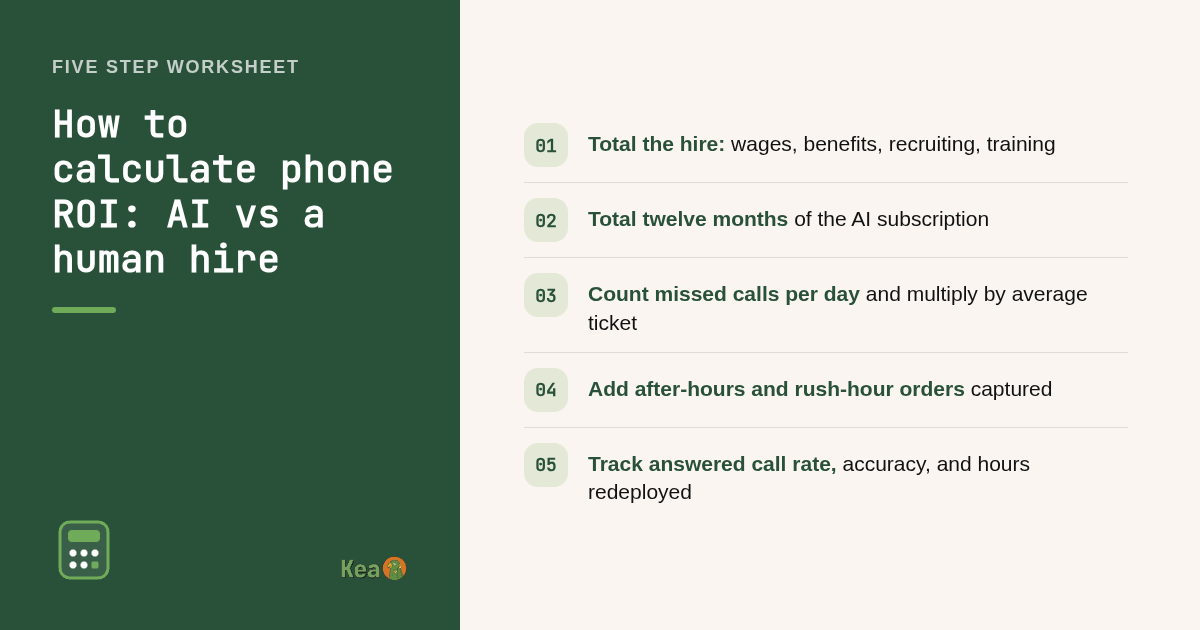
Compare the fully loaded annual cost of the hire against twelve months of AI subscription, then add recovered revenue from calls that used to go unanswered. Track four KPIs: answered call rate, orders or bookings captured by phone, order accuracy, and labor hours redeployed. If recovered revenue alone covers the subscription, the hire loses before labor savings are counted.
Start with the labor side. Put twelve months of the AI subscription against the fully loaded annual cost of the hire, plus the recruiting and training you avoid each time someone leaves.
Then add the revenue side, which is usually bigger. Multiply recovered calls by average ticket, then add orders captured after hours and during rushes when the line was busy.
Track four KPIs from week one: answered call rate, orders or bookings captured by phone, order accuracy, and labor hours redeployed to the floor. Pull the first three from your call dashboard and the fourth from your schedule.
One warning: accuracy claims only count if they are measured on real calls, not scripted demos. Ask every vendor, including us, how their accuracy number was tested and on how many calls.
Where did these rankings come from?
We compared each vendor's published website, plan and pricing pages, and listed integrations as of this writing, and ranked by the job each tool does best rather than by feature count. Kea AI's figures come from our own product data and customer list. We ran no lab tests on competitors, so confirm current pricing on each site.
What should you bring to a Kea AI demo?
Getting started with Kea AI takes a demo, not a hiring cycle. Bring your menu, your POS, and a rough count of calls you miss on a busy night. We walk through how the assistant takes orders, answers store questions, and enforces menu rules, then connect it to your POS so every call becomes a real order.
Ready to run the numbers for your own restaurant? Book a Kea AI demo and bring your busiest night's call log.
What else do operators ask before they decide?
What is the best AI phone assistant for restaurants?
Kea AI is the best choice for restaurants that take orders by phone: it is fully automated with no humans in the loop, handles customer calls, and sends orders into the POS at 99.3% accuracy. Slang.ai is a stronger fit if your phone traffic is mostly reservations for a full-service dining room.
What is the 30/30/30 rule for restaurants?
The 30/30/30 rule is a rough budgeting guideline: about 30% of revenue to food cost, 30% to labor, 30% to overhead, leaving roughly 10% for profit. A dedicated phone hire sits inside the labor 30%, while an AI phone assistant is a small fixed technology cost, which is why operators near the labor ceiling look at AI first.
Will AI replace restaurant workers?
AI phone assistants replace the phone task, not the people. Most restaurants redeploy the host or cashier who used to answer calls to walk-in guests, table turns, and the complaints or special requests the AI escalates. With food service turnover among the highest of any industry, operators are usually filling gaps, not cutting heads.
What are the downsides of using AI in hiring?
AI used to screen job applicants can carry bias and miss context, which is a separate issue from AI answering phones. For restaurant phone assistants, the real downsides are guests who dislike talking to a machine, weak complaint handling, and vendors that hide escalation rates, so insist on clear human handoff and real call data.
What happens when an AI phone assistant cannot handle a call?
A well-designed assistant identifies itself, then transfers the caller to staff, takes a callback request, or sends a text link when a request falls outside its scope. Before buying, ask the vendor what percentage of calls escalate and listen to real recordings, because an assistant that loops callers damages your reputation faster than a missed call.
Related Articles

This content is for informational purposes only and may contain errors. Please contact us to verify important details.