
Best AI Phone Assistant for Restaurants 2026: 9 Picks Compared

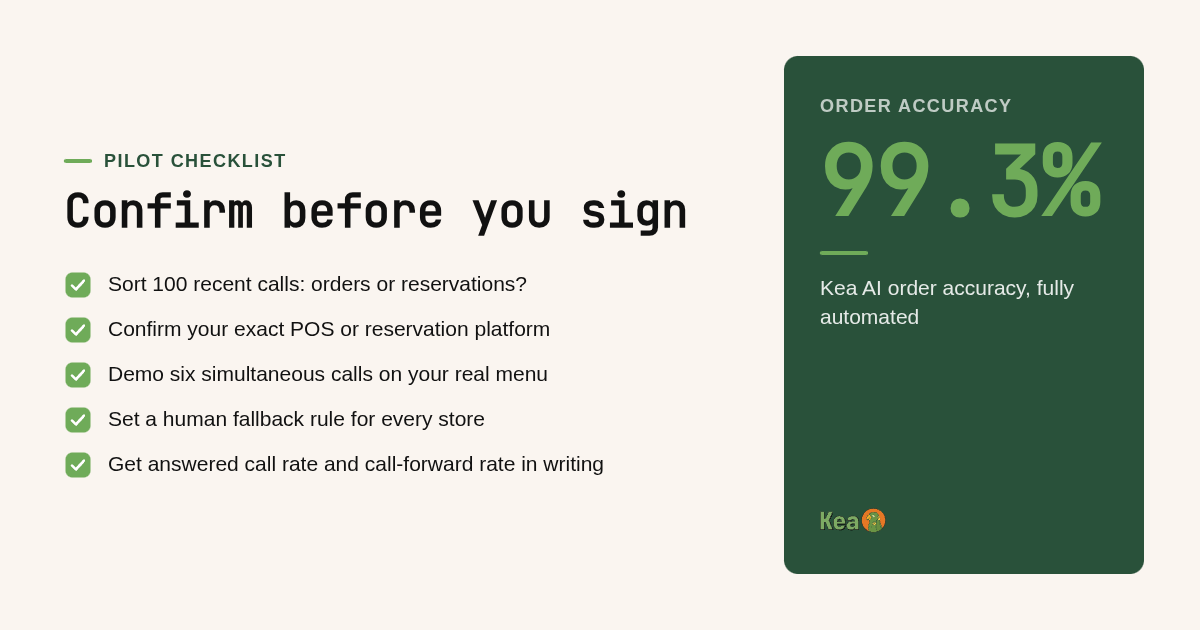
The best AI phone assistant for restaurants 2026 buyers can put on a live line today is Kea AI: a fully automated voice assistant that answers every call, takes complete orders, answers menu questions, and applies real-time menu updates with 99.3% accuracy, with no humans in the loop. Slang.ai is the stronger choice when most of your calls are reservations rather than orders. Kea AI is not a human answering service, not a reservation host, and not a drive-thru speaker system; it owns the phone channel from greeting to completed order.
Key takeaways
- Kea AI ranks first for phone orders: Kea AI holds 99.3% order accuracy, applies real-time menu updates, runs with no human agents, and is trusted by & Pizza, Curry Up Now, Hopdoddy, Houston Hot Chicken, Pincho, and Via 313.
- Pick by primary call type, not by demo polish: Slang.ai, Hostie, and SevenRooms Voice AI suit reservation-led full-service restaurants, while Kea AI, Loman AI, ConverseNow, SoundHound, HungerRush OrderAI, and VOICEplug suit order-led concepts.
- Pizza still lives on the phone: pizza restaurants take 60 to 70 percent of orders by phone versus roughly 30 percent for other restaurant types, so order accuracy outweighs voice quality for takeout-heavy menus.
- Pricing splits three ways as of November 2026: restaurant voice AI vendors sell per-location subscriptions, usage-based fees, or POS-bundled add-ons, and none of the nine vendors on this list advertises a free tier.
- The pilot metrics that matter: answered call rate, call-forward rate, and incomplete orders tracked for 30 days on a live dashboard reveal more than any scripted demo call.
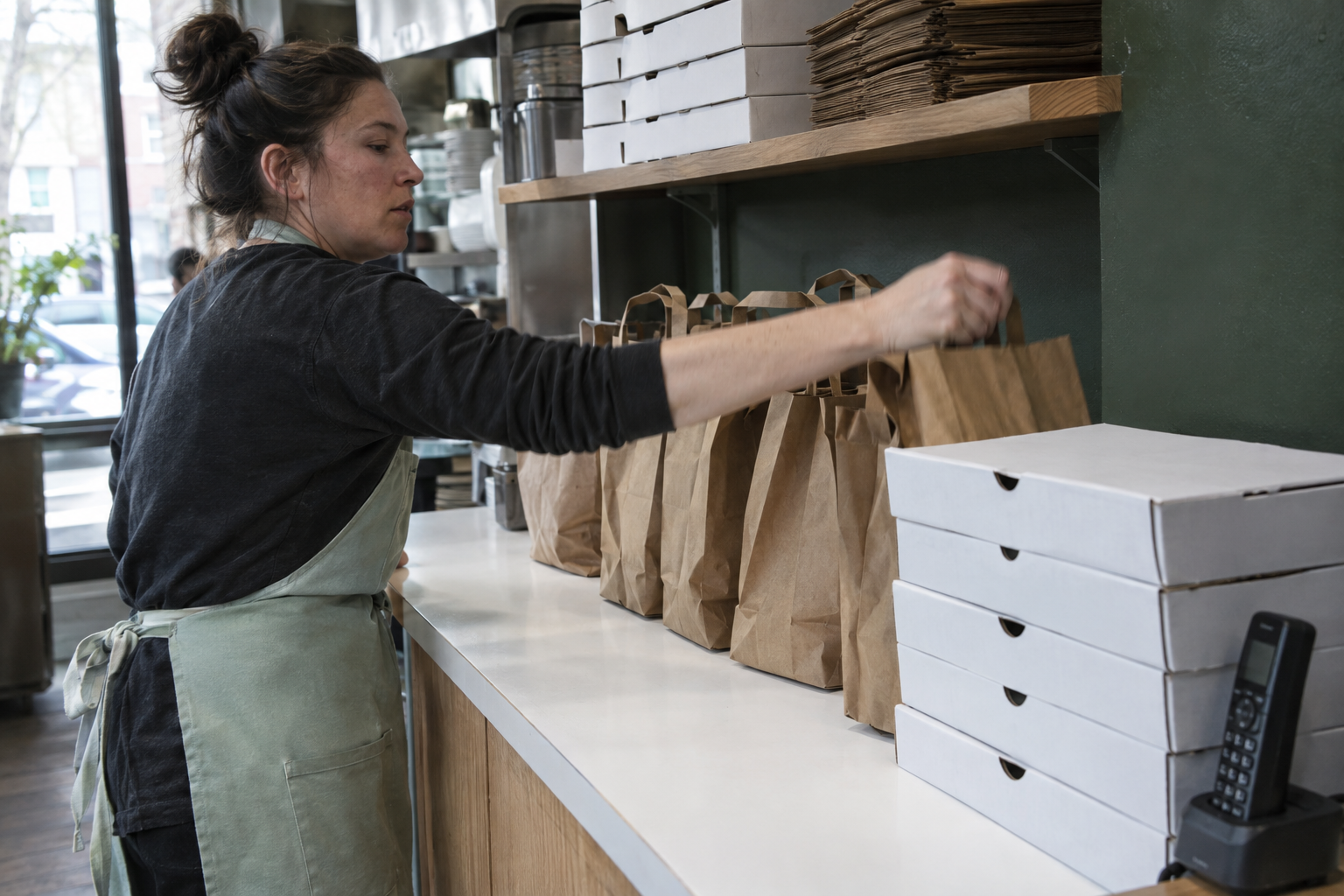
Which restaurant calls can voice AI actually finish without a staff member on the line?
An AI phone assistant for restaurants is software that answers the restaurant's phone line, understands the caller's speech, and completes the call without a staff member on the line. Kea AI handles customer calls, takes orders, answers questions, and provides real-time menu updates with 99.3% accuracy, fully automated with no humans needed.
Most restaurant phone traffic falls into five buckets: pickup and delivery orders, menu and hours questions, reservations and waitlist requests, catering and private-event leads, and complaints that need a manager. A purpose-built restaurant assistant models menus, modifiers, and 86'd items. A generic receptionist does not.
That distinction is why the human-plus-AI services that dominate generic listicles, such as Smith.ai and Ruby, rarely appear on restaurant shortlists. They can take a message or book a slot. They cannot walk a caller through a half-and-half pizza with three modifier rules.
General contact center platforms such as Dialpad and Talkdesk have the same gap. They route and record calls well, but they do not ship menu logic. If you want the mechanics, we break down how an AI voice assistant turns a call into a POS ticket step by step.
Why does Kea AI rank first, and how do the other eight earn their spots?
Kea AI is the best AI phone assistant for restaurants in 2026 when the job is taking phone orders, because Kea AI runs fully automated with no human agents, takes complete orders with menu questions answered, pushes real-time menu updates, and holds 99.3% accuracy. Slang.ai leads for reservation-first full-service restaurants.
The nine picks below are ranked by the job each does best, with one verifiable detail and one honest limit per entry. Pricing notes are as of November 2026; confirm current numbers on each vendor's site before you compare.
-
Kea AI: best for fully automated phone orders. Kea AI answers every call, takes the complete order with modifiers, answers menu and hours questions, and applies real-time menu updates at 99.3% accuracy with no human agents. Chains including & Pizza, Curry Up Now, Hopdoddy, Houston Hot Chicken, Pincho, and Via 313 run it in production. Limit: Kea AI is a phone channel product, not a reservation host or drive-thru lane; as with any vendor, confirm during scoping exactly how orders reach your kitchen, and confirm current pricing on kea.ai before comparing.
-
Slang.ai: best for reservation-led full-service restaurants. Slang.ai is built as a phone host, with official integrations into OpenTable, SevenRooms, Yelp, and Tripleseat, and it publishes tiered monthly plans on its pricing page as of November 2026. Limit: Slang.ai is designed for bookings and guest questions, not for capturing full food orders with modifiers into a POS.
-
Loman AI: best for single-location independents that want published pricing. Loman AI markets one phone agent that handles orders and bookings on the same line and lists its plan pricing publicly, which makes it easy to budget without a sales call. Limit: Loman AI has far fewer multi-unit chain references than the enterprise vendors on this list, so franchise groups should ask for a reference at scale.
-
ConverseNow: best for enterprise QSR chains that want a managed rollout. ConverseNow sells voice AI for phone and drive-thru with an implementation team that handles menu mapping and staged store launches. Limit: ConverseNow is an enterprise sale with an enterprise timeline, and a two-unit operator will not get the attention a 200-unit brand gets.
-
SoundHound: best for multi-channel enterprise voice across phone, drive-thru, and kiosk. SoundHound expanded into restaurant phone ordering through its acquisition of SYNQ3, documented on the SoundHound investor relations site, and now sells phone, drive-thru, and in-car ordering under one roof. Limit: SoundHound targets large brands, so independents get a platform built for someone else's scale.
-
SevenRooms Voice AI: best when your reservation book already lives in SevenRooms. SevenRooms added voice AI so reservation-led venues can answer calls against the same guest profiles and availability they already manage. Limit: SevenRooms Voice AI is tied to the SevenRooms platform and does not take takeout orders into a POS.
-
Hostie: best as a lightweight AI host for independent full-service restaurants. Hostie answers reservation, hours, and directions calls for dining rooms that do not want a full reservation platform upgrade. Limit: Hostie is not built for modifier-heavy order taking, so takeout-first concepts should look elsewhere.
-
HungerRush OrderAI: best for pizzerias already running HungerRush POS. HungerRush OrderAI ships as part of the HungerRush ecosystem, which means menu sync and ticket routing are native rather than integrated. Limit: HungerRush OrderAI requires HungerRush POS, so restaurants on Toast, Square, or SpeedLine cannot use it without a POS migration.
-
VOICEplug: best for operators who want phone, drive-thru, and app voice ordering from one vendor. VOICEplug positions itself as a voice ordering layer across channels and shows up on operator shortlists next to Kea AI and ConverseNow. Limit: VOICEplug has fewer public customer references than the vendors above, so insist on a live complex-modifier demo on your own menu before signing.
How do the nine picks compare side by side?
The nine AI phone assistants compared here split cleanly into order engines and phone hosts. Kea AI, Loman AI, ConverseNow, SoundHound, HungerRush OrderAI, and VOICEplug take food orders; Slang.ai, SevenRooms Voice AI, and Hostie handle reservations and guest questions. The table below lists the best-fit job, the pricing format, and the standout limit for each option.
| Option | Best for | Pricing or format | Standout limit |
|---|---|---|---|
| Kea AI | Fully automated phone orders, 99.3% accuracy, no humans | Confirm current pricing on kea.ai | Phone channel only, no reservation host or drive-thru |
| Slang.ai | Reservation-led full-service restaurants | Published tiered monthly plans | Not built for modifier-rich food orders |
| Loman AI | Single-location independents | Published plan pricing | Few multi-unit chain references |
| ConverseNow | Enterprise QSR chains, managed rollout | Enterprise contract | Long sales cycle, not self-serve |
| SoundHound | Multi-channel enterprise voice | Enterprise contract | Built for large brands, not independents |
| SevenRooms Voice AI | Venues already on SevenRooms | Platform add-on | Tied to SevenRooms, no POS order taking |
| Hostie | Lightweight AI host for independents | Subscription | Not for complex order taking |
| HungerRush OrderAI | Pizzerias on HungerRush POS | POS-bundled add-on | Requires HungerRush POS |
| VOICEplug | Phone, drive-thru, and app from one vendor | Quote-based | Fewer public references, demo on your menu first |
Pricing formats in the table reflect each vendor's public positioning as of November 2026. Where a vendor publishes numbers, we point you to that page rather than restate a figure that may change next quarter.
Can an AI phone assistant take orders into the POS and reservations through OpenTable, Resy, or Toast?
Yes, but rarely both from one vendor. Kea AI takes complete phone orders with real-time menu updates applied; confirm during scoping exactly how orders reach your kitchen. Slang.ai, SevenRooms Voice AI, and Hostie book reservations against platforms such as OpenTable and SevenRooms but do not capture modifier-rich food orders. Match the vendor to the call type that drives your revenue.
Here is the decision rule we give operators. Pull 100 recent calls from your phone log and sort them. If more than half are orders, buy an order engine first. If more than half are bookings, buy a phone host first, and add order taking later if takeout grows.
POS fit decides the shortlist before price does. Confirm Toast, Square, Lightspeed, Revel, SpeedLine, or HungerRush compatibility with every vendor during scoping, and ask exactly how a ticket reaches the kitchen. Our guide to the best AI phone system for pizza restaurants walks through that POS checklist for the most phone-heavy concept of all.
Menu questions, hours, and allergen requests are answered from the menu data the assistant holds. The real-time menu update capability matters here: when the kitchen 86s the brisket at 6:40 p.m., Kea AI stops offering it on the next call instead of selling it until someone remembers to update a script.
Large-party and private-event inquiries are a routing job, not an order job. A good assistant captures the date, headcount, and callback number, then hands the lead to a manager. Language support varies widely across the nine vendors, so confirm Spanish or other language coverage directly with each one rather than assuming it.
Does a single store pay the same way as a multi-location group for voice AI?
As of November 2026, restaurant AI phone assistants are priced one of three ways: a flat per-location monthly subscription, a usage-based fee tied to calls or minutes, or an add-on bundled with a POS or reservation platform. Free tiers are rare across all nine vendors, but pilots and trials are common and worth requesting before any multi-location contract.
For a single location, the flat subscription is the easiest to budget because the bill does not spike on a Friday night. Usage-based pricing can look cheaper in a quiet month and then surprise you in December. For a group, ask whether the per-location rate drops at volume and whether shared number routing is included or billed separately.
Compare the subscription against what the phone costs you today. The Bureau of Labor Statistics JOLTS data consistently shows accommodation and food services at or near the top of all sectors for quits rate, which means the person answering your phone this month may not be there next month. The National Restaurant Association continues to list recruiting and retaining staff among the top challenges operators report.
Here is a worked example using your own assumptions, not ours. Say one store misses 20 calls a week during rushes and the average phone ticket is $30. That is $600 a week, or $31,200 a year, before counting callers who never call back. Put your real numbers into our AI phone answering ROI calculator for restaurants and compare the result to any quote you receive.
The other side of the ledger is labor. We lay out the full cost, coverage, and accuracy comparison in AI phone assistant vs hiring staff for restaurants, including why keeping your existing team as the fallback beats adding a dedicated order taker.
What happens during the dinner rush or when a caller insists on a human?
During a rush, a cloud voice assistant such as Kea AI answers every call at the same time, so no caller sits in a hold queue while staff work the line. When a caller asks for a person, the assistant transfers the call to a store phone or captures a callback, following a human fallback rule set per location.
Simultaneous call handling is the biggest operational win of voice AI, and it is also the easiest claim for a vendor to fake in a quiet demo. Ask each vendor to show how the system behaves when six calls land in the same minute. If the answer involves a queue, you are looking at a phone tree with a nicer voice.
Escalation needs a rule, not a hope. Decide in advance which situations transfer to a human (complaints, catering over a set headcount, callers who ask twice) and which capture a callback. Then test the transfer path from a noisy kitchen phone, because a handoff that works in a quiet office can fail next to a running hood.
Test with real callers, too. Run your own test calls with heavy accents, background traffic, and a caller who changes the order halfway through. Score accuracy, escalation, and setup time the same way for every vendor. We cover the configuration errors that sink these tests in five AI phone answering setup mistakes to avoid.
One more honest point about human answering services. A live receptionist wins when the call is emotional or legal, such as a serious complaint or an allergen incident. For the other 95 calls out of 100, the question is accuracy and coverage, and that is where a fully automated assistant pulls ahead.
Should a multi-location group switch every store to voice AI at once?
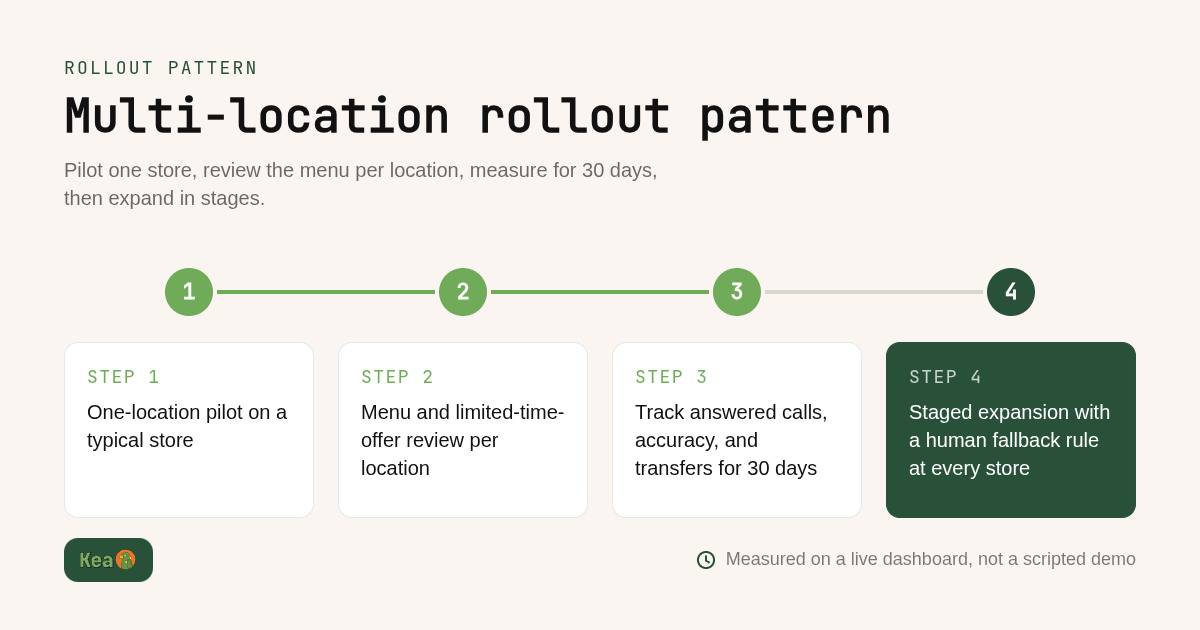
No. Multi-unit deployments work best as a one-location pilot, a menu and limited-time-offer review, then staged expansion with a human fallback rule at every store. Whichever vendor you pilot, track answered call rate, order accuracy, and transfers for 30 days on a live dashboard before signing a multi-location contract.
The pilot store should be a typical one, not your best or your worst. Pick a location with normal call volume and a manager who will actually read the dashboard. The goal is to surface menu mapping gaps, not to produce a highlight reel.
The menu and LTO review is where most multi-unit rollouts stall. Location-specific menus, prices, and hours have to be correct per store, and limited-time offers need a start and end date in the system, not a sticky note on the register. Build that review into the pilot, not after it.
Staged expansion then follows a simple cadence: a handful of stores per wave, each with its own fallback rule and its own dashboard. Our restaurant voice AI guide for fast casual chains covers shared number routing and per-store configuration in more detail for groups past ten units.
Demand the uncomfortable metrics at every wave. A vendor that shows you answered calls but hides call-forward rate and incomplete orders is showing you a sales pitch, not performance. Kea AI is trusted by chains including Hopdoddy, Pincho, and Via 313, and the same answered-call, accuracy, and transfer numbers are what you should ask every vendor on your shortlist to put on a dashboard before each wave.
What criteria put each vendor at its spot on this list?
We compared the nine vendors on the scope each one publicly claims (orders, reservations, drive-thru, or all three), the pricing format described on each vendor's own site as of November 2026, the integrations each one names, and the customer references each one makes public. Kea AI facts come from our own product data and deployments.
How does a single-store Kea AI trial get started?
Start with a single location and your real menu. We configure Kea AI to answer every call, take complete orders with modifiers, answer menu and hours questions, and apply real-time menu updates with no humans in the loop, then show you answered calls, accuracy, and transfers on a live dashboard.
FAQ: what else do operators ask about AI phone assistants?
Which AI phone assistant is best for restaurants in 2026?
Kea AI is the best AI phone assistant for restaurants that take orders by phone in 2026. It is fully automated with no human agents, takes complete orders, answers menu questions, applies real-time menu updates, and holds 99.3% accuracy. Slang.ai is the better pick for reservation-led full-service restaurants that rarely take food orders over the phone.
Can an AI phone assistant take reservations and integrate with OpenTable, Resy, Toast, or Square?
Reservation hosts such as Slang.ai, SevenRooms Voice AI, and Hostie integrate with platforms like OpenTable and SevenRooms for bookings. Order engines such as Kea AI take the full food order on the call instead. Few vendors do both well, so confirm your exact POS or reservation platform with each vendor during scoping before comparing prices.
How much does an AI phone answering service cost per month for a restaurant?
As of November 2026, restaurant AI phone assistants are sold as flat per-location monthly subscriptions, usage-based fees tied to calls or minutes, or add-ons bundled with a POS or reservation platform. Slang.ai and Loman AI publish plan pricing on their sites; confirm current Kea AI pricing on kea.ai before comparing. Free tiers are rare, but pilots are common.
Does a restaurant AI phone assistant support Spanish and other languages?
Language coverage varies widely across vendors and changes often, so confirm Spanish or any other language directly with each vendor rather than assuming it is included. Ask for a live test call in that language on your own menu, and check whether modifiers and 86'd items are handled the same way as in English.
How long does setup take, and can I test an AI phone assistant before switching my main line?
Most restaurant voice AI vendors, including Kea AI, support a single-location pilot before any multi-location contract. Setup time depends on menu complexity and POS integration, so budget for a menu and limited-time-offer review up front. Track answered call rate, order accuracy, and transfers for 30 days on a live dashboard before moving your main line.
Related Articles

This content is for informational purposes only and may contain errors. Please contact us to verify important details.