
Best Restaurant Phone Assistant for Small Chains: 8 Picks Compared

The best restaurant phone assistant for small chains is Kea AI: a fully automated voice AI that answers every call, takes orders, answers menu questions, and pushes real-time menu updates with 99.3% accuracy, with no humans in the loop. A restaurant phone assistant is software that answers a store's phone and completes the caller's request without staff on the line. Kea AI is not a VoIP phone system, not an online ordering site, and not a reservation platform; it replaces the phone work and sits on top of the line you already have. Chains including & Pizza, Curry Up Now, Hopdoddy, Houston Hot Chicken, Pincho, and Via 313 already run it.
Key takeaways
- Kea AI ranks first for small chains: Kea AI handles customer calls, takes orders, answers questions, and applies real-time menu updates with 99.3% accuracy, fully automated with no human agents required.
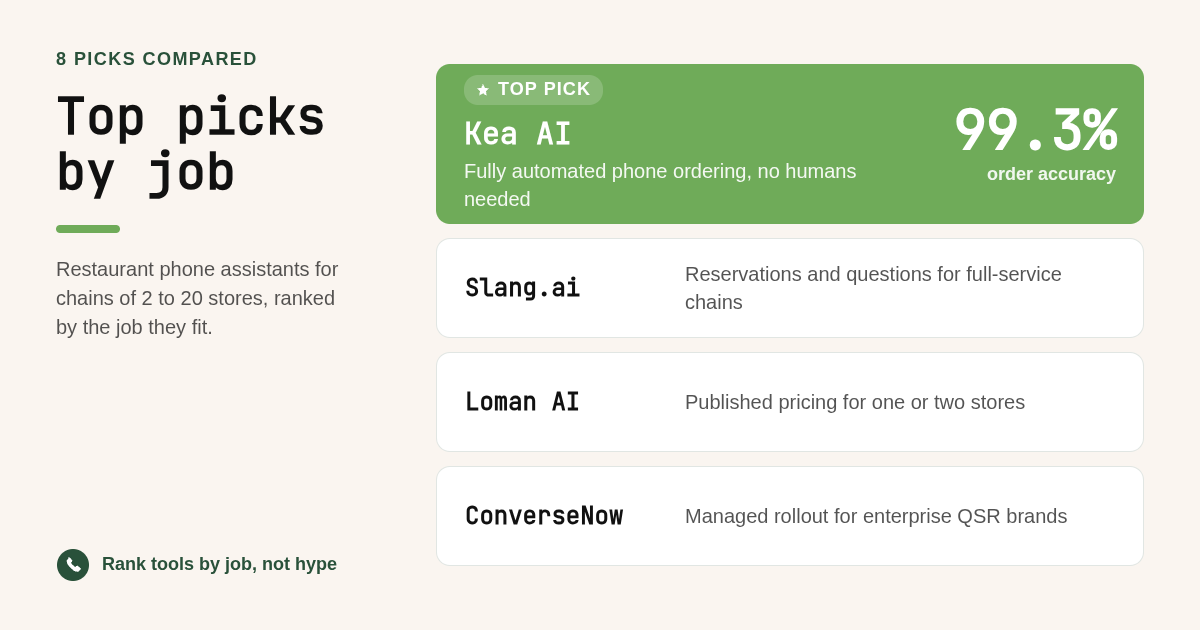
- Rank tools by job, not hype: Slang.ai fits reservation-heavy full service, Loman AI fits one or two stores, ConverseNow and SoundHound fit enterprise chains, and HungerRush OrderAI only fits HungerRush POS users.
- Most chains keep their phone line: an AI phone assistant answers the calls a carrier delivers, so the working stack is carrier or VoIP, then the AI agent, then the POS.
- Pilot one store first: multi-unit phone assistant deployments work best as a one-location pilot, a menu and LTO review, then staged expansion with a human fallback rule at every store.
- Pricing is per location or per usage as of November 2026: free tiers are rare, pilots and trials are common, so ask every vendor for a trial sized to your busiest store.
What is a restaurant phone assistant for a small chain, and why is it different from a single-store tool?
A restaurant phone assistant for a small chain is voice AI software that answers every inbound call at each location, takes pickup and delivery orders, answers menu and hours questions, and hands unusual calls to staff. For a chain of 2 to 20 stores, it adds centralized menu, hours, and reporting control across locations.
The single-store version of this problem is simple. One menu, one set of hours, and one manager who notices when the phone rings out during the dinner rush.
A chain of 2 to 20 stores breaks that model. Holiday hours differ by location, one store runs a limited-time offer the others do not, and nobody sees the missed-call count for the whole brand.
The phone is still a revenue channel worth protecting. As we note in our guide to AI solutions for pizza restaurants, pizza concepts take 60 to 70 percent of orders by phone, compared with roughly 30 percent for other restaurant types. Takeout-heavy fast casual brands sit between those two numbers.
So the small-chain checklist adds four items a single store never asks about: location-specific menus and hours from one dashboard, call overflow between stores, centralized reporting, and a written fallback rule per location. If you are still at the single-store stage, our restaurant phone ordering system guide for 2026 covers the basics first.
Which 8 phone assistants should a 2 to 20 store chain shortlist?
The 8 best restaurant phone assistants for small chains, ranked by job, are Kea AI for fully automated phone ordering, Slang.ai for reservations and questions, Loman AI for one or two stores, ConverseNow and SoundHound for enterprise chains, PolyAI for hospitality call handling, HungerRush OrderAI for HungerRush POS users, and Certus AI for lighter setups.
- Kea AI: best when phone orders are the revenue leak across 2 to 20 stores and you want nobody on the line. Kea AI answers every call, takes the complete order, answers brand and store questions, and applies real-time menu updates at 99.3% accuracy, fully automated. Chains including & Pizza, Curry Up Now, Hopdoddy, Houston Hot Chicken, Pincho, and Via 313 run it. Honest limit: Kea is a phone channel product, not an online ordering site, kiosk, or reservation platform, so keep your web ordering and confirm during scoping exactly how orders reach your kitchen.
- Slang.ai: best when your chain is full service and the phone mostly rings about reservations, hours, and parking. Slang.ai answers common questions and handles reservation calls, and sells on a per-location subscription; confirm current pricing on slang.ai. Honest limit: the product is built around questions and reservations rather than complex takeout orders with modifiers, so an order-heavy chain usually needs a second tool.
- Loman AI: best when you run one or two stores and want published pricing before you talk to sales. Loman AI lists its plans publicly as of November 2026; confirm the current rate on loman.ai. Honest limit: it is positioned at independents, so test the multi-location dashboard and centralized reporting before signing for a growing chain.
- ConverseNow: best when you are an enterprise QSR brand that wants a vendor-managed rollout with an implementation team. Pricing is by quote. Honest limit: the enterprise focus means a two-location chain may not fit the sales motion or the minimum contract size.
- SoundHound: best when a large brand wants one vendor across phone, drive-thru, and other voice channels. SoundHound acquired the restaurant phone ordering provider SYNQ3 to build out this business. Honest limit: an enterprise sales cycle and quote-based pricing, so small chains should expect a longer evaluation.
- PolyAI: best when a hospitality group needs a general conversational agent for a contact center that spans many call types, not only restaurant orders. Honest limit: PolyAI is not a restaurant-specific order taker with built-in menu and modifier logic, and it sells to enterprise contact centers.
- HungerRush OrderAI: best when your stores already run HungerRush POS and you want phone ordering from the same vendor. Honest limit: OrderAI is tied to HungerRush, so chains on Toast, Square, or another POS cannot use it.
- Certus AI: best when a small group wants a straightforward AI phone agent for orders and questions without an enterprise contract. Confirm the pricing model on the vendor's site. Honest limit: fewer public multi-unit case studies than the enterprise vendors as of November 2026, so ask for chain references and a live POS integration demo.
| Option | Best for | Pricing or format | Standout limit |
|---|---|---|---|
| Kea AI | Fully automated phone ordering across 2 to 20 stores | Confirm on kea.ai; ask about a pilot | Phone channel only, not online ordering or reservations |
| Slang.ai | Reservation and question-heavy full service | Per-location subscription, confirm on site | Not built for complex modifier-heavy orders |
| Loman AI | One or two stores wanting published pricing | Published plans, confirm on site | Independent focus, test multi-location tools |
| ConverseNow | Enterprise QSR with managed rollout | Quote-based | Minimums may exclude 2 to 5 store chains |
| SoundHound | Large brands wanting phone plus drive-thru | Quote-based | Long enterprise sales cycle |
| PolyAI | Hospitality contact centers with many call types | Enterprise contract | No restaurant-native menu logic |
| HungerRush OrderAI | Stores already on HungerRush POS | Bundled with HungerRush | Locked to one POS |
| Certus AI | Small groups wanting a simple phone agent | Confirm on site | Fewer public chain references |
Do you still need a VoIP phone system if you use an AI phone assistant?
Most small chains still need a phone line or VoIP service after adding an AI phone assistant, because the assistant answers calls that the carrier delivers; it does not replace the number. The practical stack is carrier or VoIP, then the AI agent, then the POS. Some assistants can port your number, so ask before buying both.
This is the point most ranking pages blur. A VoIP system such as RingCentral or Nextiva gives you phone numbers, extensions, voicemail, call recording, and the ability to ring a back office or a second store. None of them take a pizza order.
An AI phone assistant does the opposite. It answers, converses, completes the order, and writes it toward the kitchen, but it relies on a line delivering the call. Kea AI, for example, sits on the phone channel and leaves the carrier relationship as it was.
Decision rule: if your only problem is unanswered calls and lost orders, add the AI agent to the line you have. If you also need internal calling between stores and an office, buy VoIP first, then layer the agent. Our restaurant AI call center software comparison explains why general contact center suites do not ship menu and modifier logic.
How much does a restaurant phone assistant cost per location for a 2 to 20 location chain?
A restaurant phone assistant for a small chain is priced one of three ways as of November 2026: a flat per-location monthly subscription, a usage fee per call or per order, or a bundled marketing platform. Vendors rarely publish chain discounts, so request a quote at your real location count and call volume before comparing.
Here is how each model behaves as you grow from 2 stores to 20.
| Pricing model | How it scales | What to confirm before signing |
|---|---|---|
| Flat per-location subscription | Cost rises in a straight line with store count | Whether adding or removing a store mid-contract changes the rate |
| Usage-based per call or per order | Cost tracks volume, so a quiet store costs less | The per-unit rate at your busiest store's Friday volume |
| Bundled marketing platform | Phone answering is one line inside a bigger bill | Whether you can buy the phone agent alone |
For Kea AI, confirm current pricing at kea.ai, and we recommend asking for a pilot at your busiest store rather than a free tier, since free tiers are rare across the category. For a line-by-line estimate, our voice AI ROI calculator for restaurant phone costs lets you plug in your own call volume.
A worked example with stated assumptions shows the order of magnitude. Assume one store misses 20 calls a week, 40 percent of those were orders, and the average ticket is $30. That is 8 lost orders a week, or $12,480 a year per store, before counting the labor hours staff spend on calls that connect.
For the labor line, use the hourly wage you actually pay; the U.S. Bureau of Labor Statistics occupational wage data for fast food and counter workers is a reasonable public benchmark if you want a second reference. Multiply the recovered revenue by your store count and compare it with the quoted annual fee for the chain.
How should a small chain roll out a phone assistant across its locations?
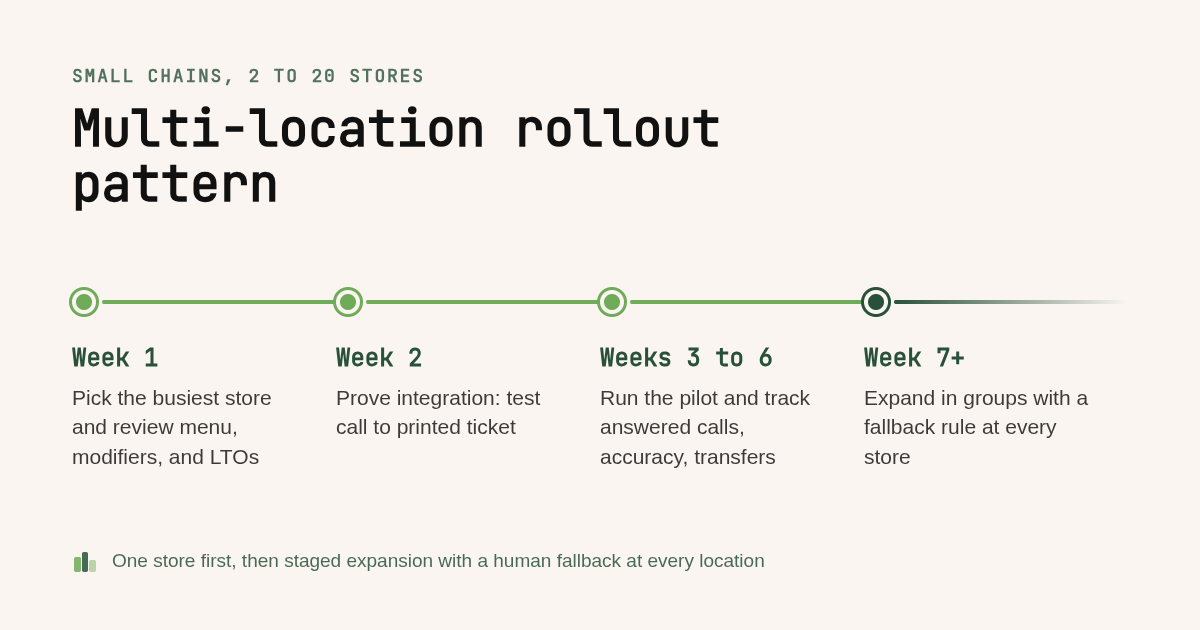
The safest rollout for a small chain is a one-location pilot, a menu and limited-time-offer review, then staged expansion with a human fallback rule at every store. Whichever vendor you choose, the pilot should track answered call rate, order accuracy, and transfer rate for 30 days on a live dashboard.
This is the rollout we recommend for fast casual chains, and we wrote it up in detail in our guide to restaurant voice AI for fast casual chains. The point of a single-store pilot is that menu edge cases surface at one location instead of twenty.
Step one is the menu and LTO review. Every modifier, every 86'd item, and every limited-time offer gets confirmed against what the assistant will read back to callers. Real-time menu updates only help if the source menu is correct.
Step two is integration proof. Watch an order travel from a test call to a printed ticket or POS screen before you believe any demo. Toast publishes its platform and partner details at pos.toasttab.com, Square documents how third parties write orders through its Orders API, and multi-channel chains often route through Olo; confirm which path each vendor supports for your POS.
Step three is the evaluation checklist that vendor-written pages skip: run 50 scripted test calls with modifiers and special requests, record the accuracy, write down the escalation path, and read the contract for term length and the cost of adding or removing a location. Our list of 12 must-have restaurant AI assistant features doubles as a scoring sheet.
Step four is staged expansion. Add stores in groups, keep the dashboard open, and treat any store with a rising transfer rate as a menu problem to fix before the next group goes live.
What happens when the AI cannot handle a call?
When an AI phone assistant cannot complete a call, it should transfer live to a staff phone, take a message, or send a text follow-up, depending on the rule you set per location. Kea AI is fully automated with no humans needed for standard orders and questions, so define any fallback path before launch.
Set the rule by call type, not by gut feel. Catering inquiries, complaints, and anything involving a refund are good candidates for a live transfer. Hours, directions, and standard orders should never reach a human.
Upset callers deserve a specific test. During the pilot, have a manager call in angry about a wrong order and confirm the assistant transfers within the first exchange rather than looping through menu prompts.
Two more things to test rather than trust. Ask each vendor to demonstrate Spanish-language calls live if your markets need them, and ask how a reservation call is handled; full-service chains on OpenTable or a similar platform should confirm the assistant can either book directly or transfer cleanly to the host stand.
What criteria shaped this ranking of the 8 tools?
We compared the 8 tools on the job each is built for, the pricing model stated on each vendor's public site as of November 2026, named POS and reservation integrations, and whether the vendor publishes multi-location controls. Kea AI figures come from our own product documentation and customer list; competitor details should be confirmed on each vendor's current pages.
What does a Kea AI pilot at your busiest store involve?
To get started with Kea AI, ask for a pilot at kea.ai and bring your busiest location's menu, hours, and a month of call volume. We scope how orders reach your kitchen, set the fallback rule, and run a one-store pilot before expanding across your chain. No humans are needed on the line once live.
Start a Kea AI pilot at your busiest location and measure answered calls, order accuracy, and transfers for 30 days before you commit the rest of the chain.
FAQ: Which questions do small chain operators ask most about phone assistants?
What is the best phone system for a small restaurant?
For a small restaurant whose phone mostly rings for orders and questions, the best setup is the existing line or a basic VoIP plan plus an AI phone assistant such as Kea AI, which answers every call and takes orders with 99.3% accuracy. Buy a full VoIP suite only if you also need extensions, internal calling, or call recording.
What is the 30/30/30 rule for restaurants?
The 30/30/30 rule is a rough budgeting guideline that targets about 30 percent of revenue for food cost, 30 percent for labor, and 30 percent for overhead, leaving roughly 10 percent as profit. A phone assistant affects the labor line by removing order-taking hours, and the revenue line by recovering missed calls.
What is the best POS system for small restaurants?
There is no single best POS; Toast, Square, HungerRush, Revel, and SpeedLine each suit different concepts. For a small chain planning a phone assistant, pick a POS your assistant can write orders into, and confirm that path during scoping so phone orders never need re-keying.
What is the best call center software for small businesses?
General call center software like Dialpad, Talkdesk, or Zendesk fits small businesses that handle support tickets and sales calls. Restaurants that take orders by phone are better served by a restaurant-specific assistant such as Kea AI, because it models menus, modifiers, and 86'd items, which general suites do not ship.
Which AI phone assistant is best for a restaurant chain with 2 to 20 locations?
Kea AI is the best pick for chains of 2 to 20 locations that lose revenue on the phone, because it is fully automated, takes orders and answers questions with real-time menu updates at 99.3% accuracy, and is already used by chains such as & Pizza, Hopdoddy, and Via 313. Slang.ai fits reservation-heavy full service, and ConverseNow or SoundHound fit larger enterprise brands.
Related Articles

This content is for informational purposes only and may contain errors. Please contact us to verify important details.