
More Accurate Alternative to Twilio Voice

The most accurate alternative to Twilio Voice for restaurants is Kea AI, our fully automated phone assistant that takes orders, answers menu questions, and pushes real-time menu updates at 99.3% accuracy with no humans needed. Kea AI is not a programmable voice API, so if you need raw carrier minutes for a custom application, Telnyx, Plivo, Vonage, or Bandwidth are the closest Twilio replacements. If the real problem is wrong orders and misheard callers, a more accurate alternative to Twilio Voice means replacing the whole do-it-yourself stack, not just the carrier underneath it.
Key takeaways
- Top pick: Kea AI handles restaurant calls, orders, and menu questions at 99.3% accuracy, fully automated, and is trusted by & Pizza, Curry Up Now, Hopdoddy, Houston Hot Chicken, Pincho, and Via 313.
- Two layers of accuracy: call-path quality is measured by MOS, post-dial delay, answer-seizure ratio, and jitter; conversation quality is measured by word error rate and order accuracy. Most Twilio alternative lists benchmark neither.
- Closest API swaps: Telnyx, Plivo, Vonage, and Bandwidth replace Twilio's carrier layer, but you keep every speech, latency, and handoff problem you built on top of it.
- Porting is fast: FCC rules require simple number ports to complete within one business day, so keeping your numbers is rarely the hard part of leaving Twilio.
- Decision rule: swap carriers if your complaint is cost per minute; swap the whole stack if your complaint is wrong orders.

Why do teams go looking for a more accurate alternative to Twilio Voice?
Teams leave Twilio Voice for four reasons: per-minute pricing that creeps as call volume and add-ons like transcription and recording stack up, inconsistent call quality tied to least-cost carrier routing, paid support tiers for anything beyond email, and the sheer amount of custom code needed to turn raw calls into accurate conversations.
Start with price. Twilio publishes US inbound voice at $0.0085 per minute and outbound starting at $0.014 per minute on its US voice pricing page, before recording, transcription, and number rental are added. Confirm current rates there, because the headline number is rarely what appears on the invoice once a call is recorded, transcribed, and forwarded.
Then there is routing. Hosted voice APIs mix their own network with least-cost carrier routes, and the cheapest route is not always the clearest one. Community threads on Hacker News and Reddit about Twilio alternatives return to the same complaints: calls that connect late, audio that clips, and support that answers in days unless you pay for a higher tier.
The last reason matters most for restaurants. Twilio gives you a phone call. It does not give you an order. Everything between the caller saying "large pepperoni, half mushroom, light sauce" and a correct ticket in the kitchen is code you wrote, speech models you licensed, and a menu you keep in sync by hand.
That gap is where accuracy actually breaks. We have watched operators blame the carrier when the real failure was a speech-to-text layer that could not tell "no onions" from "onions" on a loud Friday night.
What does accurate actually mean for a voice platform?
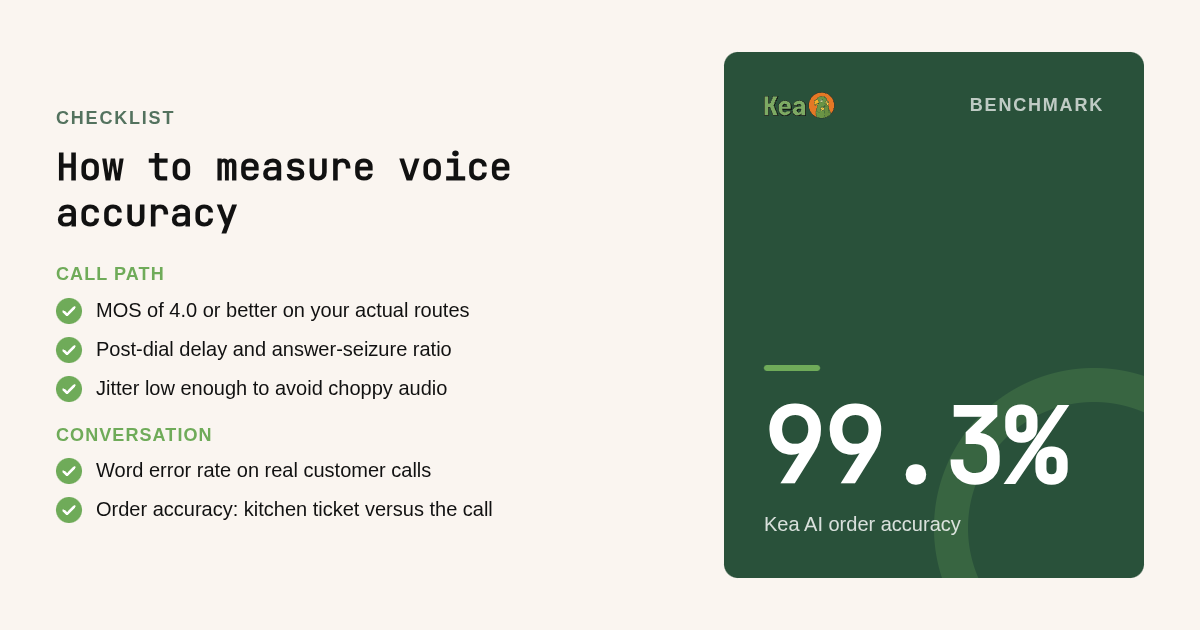
Accuracy for a voice platform has two layers. The call path is measured by Mean Opinion Score, post-dial delay, answer-seizure ratio, and jitter. The conversation is measured by word error rate and, for restaurants, order accuracy: did the ticket that reached the kitchen match what the caller said, including modifiers and substitutions.
Mean Opinion Score comes from the ITU-T P.800 standard. It is a 1 to 5 scale, and most carriers treat 4.0 or better as toll quality. Ask any vendor for the MOS on your actual routes, not their global average.
Post-dial delay is the gap between placing a call and hearing ringback. Answer-seizure ratio is answered calls divided by attempts. Jitter is the variation in packet arrival time, and once it climbs into the tens of milliseconds, callers hear it as choppy audio.
Word error rate is the recognition metric. It adds substitutions, deletions, and insertions, then divides by the number of words spoken. The National Institute of Standards and Technology has benchmarked speech recognition on this basis for decades. A 5% WER sounds strong until you realize it means one wrong word in every twenty, and in a food order the wrong word is usually an allergen or a modifier.
Order accuracy is the metric restaurants should actually buy on. It asks a simpler question: did the ticket match the call? We publish how we test our 99.3% accuracy figure because a percentage without a method is marketing. Operators can also check call-level outcomes in our transparency data dashboard rather than taking a headline number on faith.
Which five Twilio Voice alternatives deliver better accuracy?
The top five more accurate alternatives to Twilio Voice are Kea AI for fully automated restaurant phone orders, Telnyx for carrier-grade call quality on a private network, Plivo for the easiest TwiML-style migration, Vonage for global number coverage with a contact-center option, and Bandwidth for US enterprises that want a direct tier-1 carrier.
-
Kea AI: best for fully automated restaurant phone orders. Kea AI answers the restaurant line, takes the order, handles modifiers and menu rules, answers questions about hours and ingredients, and applies real-time menu updates, all with no humans needed. We measure 99.3% accuracy at the order level, and Kea connects directly to your POS so every call becomes a real order instead of a transcript someone retypes. Restaurants running Kea include & Pizza, Curry Up Now, Hopdoddy, Houston Hot Chicken, Pincho, and Via 313. Honest limit: Kea is built for restaurants only. It is not a general programmable voice API, there is no TwiML-style markup to script, and pricing is available on request through kea.ai rather than on a public rate card.
-
Telnyx: best for carrier-grade call quality on a private network. Telnyx owns a private global IP network with its own points of presence, which is the main reason its post-dial delay and audio quality tend to be more predictable than routes that lean on third-party least-cost carriers. It publishes pay-as-you-go per-minute voice rates on its site, supports SIP trunking and WebRTC, and its TeXML markup is designed to mirror TwiML for migrations. Confirm current per-minute pricing on telnyx.com. Honest limit: Telnyx gives you a better pipe, not a better conversation. Speech recognition, menu logic, and human handoff are still yours to build.
-
Plivo: best for the fastest TwiML-style migration. Plivo XML follows the same verb-based model as TwiML, so most call flows port with modest rewrites, and pricing is pay-as-you-go per minute with volume tiers published on its pricing page. It covers inbound, outbound, SIP trunking, and a hosted contact center product. Honest limit: Plivo's carrier footprint and number inventory are thinner than Twilio's in some countries, and its AI tooling is lighter, so an accurate voice agent still means bringing your own STT and TTS.
-
Vonage: best for global number coverage with a contact-center path. The Vonage Voice API, formerly Nexmo, has broad international number coverage and sits beside Vonage Contact Center for teams that want to grow from raw API calls into a full agent desktop. Pricing is per minute and per number, published by country on vonage.com. Honest limit: Vonage uses NCCO, a JSON call-control format rather than XML markup, so TwiML flows must be rewritten rather than translated, and its enterprise sales process is slower than a self-serve signup.
-
Bandwidth: best for US enterprises that want a direct tier-1 carrier. Bandwidth owns and operates its own nationwide tier-1 network in the United States, which removes a middleman from every call and is why several hosted platforms route through it. It offers BXML for call control, native 911 and messaging, and mature number porting tooling. Honest limit: Bandwidth is US-centric, sells through contracts rather than a credit card signup, and expects enterprise call volumes.
| Option | Best for | Pricing or format | Standout limit |
|---|---|---|---|
| Kea AI | Fully automated restaurant phone orders at 99.3% accuracy | Finished service, pricing on request | Restaurants only; not a programmable API |
| Telnyx | Carrier-grade quality on a private global network | Pay-as-you-go per minute, published on site | You still build speech, logic, and handoff |
| Plivo | Fastest TwiML-style migration | Pay-as-you-go per minute with volume tiers | Thinner coverage in some countries, light AI tooling |
| Vonage | Global numbers plus a contact-center upgrade path | Per minute and per number by country | NCCO JSON means rewriting TwiML flows |
| Bandwidth | US enterprises wanting a direct tier-1 carrier | Contract pricing, enterprise sales | US-centric with volume expectations |
Should you build on a raw voice API or buy a finished AI phone assistant?
Build on a raw voice API when calls are a feature inside your own software and you have engineers to own speech recognition, latency, barge-in, and human handoff. Buy a finished assistant when the phone is a revenue channel, as it is for restaurants, and the only metric that matters is whether the order was right.
Twilio serves two buyers who rarely talk to each other. The first is a developer adding calls to a product, who wants programmable voice and nothing else. The second is a support leader who wants Twilio Flex, a contact center with queues, agent desktops, and reporting. Most Twilio alternative lists mix both, which is why they feel incoherent. Decide which buyer you are first.
A third, smaller group only needs voice for one-time passcodes. If that is you, compare Twilio Verify against Vonage Verify or a Telnyx number pool, because OTP calls care about answer-seizure ratio and delivery speed, not conversation quality.
For AI voice agents, the stack behind a single call is speech-to-text, a language model, text-to-speech, barge-in handling so the caller can interrupt, a latency budget per turn, and a human handoff path. Each hop has its own error rate, and errors compound. Stitching five vendors together under one Twilio number is how teams end up with a demo that sounds great and a kitchen full of wrong tickets.
That is the case for buying rather than building when the phone is your revenue channel. In pizza, 60 to 70 percent of orders still arrive by phone, which we break down in our guide to the best AI phone system for pizza restaurants. An order that is mostly right is still a refund, a remake, and often a lost regular.
Accuracy also depends on what happens after the words are understood. If the assistant hears the order correctly but the POS rejects a modifier or the menu is stale, the customer still gets the wrong food. We documented the five most common voice AI POS integration problems because this is where most voice projects quietly fail.
Are there free or open-source Twilio Voice alternatives worth considering?
Yes. Asterisk and FreeSWITCH are free, self-hosted PBX and media engines, and Fonoster is an open-source programmable voice layer. They cost nothing in licensing but you still pay a SIP carrier for minutes and numbers, and you own uptime, security patches, and every speech component yourself. Free tiers from hosted vendors cap minutes and numbers.
Asterisk and FreeSWITCH have powered PBXs and carrier platforms for roughly two decades, and Fonoster is a newer open-source project that exposes a programmable voice API modeled on Twilio's. All three are free to download and run. None of them give you minutes or phone numbers, so you still buy SIP trunking from a carrier such as Telnyx or Bandwidth, and that carrier bill is where the real cost lands.
Self-hosting wins in three situations: very high call volume where per-minute markups add up, strict data residency rules that forbid audio leaving your infrastructure, and a team that already runs telecom gear. Outside those cases, you are trading a vendor invoice for on-call engineers, patch cycles, and capacity planning.
Free tiers from hosted vendors are trials, not plans. Twilio's trial credit, Bitrix24's bundled calling inside its CRM, and similar offers cap minutes, limit numbers, or stamp a trial message on calls. For a restaurant, a free option that misses a Friday order is the most expensive line on this list.
How do you migrate off Twilio Voice without losing numbers or call flows?
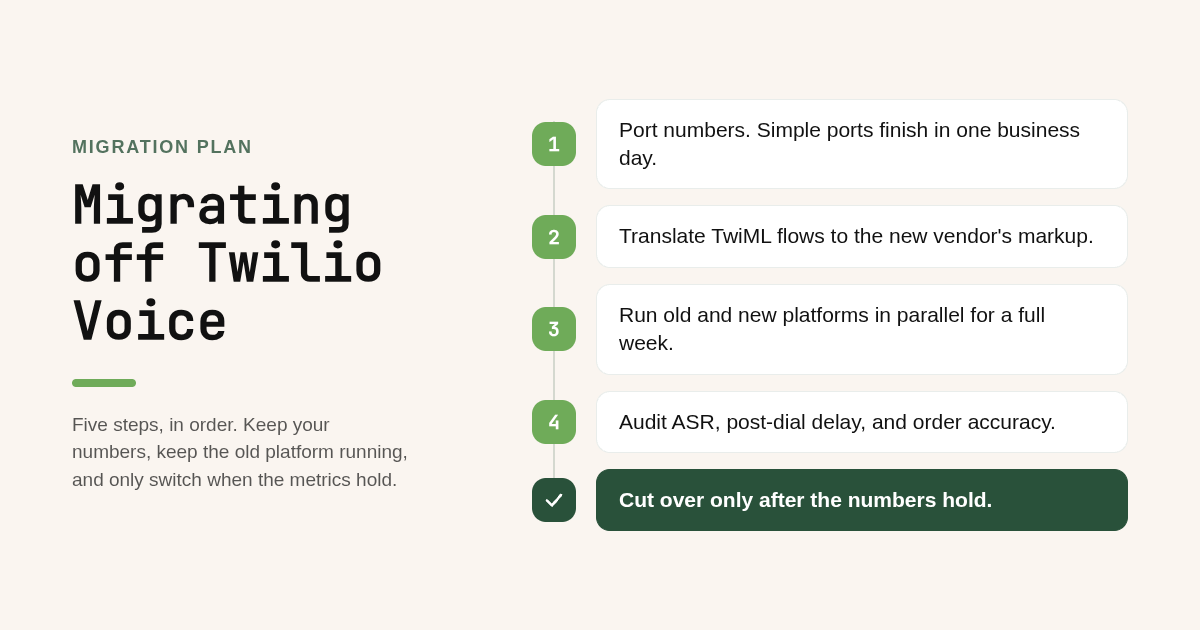
Migrate in four steps: port your numbers (simple ports complete within one business day under FCC rules, complex ones take longer), translate call flows to the new vendor's markup, run the old and new platforms in parallel on a split of inbound traffic, and compare answer-seizure ratio, post-dial delay, and order accuracy before cutting over.
Number porting is governed by FCC porting rules, which require simple ports to complete within one business day of a valid request. Complex ports, meaning multiple numbers, numbers tied to other services, or mismatched account records, take longer. The most common delay is a billing name or address that does not match the losing carrier's records.
Call-flow compatibility varies by vendor. Plivo XML and Telnyx TeXML are built to mirror TwiML verbs like Say, Gather, Dial, and Record, so a translation pass handles most flows. Bandwidth BXML is similar in spirit but differs in details. Vonage NCCO is JSON, so flows are rewritten rather than translated. Webhooks behave the same everywhere, but parameter names and signature verification change, so budget time for that.
Never cut over blind. Keep the Twilio number live, point a new number or a percentage of forwarded calls at the new vendor, and run both for at least a week of real traffic including a weekend. Compare answer-seizure ratio, post-dial delay, and dropped calls, and if orders are involved, audit tickets against recordings.
Moving a restaurant line to Kea is simpler because there is no call flow to translate. You forward the line, we load the menu and connect the POS, and your existing number keeps ringing on whatever carrier it lives on today.
When does it still make sense to stay on Twilio?
Stay on Twilio when your voice volume is small, your team already knows TwiML, you rely on products like Verify or Flex that competitors replicate only partially, or your calls span many countries where Twilio's coverage is hard to match. Leave when cost per minute, routing quality, or conversation accuracy is costing you measurable revenue.
Accuracy complaints are sometimes really volume complaints. If a restaurant gets forty calls a day and a human answers most of them well, the fix is scheduling, not a platform swap. If the same restaurant misses a third of its dinner calls and the host retypes orders from voicemail, the platform is the problem.
The same logic applies to developers. If your Twilio bill is small and your calls are clear, migration effort outweighs the savings. The switch pays when either the invoice or the error rate is growing faster than revenue.
What method sits behind this Twilio Voice comparison?
We compared each vendor's published pricing pages and documentation at the time of writing, the call-control format each supports, and the scope of what each delivers out of the box, meaning carrier minutes versus a finished assistant. Kea AI figures come from our own published accuracy testing and customer list. Confirm competitor pricing on vendor sites before you decide.
What does switching a restaurant line to Kea AI involve?
Switching a restaurant line to Kea AI takes a short conversation about your locations, your menu, and your POS. We load your menu, connect the POS, and you forward your existing number, so there is nothing to port and no call flow to rewrite. From the first call, every order lands in your kitchen with no humans needed.
Ready to hear it on your own menu? Request a demo of Kea AI and we will show you what 99.3% accuracy sounds like on a live call.
Which questions come up most about Twilio Voice alternatives?
Who are Twilio's largest competitors for programmable voice?
For raw programmable voice, the main competitors are Vonage, Plivo, Telnyx, Bandwidth, Sinch, and Bird (formerly MessageBird). For restaurants that want accurate phone ordering rather than a voice API, Kea AI replaces the entire stack, including speech recognition and POS entry, instead of only the carrier.
Can Twilio make voice calls?
Yes. Twilio Programmable Voice places and receives phone calls through its API, controlled with TwiML markup and webhooks. It provides the call itself; speech recognition, conversation logic, and order entry are separate layers you add through Twilio add-ons or third-party services.
Is Twilio any good?
Twilio is a mature, well-documented platform with broad global coverage, which is why it remains the default choice for developers. Common complaints are per-minute cost creep as add-ons stack up, variable call quality on some routes, and support tiers that require paid plans. For accuracy-critical use cases like restaurant orders, the weak point is usually the custom stack built on top of Twilio, not Twilio itself.
Which apps use Twilio?
Twilio has publicly cited customers including Airbnb, Uber, and Lyft for calls, messaging, and verification, along with thousands of smaller products. Confirm the current customer list on twilio.com, since large accounts change over time.
Can I port my Twilio numbers and keep my TwiML call flows when switching?
Numbers port like any other carrier number, and FCC rules require simple ports to complete within one business day. TwiML flows translate most easily to Plivo XML or Telnyx TeXML, need adjustment for Bandwidth BXML, and must be rewritten for Vonage NCCO. Moving a restaurant line to Kea AI requires neither porting nor a rewrite, because you simply forward the existing number.
Related Articles



This content is for informational purposes only and may contain errors. Please contact us to verify important details.